권호기사보기
| 기사명 | 저자명 | 페이지 | 원문 | 기사목차 |
|---|
| 대표형(전거형, Authority) | 생물정보 | 이형(異形, Variant) | 소속 | 직위 | 직업 | 활동분야 | 주기 | 서지 | |
|---|---|---|---|---|---|---|---|---|---|
| 연구/단체명을 입력해주세요. | |||||||||
|
|
|
|
|
|
* 주제를 선택하시면 검색 상세로 이동합니다.
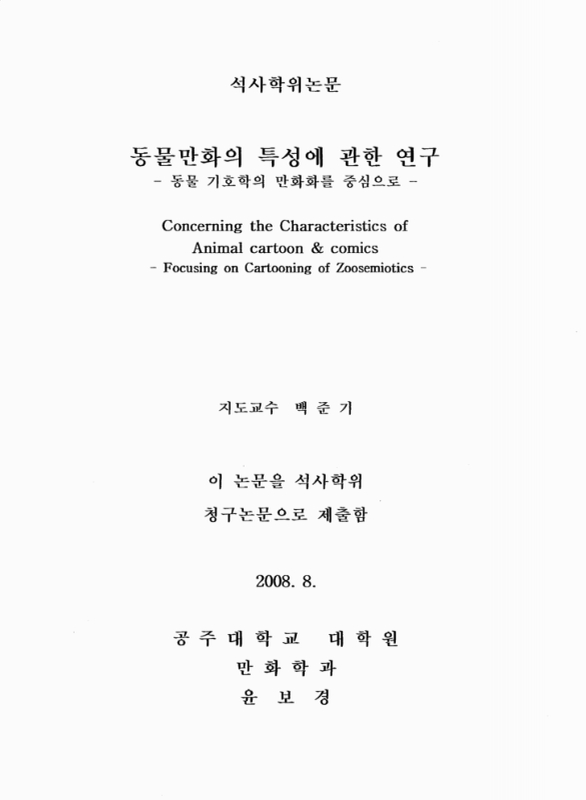
표제지
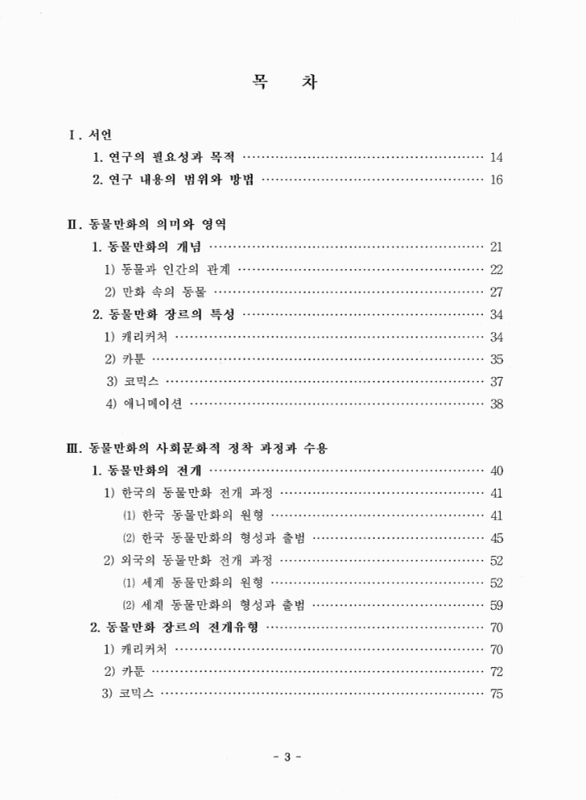
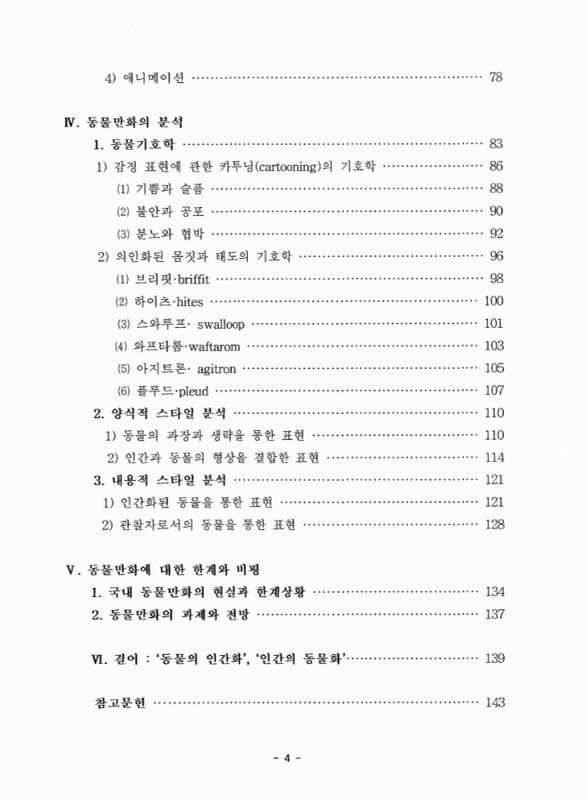
목차
I. 서언 15
1. 연구의 필요성 및 목적 15
2. 연구 내용의 범위와 방법 17
II. 동물만화의 의미와 영역 22
1. 동물만화의 개념 22
1) 동물과 인간의 관계 23
2) 만화 속의 동물 28
2. 동물만화의 장르의 특성 35
1) 캐리커처(caricature) 35
2) 카툰(cartoon) 36
3) 코믹스(comics) 38
4) 애니메이션(Animation) 39
III. 동물만화의 사회문화적 정착 과정과 수용 41
1. 동물만화의 전개 41
1) 한국의 동물만화 전개 과정 42
(1) 한국 동물만화의 원형 42
(2) 한국 동물만화의 형성과 출범 46
2) 세계의 동물만화 전개 과정 53
(1) 세계 동물만화의 원형 53
(2) 세계 동물만화의 형성과 출범 60
2. 동물만화 장르의 전개유형 71
1) 캐리커처 (caricature) 71
2) 카툰 (cartoon) 73
3) 코믹스 (comics) 76
4) 애니메이션 (animation) 79
IV. 동물만화의 분석 84
1. 동물기호학 84
1) 감정 표현에 관한 카투닝의 기호학 87
(1) 기쁨과 슬픔 89
(2) 불안과 공포 91
(3) 분노와 협박 93
2) 의인화된 몸짓과 태도의 기호학 97
(1) 브리핏(briffit) 99
(2) 하이츠(hites) 101
(3) 스와루프(swalloop) 102
(4) 와프타롬(waftarom) 104
(5) 아지트론(agitron) 106
(6) 플루드(pleud) 108
2. 양식적 스타일 분석 111
1) 동물의 과장과 생략을 통한 표현 111
2) 인간과 동물의 형상을 결합한 표현 115
3. 내용적 스타일 분석 122
1) 인간화된 동물을 통한 표현 122
2) 관찰자로서의 동물을 통한 표현 129
V. 동물만화에 대한 한계와 비평 134
1. 국내 동물만화의 현실과 한계상황 135
2. 동물만화의 과제와 전망 138
VI. 결어 : '동물의 인간화', '인간의 동물화' 140
참고문헌 144
ABSTRACT 148
RESUME 152
[그림 1] 김유신묘지환석, 〈십이지신상/十二支神像〉, 8세기 경, 「한국민족문화대백과사전 14권」, p.213, 한국정신문화연구원, 1993 28
[그림 2] 루카스 크란나크/Lucas Cranach, 〈The Donkey-Pope of Rome〉, 1523, 「Political Graphis」, p.18, Phaidon Oxford, 1982 29
[그림 3] 김수정, 〈아기공룡 둘리〉, 1983, naver카페 '네이버 한국애니 카페', cafe.naver.com/anikorean.cafe 31
[그림 4] 블론디/Blondie, 〈Mickey mouse and donald duck〉, 1930, 「Tijuana Bibles」, p.41, 1230 Avenue of the americas New York, Y 10020., 1997 32
[그림 5] 장 오노레 프라고나르/Jean Honore Fragonard, 〈Young woman palying with a dog〉, 1765~1772, naver블로그 '다Vinci의 망치', blog.naver.con/yc510(이미지참조) 33
[그림 6] 무용총/舞踊塚 벽화, 〈수렵도〉, 삼국시대 5세기 경, naver카페 '대한민국 역사 연구회 ', cafe.naver.con/jeseon 42
[그림 7] 〈보명십우도/普明十牛圖〉, 고려시대 10세기 경, 「한국만화의 역사」, p.10, 열화당, 1995 43
[그림 8] 〈의우도/義牛圖〉, 조선시대 1733, 「조선시대 판화전」, p.16~19, 홍익대학교 박물관, 1991 44
[그림 9] 〈호랑이와 토끼〉, 조선시대 민화, naver블로그 'The blog of Queen's fragrance', blog.naver.con/yj651215 45
[그림 10] 〈호작도/虎鵲圖〉, 조선시대 민화, naver블로그 '사람이 희망입니다', blog.naver.com/yammi98 45
[그림 11] 정운경, 〈똘똘원님〉, 1958, naver카페 '만화와 추억', cafe.naver.com/oldcomic 47
[그림 12] 최경, 〈동물전쟁〉, 1961, naver카페 '만화와 추억', cafe.naver.com/oldcomic 48
[그림 13] 차형, 〈꽥꽥이 일등병〉, 1970년대, naver블로그 'Milky way의 블로그', blog.naver.com/msjhjsy 48
[그림 14] 이향원, 〈이겨라 벤〉, 1987, naver블로그 'Habest days', blog.naver.com/chinppo 49
[그림 15] 김영하, 〈펭킹 라이킹〉, 1991, daum블로그 '데카르트의 클래식 스케치', blog.daum.net/jyw0617 50
[그림 16] 권윤주, 〈스노우캣〉, 2001, '스노우캣' 홈페이지, www.snowcat.co,kr 52
[그림 17] 이집트 파피루스, 〈가젤과 사자의 체스시합〉, 기원전 250년경. 53
[그림 18] 우루유적 무덤, 〈수금박스〉, B.C 2400년경, 네이버카페 '아트써클', cafe.naver.com/ikbeaek 53
[그림 19] 마르틴 숀 가우어/Martin Schongauer, 〈성 안토니우스의 유혹〉, 1480년경, 「Homme Animal - Histoires d'un face a face」, Les musees de strasbourg, 2004(이미지참조) 55
[그림 20] 히에로니무스 보쉬/Hieronymus Bosch, 〈지상의 쾌락의 동산-오른쪽 날개의 부분〉, 1505년경, 「중세말의 환상과 엽기 -히에로니무스보스」, p.94, 시공사, 2001 56
[그림 21] 그랑비유/Grandville, 〈스카라베 일가〉, 1828~1829, 「Homme Animal - Histoires d'un face a face」, Les musees de strasbourg, 2004(이미지참조) 57
[그림 22] 그랑비유/Grandville, 〈동물의 공적인 생활과 사적인 생활의 한 장면들〉, 1842, 「Homme Animal - Histoires d'un face a face」, Les musees de strasbourg, 2004(이미지참조) 57
[그림 23] 도바쇼조/鳥翼僧井, 〈금수극화/禽獸劇畵〉, 12~13세기, naver카페 '아트써클' cafe.naver.con/jkbeaek 58
[그림 24] 막스 에른스트/Max Ernst, 〈선(善)주간/A Week of Kindness〉, 1934, 「Homme Animal - Histoires d'un face a face」, Les musees de strasbourg, 2004(이미지참조) 59
[그림 25] 아웃콜트/R.F Outcault, 〈엘로키드/Yellow Kid〉, 1896, 「R.F.Outcaul t's The Yellow kid」, Northampton massachusutts, 1995 60
[그림 26] 조지 해리만/George Herriman, 〈크레이지 캣/ Krazy Kat〉, 1938, 「성완경의 세계만화탐사」, 생각의 나무, p.91, 2001 61
[그림 27] 매리 투어틀/Mary Tourtel, 〈루퍼트곰/The Bear Rupert〉, 1920, 애니메이션 일부 장면, www.youtube.com/watch?v=jgglvVjjSn0, 「성완경의 세계만화탐사」, 생각의 나무, p.37, 2001 61
[그림 28] 찰스 슐츠/Charles M. Schulz, 〈피너츠/Peanuts〉, 1950, 「Animaux en cases」, p.185, Futuropolis,1987 62
[그림 29] 로버트 크럼/Robert Crumb, 〈프리츠 더 캣/Fritz the Cat〉, 1959~72, 「Animaux en cases」, p.164, Futuropolis, 1987 63
[그림 30] 빌 와터슨/Bill Waterson, 〈캘빈과 홉스/calvin&Hobbs〉, 1985~95, 「캘빈과 홉스 1권 - 침대 밑에 괴물이 있어!」, p.18, 홍익미디어플러스, 1999 63
[그림 31] 아트 슈피겔만/Art Spiegelman, 〈쥐/Maus〉, 1986, 「성완경의 세계만화탐사」, 생각의 나무, p.232, 2001 64
[그림 32] 후지오 F. 후지오, 〈도라에몽〉, 1970, 「Animaux en cases」, p.133, Futuropolis, 1987 65
[그림 33] 고바야시 마코토, 〈What's michael?〉, 1984, 「Animaux en cases」, p.134, Futuropolis, 1987 66
[그림 34] 이가라시 미키오, 〈보노보노〉, 1986, 「오은하의 만화토피아」, p.248, 한겨례신문사, 1999 66
[그림 35] 아이하라 코지, 〈뿌삐뿌빠〉, 1989, 「오은하의 만화토피아」, p.262, 한겨례신문사, 1999 67
[그림 36] 다나카 마사시, 「곤 1권」, 대원출판, 1992 68
[그림 37] 샤를 르 브룅/Charles Le Brun, 〈Trois tete d'aigle et trois tete d'homme en relation avec l'aigle〉, 1806, 「Homme Animal - Histoires d'un face a face」, Les musees de strasbourg, 2004(이미지참조) 71
[그림 38] 샤를 르 브룅/Charles Le Brun, 〈Trois tete de boeuf et trois tete d'homme en relation avec le boeuf〉, 1806, 「Homme Animal - Histoires d'un face a face」, Les musees de strasbourg, 2004(이미지참조) 71
[그림 39] 장 옵드 백/Jan Op De Beeck, 「캐리커쳐 기법 - L'art de la carricature par Op De Beeck」, p.20, B&B, 2001.(이미지참조) 72
[그림 40] 솔 스타인버그/Saul Steinberg, 「Steinberg at the New Yorker」, La Marthiere, 2005 74
[그림 41] 윤보경, 〈정육점〉, 동아·LG 국제만화페스티벌, 2004. 75
[그림 42] 앤디 라일리/Andy Riley, 「자살토끼」, 거름, 2003 76
[그림 43] 빌 와터슨/Bill Waterson, 〈캘빈과 홉스/calvin&Hobbs〉, 1985~95, 「캘빈과 홉스 1권 - 침대 밑에 괴물이 있어!」, p.20, 홍익미디어플러스, 1999 77
[그림 44] 최도영, 〈뽀야〉, 「더 좋은 방향」, p.48, 새만화책, 2004 77
[그림 45] 윤보경, 〈비상/飛上〉, 2004. 78
[그림 46] 월트 디즈니/Walt Disney, 〈Steamboat Willie의 스토리 보드〉, 1928, 「Disney's Art of Animation」, p.14, Hyderion New york, 1991 80
[그림 47] Walt Disney & Pixar Animation Studio, 〈몬스터 주식회사〉, 2001. & 〈니모를 찾아서〉, 2003, 애니메이션 일부 장면, 'pixar' 공식홈페이지, www.pixar.com/featurefilms 81
[그림 48] 유리 노르슈테인/Yuri Norstein, 〈이야기 속의 이야기/Tale of tales〉, 애니메이션 일부 장면, 1979, naver카페 '설따무', cafe.naver.com/anisul 81
[그림 49] 이슈 파텔/Ishu Patel, 〈사후/Afterlife〉, 애니메이션 일부 장면, 1978 82
[그림 50] 고양이의 사진자료, 「The Illusion of life - Disney Animation」, p.450, Disney edition, 1981 90
[그림 51] 올리베 헤르포드/Oliver Herford, 〈Illustration de T.S.Sullivant〉, 1946, 「Neuvieme ART-12」, p.181, editions de l'An2, 2006(이미지참조) 90
[그림 52] 강도하, 「위대한 캣츠비 5권」, p.33, 애니북스, 2004 90
[그림 53] 강도하, 「위대한 캣츠비 5권」, p.35, 애니북스, 2004 90
[그림 54] 가브리엘 뱅상/Gabrielle Vincent, 「Un jour, un chien」, Casterman, 1982 91
[그림 55] 가브리엘 뱅상/Gabrielle Vincent, 「Un jour, un chien」, Casterman, 1982 91
[그림 56] 아웃콜트/R.F Outcault, 〈버스터 브라운/Burster Brown〉, 「America's great comic strip artists」, p.38, Stewart yabori&chang, 1989 92
[그림 57] 빌 와터슨/Bill Waterson, 〈캘빈과 홉스/calvin&Hobbs〉, 1985~95, 「캘빈과 홉스 1권 - 침대 밑에 괴물이 있어!」, p.16, 홍익미디어플러스, 1999 93
[그림 58] 윤보경, 〈플라이드 치킨/Flyed chicken〉, 「리미티드 에디션」, p.267, 길찾기, 2005 93
[그림 59] 데즈카 오사무, 「붓다 1권」, p.140, 학산문화사, 1972 94
[그림 60] 루포 알베르토/Lupo Alberto, 〈Quatre strips de Lupo Alberto〉, 1970, Glenat ltalia 1970, 「Animaux en cases」, p.129, Futuropolis, 1987 95
[그림 61] 디즈니/Disney, 〈몬스터 주식회사/Monsters,INC.〉, 2001, 「The art of Monsters,INC.」, p.49, Chronicle books, 2001 95
[그림 62] 길버트 셀톤/Gilbert Shelton, 〈Insect Fear No.2〉, 「Animaux en cases」, p.162, Futuropolis, 1987 96
[그림 63] 서수현, 〈아기와 고양이〉, p.192, 다밋, 2006 97
[그림 64] 로버트 크럼/Robert Crumb, 〈Those cute little bearzy wearzies〉, 1967, 「Animaux en cases」, p.161, Futuropolis, 1987 98
[그림 65] 마시모 마티오리/Massimo Mattioli, 〈Squeak the mouse〉, 1984, 「Animaux en cases」, p.130, Futuropolis, 1987 99
[그림 66] 니콜라스 드 크레시/Nicolas de Crecy, 「Periode glaciaire」, p.52, Futuropolis - Musee de Lovre editions, 2005(이미지참조) 100
[그림 67] 에르제/Herge, 〈땡땡의 모험 - 일곱 개의 수정구슬〉, p.25, Casterman/솔, 1946, 2002(이미지참조) 100
[그림 68] 아이하라 코지, 「뿌삐뿌빠 1권」, p.47, 세주문화, 1989 101
[그림 69] 찰스 슐츠/Charles M. Schulz, 〈피너츠/Peanuts〉, 1950, 「America's great comic strip artists」, p.280, Stewart yabori&chang, 1989 102
[그림 70] 김수정, 「아기공룡 둘리 - 1권」, p.35, 대원씨아이, 2004 102
[그림 71] 월트 디즈니/Walt Disney, 〈캐릭터 플루토, Disney's Art of Animation〉, 「The Illusion of life - Disney Animation」, p.100, Disney edition, 1981 103
[그림 72] 레이자로 프레스케/Lazaro Fresquet, 〈El Nuevo Herald〉, 「Best editorial cartoons of the year -2005 edition」, p.42, Pelican publishing company, 2005 103
[그림 73] 짐 데이비스/Jim davis, 〈가필드/Garfield〉, p.165, 그린북, 1995 104
[그림 74] 아이하라 코지, 「뿌삐뿌빠 1권」, p.61, 세주문화, 1989 105
[그림 75] 아이하라 코지, 「뿌삐뿌빠 1권」, p.43, 세주문화, 1989 105
[그림 76] 아이하라 코지, 〈젖고 젖은 가정교사〉, daum블로그 '아까짱', blog.daum.net/kori2sal 106
[그림 77] 찰스 슐츠/Charles M. Schulz, 〈피너츠/peanuts〉, 1950, '스누피' 공식 홈페이지, www.snoopy.com 107
[그림 78] 에르제/Herge, 「땡땡의 모험 - 푸른연꽃」, Casterman/솔, 1948, 2002(이미지참조) 107
[그림 79] 마틴 툰더/Marten toonder, 〈Tom Pouce et les scaphopodes〉, 1975, 「Animaux en cases」, p.76, Futuropolis, 1987 107
[그림 80] 세츠오 우사미, 〈현명한 선택〉, 「'97 만화세상」, p.98, 프레스빌, 1997 108
[그림 81] 아트 슈피겔만/Art Spiegelman, 「쥐/Maus 2권」, p.93, 아름드리, 1986 109
[그림 82] 팻 설리반/Pat Sullivan, 〈고양이 팰릭스/Felix the Cat〉, 1928, 「Animaux en cases」, p.28, Futuropolis, 1987 110
[그림 83] 월트 디즈니/Walt Disney, 〈미키마우스〉, 「Animaux en cases」, p.44, Futuropolis,1987 112
[그림 84] 미키마우스 mP3 플레이어, 아이리버 Mplayer 홈페이지, product.iriver.co.kr/p_mplayer2_1.asp 112
[그림 85] 팻 설리반/Pat Sullivan, 〈고양이 팰릭스/Felix the Cat〉, 1919, 「제 9의 예술 만화」, p.158, 하늘연못, 1998 113
[그림 86] 솔 스타인버그/Saul Steinberg, 《steinberg at the New Yorker》, La Marthiere, 2005 113
[그림 87] 다나카 마사시, 「곤 1권/GON」, 대원출판, 1992 114
[그림 88] 권윤주, 〈스노우 캣/Snowcat〉, 2001, '스노우캣' 홈페이지, www.snowcat.co,kr 115
[그림 89] 〈소와 인간, 개와 고양이의 골격 비교〉, 작자미상 116
[그림 90] 이집트 벽화, 〈아누비스 신과 토트 신〉, 「이집트 사자의 서」, p.114, 문학동네, 1999 117
[그림 91] 그랑비유/Grandville, 〈대법관/a magistrate〉, 1523,「Political Graphis」, p.19. Phaidon Oxford, 1982 118
[그림 92] 곤조/Gonzo, 〈Gonzo The Art〉, Hunter s. Thompson, 1998. 119
[그림 93] 아트 슈피겔만/Art Spiegelman, 〈쥐/Maus 1권〉, p.83, 아름드리, 1986 120
[그림 94] 강도하, 「위대한 캣츠비 4권」, p.183, 애니북스, 2004 121
[그림 95] 페요/Peyo, 〈Poussy〉, 1949, 「Animaux en cases」, p.17, Furopolis, 1987 123
[그림 96] 빌 와터슨/Bill Waterson, 〈캘빈과 홉스/Calvin&Hobbs〉, 1985~95, 「Animaux en cases」, p.101, Futuropolis, 1987 123
[그림 97] 아트 슈피겔만/Art Spiegelman, 〈쥐/Maus〉, 1986, 「Neuvieme ART-12」, p.158, editions de l'An2, 2006(이미지참조) 124
[그림 98] 조지 해리만/George Herriman, 〈크레이지 캣/krazy Kat〉, 1938, 「Animaux en cases」, p.32, Futuropolis, 1987 125
[그림 99] 조지 해리만/George Herriman, 〈크레이지 캣/krazy Kat〉, 1938, 「Animaux en cases」, p.35, Futuropolis, 1987 125
[그림 100] 장경섭, 〈장모씨 이야기-그와의 짧은 동거〉, 2000, naver블로그 '내 멋대로 만화저널_comix park', blog.naver.con/enterani 127
[그림 101] 우연식, 〈꽁치왕〉, 리미티드 에디션/Linited Edition, p.275, p.283, 길찾기, 2006. 128
[그림 102] 작자미상, 〈Qui est l'homme, qui est la bete?〉, 「Animaux en cases」, p.202, Futuropolis, 1987(이미지참조) 128
[그림 103] 가브리엘 뱅상/Gabrielle Vincent, 〈떠돌이 개/Un jour, un chien〉, Casterman, 1982 129
[그림 104] 다나카 마사시, 「곤 1권」, 대원출판, 1992 131
[그림 105] 이와오카 히사에, 〈하얀 구름〉, p.50~51, 애니북스, 2004 132
Communication and expression is a unique characteristic of human from the beginning of history. Today, cartoon realizes its role as a media for communication and expression by combining words and pictures.
Human is self-centered creature and has used animals for communication and expression of their thoughts and emotion, and its scope is not only limited to cartoon but also culture and art.
It was a natural result that human has used animals in cartoon in order to describe 'human life', and the cartoon was the most suitable medium to use animals in describing it. Not any single medium has fully expressed the various and volatile images as much as cartoon can.
Animal cartoon can be defined as a cartoon delivering or expressing the message of sarcasm and humor by humanizing animals or animalizing human.
Since animals has closely related with cartoon for a long time, the area and field of animal cartoon has widely expanded and complicated. New genres and images affected by animal cartoon makes the genre of cartoon more abundant.
Cartoon has pioneered new area and expanded its area with animal images. In other words, animal brought changes and variety to cartoon images in terms of vision including 'the image of metamorphosis which figures out chemical structure between animal and human', 'grotesque style which expresses non-existing creature by combining animal and human', 'image for expressing the structure and unique movement of animal', 'animal characteristic which has become new image through exaggeration and simplification'.
In addition, animal in cartoon experienced more changes with the emergence of 'characters that are disguised as human' and 'characters that are disguised as animal', and this draws more attention to the characters. Therefore, it emphasizes 'the mask effect' which is experienced by readers. Besides, it also enables writers to express more freely with masks of animals rather than masks of human.
'Humanization of animal' has also become more objective perspective toward human behavior, and delivers more in depth message rather than simple message on surface through metaphor in 'symbolization of animal'.
As such, animal in cartoon has changed and developed through various effects from 'image of cartoon' and 'contents of cartoon', and cartoon has actively accepted it.
I covered the concept, form and overall contents of animal cartoon in the research.
In Chapter II of thesis, I explain the concept of animal cartoon in order to establish the meaning and areas of animal cartoon. At first, human just mocked the image of animal in depicting relation between human and animal, but they soon facilitated to engage in creative activities with unique creativity of human.
In Chapter III, I cover the process of establishment of the genre of animal cartoon and settlement in society. The beginning of animal cartoon in Korea started from the folktale in Goryeo dynasty, and modern Korean animal cartoon has modified by reflecting each periodic situation. The cartoon dealt with war contents in Cold War era, nuclear family and family pet in westernized society, and casual stuffs in modern society characterized by penetration of Internet and individualism. The beginning of World's animal cartoon started from the image of God of ancient Egypt, Caricature in Middle Ages, and Surrealism. I also cover the fact that World's animal cartoon has been steadily with readers by reflecting the periodic situation from the beginning.
In addition, I introduce the types of animal cartoon according to various genres.
In Chapter IV, I explain Zoosemiotics which is basic principle of creating and reading animal cartoon, and analyzed semiology which comes from attitude of humanized animal and the way of expressing their emotion based on Zoosemiotics.
Besides, I look over various animal images in 'styles by form' and analyzed cartoon which humanizes animals and which not in 'styles by contents'. Since animal cartoon cover comprehensive areas and is very flexible, so the purpose of using animal should be different by contents. However, it is common that humanization of animal connotes various meaning and it can be easily delivered to readers because it is not that outspoken.
In Chapter V, I cover the overall criticism on animal cartoon and its tasks, and future perspective. We have to study new image and present the model in order to be in line with the public in rapidly changing society so that we can develop the genre in pace with the era.
Yet, animal cartoon does not fully display its potential. Of course, the history of animal cartoon is not that short and impact on various areas, but there are still more areas which is not studied or analyzed in professional way. Therefore, the development of animal cartoon in the future should not be limited to expanding its area simply, but the new concept of animal cartoon should be presented through 'humanization of animal' and 'animalization of human' by exceeding the current images and contents.
Everyone wants to express their idea and emotion, and everyone wants to know others' idea and emotion. That's why we have 'media for communication and expression'.
Now, we have image-oriented culture exceeding language or word-oriented culture. Image enables the self-expression through image and interpretation of message as language and word did. Cartoon is one part of image-oriented culture and it is the most close image culture with the public. The periodic situation which focuses on image culture brings huge development and changes of cartoon which is identified as 'the voice of the public'.
Cartoon will continuously exist as the voice of the public by using animals in it based on the periodic situation.
Because, animal cartoon, an excellent medium for reflecting the introspection of human has existed with the favorable expression of animal by reflecting and modifying the image of human. In other words, cartoon animal has become a guide for value of most desirable 'human scale' and a text for human by flowing through the period.*표시는 필수 입력사항입니다.
| 전화번호 |
|---|
| 기사명 | 저자명 | 페이지 | 원문 | 기사목차 |
|---|
| 번호 | 발행일자 | 권호명 | 제본정보 | 자료실 | 원문 | 신청 페이지 |
|---|
도서위치안내: / 서가번호:

우편복사 목록담기를 완료하였습니다.
*표시는 필수 입력사항입니다.
저장 되었습니다.
