
권호기사보기
| 기사명 | 저자명 | 페이지 | 원문 | 기사목차 |
|---|
| 대표형(전거형, Authority) | 생물정보 | 이형(異形, Variant) | 소속 | 직위 | 직업 | 활동분야 | 주기 | 서지 | |
|---|---|---|---|---|---|---|---|---|---|
| 연구/단체명을 입력해주세요. | |||||||||
|
|
|
|
|
|
* 주제를 선택하시면 검색 상세로 이동합니다.
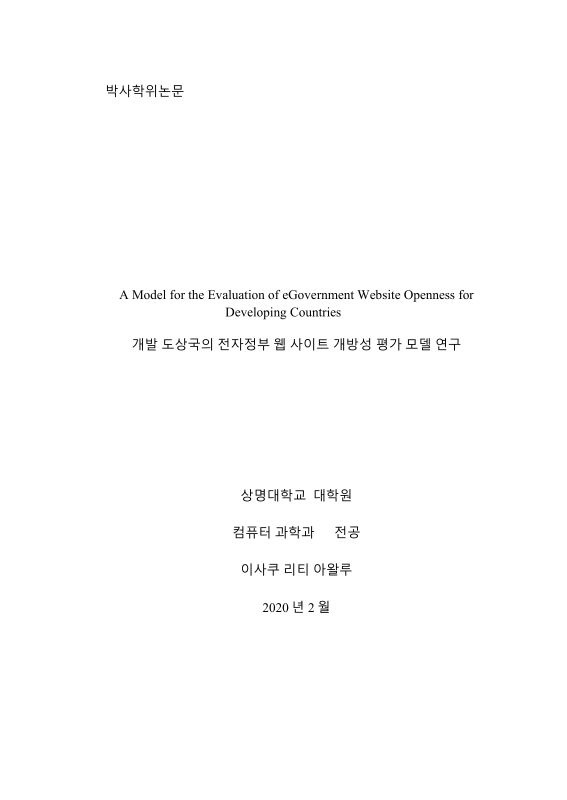
Title Page
ABSTRACT
Contents
LIST OF ABBREVIATIONS 16
CHAPTER ONE 23
1.0. INTRODUCTION 23
CHAPTER TWO 30
2.0. Literature Review 30
2.1. Formalization of eGovernment 32
2.2. The Scope of eGovernment 34
2.2.1. eAdministration 34
2.2.2. eCitizen and eServices 36
2.3. State of eGovernment 38
2.3.1. Research Paradigm 40
2.4. ICT in Developing countries 48
2.5. Previous Methodologies 50
2.5.1. eGovernment Measurement 51
2.5.2. Web Quality, Metrics and Models 52
2.5.3. eGovernment Measurement Around the World 53
2.6. eGovernment Evaluation Models 54
2.6.1. The UN Model 56
2.6.2. The Brown University (West) Model 57
2.6.3. The Accenture Model 58
2.6.4. The Capgemini Europe Model 59
2.6.5. Scholars eGovernment Models 59
2.6.6. Official eGovernment Frameworks 60
2.6.7. Evaluation of Local Government/Municipal Websites 61
2.6.8. Digital eGovernance in Municipalities Worldwide 62
2.6.9. MeGAP (The Municipal eGovernment Assessment Project) 63
2.6.10. Municipal Website Assessment of Community Benchmarks Program (CBP) 64
2.6.11. Key Elements for Electronic Local Authorities' Network (KEeLAN) 65
2.7. Limitations of eGovernment Evaluation Models 65
2.7.1. Limitations of Municipal E-Government Evaluation Models 70
2.7.2. Comparison of National and Municipal eGovernment Models 71
2.8. International Benchmarking of eGovernment 74
2.9. Government Openness 81
2.9.1. Government Openness and the World Wide Web 82
2.10. Variables Affecting Government Openness 84
2.10.1. National Income 85
2.10.2. Size and Importance of Central Governments' Expenditure 85
2.10.3. Level of Integration with World Economic System 86
2.10.4. The Level of Education, Science and Research 87
2.10.5. Level of Computing Resources 88
2.10.6. Level of Cultural Values 88
2.10.7. Level of Democratic Penetration 91
2.10.8. Transparency 92
2.10.9. Interactivity 95
2.11. Rapid Diffusion of the Worldwide Web as a Tool Towards Organizational Openness 101
2.12. Government Openness and the World Wide Web 103
2.13. Openness, Transparency and the World Wide Web 104
2.14. Participation 106
2.15. Collaboration 109
2.16. Website Evaluation Methods. 110
2.17. Web Analytics 115
2.18. Website and Web Evaluation Methods 117
2.19. Trends in Evaluation Approaches 121
2.20. Classification of Evaluation Methods 122
2.21. The WebQEM 123
CHAPTER THREE 125
3.0. RESEARCH METHODOLOGY 125
3.0.1. Research Hypothesis 125
3.0.2. Definitions of Variables 126
3.1. The Approach in the Development of the Model 128
3.1.1. Identification of Key Indicators of Openness of an eGovernment Website. 130
3.1.2. Identified Key Indicators 131
3.1.3. Determination of the Attributes of Key Indicators of Website Openness 132
3.2. Discussion on Indicators and Attributes 135
3.2.1. Reachability 142
3.2.2. Reliability 143
3.2.3. Accountability 143
3.2.4. Open Data 143
3.2.5. Navigation 144
3.2.6. Interactivity 144
3.2.7. Personalization 144
3.3. Diffusion of the Dimensions and Boundaries of Enumerated Attributes 145
3.3.1. Factors to Consider 145
3.3.2. Determination of Dimensions and Boundaries of Attributes 145
3.4. Factor Mappings 151
3.4.1. Exploratory Factor Analysis EFA 151
3.4.2. Theoretical Mapping of Attributes Based on Factor Loadings 154
3.5.0 Development of Metrics for Attributes and Indicators for the Evaluation Process 156
3.6. Weighting of Indicators and Attributes 169
3.6.1. Weight Determination 171
3.6.2. Identification of criteria for evaluation. 172
CHAPTER FOUR 176
4.0. RESULTS AND DISCUSSION ON RESULTS 176
4.1. Implementation of the Evaluation Model 176
4.2. Discussion on Results Obtained from Implementation of the Model 190
4.3. Validation of the Evaluation Model 197
4.4. Confirmation of Hypothesis 198
CHAPTER FIVE 203
5.0. CONCLUSION 203
CHAPTER SIX 206
6.0. LIMITATION AND FURTHER RESEARCH 206
CHAPTER SEVEN 208
7.0. Bibliography 208
APPENDIX 243
APPENDIX A. R-Scripts for Correlation Analysis of Survey conducted to Validate the Developed Evaluation Model. 243
APPENDIX B. R-Scripts for Correlation Analysis to Confirm the Proposed Hypothesis Based on the Results of the Implementation of the Evaluation Model. 246
APPENDIX C. Exploratory Factor Analysis 256
APPENDIX D. Survey for the Development of an eGovernment Website Evaluation 264
List of Tables
Table 1. E-Government Evaluation Models 55
Table 2. The UN E-Government Model (United Nations Reports) 56
Table 3. Summaries of Identified Benchmarks Adopted from (Rorissa,... 77
Table 4. Openness Indicators, Description and their Attributes as Adopted by... 97
Table 5. Summary of Automatic Website Analysis Tools 113
Table 6. Summary of Commonly Used Web Analytics Tools. (Analytics 2019) 116
Table 7. Identified Key Indicators and their References. 133
Table 8. Metrics of Identified Attributes 160
Table 9. Weighting of Transparency Components 173
Table 10. Variation of Openness and its Components 180
Table 11. Distribution of Transparency and its Components 181
Table 12. Distribution of Participation and its Components 182
Table 13. Distribution of Collaboration and its Components 183
Table 14. Distribution of Accountability with its Components 184
Table 15. Distribution of Openness and Hypothesis Components 185
Table 16. Variation of Openness and Basic Information About Organization 186
Table 17. Variation of Openness and Accountability Documents (Acct_Docs) 187
Table 18. Variation of Openness and Contact Information About Key Officers 188
Table 19. Correlation Analysis Results 200
Fig 1. Typical eCitizen Interactions 38
Fig 2. Distribution of Website Features 120
Fig 3. Distribution of Lifecycle Features 120
Fig 4. Distribution of Quality Features 121
Fig 5. Categories of Web and Website Evaluation Techniques 123
Fig 6. Diagram of Hypothesis with Expected Relationships Between Variables 126
Fig 7. Key Components of Website Openness for Developing Countries 132
Fig 8. Conceptual Model for the Determination of the Attributes of Key... 133
Fig 9. r-Scripts Generated for Exporatory Factor Analysis EFA 153
Fig 10. Mapping of Attributes Based on Factor Loadings 154
Fig 11. Scree Plot for Parallel Analysis 154
Fig 12. Three Factor Loading and Mappings of Attributes 155
Fig 13. Three Factor Loading and Mappings of Attributes 156
Fig 14. UML Diagrams of the Relationships between Web Metrics Elements 159
Fig 15. Diagram of Openness and its Components Weights 174
Fig 16. Diagram of Transparency and its Components Weights 174
Fig 17. Diagram of Participation and its Components Weights 174
Fig 18. Diagram of Collaboration and its Components Weights 175
Fig 19. Diagram of Accountability and its Components Weights 175
Fig 20. Variation of Openness and its Components 176
Fig 21. Variation of Transparency and its Components 177
Fig 22. Variation of Participation and Its Components 177
Fig 23. Variation of Collaboration and its Components 178
Fig 24. Variation of Accountability and its Components 178
Fig 25. Correlation of Openness and Hypothesis Components 179
Fig 26. Survey Based Variation of Openness and its Components 189
Fig 27. Survey Based Correlation of Openness and Hypothesis Components 189
Fig 28. Distribution of Transparency in the 23 Federal Ministries 190
*표시는 필수 입력사항입니다.
| 전화번호 |
|---|
| 기사명 | 저자명 | 페이지 | 원문 | 기사목차 |
|---|
| 번호 | 발행일자 | 권호명 | 제본정보 | 자료실 | 원문 | 신청 페이지 |
|---|
도서위치안내: / 서가번호:

우편복사 목록담기를 완료하였습니다.
*표시는 필수 입력사항입니다.
저장 되었습니다.
