






권호기사보기
| 기사명 | 저자명 | 페이지 | 원문 | 기사목차 |
|---|
| 대표형(전거형, Authority) | 생물정보 | 이형(異形, Variant) | 소속 | 직위 | 직업 | 활동분야 | 주기 | 서지 | |
|---|---|---|---|---|---|---|---|---|---|
| 연구/단체명을 입력해주세요. | |||||||||
|
|
|
|
|
|
* 주제를 선택하시면 검색 상세로 이동합니다.
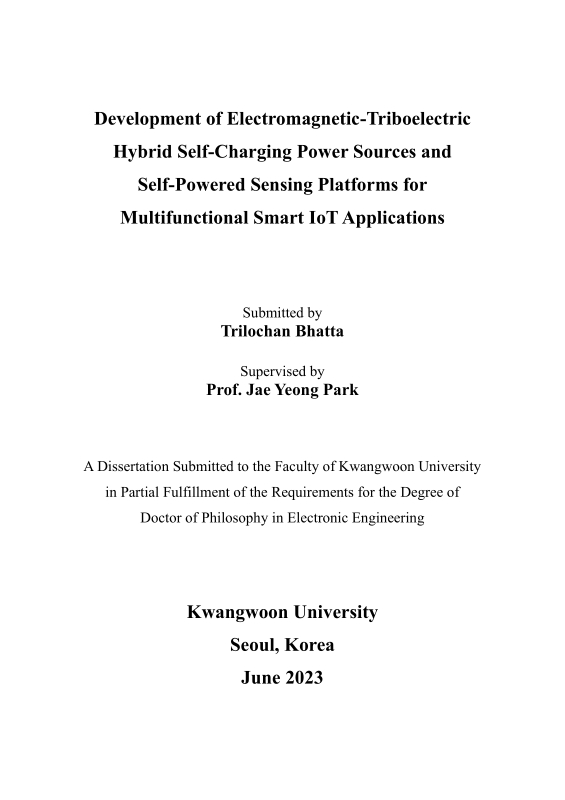
Title Page
Abstract
Contents
Abbreviations 31
Chapter 1. Introduction 32
1.1. Motivation 32
1.2. Review of Previous Works 37
1.3. Research Objectives 40
1.4. Thesis Outlines 42
Chapter 2. Basic Theory 44
2.1. Introduction 44
2.2. Vibration Energy Harvesters and Self-Powered Sensors 46
2.2.1. Electromagnetic Mechanism 47
2.2.2. Triboelectric Mechanism 49
2.2.3. Hybrid Mechanism 52
2.3. Energy Harvesting Materials and Nanocomposites 52
2.3.1. MXene (Ti₃C₂Tx)[이미지참조] 53
2.3.2. Siloxene 55
2.4. Research Challenges 56
Chapter 3. Hybrid Self-Sustainable Wireless Arbitrary Motion Monitoring Platforms 58
3.1. Magnetic Repulsion-Based Arbitrary Motion Sensing System 59
3.1.1. Introduction 59
3.1.2. Device Design and Analysis 61
3.1.3. Working Principle and Simulation Results 64
3.1.4. Materials and Fabrication Methods 67
3.1.5. Hybrid Nanogenerator Electrical Characterization 69
3.1.6. Self-Powered Motion Sensor Electrical Characterization 73
3.1.7. Wireless Motion Monitoring Application Platform 77
3.1.8. Summary 79
3.2. Magnets-Assisted Dual Mode Triboelectric Motion Sensing System 81
3.2.1. Introduction 81
3.2.2. Design and Theory 84
3.2.3. Working Principle and Simulation Results 89
3.2.4. Materials and Fabrication 92
3.2.5. Electrical Characterization of Electromagnetic Generator 94
3.2.6. Electrical Characterization of Triboelectric Motion Sensor 96
3.2.7. Self-powered Wireless Robotic Balancing Platform 100
3.2.8. Summary 102
Chapter 4. 2D Nanocomposites Based TENG & Self-Powered Sensors 104
4.1. MXene Functionalized PVDF Nanofibrous Mat Based TENG and Self-Powered Foot Motion Sensor 105
4.1.1. Introduction 105
4.1.2. Materials, Synthesis, and Nanofiber Fabrication 108
4.1.3. Material Characterization 112
4.1.4. TENG Design, Simulation, and Fabrication 120
4.1.5. TENG Electrical Characterization 122
4.1.6. TENG as a Power Source for Portable Electronics 127
4.1.7. TENG as a Self-Powered Foot Motion Sensor 128
4.1.8. Summary 129
4.2. Siloxene-PVDF Nanofibrous Mat for TENG and Hybrid Self-Powered Static/Dynamic Pressure Sensor 131
4.2.1. Introduction 131
4.2.2. Material Synthesis and Nanofiber Fabrication 134
4.2.3. Material Characterization 137
4.2.4. Device Design, Simulation, and Fabrication 144
4.2.5. Electrical Characterization of TENG 148
4.2.6. Characterization of Capacitive Pressure Sensor (CPS) 151
4.2.7. Electrical Characterization of Hybrid Pressure Sensor (HPS) 152
4.2.8. SP-HPS Array-Based User Authentication Platform 154
4.2.9. Summary 163
Chapter 5. Hybrid Self-Sustainable Wireless Aqua Environment Monitoring Platforms 166
5.1. Ellipsoidal Shaped Arbitrary Water Wave Monitoring System 167
5.1.1. Introduction 167
5.1.2. Design and Simulations 169
5.1.3. Materials and Fabrication 177
5.1.4. Electrical Characterization of EMG 179
5.1.5. Electrical Characterization of TENG (Motion Sensor) 184
5.1.6. Self-Sustained Wireless Water Wave Monitoring Platform 186
5.1.7. Summary 191
5.2. Brachistochrone Bowl Shaped Multifunctional Water Physio-Electrochemical Monitoring System 193
5.2.1. Introduction 193
5.2.2. Design and Theory 196
5.2.3. Fabrication of Hybrid Nanogenerator 201
5.2.4. Fabrication of Multifunctional Sensing Unit (MSU) 202
5.2.5. Electrical Characterization of EMG 204
5.2.6. Electrical Characterization of TENG 206
5.2.7. Electrical Characterization of MSU 208
5.2.8. Smart Pool Monitoring Application Platform 212
5.2.9. Summary 214
Chapter 6. Conclusion 216
6.1. Summary 216
6.2. Future Perspectives 221
Bibliographies 228
Figure 1.1. Global Sensor market size (in USD) forecast between 2021 to 2030. 33
Figure 1.2. Frequently used sensors for multifunctional IoT applications. 34
Figure 1.3. Power consumption of various portable/wearable electronics, sensors, and wireless components. 35
Figure 1.4. Global energy harvesting system market size (in USD) forecast between 2021 to 2030. 36
Figure 1.5. Recent progress on energy harvesting device technologies utilizing ambient arbitrary vibration motion. 38
Figure 1.6. Recent advances in self-powered kinetic vibration/motion sensors for IoT applications in multiple domains. 40
Figure 2.1. The various energy resources that can be converted into electricity. 45
Figure 2.2. The working principle of electromagnetic induction for (a) solenoid coil and (b) planar coil. 48
Figure 2.3. Four working modes of TENG. (a) Vertical contact separation. (b) Single electrode contact separation mode. (c) Contact sliding mode. (d) Freestanding... 50
Figure 2.4. List of common TENG materials based on their electron affinities. (a) Electron Acceptors. (b) Electron donors. 53
Figure 2.5. MAX phases Mn+1AXn forming elements in the periodic table. 54
Figure 2.6. The synthesis procedures for MXene. 55
Figure 2.7. Chemical Structure of CaSi₂ and Siloxene. 56
Figure 3.1. Magnetic repulsion-based dynamics. 62
Figure 3.2. (a) Magnetic force consideration. (b) Magnetic repulsive force and distance relationship between central magnet and side magnet. (c) Magnetic repulsive force and... 62
Figure 3.3. (a) 2D schematic of the magnetic repulsion-based system. (b) 3D schematic of the hybrid device. (c) The layered schematic illustrating internal components. 63
Figure 3.4. (a) Working Mechanism of EMG. (b) FEA simulation of magnetic flux density. The plot of simulated magnetic flux density for (c) EMG and (d) sensor. 65
Figure 3.5. (a) Cross-sectional view of the TENG. (b) The Working mechanism and the FEA simulation of surface potential. (c) The plot of the simulated surface potential as a... 66
Figure 3.6. FESEM images of the fabricated (a) PTFE Nanowires and (b) Al nano-grass structures. 68
Figure 3.7. Device fabrication process and the photograph of the actual device 69
Figure 3.8. Voltage waveforms of EMG during (a) linear and (b) rotational motion. 70
Figure 3.9. (a) Voltage-frequency-acceleration response of EMG. (c) The load voltage and peak power as a function of the input frequency. 70
Figure 3.10. Linear motion excitation, (a) Voc waveform of TENG and its enlarged view. (b) Transferred charge waveform of TENG and its enlarged view.[이미지참조] 71
Figure 3.11. Rotational motion excitation, (a) Voc waveform of TENG and its enlarged view. (b) Transferred charge waveform of TENG and its enlarged view.[이미지참조] 71
Figure 3.12. (a) Voltage-frequency-acceleration relationship of TENG. (c) The load voltage and peak power of TENG as a function of the input frequency. 73
Figure 3.13. (a) The peak power of EMG and TENG at varying load conditions. (b) The capacitor charging performance of generator. (c) The energy harvesting performance... 73
Figure 3.14. (a) Schematic of the device illustrating linear motion excitation. (b) Voc waveform of a sensor. (c) The frequency sensitivity analysis of a sensor. (d) The...[이미지참조] 75
Figure 3.15. (a) Device schematic illustrating the arbitrary direction operating modes. (b) The voltage waveforms of individual sensors recorded during linear motion toward... 76
Figure 3.16. Summarized performance metrics and obtained results of the developed motion sensing platform with available similar works. 77
Figure 3.17. (a) The photograph of the fabricated device components. (b) The LED arrangement for the harvester. (c) Photograph of the LED turned on by the harvester. (d)... 78
Figure 3.18. (a) The capacitor charging and discharging voltage curve during real-time wireless monitoring of the motion parameters. (b) The photographs of the developed... 78
Figure 3.19. (a) Illustration of the overall design optimization compared to the previous work. (b) The magnetic repelling force-distance relationship between CM and SM. 85
Figure 3.20. (a) Device Schematic and its layered view illustrating internal components. (b) Schematic representation of the arbitrary direction motion sensing. 85
Figure 3.21. Theoretical Analysis of various motion states of magnets. Schematic representation of the various motion states of magnet such as (a) rest, (b) linear... 87
Figure 3.22. (a) EMG Working mechanism. (b) FEMM simulation of the magnetic flux density. (c) The plot of the simulated flux density at the center of the coil during various... 90
Figure 3.23. (a) The schematic of the CS-TENG working. (b) Detailed working mechanism. (c) FEA simulation results of surface potential for CS-TENG. 91
Figure 3.24. (a) Various moving conditions of the magnet along the liner direction. The working mechanism of S-TENG under (b) linear and (c) rotational motion conditions.... 91
Figure 3.25. (a) Photograph of the fabricated double-layered ferromagnetic films. The FESEM images of the surface modified (b) Al and (c) PTFE films. (d,e) The photographs... 94
Figure 3.26. (a) Voc waveform of EMG during linear motion excitation. (b) The frequency and acceleration response in terms of Voc. (c) The load voltage and peak power...[이미지참조] 95
Figure 3.27. (a) The Voc waveform of EMG during rotational motion excitation. (b) The influence of angular frequency on Voc and V RMS of EMG. (c) The VL and Ppeak of EMG...[이미지참조] 95
Figure 3.28. (a) EMG performance comparison at various low-frequency motions. (b) Capacitor charging performance of individual generators and the series combination. (c)... 96
Figure 3.29. (a) Schematic of S-TENG for linear motion sensing. The output voltage waveforms of S-TENG for linear motion from (b) center to E1 and (c) center to corner,... 97
Figure 3.30. (a) Schematic of S-TENG for rotational motion sensing. The output voltage waveforms of S-TENG for (b) 90-degree and (c) 360-degree anticlockwise rotations.... 98
Figure 3.31. (a) Schematic of the CS-TENG for linear motion sensing. (b) The linear direction sensing voltage waveforms. (c) Tilting angle sensitivity analysis. The linear (d)... 98
Figure 3.32. (a) Schematic of the CS-TENG for rotational motion sensing. (b) The clockwise rotational direction sensing output voltage waveforms (c) The anticlockwise... 99
Figure 3.33. Summarized performance metrics and obtained results of the developed motion sensing platform with available similar works. 100
Figure 3.34. The flow diagram of the developed self-sustainable wireless robotic ball balancing application platform. 101
Figure 3.35. (a) The systematic block diagram of the self-powered wireless robotic balancing platform. (b) The photographs of the wireless transceiver circuits and components. 102
Figure 3.36. (a) The systematic illustration of motion-controlled self-powered wireless robotic balancing platform. (b) The photograph of the real-time ball balancing... 102
Figure 4.1. The cross-sectional image of exfoliated multilayered MXene (Ti₃C₂Tx).[이미지참조] 109
Figure 4.2. MXene synthesis and PVDF/MXene Nanofibrous Mat Fabrication. 110
Figure 4.3. Photographs of the fabricated PVDF and PVDF/MXene nanofibrous mats. FESEM images of (b) PVDF and (c) PVDF/MXene Nanofibrous mats. 111
Figure 4.4. FESEM Images of Nylon 6/6 nanofibrous mat. 111
Figure 4.5. (a) The XRD diffraction curve for the MXene illustrating the successful etching of metallic Al layer. (b) The Raman shifts corresponding to the various vibration... 113
Figure 4.6. The chemistry behind blending of MXene with PVDF. 114
Figure 4.7. (a,b) TEM images of the PMC nanofiber showing intercalation of MXene nanosheets within the PVDF matrix. (c) The EDS elemental mapping image of the PMC... 115
Figure 4.8. (a) The XRD spectra of PMC nanofibers with various wt. % MXene. (b) FTIR data corresponding to each wt. % of MXene content in the PVDF nanofiber. (c)... 116
Figure 4.9. (a) The plot of the measured values of dielectric constant as a function of frequency. (b) The plot of the measured values of dielectric loss as a function of... 118
Figure 4.10. 3D schematic of the TENG. 120
Figure 4.11. (a-b) Working mechanism of the TENG. (c) The FEA simulation of surface potential using COMSOL. (d) The simulated potential distribution of TENG at varying... 121
Figure 4.12. (a) The photographs of the fabricated nanofibrous mats and TENG. (b) The photograph of the fabricated human foot motion sensor for smart step light control application. 121
Figure 4.13. The measured (a) Voc (b) Isc, and (c) charge waveforms of the TENG incorporating PVDF/MXene mats with various content of MXene.[이미지참조] 123
Figure 4.14. The measured (a) Voc, (b) Isc, and (c) charge waveforms of the TENG. 124
Figure 4.15. The measured (a) Voc, (b) Isc, and (c) charge waveforms of the TENG at varying impact forces (f=1 Hz).[이미지참조] 125
Figure 4.16. The performance comparison of TENG with different MXene filler concentrations. (b) The load voltage and peak power curves for TENG with pristine and... 125
Figure 4.17. Capacitor charging voltage curves. 125
Figure 4.18. Performance comparison of the developed nanocomposite with similar previous works in terms of power density and current density. 127
Figure 4.19. Demonstration of TENG as a power source to operate (a) LEDs, (b) sports watch, and (c) thermohygrometer sensor. 129
Figure 4.20. The application demonstration of the developed TENG as a self-powered foot motion sensor for step light control and automation. (a) The schematic illustration.... 129
Figure 4.21. Siloxene synthesis and S-PVDF nanofibrous mat fabrication process. 135
Figure 4.22. (a) The photographs of the fabricated nanofibrous mat of PVA-LiTFSI and its (b) FESEM image. 136
Figure 4.23. (a) Photograph of the fabricated Au electrode and its (b) FESEM image. 137
Figure 4.24. (a) The chemical structure of the CaSi₂, Siloxene, and S-PVDF. (b) The FESEM image CaSi₂. (c) FE-SEM image of the Siloxene after exfoliation and Energy... 138
Figure 4.25. (a) XRD and (b) XPS results for CaSi₂ and Siloxene. 139
Figure 4.26. (a) The FESEM image of S-PVDF composite nanofibrous mat. (b) The EDS elemental mapping image of S-PVDF composite and elemental composition. (c) The... 140
Figure 4.27. The plot of the dielectric constant of the S-PVDF mats with various filer concentrations. (b) The plot of measured dielectric constant and dielectric loss as a... 143
Figure 4.28. The 3D schematic design of the hybrid pressure sensor for self-powered static dynamic pressure sensing applications. 145
Figure 4.29. (a) Working mechanism of TENG and CPS. (b) Zoomed view illustrating CPS working mechanism. 146
Figure 4.30. (a) FEA simulation of TENG surface potential using COMSOL. (b) The plot of the simulated surface potential as a function of the gap between the layers. 146
Figure 4.31. (a) The photographs of the fabricated HPS components. The photographs of the fabricated 2x2 array of (b) TENG, (c) CPS, and HPS, respectively. 147
Figure 4.32. The electrical performance of the TENG employing S-PVDF nanofibrous mats with varying concentrations of Siloxene in terms of (a) output voltage, (b) output... 149
Figure 4.33. (a) The load voltage and output power of the TENG at varying loads. (b) The frequency response of the TENG in terms of Voc, Isc, and charge. (c) The measured...[이미지참조] 150
Figure 4.34. (a) Stability test voltage waveform of the TENG. (b) The capacitor charging voltage curves. (c) The schematic illustration of the TENG as a power source for low-... 151
Figure 4.35. (a) The working state of CPS under vertical mechanical pressure. (b) The static pressure sensitivity analysis in terms of capacitance change. 152
Figure 4.36. (a) The voltage waveforms of TENG at varying input pressure. (b) The equivalent circuit model for simultaneous detection of static and dynamic pressure in... 154
Figure 4.37. HPS array-based user authentication and security access system. 154
Figure 4.38. Plots of the multiple trial voltage outputs from each of the TENG recorded simultaneously for multiple users such as (a) User 1, (b) User 2, and (c) User 3 while... 156
Figure 4.39. The plots of the multiple trial voltage outputs from each sensor unit of the self-powered CPS array recorded simultaneously for multiple users such as (a) User 1,... 157
Figure 4.40. The plots of the multiple trial timing signal information from the HPS array for each of the users such as: (a) User 1, (b) User 2, and (c) User 3 while pressing the... 158
Figure 4.41. (a) The comparison between the average rectified voltage of individual TENG while pressing a common passcode by three users, '80 time as trial data'. (b) The... 160
Figure 4.42. The schematic of the user data acquisition, AI analysis, and the user identification and authentication system. 160
Figure 4.43. (a) The modal accuracy and loss curves of the (a) TENG array, (b) CPS array, and (c) HPS array. 161
Figure 4.44. The accuracy scores obtained for user authentication based on the (a) CPS array, (b) TENG sensor array, and (c) HPS array. (d) The comparison of the user accuracy... 162
Figure 5.1. Elliptical trajectory of particles in shallow water. 170
Figure 5.2. Theoretical analysis of the spherical ball motion over various curved paths such as (a) circular path and (b) cycloidal path. (c) Comparison of the time taken by the... 171
Figure 5.3. The design concept for realizing the semi-ellipsoidal device inspired by (a) cycloid curve, (b) ellipsoid, (c) fully enclosed ellipsoidal device, and (d) dimensional details. 172
Figure 5.4. The 3D schematic of the arbitrary water wave energy harvester and self- powered wave motion sensor- self-sustained arbitrary wave monitoring platform. 173
Figure 5.5. (a) Schematic of the device illustrating individual components. Various motion states of the magnet during the device working along (b) YY′ (minor axis)... 174
Figure 5.6. The FEMM simulation of the magnetic flux density and the corresponding plots for the magnetic flux densities linked at the center of each coil during various... 176
Figure 5.7. The FEA simulation of the developed surface potential of the CS-TENG unit using COMSOL. 177
Figure 5.8. The fabrication sequence of the TENG and EMG. (b) The photographs of the fabricated device. (c) Photograph of the fully packaged free-floating device. 178
Figure 5.9. The electrical characterization of individual EMG components for device excited along (a) XX′ direction, (b) rotation about the Z axis, and (c) YY′ direction. 180
Figure 5.10. The Voc waveforms of EMG during (a) XX′ direction linear and (b) YY′ direction linear motion excitation. The Isc waveforms of EMG during (c) XX′ direction...[이미지참조] 181
Figure 5.11. The load voltage and peak power curves of EMG actuated along (a) XX′ direction and (b) YY′ direction. The load voltage and peak power of EMG as a function... 182
Figure 5.12. (a) The schematic representation of the device operation along multiple axis directions. (b) The Voc waveform of single TENG. (c) The frequency response of a single...[이미지참조] 184
Figure 5.13. The motion direction sensing capability of four TENG pairs and the recorded voltage waveforms of individual TENG components for (a) linear motion along... 185
Figure 5.14. (a) The test setup for the water wave characterization of the device. (b) The load voltage and peak power of the harvester in water at varying wave frequencies. (c)... 187
Figure 5.15. The output response of each sensor as a function of (a) wave frequency, (b) wave height, (c) wavelength, and (d) wave period. 189
Figure 5.16. (a) The schematic of the developed self-sustainable arbitrary wave monitoring platform. (b) The circuit arrangement for the wireless demonstration. (c) The... 190
Figure 5.17. The theoretical analysis of distinct geometries based on curvatures of motion trajectories for maximizing the energy output. (a) Spherical trajectory, (b) Ellipsoidal... 197
Figure 5.18. The brachistochrone path and velocity equation. 197
Figure 5.19. (a) The 3D schematic of the brachistochrone bowl-shaped hybrid system. (b) The layered schematic of the internal components. (c) The schematic of the freely... 198
Figure 5.20. The working mechanism of the EMG and TENG. 199
Figure 5.21. (a) The FEMM simulation results of the magnetic flux density. The plots of the simulated magnetic flux densities at the center of (a) top and (b) bottom coils, due... 200
Figure 5.22. (a) The FEA analysis of the developed surface potential of the TENG for magnet moving at different positions from the origin. (b) The plot of the simulated... 201
Figure 5.23. (a) The layered schematic showing the stepwise assembly of the individual components. (b) The hybrid nanogenerator fabrication sequence. The photographs of the... 202
Figure 5.24. Schematic showing (a) the bottom view of the device and (b) the enlarged view of MSU. (b) The photograph of the fabricated MSU. 203
Figure 5.25. (a) The Voc waveform of EMG. (b) The voltage vs. frequency response. (c) The acceleration response at 3 Hz. (d) The peak power analysis at varying load...[이미지참조] 205
Figure 5.26. The motion direction sensing along linear specific paths (a) schematic illustration, (b) Voc waveform of single TENG, and (c) TENG voltage waveforms for...[이미지참조] 207
Figure 5.27. Characterization of pH and Clˉ sensor. (a) The OCP response of the pH sensor with pH ranging from 10 to 4 and back to 10. (b) The calibration plot of the OCP... 209
Figure 5.28. (a) Characterization of temperature and conductivity sensor. (b) The plot illustrating the resistance variation of the temperature sensor when the temperature rises... 210
Figure 5.29. The customized test setup for self-powered water wave energy harvesting and water quality monitoring. 212
Figure 5.30. (a) The schematic of the SMPS and the zoomed view of the device floating in the pool water. (b) Photograph of the fabricated SMPS device. (c) Conceptual circuit... 213
Figure 6.1. The road map on the development of arbitrary motion energy harvesting and self-powered motion sensing systems for various IoT applications. 223
Figure 6.2. The roadmap on triboelectric energy harvesters and their integration into other transduction methods for achieving future self-sustainable multifunctional IoTs. 224
Figure 6.3. The roadmap on self-powered and self-sustainable water environment monitoring IoT platform and future perspectives. 225
IoT has played a significant role in the advancement of multiple domains where millions of sensors and devices are interconnected. Among these domains, autonomous systems (such as robotics, drones, underwater vehicles, humanoids, autonomous vehicles), smart homes or buildings, sports/gaming, healthcare monitoring, industrial automation, and outdoor environment monitoring platforms (such as air quality, water quality) are directly linked with the life of living creatures. At the same time, wireless monitoring technologies are prevailing over traditional wired interconnections. In the era of Artificial Intelligence, human-machine interfaces, and environmental monitoring concerns, a huge number of sensors and components are being deployed. The seamless operation of multiple sensors and components requires self-sustainable power supplies which may not be feasible to provide through conventional grid lines and rechargeable batteries due to installation, charging, and replacement complexities. Moreover, the integrated passive sensors increase the overall power consumption of the system thereby threatening the integrity of the monitoring systems. Over the years, alternative energy transduction strategies are being researched and deployed such as photovoltaic cells, wind turbines, battery backups, and nuclear power plants. However, the interconnection compatibility of these resources to the distributed sensors is challenging and a complex thing. Moreover, these efforts are less effective in terms of portability, miniaturization, cost-effectiveness, and undisrupted energy outputs. The vibration motion-based energy harvesting strategies based on electromagnetic, triboelectric, piezoelectric, and electrostatic, along with the hybridization with photovoltaic and wind energies could pave the sustainable path for modern and future smart IoT platforms. Parallelly these energy transduction methods are equally suitable to utilize as a self-powered sensor that can convert physical and or mechanical parameters into electrical signals directly thereby reducing the overall power consumption during signal processing for practical implementations. Therefore, mechanical vibration energy harvesters and self-powered sensors are the recently emerged alternatives to conventional power sources and passive sensing components. However, the random low-frequency nature of vibration, resonant behavior of harvesting components, a limited degree of freedom, and limited electron affinity of the triboelectric materials have constrained their practical implementation as an efficient power source and as a highly sensitive self-powered sensor on a large scale.
To overcome these issues numerous novel strategies and designs have been investigated and implemented to develop efficacious electromagnetic, triboelectric, and hybrid energy harvesters and highly sensitive self-powered sensors for self-sustainable multifunctional smart IoT applications including multiple domains such as human body motion, human-machine interactions, automotive vibration, smart lighting control, user authentications systems, robotic, water wave monitoring systems and water quality monitoring systems, respectively.
In the beginning, extensive research was carried out to generate the concept of battery-autonomous self-powered sensors and sensing systems. To realize this concept magnetic repulsion mechanisms and their usability in low-frequency random direction kinetic energy harvesting and self-powered motion sensing were investigated. Therefore, a magnetic repulsion-based battery-less arbitrary motion sensing system was designed and developed based on electromagnetic and triboelectric principles and demonstrated as a self-sustained motion sensing system with energy harvesting and self-powered sensing functionality together for wireless autonomous control applications. In this design, the magnetic repulsion strategy was utilized to detect in-plane random motion parameters such as motion direction, frequency, acceleration, tilting angle, and rotational speed. The generated energy (EMG: 27 mW, TENG: 56 μW) was utilized to charge the capacitor to operate signal processing and wireless transmission components for making the entire motion monitoring system self-powered. A custom-designed mobile application was utilized for real-time monitoring and display of the motion parameters wirelessly.
To further boost the motion sensitivity, and output power, and to reduce design complexity within miniaturized volume, an interdigitated electrode pattern was optimized for TENG in the second work. Where, nanowire and nano-grass structures were developed through surface modification over polytetrafluorethylene (PTFE) and Aluminum surface to maximize the contact area and triboelectric performance, whereas a double-layered ferromagnetic composite of PDMS-FeSiCr/PDMS was introduced as a self-actuating layer of TENG to reduce the operational complexity. The optimized design includes magnets assisted dual mode (contact and sliding) triboelectric sensors and an integrated high-performance electromagnetic generator as a self-sustained system for the robotic balancing platform with enhanced motion sensitivity. The motion parameters such as direction, frequency, acceleration, angle, and rotation degrees were detected from the single platform. Furthermore, the practical demonstration was realized by utilizing a developed self-powered motion sensing system to wirelessly control the custom-developed robotic ball balancing table.
In the third work, a novel 2D MXene/PVDF nanofiber and nanofibrous mats were introduced as a highly electronegative triboelectric composite material with optimized concentration and thickness that significantly improved the TENG performance as a power source as well as a self-powered sensor owing to significant improvement in the dielectric property, charge density, and the current density. The developed TENG using MXene/PVDF composite nanofiber paired with nylon nanofiber was able to operate wearable sports watches and thermohydrometer sensors easily and was effective for self-powered step light control applications based on the human motion over the stairs.
In the fourth work, a novel composite of 2D Siloxene/PVDF was introduced as a highly negative layer of TENG in the form of an electrospun nanofibrous mat. The facile fabricated nanofiber paired with nylon nanofiber significantly improved the triboelectric performance and was able to operate commercial low-power electronics. Furthermore, the excellent compressibility of the developed nanofiber showed great potential to use as a self-powered pressure sensor. Considering this aspect, a hybrid capacitive-triboelectric self-powered static and dynamic pressure sensor was developed that showed promising applications for measuring static and dynamic pressure simultaneously without requiring external power. In this case, the hybrid pressure sensor array was designed and demonstrated as a self-powered user authentication system powered by Artificial Intelligence that can accurately identify the user during pressing a keypad considering the pressure parameters and user behaviors into account with excellent accuracy.
In the fifth work, the developed MXene/PVDF nanofiber was utilized as a self-powered water wave motion sensor by integrating it with a novel ellipsoidal-shaped arbitrary direction water wave energy harvester in which the six pairs of electromagnetic nanogenerators and four pairs of triboelectric motion sensors were integrated for simultaneous energy generation and water wave motion parameter sensing without requiring external electricity and the wave parameters (wave height, wave period, wave length and wave frequency) were wirelessly monitored on custom-designed mobile application through the free-floating hybrid ellipsoidal device. The triboelectric generators were actuated with the help of magnetic ferromagnetic film, the attraction between the FeSiCr film, and the working magnet for EMG.
In the sixth work, the water wave monitoring system was further optimized, and a novel Brachistochrone bowl-shaped geometry was introduced that offered the fastest descent for the magnet motion inside the curve thus maximizing the energy output along a random path. In addition to the integrated triboelectric motion sensors as in previous work, a multifunctional physio-electrochemical (wave motion, temperature, pH, Chloride ion, and water conductivity) sensing unit was designed, developed, and integrated with the brachistochrone bowl to realize a freely floating self-powered wireless autonomous smart pool monitoring system powered by the inbuilt electromagnetic energy harvester. A custom-developed smart pool monitoring mobile application was developed to wirelessly monitor the various contents of the pool water for maintaining a safe and hygienic swimming environment.*표시는 필수 입력사항입니다.
| 전화번호 |
|---|
| 기사명 | 저자명 | 페이지 | 원문 | 기사목차 |
|---|
| 번호 | 발행일자 | 권호명 | 제본정보 | 자료실 | 원문 | 신청 페이지 |
|---|
도서위치안내: / 서가번호:

우편복사 목록담기를 완료하였습니다.
*표시는 필수 입력사항입니다.
저장 되었습니다.
