본문 바로가기 주메뉴 바로가기
국회도서관 홈으로 정보검색 소장정보 검색

목차보기


List of Contributors
Preface
Part I Reflections on the Fundamental Contents and Mechanisms of Creative Cognition
1 Divergent Thinking as Creative Cognition
2 Measuring Creativity with the Consensual Assessment Technique (CAT)
3 Constraints and Creativity: Classifying, Balancing, and Managing Constraints
4 The Role of Serendipity in Creative Cognition
5 The Two Faces of Curiosity in Creative Cognition: Curiosity1, Curiosity2 (and Their Interaction)
6 Thinking Wide and Narrow: A ‘Cultural Creative Cognition’ Approach to Possibility Thinking
7 Analogy and the Transfer of Creative Insights
8 Creative Cognition: From Ideation to Innovation
9 Insight in the Kinenoetic Field
Part II Reflections on the Nature of Creative Cognition as Revealed through Traditional Methodologies
10 Idea Generation and Associative Memory
11 Creatively Searching Through Semantic Memory Structure: A Short Integrative Review
12 Mental Imagery and Creative Cognition
13 Incubation
14 Of Night and Light and the Half-​Light: The Role of Multidimensions of Emotion and Tolerance of Uncertainty in Creative Flow
15 Problem-​Solving, Collaboration, and Creativity
16 Metaphoric Creativity as Embodied Performance in Social Interaction
17 Analyzing Changing Patterns of External Reference Use from Informal Lab Group Presentations to Formal Colloquia
18 Measuring Judgment and Decision-​Making in Developmental Samples: Assessment of the Generation of Cognitively Sophisticated Responses and Implications for the Study of Creative Cognition
19 The Phenomenology of Insight: The Aha! Experience
20 Reconcilable Differences: Working Memory Capacity Both Supports and Hinders Insight
21 Comparing Theoretical and Computational Models of Insight: Investigating Cognitive and Phenomenological Perspectives
22 Collaborative Meta-​Reasoning in Creative Contexts: Advancing an Understanding of Collaborative Monitoring and Control in Creative Teams
Part III Reflections on the Nature of Creative Cognition as Revealed through Cognitive Neuroscience Approaches
23 An Archaeological Perspective on Creative Cognition
24 The Role of Semantic Versus Episodic Memory in Creative Cognition
25 Network Neuroscience of Domain-​General and Domain-​Specific Creativity
26 A Closer Look at Transitions between the Generative and Evaluative Phases of Creative Thought
27 Markers of Insight
28 A Cognitive Neuroscience Perspective on Insight as a Memory Process: Searching for the Solution
29 A Cognitive Neuroscience Perspective on Insight as a Memory Process: Encoding the Solution
Part IV Reflections on Creative Cognition from Pedagogical, Organisational, Archaeological and Post-Phenomenological Perspectives
30 Creativity in Education
31 Creative Learning: A Pedagogical Perspective
32 Tool Use and Creativity
33 Art Through Material Engagement…and Vice Versa
34 Creativity as a Discursive Construct
35 Collaborative Creativity: Information-Driven Coordination Dynamics and Prediction in Movement and Musical Improvisation
36 Common Creativity
Part V Reflections on Creative Cognition in Domains Involving Creativity and Innovation
37 Team Cognition and Team Creativity
38 Creative Cognition in Engineering and Technology
39 Creative Cognition and Entrepreneurship
40 Creative Cognition in Advertising
41 The Creative Generation and Appreciation of Artistic Artifacts in the Visual Domain
42 Individual Innovation and Creativity: An Interdisciplinary Mapping of Creative Cognition
Part VI Reflections on the Paradoxical Misalignment Between Findings that Derive from In Vivo Versus In Vitro Research on Creative Cognition
43 A Quandary in the Study of Creativity: Conflicting Findings from Case Studies versus the Laboratory
Index

이용현황보기

The Routledge international handbook of creative cognition 이용현황 표 - 등록번호, 청구기호, 권별정보, 자료실, 이용여부로 구성 되어있습니다.
등록번호 청구기호 권별정보 자료실 이용여부
0003075515 153.35 -A24-2 [서울관] 인문자연과학자료실(열람신청 후 1층 대출대) 이용가능

출판사 책소개

알라딘제공

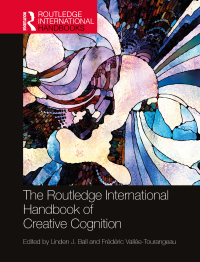
The Routledge International Handbook of Creative Cognition is an authoritative reference work that offers a well-balanced overview of current scholarship across the full breadth of the rapidly expanding field of creative cognition. It contains 43 chapters written by world-leading researchers, covering foundational issues and concepts as well as state-of-the-art research developments.

The handbook draws extensively on contemporary work exploring the cognitive representations and processes associated with creativity, whether studied in the laboratory or as it arises in real-world practice in domains such as education, art, science, entrepreneurship, design, and technological innovation. Chapters also examine the sociocognitive and cultural aspects of creativity in teams and organisations, while additionally capturing the latest research on the cognitive neuroscience of creativity.

Providing a compelling synopsis of emerging trends and debates in the field of creative cognition and positioning these in relation to established findings and theories, this text provides a clear sense of the way in which new research is challenging traditional viewpoints. It is an essential reading for researchers in the field of creative cognition as well as advanced students wishing to learn more about the latest developments in this important and rapidly growing area of enquiry.


This is an authoritative reference work that offers a well-balanced overview of current scholarship across the full breadth of the rapidly expanding field of creative cognition. It contains 43 chapters written by world-leading researchers, covering foundational issues and concepts as well as state-of-the-art research developments.


