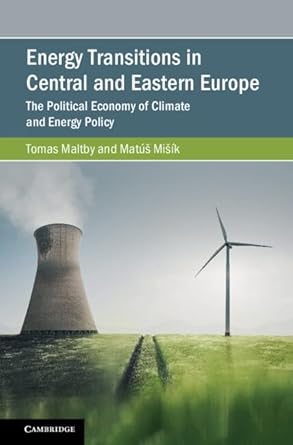
Cambridge studies on environment, energy and natural resources governance
표준번호/부호
ISBN: 9781108477130
제어번호
MONO22025000002527
주기사항
Includes bibliographical references and index.
연계정보
외부기관 원문
목차보기
List of Figures page xi List of Tables xiii Preface xv Acknowledgements xvii List of Abbreviations xix Introduction 1 I.1 How Does This Book Differ from Existing Works? 4 I.2 The Main Objective and Arguments of the Book 5 I.3 Energy Policy of the CEE Countries 7 I.4 Climate Policy and the CEE Countries 8 I.5 Structure of the Book 9 1 The Development of Energy and Climate Policy in the EU and CEE 13 1.1 Introduction 13 1.2 The Development of the EU’s Climate and Energy Policy 16 1.3 The EU’s Progress towards Its Climate and Energy Policy Goals 26 1.4 An Introduction to Energy Transitions in CEE 27 1.5 Conclusion 35 2 A Conceptual Framework for Understanding Energy Transitions 36 2.1 Introduction 36 2.2 Energy Transitions Literature 37 2.3 Institutional Change and Climate and Energy Governance 41 2.4 Securitisation/Politicisation: The Framing of Policy Issues 44 2.5 Conclusion 47 3 Energy Governance 49 3.1 Introduction 49 3.2 State-Market Relations and Liberalisation 51 3.3 Security of Energy Supply Legislation 54 3.4 Governing Sustainable Energy Transitions 58 3.5 Governing Fossil Fuel Phase-Outs: Carbon Pricing 62 3.6 Conclusion 63 4 The Effect of Foreign Policy on Climate and Energy Policy 65 4.1 Introduction 65 4.2 The EU’s Security of Supply Legislation 66 4.3 Gas Supply Diversiûcation 67 4.4 Promoting Coal Despite Climate Goals? 81 4.5 Renewable Energy: The New ‘Energy Independence’ Tool? 87 4.6 Nuclear Energy, Perceived as a Secure and Climate-Neutral Energy Source 92 4.7 Conclusion 101 5 State-Society Relations 103 5.1 Introduction 103 5.2 Changing State-Society Relations in the Context of CEE Energy Transition 104 5.3 Green Growth in CEE 109 5.4 Contesting Energy Transitions in Practice 119 5.5 Conclusion 128 6 The Inûuence of CEE Countries on EU Climate and Energy Policy 129 6.1 Introduction 129 6.2 Joining the EU and Its Decision-Making Process 131 6.3 Collective Action on Gas 134 6.4 Shaping Gas Legislation 140 6.5 Financing 145 6.6 Climate Ambitions 146 6.7 Conclusion 150 7 The Global Context: Decarbonisation, Pandemic and Invasion 152 7.1 Introduction 152 7.2 Global Energy Transition 154 7.3 Energy Justice, Burden Sharing and Worldwide Employment of Renewables 156 7.4 Natural Gas as a Bridging Fuel 160 7.5 Coal Phasing Out/Phasing Down? 160 7.6. Global Energy Transitions and the Rebirth of Nuclear Energy? 164 7.7 Conclusion 166 8 Conclusion 168 8.1 Two Main Arguments of the Book 170 8.2 Research Questions 170 8.3 The Way Forward 173 Bibliography 177 Index 233
이용현황보기
Energy transitions in Central and Eastern Europe : the political economy of climate and energy policy 이용현황 표 - 등록번호, 청구기호, 권별정보, 자료실, 이용여부로 구성 되어있습니다.
등록번호
청구기호
권별정보
자료실
이용여부
0003176902
333.7909437 -A25-1
서울관 사회과학자료실(208호)
이용가능
출판사 책소개
This book examines the mutual interplay of climate and energy policies in eleven Central and Eastern European countries in the context of the EU's energy transition. Energy security has long been prioritised in the region and has shaped not only national climate and energy policy, but also EU-level policy-making and implementation. Whilst the region shares economic, institutional and historical energy supplier commonalities it is not homogenous, and the book considers the significant differences between the preferences and policies of these member states. Chapters also explore the effect of the EU on member states that have joined since 2004 and their influence on the EU's energy and climate policies and their role in highlighting the importance of the concepts of security and solidarity. The book highlights the challenges to, and drivers of, energy transitions in the region and compares these with those in global energy transitions.

 대표어
대표어