
 대표어
대표어

권호기사보기
| 기사명 | 저자명 | 페이지 | 원문 | 기사목차 |
|---|
결과 내 검색
동의어 포함
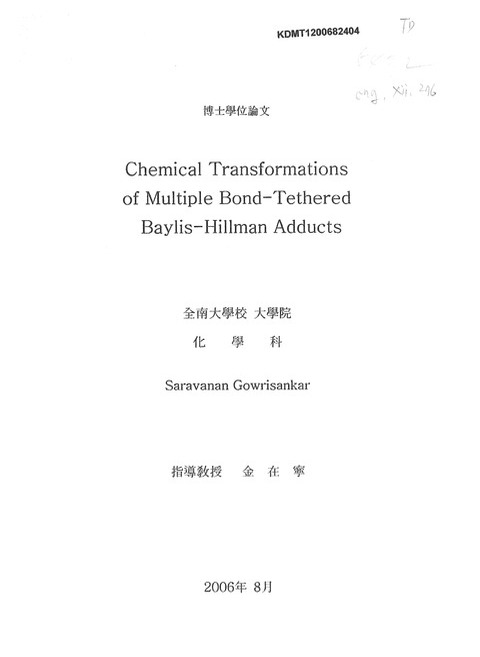
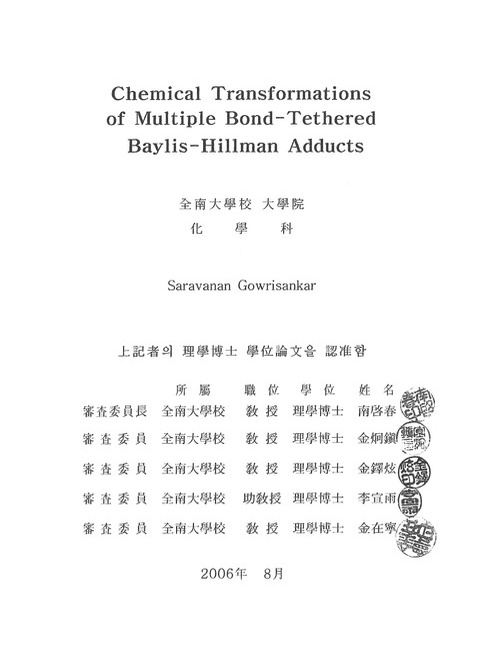
title page
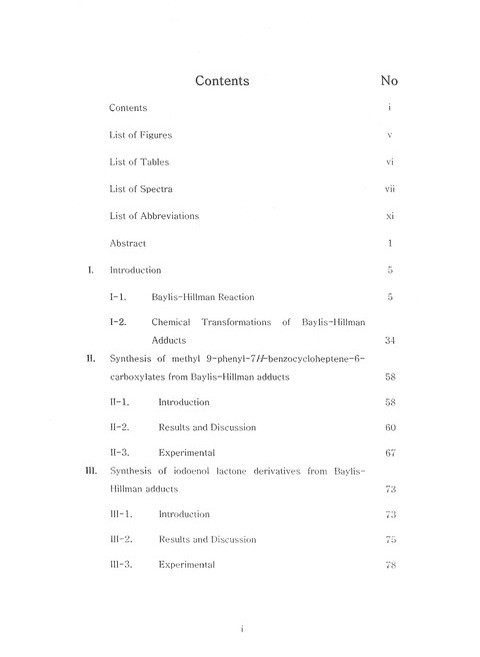
Contents
List of abbreviations 14
Abstract 16
I. Introduction 20
I-1. Introduction of Baylis-Hillman reaction. 20
I-2. Chemical transformations of Baylis-Hillman adducts 49
II. Synthesis of methyl 9-phenyl-7H-benzocycloheptene-6-carboxylates from Baylis-Hillman adducts 73
II-1. Introduction 73
II-2. Results and discussion 75
II-3. Experimental 82
II-4. Typical experimental procedure for 3a: 82
II-5. Typical experimental procedure for 4a: 84
III. Synthesis of iodoenol lactone derivatives from Baylis-Hillman adducts 88
III-1. Introduction 88
III-2. Results and discussion 90
III-3. Experimental 93
III-4. Typical experimental procedure for 14a: 93
III-5. Typical experimental procedure for 15a: 94
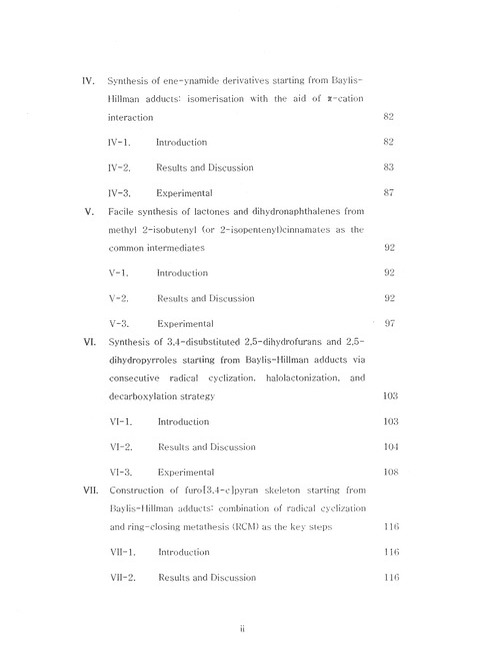
IV. Synthesis of ene-ynamide derivatives starting from Baylis-Hillman adducts: isomerisation with the aid of π-cation interaction 97
IV-1. Introduction 97
IV-2. Results and discussion 98
IV-3. Experimental 102
IV-4. General experimental procedure for cinnamic acid derivatives: 102
IV-5. Typical experimental procedure for 19a: 103
IV-6. Typical experimental procedure for 20a: 104
IV-7. General experimental procedure for 20d: 106
V. Facile synthesis of lactones and dihydronaphthalenes from methyl 2-isobutenyl (or 2-isopentenyl)cinnamates as the common intermediates 107
V-1. Introduction 107
V-2. Results and discussion 107
V-3. Experimental 112
V-4. Typical experimental procedure for 22a: 112
V-5. Typical experimental procedure for 23a: 113
V-6. Typical experimental procedure for 24a: 114
V-7. Typical experimental procedure for 25a: 116
VI. Synthesis of 3,4-disubstituted 2,5-dihydrofurans and 2,5-dihydropyrroles starting from Baylis-Hillman adducts via consecutive radical cyclization, halolactonization, and decarboxylation strategy 118
VI-1. Introduction 118
VI-2. Results and discussion 119
VI-3. Experimental 123
VI-4. Typical experimental procedure for 26a: 123
VI-5. Typical experimental procedure for 26d: 123
VI-6. Typical experimental procedure for 27c: 124
VI-7. Typical experimental procedure for 28a: 124
VI-8. Typical experimental procedure for 29a: 126
VI-9. Typical experimental procedure for 30 and 31: 127
VI-10. Typical experimental procedure for 32: 128
VI-11. Typical experimental procedure for 33: 129
VI-12. Typical experimental procedure for 34: 129
VII. Construction of furo[3,4-c]pyran skeleton starting from Baylis-Hillman adducts : combination of radical cyclization and ring-closing metathesis (RCM) as the key steps 131
VII-1. Introduction 131
VII-2. Results and discussion 131
VII-3. Experimental 137
VII-4. Typical experimental procedure for 40c: 137
VII-5. Typical experimental procedure for 41d: 138
VII-6. Typical experimental procedure for 26f: 138
VII-7. Typical experimental procedure for 27d: 138
VII-8. Typical experimental procedure for 43: 139
VII-9. Typical experimental procedure for 27f: 139
VII-10. Typical experimental procedure for 36a: 139
VII-11. Typical experimental procedure for 36f: 141
VII-12. Typical experimental procedure for 37a: 141
VII-13. Typical experimental procedure for 37b: 142
VII-14. Typical experimental procedure for 37d: 144
VII-15. Typical experimental procedure for 37h: 144
VII-16. Typical experimental procedure for 38a: 145
VII-17. General experimental procedure for 44: 147
VIII. Synthesis of 2,3,4-trisubstitued 2,5-dihydrofuran derivatives 149
VIII-1. Introduction 149
VIII-2. Results and discussion 150
VIII-3. Experimental 153
VIII-4. Typical experimental procedure for 47a: 153
VIII-5. Typical experimental procedure for 49a: 154
VIII-6. Typical experimental procedure for 50a: 156
IX. Synthesis of 3-benzyl-2-hydroxy-7,8-dihydro-6H-quinolin-5-ones from Baylis-Hillman adducts 157
IX-1. Introduction 157
IX-2. Results and discussion 158
IX-3. Experimental 161
IX-4. Typical experimental procedure for 53a (Method A): 161
IX-5. Typical procedure for the synthesis of 53d (Method B): 162
IX-6. Typical procedure for the synthesis of 55a: 163
X. Synthesis of 9-oxo-9,13b-dihydro-7H-benzo[3,4]azepino[2,1-a]isoindole-6-carboxylic acid derivatives from Baylis-Hillman adducts 165
X-1. Introduction 165
X-2. Results and discussion 165
X-3. Experimental 171
X-4. Typical experimental procedure for 56a: 171
X-5. Typical experimental procedure for 57a and 57a': 172
X-6. Typical experimental procedure for 58a: 174
XI. Synthesis of hexahydrofuro[2,3-b]furan and hexahydrofuro[2,3-b]pyran derivatives starting from Baylis-Hillman adducts : the Ueno-Stork reaction 177
XI-1. Introduction 177
XI-2. Results and discussion 178
XI-3. Experimental 180
XI-4. Typical synthetic procedure for the bromoacetal 63a: 181
XI-5. Typical procedure for the radical cyclization of 63a to 64a and 64a': 182
XII. Conclusion 186
XIII. References 192
XIV. Abstract (Korean) 224
XV. Spectra 228
Curriculum vitae 277
Acknowledgement 286
Figure 1. Various tertiary amine catalysts. 23
Figure 2. Various enantiopure electrophiles. 25
Figure 3. Various tertiary amines derived from cinchona alkaloids. 27
Figure 4. Enantiopure ligands. 28
Figure 5. Sulfides and Selenides catalysts. 31
Figure 6. 2,6-diphenyl-4H-chalcogenopyran-4-ones. 32
Figure 7. NOE for 2-benzyl-5-phenylpent-2-en-4-ynoic acid cyclohexylamide. 102
Figure 8. NOE for 5,5-diethyl-3-(4-methylbenzylidene)-dihydrofuran-2-one. 111
Figure 9. Metallacyclobutane intermediate for 38a. 132
Figure 10. NOE for 4,5-dimethyl-2-phenyl-2,5-dihydrofuran-3-carboxylic acid. 152
Figure 11. NOE for 2-methyl-1-p-tolyl-1,2-dihydro-4aH-4-oxa-9a-azafluorene-3,9-dione. 170
Figure 12. Biologically active natural products-hexahydrofurofuran unit. 177
Figure 13. 3-benzylhexahydrofuro[2,3-b]furan-3-carbonitrile. 180
Spectrum 1. ¹H NMR spectrum of 2-benzylidene-5-phenylpent-4-ynoic acid methyl ester (3a) 229
Spectrum 2. 13C(이미지참조) NMR spectrum of 2-benzylidene-5-phenylpent-4-ynoic acid methyl ester (3a) 230
Spectrum 3. ¹H NMR spectrum of 9-phenyl-7H-benzocycloheptene-6-carboxylic acid methyl ester (4a) 231
Spectrum 4. 13C(이미지참조) NMR spectrum of 9-phenyl-7H-benzocycloheptene-6-carboxylic acid methyl ester (4a) 232
Spectrum 5. ¹H NMR spectrum of 3-benzylidene-5-(iodophenylmethylene)-dihydrofuran-2-one (15a) 233
Spectrum 6. 13C(이미지참조) NMR spectrum of 3-benzylidene-5-(iodophenylmethylene)-dihydrofuran-2-one (15a) 234
Spectrum 7. ¹H NMR spectrum of 3-benzylidene-5-(1-iodoethylidene)-dihydrofuran-2-one (15g) 235
Spectrum 8. 13C(이미지참조) NMR spectrum of 3-benzylidene-5-(1-iodoethylidene)-dihydrofuran-2-one (15g) 236
Spectrum 9. ¹H NMR spectrum of 2-benzylidene-5-phenylpent-4-ynoic acid cyclohexylamide (19e) 237
Spectrum 10. 13C(이미지참조) NMR spectrum of 2-benzylidene-5-phenylpent-4-ynoic acid cyclohexylamide (19e) 238
Spectrum 11. ¹H NMR spectrum of 2-benzyl-5-phenylpent-2-en-4-ynoic acid cyclohexylamide (20e) 239
Spectrum 12. 13C(이미지참조) NMR spectrum of 2-benzyl-5-phenylpent-2-en-4-ynoic acid cyclohexylamide (20e) 240
Spectrum 13. NOE spectrum of 2-benzyl-5-phenylpent-2-en-4-ynoic acid cyclohexylamide (20e) 241
Spectrum 14. ¹H NMR spectrum of 5,5-dimethyl-3-(4-methylbenzylidene)-dihydrofuran-2-one (23c) 242
Spectrum 15. 13C(이미지참조) NMR spectrum of 5,5-dimethyl-3-(4-methylbenzylidene)-dihydrofuran-2-one (23c) 243
Spectrum 16. ¹H NMR spectrum of 4,4,6-trimethyl-3,4-dihydronaphthalene-2-carboxylic acid (24c) 244
Spectrum 17. 13C(이미지참조) NMR spectrum of 4,4,6-trimethyl-3,4-dihydronaphthalene-2-carboxylic acid (24c) 245
Spectrum 18. ¹H NMR spectrum of 5-hydroxymethyl-5-methyl-3-(4-methylbenzylidene)-dihydrofuran-2-one (25c) 246
Spectrum 19. 13C(이미지참조) NMR spectrum of 5-hydroxymethyl-5-methyl-3-(4-methylbenzylidene)-dihydrofuran-2-one (25c) 247
Spectrum 20. NOE spectrum of 5,5-dimethyl-3-(4-methylbenzylidene)-dihydrofuran-2-one (23c) 248
Spectrum 21. ¹H NMR spectrum of 3-benzyl-4-iodomethyl-2,5-dihydrofuran (29a) 249
Spectrum 22. 13C(이미지참조) NMR spectrum of 3-benzyl-4-iodomethyl-2,5-dihydrofuran (29a) 250
Spectrum 23. ¹H NMR spectrum of 3-benzyl-4-iodomethyl-1-(toluene-4-sulfonyl)-2,5-dihydro-1H-pyrrole (29e) 251
Spectrum 24. 13C(이미지참조) NMR spectrum of 3-benzyl-4-iodomethyl-1-(toluene-4-sulfonyl)-2,5-dihydro-1H-pyrrole (29e) 252
Spectrum 25. ¹H NMR spectrum of 5-benzyl-4-bromomethyl-3,6-dihydro-2H-pyran (32) 253
Spectrum 26. 13C(이미지참조) NMR spectrum of 5-benzyl-4-bromomethyl-3,6-dihydro-2H-pyran (32) 254
Spectrum 27. ¹H NMR spectrum of 3-allyloxymethyl-3-benzyl-4-methylenetetrahydrofuran (37a) 255
Spectrum 28. 13C(이미지참조) NMR spectrum of 3-allyloxymethyl-3-benzyl-4-methylenetetrahydrofuran (37a) 256
Spectrum 29. ¹H NMR spectrum of 3a-benzyl-1,3a,4,6-tetrahydro-3H-furo[3,4-c]pyran (38a) 257
Spectrum 30. 13C(이미지참조) NMR spectrum of 3a-benzyl-1,3a,4,6-tetrahydro-3H-furo[3,4-c]pyran (38a) 258
Spectrum 31. ¹H NMR spectrum of compound 38e 259
Spectrum 32. 13C(이미지참조) NMR spectrum of compound 38e 260
Spectrum 33. ¹H NMR spectrum of 4,5-dimethyl-2-phenyl-2,5-dihydrofuran-3-carboxylic acid (49e) 261
Spectrum 34. 13C(이미지참조) NMR spectrum of 4,5-dimethyl-2-phenyl-2,5-dihydrofuran-3-carboxylic acid (49e) 262
Spectrum 35. NOE spectrum of 4,5-dimethyl-2-phenyl-2,5-dihydrofuran-3-carboxylic acid (49e) 263
Spectrum 36. ¹H NMR spectrum of 3-(4-chlorobenzyl)-2-hydroxy-7,8-dihydro-6H-quinolin-5-one (53b) 264
Spectrum 37. 13C(이미지참조) NMR spectrum of 3-(4-chlorobenzyl)-2-hydroxy-7,8-dihydro-6H-quinolin-5-one (53b) 265
Spectrum 38. ¹H NMR spectrum of 9-oxo-9,13b-dihydro-7H-benzo[3,4]azepino[2,1-a]isoindole-6-carboxylic acid methyl ester (58a) 266
Spectrum 39. 13C(이미지참조) NMR spectrum of 9-oxo-9,13b-dihydro-7H-benzo[3,4]azepino[2,1-a]isoindole-6-carboxylic acid methyl ester (58a) 267
Spectrum 40. ¹H NMR spectrum of 2-methyl-1-p-tolyl-1,2-dihydro-4aH-4-oxa-9a-azafluorene-3,9-dione (61b) 268
Spectrum 41. 13C(이미지참조) NMR spectrum of 2-methyl-1-p-tolyl-1,2-dihydro-4aH-4-oxa-9a-azafluorene-3,9-dione (61b) 269
Spectrum 42. NOE spectrum of 2-methyl-1-p-tolyl-1,2-dihydro-4aH-4-oxa-9a-azafluorene-3,9-dione (61b) 270
Spectrum 43. ¹H NMR spectrum of 3-benzylhexahydrofuro[2,3-b]pyran-3-carboxylic acid methyl ester (64a') 271
Spectrum 44. 13C(이미지참조) NMR spectrum of 3-benzylhexahydrofuro[2,3-b]pyran-3-carboxylic acid methyl ester (64a') 272
Spectrum 45. ¹H NMR spectrum of 3-benzylhexahydrofuro[2,3-b]pyran-3-carboxylic acid methyl ester (64a) 273
Spectrum 46. 13C(이미지참조) NMR spectrum of 3-benzylhexahydrofuro[2,3-b]pyran-3-carboxylic acid methyl ester (64a) 274
Spectrum 47. NOE spectrum of 3-benzylhexahydrofuro[2,3-b]furan-3-carbonitrile (64c) 275
Spectrum 48. NOE spectrum of 3-benzylhexahydrofuro[2,3-b]furan-3-carbonitrile (64c) 276
1972년에 베일리스(Baylis)와 힐만(Hillman)에 의하여 발견된 소위 베일리스-힐만(Baylis-Hillman) 반응은, 전자끌개 치환체(electron-withdrawing substituent)에 의하여 활성화된 비닐 화합물(activated vinyl compound)의 α-위치가 알데히드 등의 친전자체(electrophile)를 공격하여 탄소-탄소 단일결합을 형성하는 매우 중요한 발견이었다. 활성화된 비닐 화합물의 α-위치는 그 친핵성(nucleophilicity)이 매우 약하여, 그 자체로서는 알데히드와 반응하지 못하지만 DABCO 등의 삼차 아민을 촉매로 사용하여 활성화시키면, 반응시간이 매우 느리지만 원하는 탄소-탄소간의 결합반응이 일어난다. 그러나, 이와 같은 중요성에도 불구하고 베일리스-힐만 반응은 너무도 느린 반응속도 때문에 약 20년 정도의 기간 동안 빛을 보지 못하였다.
1990년대에 들어와서 Basavaiah 연구진과 우리 연구진이 베일리스-힐만 반응에 의하여 얻어진 화합물(Baylis-Hillman adducts)의 중요성을 인식하고 다양한 화학적 변환을 통한, 여러 가지의 고리화합물과 유용한 비고리 화합물들을 합성하는 방법을 연구하면서부터 이 반응은 다시 각광을 받기에 이르렀다. 베일리스-힐만 반응 결과 얻어지는 알릴 알코올 유도체를 통상적으로 베일리스-힐만 부가생성물(Baylis-Hillman adducts)이라 하며, 이 물질은 알릴 알코올과 다양한 전자끌개 치환체의 존재로 인하여 다양한 화학적 변환이 가능한 유용한 골격의 화합물이다.
본 논문에서는 베일리스-힐만 부가생성물의 화학적 변환 중에서도 다중결합을 함유한 베일리스-힐만 부가생성물의 화학적변환에 집중하여 다양한 반응들을 시도하였다. 우선, 삼중결합 작용기가 베일리스-힐만 부가생성물의 일차 위치(primary position)에 도입된 출발물질을 합성하였고, 이 화합물을 이용하여 산 조건에서의 Friedel-Crafts alkenylation을 시도하였으며, 그 결과 벤조시클로헵텐(benzocycloheptene) 화합물을 합성하였다. 이 반응은 삼중결합으로부터 산 촉매에 의하여 생성된 비닐 양이온(vinyl cation)이 전자가 부족한 상태의 벤젠고리에 의하여 분자내 (intramolecular) Friedel-Crafts 형태의 반응이 일어나고, 그 결과로 보기가 드문 7각형의 고리가 합성된다는 점에서 그 학문적 가치가 매우 큰 발견이었다.
이와 같은 삼중결합을 함유한 베일리스-힐만 부가생성물의 유용성을 더욱 깊이 연구하고자, 우리는 적당한 친전자체에 의하여 생성된 비닐 양이온을 방향족 고리에 의한 Friedel-Crafts 반응이 아닌, 에스테르 작용기가 친핵체로 사용될 수 있는 가능성에 관하여 연구하였다. 그 결과 요오드(iodine)나 NBS(N-bromosuccinimide) 등의 시약을 이용한 경우, 카르복실 작용기가 반응 중간에 생성된 비닐 양이온 중간체와 반응한 요오드화 엔올 락톤(iodoenol lactone) 유도체를 합성할 수 있음을 발견하였다. 이 반응은 에스테르 상태로는 어려우나, 에스테르를 가수분해하여 카르복실기로 바꾼 다음에 iodolactonization 형태의 반응을 시킴으로써 우리는 유용한 요오드화 엔올 락톤 유도체를 합성할 수 있었다.
계속되는 연구의 일환으로서 아미드 작용기를 비닐 양이온과 반응시켜서 락탐(lactam) 유도체를 합성하고자, 삼중결합을 함유한 베일리스-힐만 부가생성물과 해당하는 아민 화합물로부터 아미드 유도체를 합성하고, 이를 이용하여 앞서 개발한 방법을 적용시켜 보았다. 그러나, 원하였던 락탐 유도체가 합성되지 않고, 출발물질에 있던 이중결합이 보다 안정한 상태로 이성질화(isomerizatione)되는 결과를 얻었다. 원하는 락탐은 얻지 못하였으나, 얻어진 conjugated ene-ynamide 유도체는 다양한 생리활성을 나타내는 골격이었다. 반응이 락탐 쪽으로 일어나지 못한 것은 아미드 음이온의 친핵성이 카르복실 음이온 보다 현저히 떨어지기 때문으로 생각된다.
그리그나드(Grignard) 반응을 이용하면 베일리스-힐만 부가생성물의 일차 위치에 다양한 이중결합을 도입할 수 있다. 이렇게 합성된 물질 역시 같은 분자 내에 존재하는 벤젠 고리 혹은 에스테르 작용기와 반응할 수 있다. 이중 결합을 함유한 출발물질의 합성은 쉽게 이루어졌으며, 이 출발물질을 황산 촉매와 벤젠 용매에서 반응시킨 결과 분자간의 Friedel-Crafts 반응은 전혀 일어나지 않았고, 에스테르 작용기와 반응 중간에 얻어진 알킬 양이온(alkyl cation)이 반응한 아릴리덴 락톤(arylidene lactone) 화합물이 합성되었다. 또한 흥미롭게도 이 화합물은 동일한 조건에서 단순히 온도를 좀 높이게 되면 디히드로 나프탈렌(dihydronaphthalene) 골격으로 쉽게 변화되었다.
삼중결합은 hydrostannylation 등에 의하여 비닐 라디칼(vinyl radical) 화학종도 생성시킬 수 있다. 앞서 이용했던 비닐 양이온 대신에 비닐 라디칼을 이용한 반응을 연구하고자, propargyl alcohol을 베일리스-힐만 부가생성물의 일차 위치에 도입하였다. 이 물질을 이용하여 radical cyclization을 통하여 테트라히드로퓨란(tetrahydrofuran) 골격을 합성하였다. 또한 이 물질은 에스테르 부분을 가수분해 한 다음에 iodolactonization 조건에서 반응시키면 4-exo-dig 형태의 고리화(cyclization) 반응과 탈이산화탄소 반응(decarboxylation)이 동시에 진행되어, 2,5-dihydrofuran 골격으로 변환되었다. 이 발견은 베일리스-힐만 부가생성물로부터 다양한 종류의 exo-methylene tetrahydrofuran은 물론 2,5-dihydrofuran, 그리고 나아가서는 퓨란(furan) 화합물을 합성할 수 있음을 보여준 좋은 보기가 되었다.
위에서 합성한 exo-methylene tetrahydrofuran 화합물은 에스테르를 알코올 작용기로 환원시킨 다음에 다시 알릴기(allyl group)를 붙이면, 최근에 많이 연구되고 있는 RCM(ring-closing metathesis) 반응에 의하여 furo[3,4-c]pyran 골격을 합성할 수 있다. 이와 같은 골격의 화합물은 천연물 등의 합성에 매우 유용하게 사용될 수 있으므로 RCM 반응의 성공 여부는 매우 중요하게 인식되었다. 구입이 가능하고 강력한 효과를 갖고 있는 2세대 Grubbs 촉매(second generation Grubb's catalyst)를 이용하여 우리는 성공적으로 몇 가지의 경우에 RCM 반응을 성공적으로 수행할 수 있었으며, 그 결과 furo[3,4-c]pyran 골격을 합성할 수 있었다. 그러나, 불행하게도 이 반응은 RCM 반응이 일어나는 전이상태(transition state)에서 입체장애가 좀 심해지면 RCM 반응 대신에 self-metathesis가 일어나는 단점이 있음도 발견되었다.
위에서 연구한 exo-methylene tetrahydrofuran 유도체의 유용성을 연구하던 중에 benzylidenemalonate로부터 합성된 exo-methylene tetrahydrofuran 유도체의 경우에 LiOH를 이용한 에스테르의 가수분해 반응 중에, 한 에스테르 작용기의 제거와 이중결합의 이동(double bond isomerization)을 통하여 2,3,4-삼중치환 2,5-디히드로 퓨란(2,3,4-trisubstituted 2,5-dihydrofuran)이 합성됨을 발견하였다.
베일리스-힐만 부가생성물로부터 쉽게 얻어지는 신남알코올(cinnamyl alcohol) 유도체를 이용하여 브로모 아세탈(bromoacetal) 유도체를 합성한 다음에 n-Bu₃SnH를 이용하여 소위 Ueno-Stork radical cyclization을 시키면 다양한 종류의 furo[2,3-b]furan 이나, furo[2,3-b]pyran 유도체를 합성할 수 있을 것으로 생각하였다. 필요한 출발 물질인 bromoacetal의 합성은 성공적으로 수행되었으며, 마지막 단계인 Ueno-Stork 반응 단계도 원활하게 진행되었다. 그 결과 다양한 종류의 furo[2,3-b]furan과 furo[2,3-b]pyran 유도체들을 합성할 수 있었다. 이와 같은 골격은 많은 종류의 천연물에 자주 등장하는 중요한 골격으로서 베일리스-힐만 부가생성물로부터 간단한 세 단계의 반응을 거쳐 furo[2,3-b]furan과 furo[2,3-b]pyran 골격을 합성할 수 있었다는 것은 그 이용 가치가 매우 높다고 생각된다.
이와 같이, 본 논문에서는 주로 다양한 이중결합과 삼중결합을 함유하고 있는 베일리스-힐만 부가생성물을 이용하여 천연물에 존재하거나, 생리 활성이 기대되는 중요한 골격의 화합물들로 변환시키는 다양한 방법들에 관하여 연구하였다.*표시는 필수 입력사항입니다.
| 전화번호 |
|---|
| 기사명 | 저자명 | 페이지 | 원문 | 기사목차 |
|---|
| 번호 | 발행일자 | 권호명 | 제본정보 | 자료실 | 원문 | 신청 페이지 |
|---|
도서위치안내: / 서가번호:

우편복사 목록담기를 완료하였습니다.
*표시는 필수 입력사항입니다.
저장 되었습니다.
