
 대표어
대표어
권호기사보기
| 기사명 | 저자명 | 페이지 | 원문 | 기사목차 |
|---|
결과 내 검색
동의어 포함
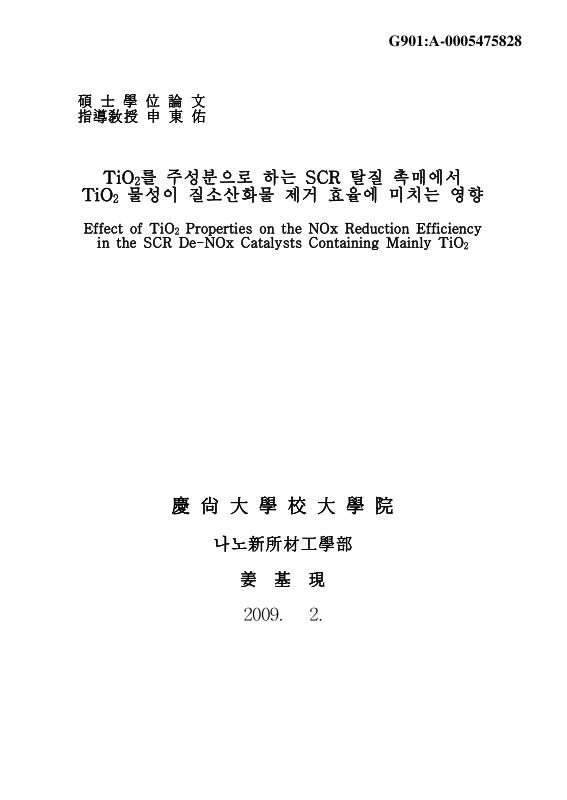
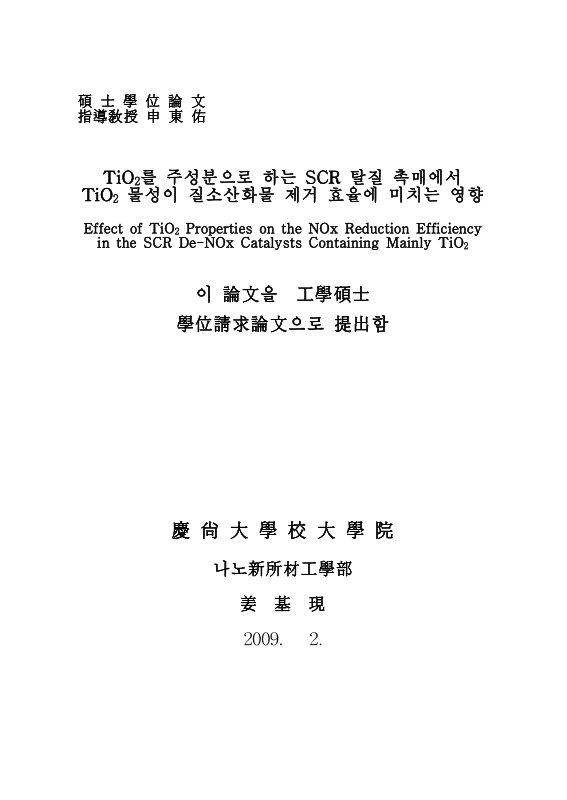
표제지
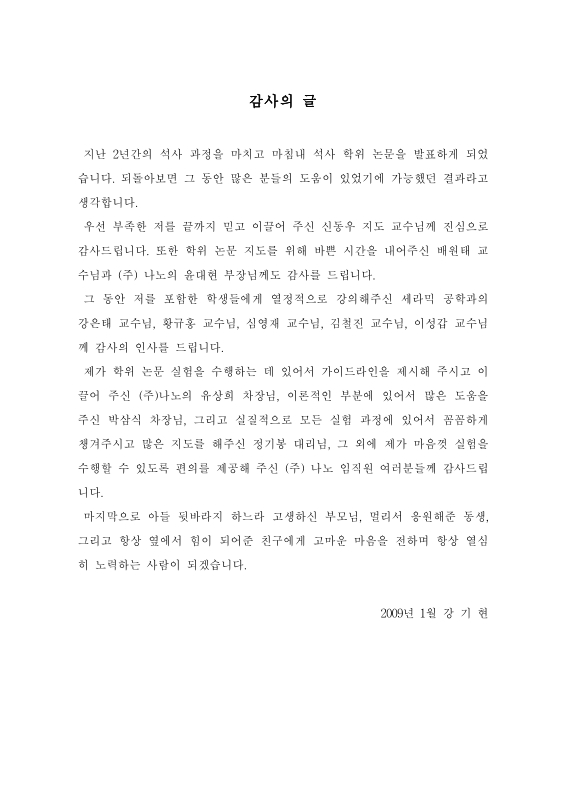
감사의 글
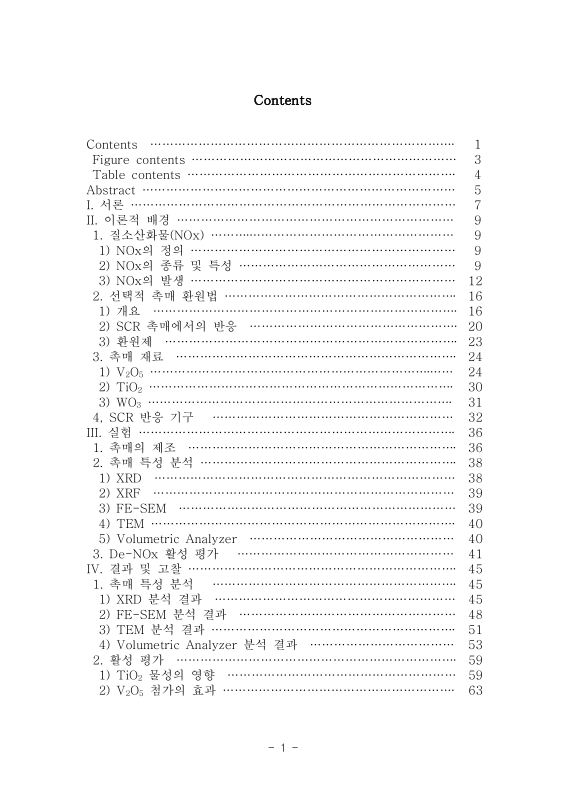
목차
Abstract 9
I. 서론 11
II. 이론적 배경 13
1. 질소산화물(NOx) 13
1) NOx의 정의 13
2) NOx의 종류 및 특성 13
3) NOx의 발생 16
2. 선택적 촉매 환원법(Selective Catalytic Reduction: SCR) 20
1) 개요 20
2) SCR 촉매에서의 반응 24
3) 환원제 27
3. 촉매 재료 28
1) V₂O5(이미지참조) 28
2) TiO₂ 34
3) WO₃ 35
4. SCR 반응기구 36
III. 실험 40
1. 촉매의 제조 40
2. 촉매 특성 분석 42
1) XRD (X-ray Diffraction) 42
2) XRF (X-ray Flourescence Spectrometry) 43
3) FE-SEM (Field Emission Scanning Electron Microscope) 43
4) TEM (Transmission Electron Microscope) 44
5) Volumetric Analyzer 44
3. De-NOx 활성 평가 45
IV. 결과 및 고찰 49
1. 촉매 특성 분석 49
1) XRD 분석 결과 49
2) FE-SEM 분석 결과 52
3) TEM 분석 결과 55
4) Volumetric Analyzer 분석 결과 57
2. 활성 평가 63
1) TiO₂ 물성의 영향 63
2) V₂O5 첨가의 효과(이미지참조) 67
3) WO₃ 첨가의 효과 69
4) NO/NH₃ ratio의 영향 71
V. 결론 73
참고문헌 75
Fig. 1. V₂O5 structure showing different V-O distance.(이미지참조) 31
Fig. 2. Geometric structure of an orthorhombic bulk V₂O5.(이미지참조) 32
Fig. 3. A schematic of the transformation of V₂O5 on TiO₂. (a) low loading V₂O5 supported on sulfer-free TiO₂ (b) low loading V₂O5 supported on sulfated TiO₂ (c) high loading V₂O5 supported on sulfated TiO₂(이미지참조) 33
Fig. 4. Flow chart of the manufacturing process of powder mixture of V₂O5-WO₃/TiO₂.(이미지참조) 41
Fig. 5. Fixed bed SCR reaction system. (a) Schematic diagram (b) Evaluation set-up 46
Fig. 6. XRD Pattern vs. Heating Temperature. 51
Fig. 7. SEM micrographs (×100,000) of TiO₂ powder. (a) without WO₃ and V₂O5 (b) with 5 wt% WO₃ and 1 wt% V₂O5(이미지참조) 53
Fig. 8. SEM micrographs (×100,000) of TiO₂ powder depending on heat-treating temperature. 54
Fig. 9. TEM morphology of TiO₂ powder depending on the heat-treating temperature. (Scale bar=20 nm) 56
Fig. 10. Specific surface area as a function of heat treating temperature. Surface area is decreased gradually by increasing processing temperature. 59
Fig. 11. Pore volume as a function of heat treating temperature. Pore volume of TiO₂ is decreased by increasing processing temperature. 60
Fig. 12. Mean pore size as a function of heat treating temperature. Mean pore size is increased by increasing processing temperature. 61
Fig. 13. Pore size distribution vs. Heating temperature. Pore size was increased by increasing processing temperature. 62
Fig. 14. De-NOx activity of TiO₂ powder without V₂O5 and WO₃. De-NOx efficiency is decreased by increasing processing temperature.(이미지참조) 64
Fig. 15. De-NOx activity of TiO₂ powder with V₂O5 and WO₃. Showing higher than 90% at the reaction temperature higher than 300℃ irrespective of processing temperatures.(이미지참조) 66
Fig. 16. Effect of V₂O5 addition on De-NOx efficiency for the powder containing 5 wt% WO₃. Showing higher De-NOx eficiency at higher content of V₂O5.(이미지참조) 68
Fig. 17. Effect of WO₃ addition on De-NOx efficiency for the powder containing 1 wt% V₂O5. Showing higher De-NOx efficiency at higher content of WO₃ in the lower region of reaction temperatures.(이미지참조) 70
Fig. 18. Effect NO/NH₃ ratio on De-NOx efficiency. 72
Titanium dioxide (TiO₂) powder with anatase crystalline phase prepared using meta-titanic acid (MTA) was used as raw powder material for the SCR catalyst.
MTA slurry was dreid at 120℃ for 24 hours. Then, Ammonium Metatungstate (AMT) as a source of WO₃ was mixed with MTA for 10 hours. The dried powder mixture was heat treated at various temperature in the range of 400℃ to 800℃ to obtain the powder showing various specific surface area, pore volume and pore size. Ammonium Vanadate (AMV) as raw material of V₂O5 was dissolved in Oxalic Acid. Drying and heat treatment were performed. The powder mixture which mainly composed of titanium dioxide loaded vanadium and tungsten oxides, V₂O5-WO₃/TiO₂ was prepared for the application of SCR catalysts.
X-ray diffraction revealed that all samples heated in the range of 400℃ to 800℃ showed the anatase phase. Scanning Electron Microscope and Transmission Electron Microscope showed gradual increase of primary particle size from 15 nm to 50 nm, by heat treating from 400℃ to 800℃.
The data taken from BET showed gradual decrease of specific surface area from 163 m²/g to 13 m²/g, total pore volume from 0.299 cm³/g to 0.086 cm³/g, and increase of mean pore size from 5.7 nm to 28.5 nm, by heat treating from 400℃ to 800℃, respectively.
From the result of activity test, the increment of V₂O5 concentration from 1wt% to 2wt% was not significantly improved NOx removal efficiency. However, the addition of WO₃ increased the activity at lower temperature range of 200℃ to 300℃. The addition of WO₃ in to the powder mixture containing no V₂O5 did not show any effect on the activity.
The optimum TiO₂ properties leading to high NOx reduction efficiency can be obtained by heat treating at 600℃∼700℃, which resulted in the mean pore size range of 20∼25nm, specific surface area range of 30∼50 m²/g, total pore volume range of 0.20∼0.23 cm³/g.*표시는 필수 입력사항입니다.
| 전화번호 |
|---|
| 기사명 | 저자명 | 페이지 | 원문 | 기사목차 |
|---|
| 번호 | 발행일자 | 권호명 | 제본정보 | 자료실 | 원문 | 신청 페이지 |
|---|
도서위치안내: / 서가번호:

우편복사 목록담기를 완료하였습니다.
*표시는 필수 입력사항입니다.
저장 되었습니다.
