
 대표어
대표어
권호기사보기
| 기사명 | 저자명 | 페이지 | 원문 | 기사목차 |
|---|
결과 내 검색
동의어 포함
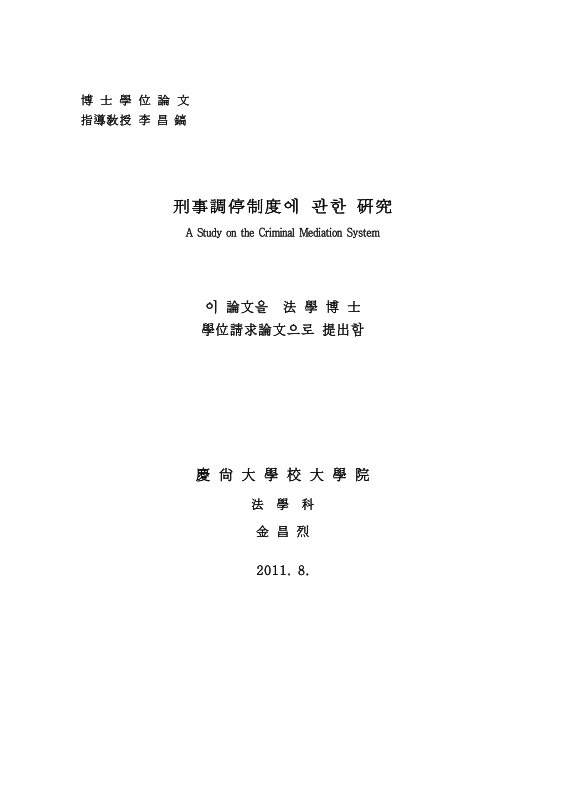
표제지
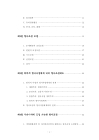
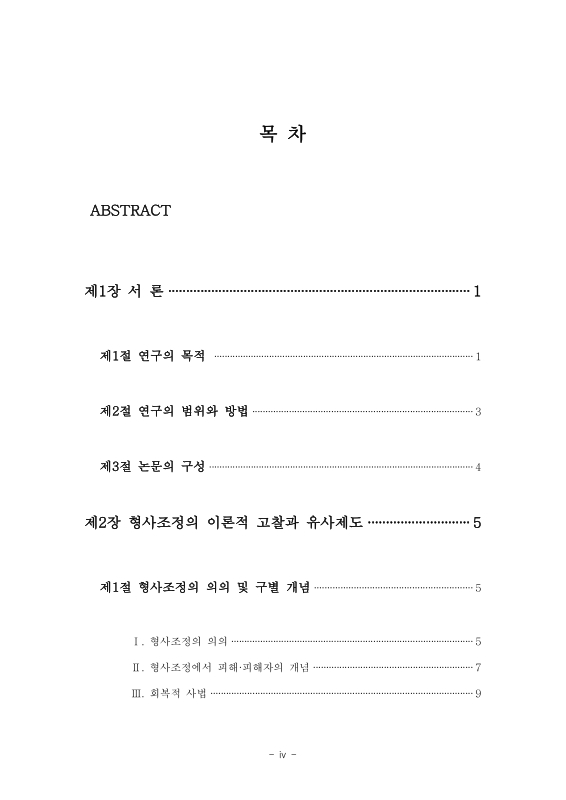
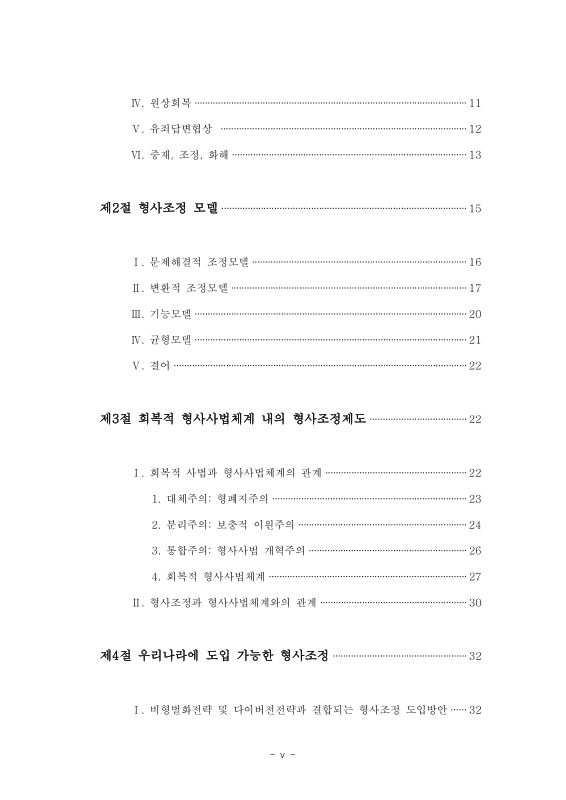
목차
ABSTRACT 13
제1장 서론 16
제1절 연구의 목적 16
제2절 연구의 범위와 방법 18
제3절 논문의 구성 19
제2장 형사조정의 이론적 고찰과 유사제도 20
제1절 형사조정의 의의 및 구별 개념 20
I. 형사조정의 의의 20
II. 형사조정에서 피해·피해자의 개념 22
III. 회복적 사법 24
IV. 원상회복 26
V. 유죄답변협상 27
VI. 중재, 조정, 화해 28
제2절 형사조정 모델 30
I. 문제해결적 조정모델 31
II. 변환적 조정모델 32
III. 기능모델 35
IV. 균형모델 36
V. 결어 37
제3절 회복적 형사사법체계 내의 형사조정제도 37
I. 회복적 사법과 형사사법체계의 관계 37
II. 형사조정과 형사사법체계와의 관계 45
제4절 우리나라에 도입 가능한 형사조정 47
I. 비형벌화전략 및 다이버전전략과 결합되는 형사조정 도입방안 47
II. 형벌완화전략과 결합된 형사조정 도입방안 48
III. 형사제재체계 속에서의 형사조정 49
제5절 우리나라의 형사조정 유사제도 52
I. 배상명령제도 52
II. 범죄피해자구조제도 58
III. 형사재판상화해제도 61
IV. 소년법상 화해권고제도 66
V. 합의 67
제3장 외국의 형사조정제도 70
제1절 독일 73
I. 법적근거 74
II. 운용 및 실시현황 85
III. 평가와 전망 93
제2절 프랑스 97
I. 법적근거 99
II. 운용 및 실시현황 103
III. 평가와 전망 107
제3절 영국 108
I. 법적근거 111
II. 운용 및 실시현황 113
III. 평가와 전망 115
제4절 미국 118
I. 법적근거 119
II. 운용 및 실시현황 127
III. 평가와 전망 137
제5절 중국 138
I. 형사화해제도의 근거 139
II. 형사화해제도의 운용과 실시현황 140
III. 형사화해제도의 평가와 전망 143
제4장 형사조정의 문제점과 개선방향 150
제1절 실정법상의 문제점과 개선방향 152
I. 헌법상의 문제점 152
II. 형법상의 문제점과 개선방향 156
III. 형사소송법상의 문제점과 개선방향 166
IV. 범죄피해자보호법의 개정방향 174
제2절 제도 운용상의 문제점과 개선방향 179
I. 형사조정 현황 179
II. 문제점 191
제3절 형사조정법 입법안 200
I. 형사조정의 목적 200
II. 형사조정의 조정기관 201
III. 형사조정의 대상범죄와 절차 203
IV. 단계별 조정절차의 의뢰주체 205
V. 형사조정의 효과 208
제5장 결론 210
참고문헌 214
In 20th century, right of people increased through widened people's political participation, realization of practical liberty and rights of equality. In the field of the criminal justice system, at the same time, participation of criminal proceeding, increased indemnification system, and legislation of the charter of victim made the society that strongly protects position and role of victims.
In 1950s, the criminal proceeding that was offender centered was criticized as victimology progressed. It was also argued that position of victim was maintained in the criminal proceeding and the chance to recover the damage should be given, which led the rise of restorative justice.
From late 1950s to 1960s, protection movement for victim had spreaded in North America and Europe, and many developed countries started to adopt the criminal damage compensation law to establish the victim support system since England and New Zealand legislated the law in 1962.
Restorative justice model also began based on the idea that if offender compensated the damage by paying and apologized, criminal penalty was exempted or reduced. One of the types of restorative justice is criminal mediation.
Criminal mediation is the process that interested parties try to settle the case by apologizing and compensating for material and emotional damages through certain arbitration. This is to resolve the problem through a certain organization, which used to be settled through an unofficial process. Recent criminal justice concerns not only punishing offender but also recovering the damage. The criminal mediation is one of those to realize this restorative justice.
When trying to resolve the conflict caused by crime, it is still considered to be a problem between the perpetrator and the society. However, it has been strongly claimed that punishing system between the offender and the government does not contribute to re-socialization of the criminals.
This means that existing correction policy failed because conventional criminal justice system is not effective enough to prevent the second conviction. Due to the increasing crimes, trust in justice system dropped and it became even harder for the perpetrators to come back to the society. This led the rising of the claim that the peace should be regained by the criminal mediation, which the offender, victim, and local society participate rather than one-sided punishing by governmental power.
The criminal reconciliation or mediation system, which is operated in North America and Europe, is a new response to crime that the offender, the victim, and the member of the local society actively intervene to solve the problem.
After all, it is believed that punishing criminal justice system is not the best way to response to crime because it's been proved that it's not effective enough to prevent second conviction or to recover the damage of the victims. Criminal mediation is better than any ruling no matter how good they are.
Department of Justice announced that criminal victim support center would be conducting criminal reconciliation and mediation as a part of plan for maintaining support and protection for the criminal victim.
In 2006 April, Seoul South Province Prosecutors' Office and Daejun Province Prosecutors' Office test conducted, and Supreme Prosecutors' Office made 'accused affairs criminal mediation practical affairs management guide' in 2007 June. This defines the detail processes in criminal mediation and dealing with cases. 57 criminal victim support centers are being operated in Province Prosecutors' Office in whole country since 2007 August. On October 27th in 2009, existing 'accused affairs criminal mediation practical affairs management guide' was abolished, and new 'criminal mediation practical affairs management guide' was legislated. The criminal mediation system had been operated by prosecutor's own guideline, which was criticized because there was no legal base. But, as 'Criminal Victim Protection Law' was completely revised on May 14th 2010, it acquired the legal base in article 41.
However, there are still many problems although the legal base was established. The criminal mediation has legal theoretical argue in relation to existing criminal justice system. There are also some problems in operating process of the criminal mediation that needs to be solved. This problems should be examined and dealt with for improvement of the criminal mediation.
In-depth and variety of study must be done for resolving problems and smooth settling, such as theoretical principle of the criminal mediation and other countries' cases.
This study will discuss legal system, which needs improvement in comparison to developed countries. The theoretical basis will be established by studying other countries' criminal mediation systems in hope of examining the problems in operation and settling the system nicely. The ultimate purpose of the study is to adopt the criminal mediation into the criminal process and to research the legislation of the criminal mediation as a single law itself.
*표시는 필수 입력사항입니다.
| 전화번호 |
|---|
| 기사명 | 저자명 | 페이지 | 원문 | 기사목차 |
|---|
| 번호 | 발행일자 | 권호명 | 제본정보 | 자료실 | 원문 | 신청 페이지 |
|---|
도서위치안내: / 서가번호:

우편복사 목록담기를 완료하였습니다.
*표시는 필수 입력사항입니다.
저장 되었습니다.
