
 대표어
대표어
권호기사보기
| 기사명 | 저자명 | 페이지 | 원문 | 기사목차 |
|---|
결과 내 검색
동의어 포함
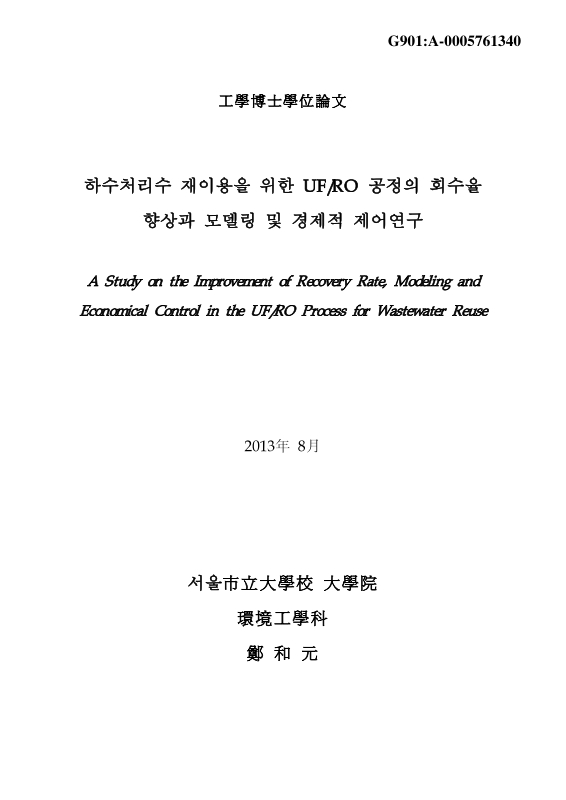
표제지
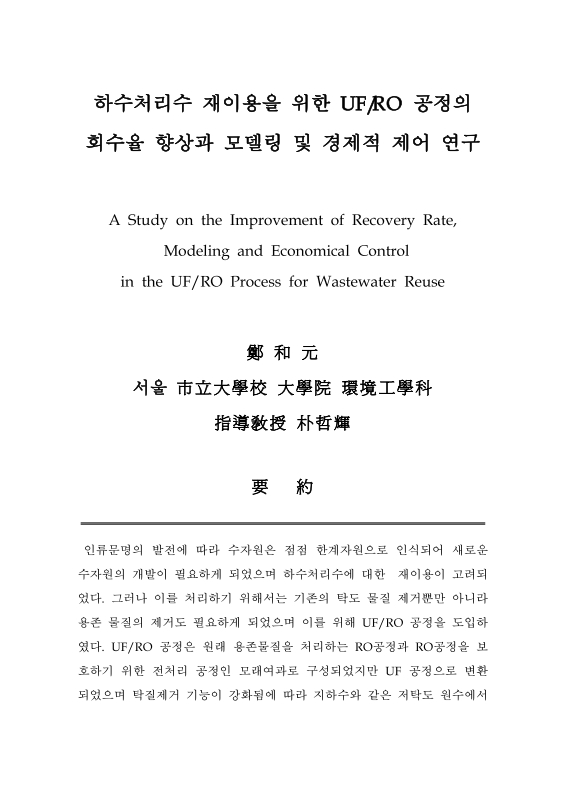
要約
목차
1. 서론 14
1.1. 연구배경 및 목적 14
1.2. 연구내용 및 범위 16
2. 이론적 고찰 20
2.1. 멤브레인의 기본 개요 20
2.1.1. 멤브레인의 종류 20
2.1.2. 멤브레인의 여과방식 23
2.1.3. 멤브레인 여과영향 인자 25
2.2. 멤브레인 파울링 및 세정 29
2.2.1. 멤브레인 파울링 29
2.2.2. 멤브레인 세정 33
2.3. 한외여과(UF)와 역삼투(RO) 공정 36
2.3.1. 한외여과(ultrafiltration, UF) 36
2.3.2. 역삼투(reverse osmosis, RO) 38
2.4. UF/RO 공정을 이용한 수처리 44
2.4.1. 공정개요 44
2.4.2. 하수처리수로의 이용 47
2.4.3. 국외 하수처리수 재이용 51
2.5. RO 공정의 모델화 55
2.6. RO 공정의 최적제어 58
3. RO농축수를 이용한 UF/RO공정 회수율 향상 61
3.1. 서론 61
3.1.1. 연구배경 61
3.1.2. 연구목표 65
3.2. 실험장치 및 운영 66
3.2.1. 실험장치 66
3.2.2. Pilot 주요 공정 66
3.2.3. Process flow 67
3.2.4. 화학세정 68
3.2.5. 수질 분석 69
3.2.6. Amicon-cell Test 71
3.2.7. 막 표면 오염물질 관찰 72
3.3. Pilot 운영결과 73
3.3.1. 원수분석 73
3.3.2. UF공정 결과 73
3.3.3. RO공정 결과 78
3.4. UF 투과수 및 RO 농축수 비교 81
3.5. 물질수지 82
3.6. 투과 처리능 비교 84
3.6.1. 투과 처리능 연속시험 84
3.6.2. 투과 성능 Pilot Plant 운전결과 87
3.7. 소결 89
4. 전이함수 ARIMA를 이용한 RO막차압의 모델화 91
4.1. 서론 91
4.2. 이론적 고찰 93
4.2.1. 전이함수 93
4.2.2. ARIMA 94
4.2.3. 전이함수 ARIMA의 검증 95
4.2.4. 전이함수 ARIMA의 모델화 순서 97
4.3. 기초통계분석 99
4.3.1. 기초통계분석 99
4.3.2. 상관분석 103
4.3.3. 자기상관분석 103
4.3.4. 주기도 분석 105
4.4. 전이함수 ARIMA 107
4.4.1. 상호상관분석 107
4.4.2. 최적 모델의 선정 112
4.4.3. 최적모델검증 및 결과 114
4.4.4. 모델에 의한 예측 118
4.5. 소결 120
5. 운영비용 최소화를 위한 UF/RO 시스템 제어 122
5.1. 서론 122
5.2. 연구방법 123
5.2.1. 막제어 방식 123
5.2.2. 전력비의 추정 124
5.2.3. 비용함수산정 125
5.2.4. 최적 화학세정제어 127
5.2.5. 제어알고리즘의 구현 130
5.3. 최적 전력소요량 추정함수의 결정 132
5.3.1. 기초통계량 분석 132
5.3.2. 최적 함수입력자료의 기간설정 133
5.3.3. 최적함수의 차수분석 135
5.4. 실시간 제어에 따른 경제성 분석 139
5.4.1. 비용함수의 계산 139
5.4.2. Phase I 분석자료 139
5.4.3. Phase II 분석자료 141
5.5. 소결 145
6. 결론 146
References 149
Abstract 163
Fig. 1.1. UF/RO process and Subjects in this study 17
Fig. 1.2. Study subjects and procedure 18
Fig. 2.1. Membrane module types 21
Fig. 2.2. Fouling mechanism for MBR operated at constant flux 30
Fig. 2.3. Principle of RO membrane 38
Fig. 3.1. Pretreatment facilities in the conventional and membrane process. 64
Fig. 3.2. Schematic of lab scale test 72
Fig. 3.3. TMP and Temperature variation of UF membrane in the experiment period 76
Fig. 3.4. TMP and Flux Variation of UF membrane in the experiment period 77
Fig. 3.5. TMP and Flux of RO membrane in the experiment period 80
Fig. 3.6. Comparison of total flow rate between conventional and developed UF/RO system. 83
Fig. 3.7. Reverse Flux of UF permeate and RO concentrate 84
Fig. 3.8. Flux after backwash by UF permeate and RO concentrate 85
Fig. 3.9. SEM of membrane surface for comparison of each condition 87
Fig. 4.1. Flow chart of Transfer ARIMA modeling procedure 98
Fig. 4.2. Variation of TMP in the experiment period 100
Fig. 4.3. Variation of Flux in the experiment period 100
Fig. 4.4. Variation of TDS in the experiment period 101
Fig. 4.5. Variation of Temperature in the experiment period 101
Fig. 4.6. Variation of pH in the experiment period 102
Fig. 4.7. Auto correlation analysis of TMP in RO membrane 104
Fig. 4.8. Spectrum analysis of TMP in RO membrane 106
Fig. 4.9. Result of cross correlation analysis between TMP and Flux in RO membrane 108
Fig. 4.10. Result of cross correlation analysis between TMP and Temperature in RO membrane 109
Fig. 4.11. Result of cross correlation analysis between TMP and operating period after backwashing in RO membrane 110
Fig. 4.12. Result of cross correlation analysis between TMP and CIP in RO membrane 111
Fig. 4.13. Correlation of real and forecasted TMP in modeling period using Transfer ARIMA 115
Fig. 4.14. Variation of residuals in modeling period using Transfer ARIMA 116
Fig. 4.15. Variation of real and forecasted TMP in the modeling period using Transfer ARIMA 117
Fig. 4.16. Correlation of real and forecasted TMP in the forecasting period using transfer ARIMA 118
Fig. 4.17. Variation of real and forecasted TMP in the forecasting period using Transfer ARIMA 119
Fig. 5.1. Procedure of control logic development 124
Fig. 5.2. Electricity consumption cycle in various backwash condition 126
Fig. 5.3. Total operation loss, electric power loss, cleaning loss and optimal chemical cleaning point during operation by maximum electric power 128
Fig. 5.4. Formula of total operation loss 129
Fig. 5.5. The control system of chemical cleaning method 131
Fig. 5.6. Consumed electrical energy in RO membrane 132
Fig. 5.7. Auto-correlation analysis of electrical energy in the operation period 134
Fig. 5.8. Result of 1st regression function in the experiment period 136
Fig. 5.9. Result of 2nd regression function in the experiment period 137
Fig. 5.10. Result of 3rd regression function in the experiment period 138
Fig. 5.11. Consumed electrical energy in Phase I 143
Fig. 5.12. Consumed electrical energy in Phase II 144
| 번호 | 참고문헌 | 국회도서관 소장유무 |
|---|---|---|
| 1 | 2000. 역삼투 분리막 개발 동향. 한국막학회.10(1), pp. 1-18. | 미소장 |
| 2 | 침지식 정밀여과막을 이용한 막여과 역세배출수 처리성 평가 | 소장 |
| 3 | Case Study를 통한 국내 하수처리수 재이용 경제성 평가 | 소장 |
| 4 | 한국개발연구원, 2011, 환경분야 편익산정방안에 관한 연구. 한국환경정책·평가연구원, 2009, 지역단위 하수재이용 활성화를 위한 기초연구. | 미소장 |
| 5 | 하수처리수 재이용 가이드 북(2009.10)  |
미소장 |
| 6 | 환경부-산업계 합동 기후전략 연구 |
미소장 |
| 7 | 하수처리수 재이용 법정 수질기준의 합리적인 적용방안 마련을 위한 연구 |
미소장 |
| 8 | 물 재이용 효율성 제고를 위한 정책방안 연구 |
미소장 |
| 9 | Modeling of an RO water desalination unit using neural networks |
미소장 |
| 10 | 2006, "Model predictive control of a reverse osmosis desalination unit", Desalination, 194(1-3), pp. 268-280. | 미소장 |
| 11 | Comparative assessment of advanced membrane treatment of municipal wastewater for reuse in Kuwait |
미소장 |
| 12 | 2007, "Neural network modeling and optimization of scheduling backwash for membrane bioreactor", Clean Technology Environ Policy, 10, pp. 389-395. | 미소장 |
| 13 | 2008, "Conceptual design of UF and RO for advanced treatment of wastewater", Kuwait Journal of Science and Engineering, 35(2), pp. 79-100. | 미소장 |
| 14 | Australian and New Zealand Environment and Conservation Council, 2000, Guidelines for sewage systems; Use of reclaimed water. | 미소장 |
| 15 | Characterisation and removal of recalcitrants in reverse osmosis concentrates from water reclamation plants |
미소장 |
| 16 | Biofouling in membrane systems — A review |
미소장 |
| 17 | 1985, "Cannery wastewater management using membrane process", ASAE publication, pp. 1-10. | 미소장 |
| 18 | UF/MF as RO pre-treatment: the real benefit |
미소장 |
| 19 | Transient and stationary operating conditions on performance of lactic acid bacteria crossflow microfiltration |
미소장 |
| 20 | Comparison of MF/UF pretreatment with conventional filtration prior to RO membranes for surface seawater desalination |
미소장 |
| 21 | Modeling and optimizing submerged hollow fiber membrane modules |
미소장 |
| 22 | MBR/RO/ozone processes for TFT-LCD industrial wastewater treatment and recycling. |
미소장 |
| 23 | Combined coagulation-disk filtration process as a pretreatment of ultrafiltration and reverse osmosis membrane for wastewater reclamation: An autopsy study of a pilot plant |
미소장 |
| 24 | Recycling the wastewater of the industrial park in Northern Taiwan using UF-RO system: in-situ pilot testing and cost analysis |
미소장 |
| 25 | Desalination with a reversible flashing process |
미소장 |
| 26 | Control system design of reverse osmosis plants by using advanced optimization techniques |
미소장 |
| 27 | 2004, “Fouling of reverse osmosis and ultrafiltration membrane: A critical review”, Separation Science and Technology, Vol. 39 (10), pp.2261∼2298. | 미소장 |
| 28 | Screen filtration technology as applied to pretreatment of RO and UF systems |
미소장 |
| 29 | Prediction of membrane fouling rate by neural network modeling |
미소장 |
| 30 | UF/RO treatment plant Heemskerk: from challenge to full scale application |
미소장 |
| 31 | 1986, "Multi-level control and optimization methods for desalination plants", IFAC workshop on Automatic Control in Petroleum, pp. 165-170. | 미소장 |
| 32 | Effect of pump shear on the performance of a crossflow membrane bioreactor |
미소장 |
| 33 | Neural network approach for modeling the performance of reverse osmosis membrane desalting |
미소장 |
| 34 | Wastewater Reclamation at Lake Arrowhead, California: An Overview |
미소장 |
| 35 | 1999, "Large-scale application of UF and RO in the production of demineralized water", Water Supply, 17(1), pp. 285-292. | 미소장 |
| 36 | 2001, "Treatment and reuse of textile effluents based on new ultrafiltration and other membrane technologies", Desalination, 138(1-3), pp. 75-82. | 미소장 |
| 37 | Prediction of RO membrane performances by use of artificial neural network and using the parameters of a complex mathematical model |
미소장 |
| 38 | Time Series Analysis Models of Activated Sludge Plants |
미소장 |
| 39 | 2007, "Colloidal fouling of RO membranes following MF/UF in the reclamation of municipal wastewater", Desalination, 208(1-3), pp. 232-237. | 미소장 |
| 40 | Membrane fouling during constant flux filtration in membrane bioreactors |
미소장 |
| 41 | Characterisation and modelling of fouling in membrane bioreactors |
미소장 |
| 42 | Evaluation of MF and UF as pretreatments prior to RO applied to reclaim municipal wastewater for freshwater substitution in a paper mill: A practical experience |
미소장 |
| 43 | 2009, Development of rainfall forecasting model in Indonesia by using ASTAR, transfer function, and ARIMA methods, European Journal of Scienticif Research, 38(3), pp. 386-395. | 미소장 |
| 44 | Application of membranes to treat wastewater for its recycling and reuse: new considerations to reduce fouling and increase recovery up to 99 percent |
미소장 |
| 45 | Coupling of biological methods with membrane filtration using ozone as pre-treatment for water reuse |
미소장 |
| 46 | A dual membrane UF/RO process for reclamation of spent rinses from a nickel-plating operation—a case study |
미소장 |
| 47 | The case for UF/MF pretreatment to RO in seawater applications |
미소장 |
| 48 | 2005, “Application of a combined UF/RO system for the reuse of filter backwash water from treated swimming pool water”, Desalination, 178, pp.41-49. | 미소장 |
| 49 | Possibilities for reuse of treated domestic wastewater in the Netherlands. |
미소장 |
| 50 | 2006, "Predicting flux decline in crossflow membrane using artificial neural networks and genetic algorithms", Journal of membrane science, 283(1-2), pp. 147-157. | 미소장 |
| 51 | Predicting flux decline of reverse osmosis membranes |
미소장 |
| 52 | 2010, Comparison of ARIMA ans Transfer Function(TF) models in Water Temperature simulation in dam - Lake Thesaurus, eastern Macedonia, Greece, Environmental Hydraulics - Proceedings of the 6th International Symposiun on Environmental Hydraulics, 2, pp. 929-934. | 미소장 |
| 53 | Dead-end ultrafiltration in hollow fiber modules: Module design and process simulation |
미소장 |
| 54 | 2004. Effect of pretreatment on the fouling of membranes: Application in biologically treated sewage effluent, Journal of Membrane Science, 234(1-2), pp. 111-120. | 미소장 |
| 55 | 2000, “Model for flux prediction in high-shear microfiltration systems”, Journal of Membrane Science, 173, pp.87-98. | 미소장 |
| 56 | 2000, “Membrane bioreactors for wastewater treatment”, IWA Publishing | 미소장 |
| 57 | Colloidal interactions and fouling of NF and RO membranes: A review |
미소장 |
| 58 | Assessment of UF pretreatment prior RO membranes for seawater desalination |
미소장 |
| 59 | US EPA, 2004, Guidelines for water reuse. | 미소장 |
| 60 | US EPA, 2012, Guidelines for water reuse. | 미소장 |
| 61 | 1988, "Flux decline in membrane processes", Filtration and Separation, 25(2), pp.115-121. | 미소장 |
| 62 | Membrane Separation Bioreactors for Wastewater Treatment |
미소장 |
| 63 | 1995, "Simulation aided design and development of an adaptive scheme with optially tuned PID controller for a large multistage flash seawater desalination plant", Prodeedings of the 1995 IEEE conference, pp 835-841. | 미소장 |
| 64 | 2003, Nonlinear forecasting models for prediction wastewater effluent loads, 2003, Proceedings - Annual Meeting of the Decision Sciences Institute, pp. 2373-2378. | 미소장 |
| 65 | Oxidation of organics in retentates from reverse osmosis wastewater reuse facilities |
미소장 |
| 66 | Improved performance and cost reduction of RO seawater systems using UF pretreatment |
미소장 |
| 67 | Predicting RO/NF water quality by modified solution diffusion model and artificial neural networks |
미소장 |
| 68 | Status and development for municipal wastewater reuse in China |
미소장 |
| 69 | Treatment of organics in reverse osmosis concentrate from a municipal wastewater reclamation plant: Feasibility test of advanced oxidation processes with/without pretreatment |
미소장 |
| 70 | Automation and process control of reverse osmosis plants using soft computing methodologies |
미소장 |
| 71 | 日本水環境學會, 2011, 日本の水環境行政改訂版. | 미소장 |
*표시는 필수 입력사항입니다.
| 전화번호 |
|---|
| 기사명 | 저자명 | 페이지 | 원문 | 기사목차 |
|---|
| 번호 | 발행일자 | 권호명 | 제본정보 | 자료실 | 원문 | 신청 페이지 |
|---|
도서위치안내: / 서가번호:

우편복사 목록담기를 완료하였습니다.
*표시는 필수 입력사항입니다.
저장 되었습니다.
