
 대표어
대표어

권호기사보기
| 기사명 | 저자명 | 페이지 | 원문 | 기사목차 |
|---|
결과 내 검색
동의어 포함
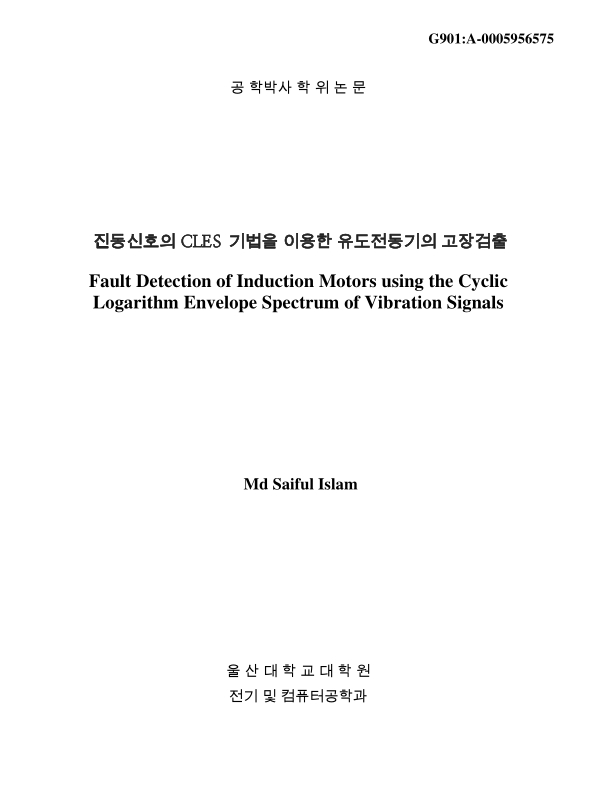
Title Page
Abstract
국문초록
Contents
List of Acronyms 14
Chapter 1. Introduction 19
1.1. Background 19
1.2. Motivation and Contributions 20
1.2.1. Motivation 20
1.2.2. Contributions of the thesis 21
1.3. Outline of Thesis 22
Chapter 2. Background Information for Induction Motor Condition Monitoring 24
2.1. Induction Motor 24
2.2. Structure of Induction Motor 24
2.3. Induction Motor Faults 27
2.4. Mechanical Faults in Motor 28
2.4.1. Bearing faults 28
2.4.2. Broken rotor bar and End-ring faults 29
2.4.3. Eccentricity faults 30
2.5. Medium for Induction Motor Condition Monitoring 31
2.5.1. Electrical signals 31
2.5.2. Vibration signals 32
2.6. Data Processing 33
2.6.1. Signal-based fault diagnosis 33
2.6.2. Machine-learning-based fault diagnosis 37
Chapter 3. Signal Processing Techniques for Vibration Analysis 38
3.1. Fourier Analysis 38
3.1.1. Fourier series 38
3.1.2. Sampled time signals 39
3.1.3. Discrete Fourier transform 40
3.1.4. Fast Fourier transform 41
3.1.5. Zoom FFT 41
3.2. Probability Distribution and Density 43
3.3. Cepstrum Analysis 45
3.4. Short Time Fourier Transform 47
3.5. Wigner-Ville Distribution 48
3.6. Wavelet Analysis 49
3.6.1. Wavelet denoising 49
3.6.2. Traditional threshold function 51
3.6.3. An improved threshold function 53
Chapter 4. Separation of Vibration Data from Noise 54
4.1. Introduction 54
4.2. Time Synchronous Averaging 54
4.3. Linear Prediction 56
4.4. Adaptive Noise Cancellation 57
4.4.1. Adaptive filter 57
4.4.2. Step size 59
4.4.3. Wavelet entropy 60
4.5. Wavelet Entropy based Adaptive Noise Cancellation 61
Chapter 5. Order Tracking of Vibration Signals 63
5.1. Introduction 63
5.2. Tacho Signal 64
5.3. Tacho Signal Generation 64
5.4. Order Tracking 66
5.5. Vold-Kalman Filter (VKF) 67
5.5.1. Structure equation of VKF 67
5.5.2. Data equation of VKF 68
5.5.3. Computations for order components 68
5.6. Computed Order Tracking (COT) 69
5.6.1. Sampling in the time domain 70
5.6.2. Equi-angel sampling 70
5.6.3. Order analysis 71
5.6.4. Example of computed order tracking 71
Chapter 6. Spectrum Analysis of Vibration Signal 75
6.1. Introduction 75
6.2. Demodulation and Fault Detection 75
6.2.1. Hilbert transform 76
6.2.2. Envelope analysis 77
6.2.3. Performance of square and Hilbert-based envelope 79
6.3. Cyclostationary 88
6.3.1. First-order cyclostationarity 89
6.3.2. Second-order cyclostationarity 90
6.4. Cyclic Spectral Analysis 91
6.5. Cyclic Logarithmic Envelope Spectrum 92
Chapter 7. Analysis of Experimental Results 94
7.1. Introduction 94
7.2. Experiments of Induction Motor Faults 94
7.3. Simulation Verification 96
7.3.1. Fault detection performance using WE 96
7.3.2. Benefits of CLES over CMS for spectrum analysis 99
7.4. Experimental Results 101
7.4.1. Bearing outer race fault 101
7.4.2. Rotor unbalance fault 105
Chapter 8. Conclusions and Future Work 109
8.1. Conclusions 109
8.2. Future Work 110
References 111
Figure 2.1. Types of electric motors 25
Figure 2.2. Induction motor structure 26
Figure 2.3. Induction motor components 27
Figure 2.4. Induction motor bearing 28
Figure 2.5. Induction motor rotor 29
Figure 2.6. Eccentricities of induction motor 30
Figure 2.7. Fault diagnosis approaches 33
Figure 3.1. Fourier series: periodic in time domain and discrete in frequency domain 39
Figure 3.2. Sampled: Discrete in time domain and periodic in frequency domain 40
Figure 3.3. Discrete Fourier transform: Discrete and periodic in both time and frequency... 41
Figure 3.4. Process of zoom FFT 42
Figure 3.5. Random signal with minimum value and maximum value 43
Figure 3.6. Probability distribution 44
Figure 3.7. Power spectra for the case of a bearing fault 46
Figure 3.8. Auto-correlation for the case of a bearing fault 46
Figure 3.9. Cepstrum for the case of a bearing fault 47
Figure 3.10. Comparison of time-frequency distributions for a diesel engine vibration signal 49
Figure 3.11. Example of wavelet denoising 51
Figure 3.12. Thresholding functions with threshold value λ (a) linear, (b) Soft and (c) Hard 52
Figure 4.1. Characteristics of TSA 55
Figure 4.2. Structure of typical adaptive filter 58
Figure 5.1. Shaft speed variation with time 65
Figure 5.2. Spectrum of shaft speed 65
Figure 5.3. Generated tacho signal (for 1s) 66
Figure 5.4. Sampling of vibration signal 72
Figure 5.5. Resampling of vibration signal at a uniform △Ø 74
Figure 6.1. Example of envelope analysis 78
Figure 6.2. (a) Vibration signal of rolling elements from accelerometer, (b) Corresponding frequency spectrum of vibration signal 81
Figure 6.3. Frequency spectrum of figure 6.2(a) 81
Figure 6.4. Frequency spectrum of vibration signal which is contaminated by AWGN with 10 dB 82
Figure 6.5. Frequency spectrum of vibration signal which is contaminated by AWGN with 20 dB 82
Figure 6.6. Frequency spectrum of vibration signal which is contaminated by AWGN with 30 dB 83
Figure 6.7. Frequency spectrum of vibration signal which is contaminated by AWGN with 40 dB 83
Figure 6.8. Frequency spectrum of vibration signal which is contaminated by Random noise with 10 dB 84
Figure 6.9. Frequency spectrum of vibration signal which is contaminated by Random noise with 20 dB 85
Figure 6.10. Frequency spectrum of vibration signal which is contaminated by Random noise with 30 dB 85
Figure 6.11. Frequency spectrum of vibration signal which is contaminated by Random noise with 40 dB 86
Figure 6.12. Performance of square and Hilbert based envelope to AWGN 87
Figure 6.13. Performance of square and Hilbert based envelope to random noise 88
Figure 6.14. Example of the first-order cyclostationary 90
Figure 6.15. Example of Second-order cyclostationary 91
Figure 7.1. Test rig 95
Figure 7.2. Faults of induction motor 95
Figure 7.3. Vibration signal and its frequency spectrum 97
Figure 7.4. Fault value using Hilbert transform 98
Figure 7.5. Fault value using square envelope 98
Figure 7.6. A simple sine wave without a modulation 99
Figure 7.7. A simple signal with CS2 components 99
Figure 7.8. Cyclic modulation spectrum (fault signatures absent at frequency 15 ㎐) 100
Figure 7.9. Cyclic log envelope spectrum (fault signatures appear at frequency 15 ㎐ as well as harmonics of background noise) 101
Figure 7.10. Outer race bearing fault signal 102
Figure 7.11. Spectrum of outer race bearing fault 102
Figure 7.12. Cyclic log envelope spectrum of outer race bearing fault 103
Figure 7.13. Cyclic log envelope spectrum of outer race bearing fault using proposed method 104
Figure 7.14. Rotor unbalance faults signal 104
Figure 7.15. Spectrum of outer race bearing fault 105
Figure 7.16. Cyclic log envelope spectrum for rotor unbalance faults 106
Figure 7.17. Cyclic log envelope spectrum for unbalance faults using proposed method 107
Figure 7.18. Cyclic modulation spectrum of outer race bearing fault 107
Figure 7.19. Cyclic modulation spectrum for unbalance faults 108
*표시는 필수 입력사항입니다.
| 전화번호 |
|---|
| 기사명 | 저자명 | 페이지 | 원문 | 기사목차 |
|---|
| 번호 | 발행일자 | 권호명 | 제본정보 | 자료실 | 원문 | 신청 페이지 |
|---|
도서위치안내: / 서가번호:

우편복사 목록담기를 완료하였습니다.
*표시는 필수 입력사항입니다.
저장 되었습니다.
