
 대표어
대표어
 한국학술지인용색인(NRF)
권호기사보기
| 기사명 | 저자명 | 페이지 | 원문 | 기사목차 |
|---|
결과 내 검색
동의어 포함
목차
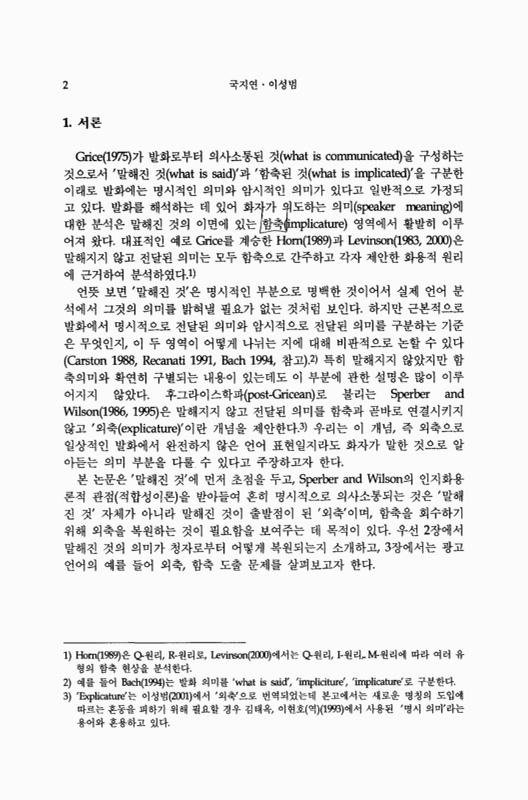
'말해진 것'의 명시의미 : 적합성이론 분석 / 국지연 ; 이성범 1
[요약] 1
1. 서론 2
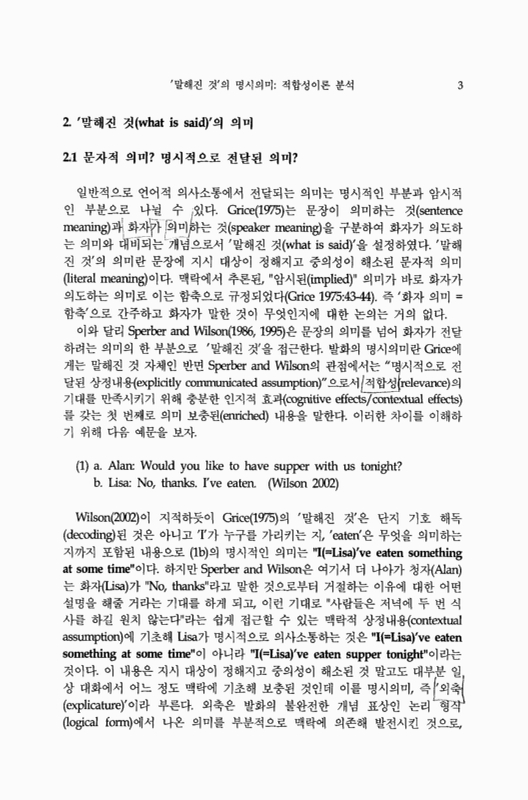
2. '말해진 것(what is said)'의 의미 3
2.1. 문자적 의미? 명시적으로 전달된 의미? 3
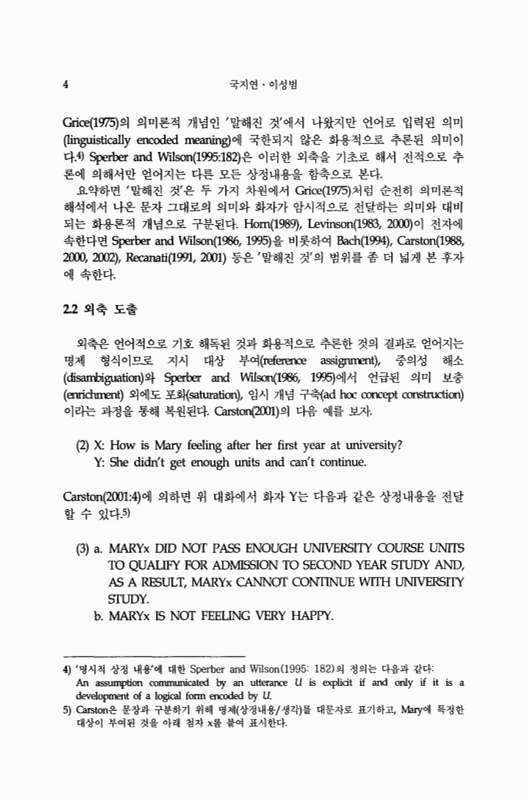
2.2. 외축 도출 4
2.3. 외축 유형 5
3. '말해진 것'의 실제 6
3.1. 의미적 미확정성(semantic underdeterminacy) 6
3.2. 외축: '말해진 것'과 '함축된 것' 사이의 격차 줄이기 8
3.3. '말해진 것'의 화용적 성격 14
3.4. 화자 의미: 연속선상의 외축과 함축 22
4. 결론 23
참고문헌 24
| 기사명 | 저자명 | 페이지 | 원문 | 목차 |
|---|---|---|---|---|
| '말해진 것'의 명시의미 :적합성이론 분석 | 국지연 ;이성범 | pp.1-25 |
|
보기 |
| The role of subjectivity and intersubjectivity in the grammaticalization of Icey in Korean | Myung-hee Kim ;Jeonghwa Lee | pp.27-49 |
|
보기 |
| Multi-question turns in English conversation | Haeyeon Kim | pp.51-71 |
|
보기 |
| The use of questions in EFL writing tutorial discourse | Yong-yae Park | pp.73-98 |
|
보기 |
| Grammaticalization of causal prepositions :with reference to because of, on account of, and by reason of | Mikyung Ahn | pp.99-115 |
|
보기 |
| Metapragmatics of speech and its interactions with pragmatic inferences | Sungbom Lee | pp.117-136 |
|
보기 |
| 정치담화에서의 관여(involvement) 전략 :노무현 대통령의 '연설문'의 경우 | 이원표 | pp.137-170 |
|
보기 |
| A contrastive analysis of acknowledgement texts in English and Korean research articles | Hye-kyung Lee | pp.171-191 |
|
보기 |
| 한국어 연극 은유 | 임혜원 | pp.193-215 |
|
보기 |
| 구어와 문어에 나타난 '그리고' 연구 | 전영옥 | pp.217-248 |
|
보기 |
| 번호 | 참고문헌 | 국회도서관 소장유무 |
|---|---|---|
| 1 | (1993) 인지적 화용론, 서울: 한신문화사 | 미소장 |
| 2 | (2001) 추론의 화용론, 서울: 한국문화사 | 미소장 |
| 3 | (2004) 의사소통에서 미결정적 정보내용의 명시화 과정 연구, | 미소장 |
| 4 | (1994) Conversational impliciture, | 미소장 |
| 5 | (2000) Explicature and semantics, | 미소장 |
| 6 | (2001) Relevance theory and the saying/implicating distinction, | 미소장 |
| 7 | (2002) Thoughts and utterances: The pragmatics of explicit communication, Oxford: Blackwell | 미소장 |
| 8 | (1989) A natural history of negation, University of Chicago Press | 미소장 |
| 9 | (1983) Pragmatics, Cambridge University Press | 미소장 |
| 10 | (2000) Presumptive meanings: The theory of generalized conversational implicature, Cambridge, MA: MIT Press | 미소장 |
| 11 | (2000) Metarepresentation, Amsterdam:John Benjamins | 미소장 |
| 12 | (1991) The pragmatics of what is said, Oxford University Press | 미소장 |
| 13 | (2001) What is said, | 미소장 |
| 14 | (1995) Relevance: Communication and cognition, 2nd ed. (with Postface), Oxford: Blackwell | 미소장 |
| 15 | (1999) Understanding pragmatics, ArnoLondon: Arnoldld | 미소장 |
| 16 | (2000) Metarepresentation in linguistic communication, Oxford:Oxford University Press | 미소장 |
| 17 | (2002) Pragmatic theory, | 미소장 |
| 18 | (2000) Truthfulness and relevance, | 미소장 |
*표시는 필수 입력사항입니다.
| 전화번호 |
|---|
| 기사명 | 저자명 | 페이지 | 원문 | 기사목차 |
|---|
| 번호 | 발행일자 | 권호명 | 제본정보 | 자료실 | 원문 | 신청 페이지 |
|---|
도서위치안내: 정기간행물실(524호) / 서가번호: 국내03
2021년 이전 정기간행물은 온라인 신청(원문 구축 자료는 원문 이용)

우편복사 목록담기를 완료하였습니다.
*표시는 필수 입력사항입니다.
저장 되었습니다.
