
 대표어
대표어
 한국학술지인용색인(NRF)
권호기사보기
| 기사명 | 저자명 | 페이지 | 원문 | 기사목차 |
|---|
결과 내 검색
동의어 포함
목차
정원 속의 작은 정원 : 조선후기 분경애호와 원림화의 분경 / 송희경 1
[목차] 1
〈국문 요약〉 2
I. 머리말 3
II. 조선후기 분경애호의 배경과 전개 4
1. 중국 명대 원림문화의 전래 4
2. 조선후기 원림조성과 분경 10
III. 조선후기 분경의 시각화와 그 유형 16
1. 원림의 구성소품 16
2. 아회현장의 완상물 21
IV. 맺음말 26
〈작품 목록〉 28
〈참고 문헌〉 37
Abstract 39
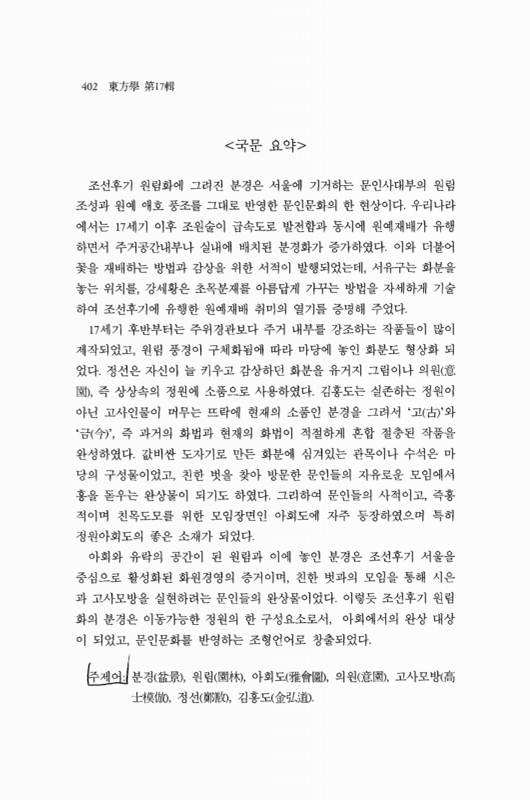
조선후기 원림화에 그려진 분경은 서울에 기거하는 문인사대부의 원림조성과 원예 애호 풍조를 그대로 반영한 문인문화의 한 현상이다. 우리나라에서는 17세기 이후 조원술이 급속도로 발전함과 동시에 원예재배가 유행하면서 주거공간내부나 실내에 배치된 분경화가 증가하였다. 이와 더불어 꽃을 재배하는 방법과 감상을 위한 서적이 발행되었는데, 서유구는 화분을 놓는 위치를, 강세황은 초목분재를 아름답게 가꾸는 방법을 자세하게 기술하여 조선후기에 유행한 원예재배 취미의 열기를 증명해 주었다.
17세기 후반부터는 주위경관보다 주거 내부를 강조하는 작품들이 많이 제작되었고, 원림 풍경이 구체화됨에 따라 마당에 놓인 화분도 형상화 되었다. 정선은 자신이 늘 키우고 감상하던 화분을 유거지 그림이나 의원(意園), 즉 상상속의 정원에 소품으로 사용하였다. 김홍도는 실존하는 정원이 아닌 고사인물이 머무는 뜨락에 현재의 소품인 분경을 그려서 ‘고(古)’와 ‘금(今)’, 즉 과거의 화법과 현재의 화법이 적절하게 혼합 절충된 작품을 완성하였다. 값비싼 도자기로 만든 화분에 심겨있는 관목이나 수석은 마당의 구성물이었고, 친한 벗을 찾아 방문한 문인들의 자유로운 모임에서 흥을 돋우는 완상물이 되기도 하였다. 그리하여 문인들의 사적이고, 즉흥적이며 친목도모를 위한 모임장면인 아회도에 자주 등장하였으며 특히 정원아회도의 좋은 소재가 되었다.
아회와 유락의 공간이 된 원림과 이에 놓인 분경은 조선후기 서울을 중심으로 활성화된 화원경영의 증거이며, 친한 벗과의 모임을 통해 시은과 고사모방을 실현하려는 문인들의 완상물이었다. 이렇듯 조선후기 원림화의 분경은 이동가능한 정원의 한 구성요소로서, 아회에서의 완상 대상이 되었고, 문인문화를 반영하는 조형언어로 창출되었다.
As there was a tendency of liking for BunKyeong (盆景, a little natural garden with flowers, stones, or sand in a pot) and WonRim (園林, a garden) in the late Joseon dynasty, they often appeared in paintings created by aristocratic gentlemen residing in Seoul. As gardening had been popular with the rapidly developing skills in the realm since the 17th century, they painted more and more BunKyeongHwas(盆景?) that were placed inside the living quarters. In addition to this, there were publications that covered not only how to grow flowers but how to appreciate them. For instance, Suh You-gu(徐有?, 1764-1845), politician) explained how pots should be placed, and Kang Se-hwang(姜世晃, 1713-1791), high government official, and representative painter) suggested a detailed description of how to decorate dwarf plants in a little pot, thus demonstrating how enthusiastically they were engaged in the art of gardening.
Since the late 17th century when an emphasis was put on the interior of living quarters rather than on the surrounding landscape, the tendency of delineating landscape with little details in WonRim led into the inclusion of flower pots placed in the front yard. Jeong Seon (鄭敾, 1676?1759), well-known landscape painter, also known as by hispenname Gyeomjae(meaning humblestudy))utilized his cherished pots as subjects for YouGeoJi Hwa(a painting of living spaces)and EoiWon(意園) which means a ‘imaginary garden’. Kim Hong-do (金弘道, 1745?c. 1806), painter better known as Danwon (檀園)) accomplished a work of art in which past techniques(Go(古), the old) were aptly harmonized with present skills(Geum(今), the present) by painting BunKyeong for a present subject in the visionary yard where hermitlike gentlemen of integrity were laid back. Shrubs or SuSeok (水石 or 壽石, ornamental stones) planted in a little priceless porcelain served as ornamental objects for the enjoyment of visiting gentlemen.
Therefore, it often appeared in Ahoi'-do(雅會圖)’(Elegant assembly Paintings) serving as a coveted subject for Garden Ahoi'-do. WonRim, as a space for AhHeo and a variety of amusements and BunKyeong as its component, demonstrates the widespread trend of gardening particularly in Seoul in the late Joseon Dynasty, realizing a sense of SiEun (市隱, intentionally avoiding to contact the world even though living in a city) and Gosa Mobang(高士 模倣, trying to imitate living styles of hermit like gentlemen of integrity) for gentlemen through gatherings with close friends.
As such, BunKyeong in WonRimHwa as a movable element for garden creation in the late Joseon Dynasty served as a subject for serene appreciation in Ahoi'-do and as a visual language reflecting gentlemen’s culture.| 기사명 | 저자명 | 페이지 | 원문 | 목차 |
|---|---|---|---|---|
| 鄕歌와 讚詩의 결합양상과 의미 | 최정선 | pp.7-34 |
|
보기 |
| 박세당의 北關宦遊記 北征錄 연구 | 朱榮兒 | pp.35-70 |
|
보기 |
| 從<<紅樓夢>>看韓國讀者的審美意識 | 金芝鮮 | pp.71-91 |
|
보기 |
| 朱熹의 詞論 고찰 | 이태형 | pp.93-107 |
|
보기 |
| 일본 고전문학 여성인물조형의 여성적 글쓰기 일고찰 :『겐지모노가타리(源氏物語)』유가오(夕顔)를 중심으로 | 朴姸貞 | pp.109-135 |
|
보기 |
| 공자의 인격성숙에 관한 고찰 :에릭슨의 발달단계와 긍정심리학의 시선 | 신창호 ;심경섭 | pp.137-163 |
|
보기 |
| 孔子·孟子의 信賴觀과 그 差異性 考察 | 姜允炯 ;李炯性 | pp.165-196 |
|
보기 |
| Origin of the Chinese political virtue concepts | 張迪 ;雷松林 ;李尙曄 | pp.197-219 |
|
보기 |
| 晦軒 安珦의 朱子學 수용과 성격 | 정성식 | pp.221-245 |
|
보기 |
| 星湖 李瀷의 大學觀 | 김인규 | pp.247-278 |
|
보기 |
| 식민지적 근대문명에 대한 한국 유교의 분기와 이념적 지형 :일제초기(1900-1910)를 중심으로 | 안외순 | pp.279-312 |
|
보기 |
| 대종교의 삼교합일론 :윤세복의 인식을 중심으로 | 조남호 | pp.313-335 |
|
보기 |
| 中國 民俗文化의 幼兒禁忌 考察 | 尙基淑 | pp.337-366 |
|
보기 |
| 한국 전래동화 영역본을 통한 영재교육 프로그램이 유아의 언어기능에 미치는 효과 | 함정현 ;민현정 | pp.367-399 |
|
보기 |
| 정원 속의 작은 정원 :조선후기 盆景애호와 園林畵의 분경 | 송희경 | pp.401-440 |
|
보기 |
| 번호 | 참고문헌 | 국회도서관 소장유무 |
|---|---|---|
| 1 | 강희안 지음 이병훈 옮김, 양화소록 , 을유문화사, 1973. | 미소장 |
| 2 | 計成 著 金聖雨‧安大會 譯, 園冶 , 圖書出版 藝耕, 1993, | 미소장 |
| 3 | 단국대학교 동양학연구소 편, 한화대사전 권9, 단국대학교출판부, 2000, | 미소장 |
| 4 | 屠隆 著 權德周 譯, 考槃餘事 , 을유문화사, 1969. | 미소장 |
| 5 | 서유구 지음, 안대회 엮어 옮김, 산수간에 집을 짓고 , 돌베개, 2005. | 미소장 |
| 6 | 연못이 있는 정원 : 조선후기 園池·園林畵의 유형과 그 함의 | 소장 |
| 7 | The Housing Culture in the 18?19th Century and the Imaginary Garden | 소장 |
| 8 | 이규상, 18세기 조선인물지-幷世才彦錄 , 창작과 비평사, 1997. | 미소장 |
| 9 | The Visualization of Commercial Life in a City: Painting of the City of Supreme Peace (Taepyongsongsido) of the Late Choson Dynasty | 소장 |
| 10 | 『양화소록(養花小錄)』에 담긴 15세기 꽃·나무 사랑법 | 소장 |
| 11 | 袁宏道의 《甁史》 分析 | 소장 |
| 12 | Between Non-Attachment and Obsession: The Collecting Culture of Late Choson Korea | 소장 |
| 13 | 정동오, 한국의 정원 , 민음사, 1986. | 미소장 |
| 14 | 정민, 「18,19세기 문인지식인층의 원예 취미」 조선지식인의 재발견 , 휴머니스트, 2007. | 미소장 |
| 15 | 허균 지음 민족문화추진회 편, 한정록 2, 솔, 1997. | 미소장 |
| 16 | 호암미술관 편 , 인물로 보는 한국미술 , 호암미술관, 1998. | 미소장 |
| 17 | 洪善杓, 「朝鮮後期 繪畵의 愛好風潮와 感平活動」, 朝鮮時代 繪畵史論 , 文藝出版社, 1999. | 미소장 |
| 18 | 홍선표 외, 17‧18세 조선의 외국서적 수용과 독서문화 , 도서출판 혜안 2006. | 미소장 |
| 19 | 개인 소장<十八學士圖>의 신원 | 소장 |
| 20 | Alfreda Murck, Wen C Fong, A Chinese Garden Court, The Metropolitan Museum of Art, 1993. | 미소장 |
| 21 | Kathleen Ryor, “Nature Contained : Penjing and Flower Arrangements as Surrogate Gardens in Ming China”, Orientations, Vol.33, 2002. 3. | 미소장 |
| 22 | Robert D. Mowry, “Chinese Scholars' Rocks: An Overview”, Oriental Art, Vol.XLIV., No. Spring, 1998. | 미소장 |
| 23 | Wai-Kam Ho, “Late Ming Literati : Their Social and Cultual Ambience”, in The Literati Life, The Chinese Scholar's Studio : Artistic Life In The Late Ming Period, The Asia Society Galleries, Thames and Hudson, 1987. | 미소장 |
*표시는 필수 입력사항입니다.
| 전화번호 |
|---|
| 기사명 | 저자명 | 페이지 | 원문 | 기사목차 |
|---|
| 번호 | 발행일자 | 권호명 | 제본정보 | 자료실 | 원문 | 신청 페이지 |
|---|
도서위치안내: 정기간행물실(524호) / 서가번호: 대학02
2021년 이전 정기간행물은 온라인 신청(원문 구축 자료는 원문 이용)

우편복사 목록담기를 완료하였습니다.
*표시는 필수 입력사항입니다.
저장 되었습니다.
