
 대표어
대표어
권호기사보기
| 기사명 | 저자명 | 페이지 | 원문 | 기사목차 |
|---|
결과 내 검색
동의어 포함
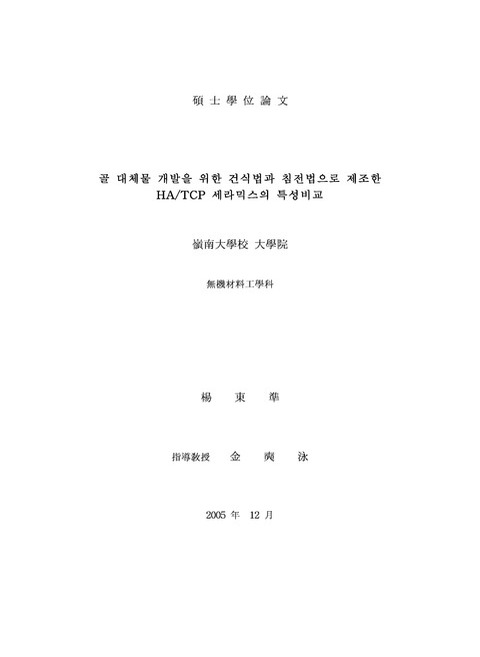
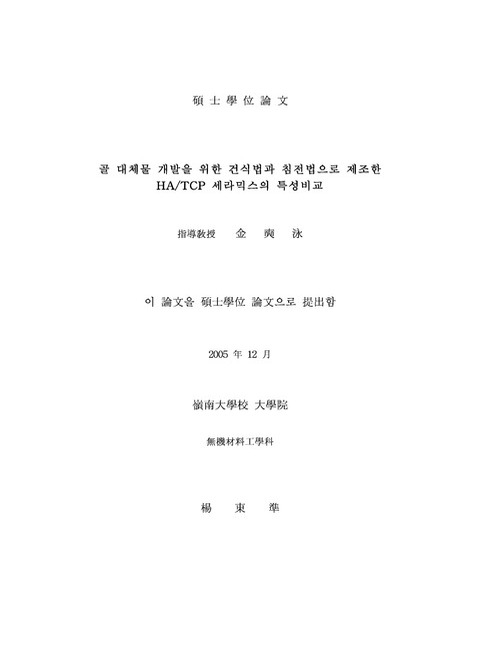
표제지
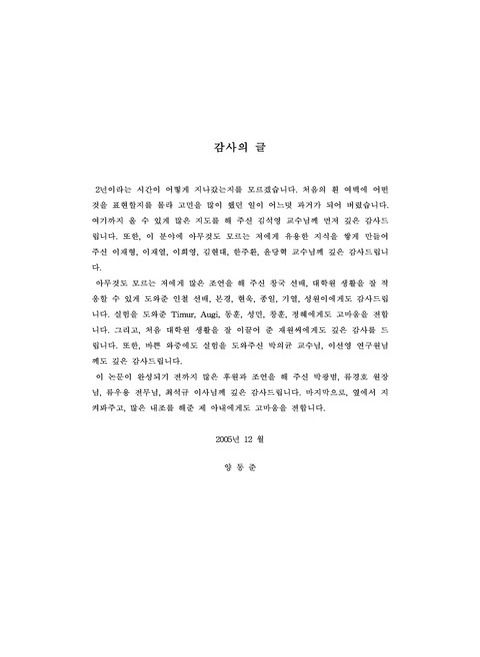
감사의 글
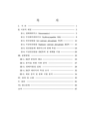
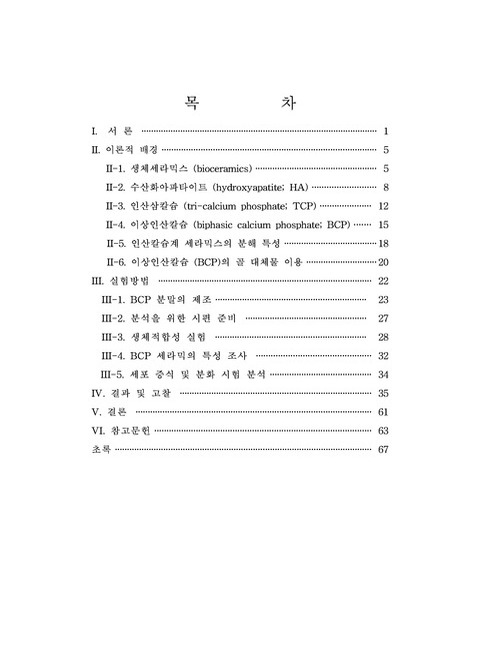
목차
Ⅰ. 서론 6
Ⅱ. 이론적 배경 10
Ⅱ-1. 생체세라믹스 (bioceramics) 10
Ⅱ-2. 수산화아파타이트 (hydroxyapatite; HA) 13
Ⅱ-3. 인산삼칼슘 (tri-calcium phosphate; TCP) 17
Ⅱ-4. 이상인산칼슘 (biphasic calcium phosphate; BCP) 20
Ⅱ-5. 인산칼슘계 세라믹스의 분해 특성 23
Ⅱ-6. 이상인산칼슘 (BCP)의 골 대체물 이용 25
Ⅲ. 실험방법 27
Ⅲ-1. BCP 분말의 제조 28
Ⅲ-1-1. 건식법 (Mechanically Mixed)을 이용한 BCP 분말의 준비 28
Ⅲ-1-2. 침전법 (Precipitation)을 이용한 BCP 분말의 제조 30
Ⅲ-2. 분석을 위한 시편 준비 32
Ⅲ-3. 생체적합성 실험 33
Ⅲ-3-1. 유사체액 (SBF; Simulated Body Fluid) 제조 33
Ⅲ-3-2. in-vitro 실험 34
Ⅲ-4. BCP 세라믹의 특성 조사 37
Ⅲ-4-1. BCP 분말의 특성 조사 37
Ⅲ-4-2. 중량변화 37
Ⅲ-4-3. X-선 회절 분석 37
Ⅲ-4-4. 유도결합 플라즈마(ICP) 방출 분광 분석 38
Ⅲ-4-5. SEM 관찰 38
Ⅲ-5. 세포 증식 및 분화 시험 분석 39
Ⅳ. 결과 및 고찰 40
Ⅳ-1. BCP 분말의 특성 조사 40
Ⅳ-1-1. Ca/P 비율에 따른 P-BCP 분말 분석 40
Ⅳ-1-2. 적외선 흡수 분광분석 장비에 의한 M-BCP, P-BCP 분말 분석 43
Ⅳ-1-3. 열 중량ㆍ시차열 분석 에 의한 M-BCP, P-BCP 분말 분석 45
Ⅳ-1-4. X-선 회절분석 (분말 분석) 47
Ⅳ-2. X-선 회절분석 (R-SBF 침적 전ㆍ후) 50
Ⅳ-3. 중량변화 52
Ⅳ-4. SEM 분석 54
Ⅳ-5. ICP 방출 분광분석 62
Ⅳ-6. 세포 증식 및 분화 시험 분석 65
Ⅴ. 결론 66
Ⅵ. 참고문헌 68
초록 72
Fig. 1 Hydroxyapatite structure. The numbers printed on the atom symbols are the Z co-ordinates. 15
Fig. 2 α-TCP unit cell (left) projected on the (a, b) plane, (right) projected onto the (b, c) plane. Tetrahedra represent PO₄ groups, and light balls denote Ca atoms 19
Fig. 3 β-TCP unit cell projected on the (a, c) plane. Tetrahedra represent PO4 groups, small balls designate Ca atoms, and big balls are for the Ca's with half occupancy 19
Fig. 4 XRD pattern of calcium deficient apatite 21
Fig. 5 Various shapes and forms of commercialized BCP 25
Fig. 6 BCP manufactured by Osteon 25
Fig. 7 Flow chart for the preparation and characterization of specimen 27
Fig. 8 Flow chart of mechanically mixed BCP preparation procedure 29
Fig. 9. Flow chart of chemically precipitated BCP preparation procedure 31
Fig. 10 XRD patterns of P-BCP heat treated at 900℃ for 1 hour with different Ca/P ratio during precipitation 41
Fig. 11 XRD pattern of mixed commercial HA and TCP powders (before ball milling) 42
Fig. 12 XRD pattern of chemically precipitated BCP (calcined at 900℃ for 1 hour; Ca/P=1.55) 42
Fig. 13 FT-IR spectra of M-BCP powder before sintering 44
Fig. 14 FT-IR spectra of calcined P-BCP powder 44
Fig. 15 TG/DTA evolution curves for M-BCP powder before sintering 46
Fig. 16 TG/DTA evolution curves for P-BCP powder before sintering 46
Fig. 17 XRD patterns of M-BCP specimens heated at 1000, 1100, 1200 and 1300℃ for 2 hours, respectively 48
Fig. 18 XRD patterns of P-BCP specimens heated at 1000, 1100, 1200 and 1300℃ for 2 hours, respectively 48
Fig. 19 Experimental curves of relative densities for P-BCP & M-BCP specimens measured by Archimedes method 49
Fig. 20 XRD patterns of mechanically mixed BCP specimens ; unsoaked and soaked for 1, 7, 21 days, respectively 51
Fig. 21 XRD patterns of chemically precipitated BCP specimens ; unsoaked and soaked for 1, 7, 21 days, respectively 51
Fig. 22 Curves represent weight gain of M-BCP and P-BCP with immersion period 52
Fig. 23 Schematic presentations of the origin of negative charge on the HA surface and the process of bonelike apatite formation thereon in SBF 55
Fig. 24. Surface morphology of M-BCP specimens before soaking (L : 500, R : 5000) 57
Fig. 25. Surface morphology of P-BCP specimens before soaking (L : 500, R : 5000) 57
Fig. 26. Surface morphology of M-BCP specimens soaked in R-SBF for 7 days (L : 500, R : 5000) 58
Fig. 27. Surface morphology of P-BCP specimens soaked in R-SBF for 7 days (L : 500, R : 5000) 58
Fig. 28. Surface morphology of M-BCP specimens soaked in R-SBF for 21 days (L : 500, R : 5000) 59
Fig. 29. Surface morphology of P-BCP specimens soaked in R-SBF for 21 days (L : 500, R : 5000) 59
Fig. 30. Surface morphology of M-BCP specimens soaked in R-SBF during 1, 3, 6, 12, 18 and 24 hours 60
Fig. 31. Surface morphology of P-BCP specimens soaked in R-SBF during 1, 3, 6, 12, 18 and 24 hours 61
Fig. 32 Calcium ion concentration and pH of R-SBF as a function of soaking time 64
Fig. 33 Phosphorus ion concentration and pH of R-SBF as a function of soaking time 64
Fig. 34 Comparison of M-BCP, P-BCP, and control (culture plate) in terms of cell proliferation after 1 day cell culture 65
Fig. 35 ALP Staining results; left: M-BCP, right: P-BCP (200x) after 7 days. Red color showed ALP positive cells response 65
*표시는 필수 입력사항입니다.
| 전화번호 |
|---|
| 기사명 | 저자명 | 페이지 | 원문 | 기사목차 |
|---|
| 번호 | 발행일자 | 권호명 | 제본정보 | 자료실 | 원문 | 신청 페이지 |
|---|
도서위치안내: / 서가번호:

우편복사 목록담기를 완료하였습니다.
*표시는 필수 입력사항입니다.
저장 되었습니다.
