
 대표어
대표어

권호기사보기
| 기사명 | 저자명 | 페이지 | 원문 | 기사목차 |
|---|
결과 내 검색
동의어 포함
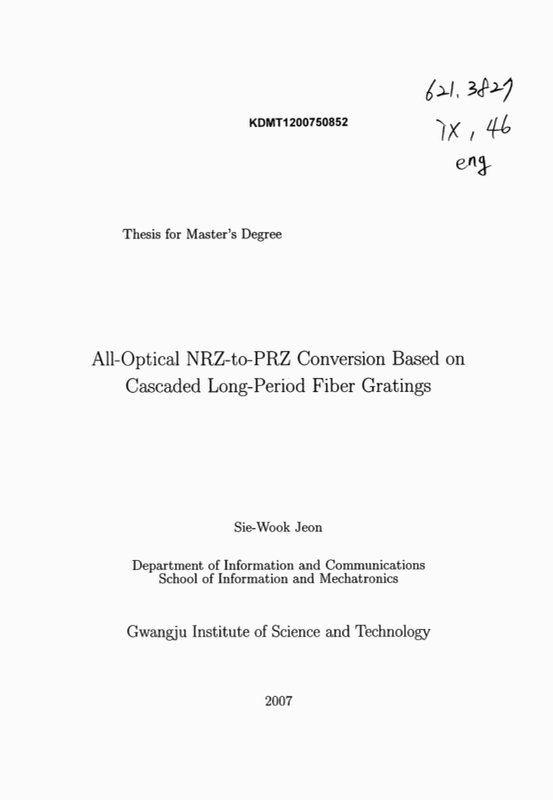
title page
Abstract
국문요약
Acknowledgements
Contents
Chapter 1. Introduction 15
1.1. Research background and motivation 15
1.2. Thesis organization 17
Chapter 2. NRZ-to-PRZ conversion 18
2.1. Asymmetric mach-zender interferometer 18
2.2. π-phase shifted fiber bragg grating 21
Chapter 3. Proposed NRZ-to-PRZ conversion method 28
3.1. Principle of long-period fiber gratings 28
3.2. Architecture of the proposed method 30
3.2.1. Cascaded LPGs 30
3.2.2. Realization of true time delay 32
3.3. Extraction of PRZ signal 33
Chapter 4. Optimum time delay and theoretical study for extracting clock components 36
4.1. Comparison of clock components of PRZ and NRZ signal 36
4.2. Optimum time delay 42
Chapter 5. Experiment result 46
5.1. Experimental setup 46
5.2. Experimental result 48
Chapter 6. Conclusion 55
References 58
Curriculum vitae
2.1. Ideal NRZ signal 19
2.2. Actual NRZ signal 20
2.3. Clock extraction method by an asymmetric Mach-Zender interferometer 22
2.4. Timing diagram of an asymmetric Mach-Zender interferometer 23
2.5. Clock extraction method by the π-phase shifted fiber bragg grating 25
2.6. Reflection spectrum of the π-PSFBG 26
3.1. Operation of cascaded LPGs 31
3.2. The principle of PRZ signal extraction 34
4.1. (a) The basic pulse of the NRZ signal (b) the differentiated pulse 38
4.2. The power spectral density of the NRZ signal 40
4.3. (a) The basic pulse of the PRZ signal (b) the differentiated pulse 41
4.4. The power spectral density of the PRZ signal 43
4.5. Relative clock component power as a function of time delay △t: time delay, Tb: bit duration 45
5.1. Experimental setup of proposed method to extract clock components 47
5.2. The spectrum of the NRZ-to-PRZ converter 50
5.3. The waveform and eye-diagram of the NRZ signal 51
5.4. The waveform and eye diagram of the PRZ signal 52
5.5. The RF spectra of the NRZ signal 53
5.6. The RF spectra of the PRZ signal 54
광통신 시스템에서는 전기적으로 변환된 광신호의 지터를 줄이고 안정적인 동작을 위해서는 클럭 추출이 필수적이다. 광통신 시스템에서 주로 사용되는 NRZ(non return-to-zero) 신호의 경우 대역폭을 적게 차지하고 쉬운 변조방식 때문에 주로 사용되지만 미약한 클럭성분을 가지고 있기 때문에 낮은 CMR(the clock-to-modulation component ratio) 특성을 갖는다. 따라서 NRZ 신호에서 클럭을 추출하기 위해서는 광전변환 후 전기적 클럭 복원 회로를 사용하여야 하지만 40Gb/s급 이상의 통신 시스템에서 전기 소자의 대역폭 제한 때문에 전기적 클럭 복원 회로 구현이 힘들다. 따라서 우리는 NRZ 신호를 충분한 클럭성분으로 인해 높은 CMR특성을 갖는 PRZ(pseudo-return-to-zero) 신호로 변환함으로써 클럭성분을 추출하는 새로운 방법을 제안한다.
본 연구에서는 배열된 장주기 격자(Cascaded Long-Period Fiber Gratings : cas-caded LPGs)를 이용한 새로운 형태의 NRZ-to-PRZ 변환 방법을 이용한다. 코어를 따라 진행하던 NRZ신호가 첫번째 LPG 만나면 코어모드와 클래딩 모드로 분기된다. 이 두 모드는 같은 길이를 진행하지만 두 모드 사이의 유효 굴절률 차이에 의해 광경 로차를 갖게 된다. 두 모드가 다시 두번째 LPG를 만나면, 각각의 모드는 다시 커플링이 일어난다. 즉, cascaded LPGs는 일정한 시간 지연을 갖는 간섭계로 동작을 하게 되고 이 때 두 NRZ 신호 사이의 위상 차이가 180°가 된다면, 간섭현상 때문에 출력에서 PRZ 신호를 얻을 수 있다. 10Gb/s NRZ신호 전송 시스템에서 클럭 성분을 추출하기 위해 NRZ-to-PRZ 변환기를 제작하였다. 강한 클럭 성분을 얻기 위한 최적의 시간 지연은 비트 듀레이션의 반이라는 것을 이론적으로 증명한 후, 10Gb/s NRZ 신호 전송 시스템에서 50ps의 시간지연을 위해 두 LPG 사이의 거리는 2m로 만들어졌다. 이 변환기를 사용한 결과, NRZ신호일 때 보다 PRZ 신호일 때 CMR이 48dB 증가하는 것을 확인하였다.*표시는 필수 입력사항입니다.
| 전화번호 |
|---|
| 기사명 | 저자명 | 페이지 | 원문 | 기사목차 |
|---|
| 번호 | 발행일자 | 권호명 | 제본정보 | 자료실 | 원문 | 신청 페이지 |
|---|
도서위치안내: / 서가번호:

우편복사 목록담기를 완료하였습니다.
*표시는 필수 입력사항입니다.
저장 되었습니다.
