
 대표어
대표어

권호기사보기
| 기사명 | 저자명 | 페이지 | 원문 | 기사목차 |
|---|
결과 내 검색
동의어 포함
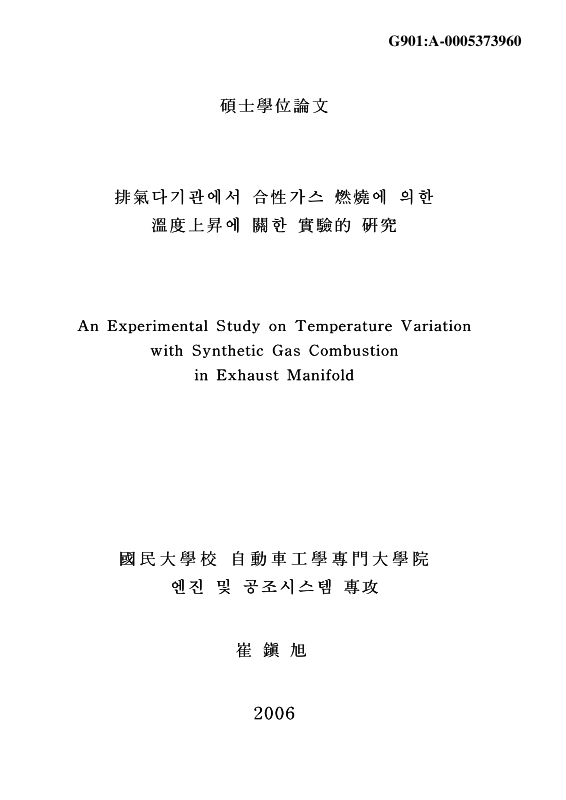
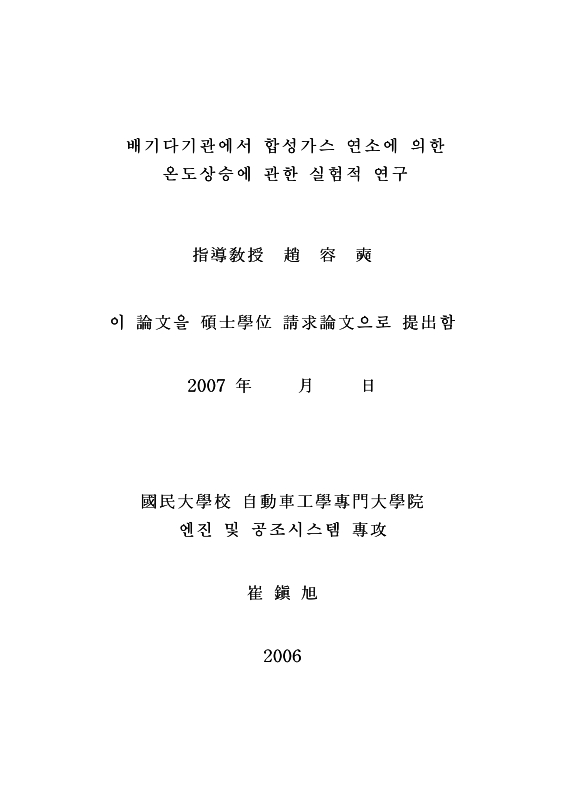
표제지
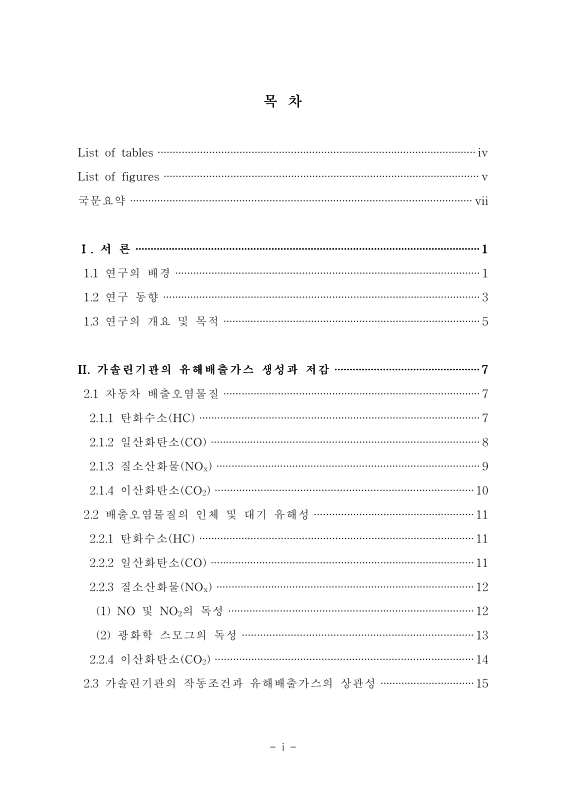
목차
국문요약 10
I. 서론 12
1.1 연구의 배경 12
1.2 연구의 동향 14
1.3 연구의 개요 및 목적 16
II. 가솔린기관의 유해배출가스 생성과 저감 18
2.1 자동차 배출오염물질 18
2.1.1 탄화수소(HC) 18
2.1.2 일산화탄소(CO) 19
2.1.3 질소산화물(NOx) 20
2.1.4 이산화탄소(CO₂) 21
2.2 배출오염물질의 인체 및 대기 유해성 22
2.2.1 탄화수소(HC) 22
2.2.2 일산화탄소(CO) 22
2.2.3 질소산화물(NOx) 23
(1) NO 및 NO₂의 독성 23
(2) 광화학 스모그의 독성 24
2.2.4 이산화탄소(CO₂) 25
2.3 가솔린기관의 작동조건과 유해 배출가스의 상관성 26
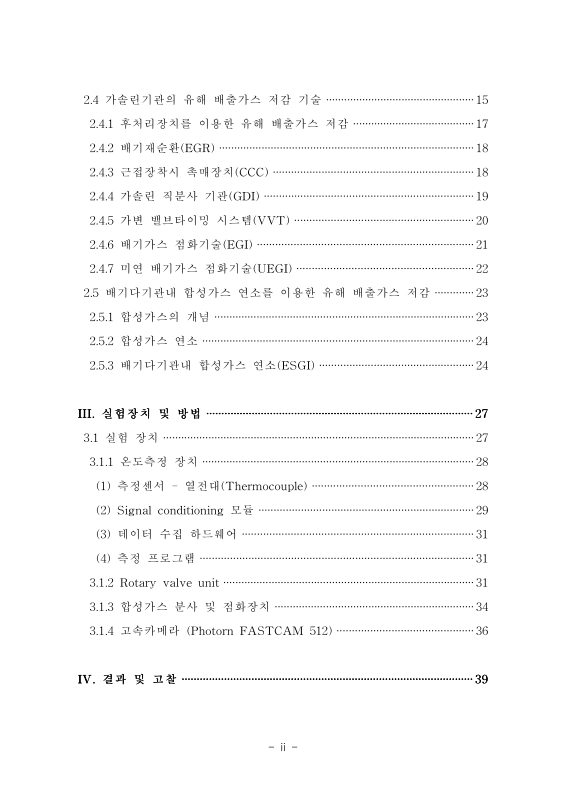
2.4 가솔린기관의 유해 배출가스 저감 기술 28
2.4.1 후처리장치를 이용한 유해 배출가스 저감 28
2.4.2 배기재순환(EGR: Exhaust Gas Recirculation) 29
2.4.3 근접장착시 촉매장치(CCC: Closed-Coupled Catalyst 29
2.4.4 가솔린 직분사 기관(GDI: Gasoline Direct Injection) 30
2.4.5 가변 밸브타이밍 시스템(VVT: Variable Valve Timing) 31
2.4.6 배기가스 점화기술(EGI) 32
2.4.7 미연 배기가스 점화기술(UEGI) 33
2.5 배기다기관내 합성가스 연소를 이용한 유해 배출가스 저감 34
2.5.1 합성가스의 개념 34
2.5.2 합성가스 연소 35
2.5.3 배기다기관내 합성가스 연소(ESGI) 35
III. 실험장치 및 방법 38
3.1 실험 장치 38
3.1.1 온도측정 장치 39
(1) 측정센서-열전대(thermocouple) 39
(2) Signal conditioning 모듈 40
(3) 데이터 수집 하드웨어 42
(4) 측정 프로그램 42
3.1.2 Rotary valve unit 42
3.1.3 합성가스 분사 및 점화장치 45
3.1.4 고속카메라 (Photorn FASTCAM 512) 47
3.2 실험 방법 및 조건 48
IV. 결과 및 고찰 50
4.1 분사위치에 따른 연소특성 50
4.2 합성가스 분사압력에 따른 연소 특성 53
4.3 산소량에 따른 합성가스 연소 특성 54
4.4 합성가스 연소 가시화 56
V. 결론 59
Reference 61
Abstract 65
감사의 글 67
그림목차
Fig. 2.1 Variation of HC, CO, and NO concentration in the exhaust gas of a conventional spark-ignition engine with fuel/air equivalence ratio 27
Fig. 2.2 Schematic diagram of synthetic gas generatio 34
Fig. 2.3 Concept ESGI operation strategy 36
Fig. 2.4 Schematic diagram of on-board ESGI system in an exhaust manifold 36
Fig. 3.1 Schematic diagram of rig-test for ESGI 38
Fig. 3.2 K-Type Thermocouple 40
Fig. 3.3 Signal conditioner SCXI 1000 and terminal block TC-2095 41
Fig. 3.4 Rotary valve unit and Chopper design 43
Fig. 3.5 Chopper disk 44
Fig. 3.6 Photograph of injector 45
Fig. 3.7 Photograph of glow plug 46
Fig. 3.8 High speed camera(Photorn FASTCAM 512) 47
Fig. 3.9 Location of injector and thermocouple 49
Fig. 4.1 Variation of exhaust gas temperature (Injection point : I1) 50
Fig. 4.2 Variation of exhaust gas temperature (Injectionpoint : I2) 51
Fig. 4.3 Variation of exhaust gas temperature (Injection point : I3) 51
Fig. 4.4 Variation of exhaust gas temperature (Injection point : I4) 52
Fig. 4.5 Variation of exhaust gas temperature with changes in injection pressure 53
Fig. 4.6 Combustion temperature of O₂ volume fraction(%) 54
Fig. 4.7 Thermo intensity images of synthetic gas combustion in exhaust manifold (20% O₂) 56
Fig. 4.8 Thermo intensity images of synthetic gas combustion in exhaust manifold (I2) 57
*표시는 필수 입력사항입니다.
| 전화번호 |
|---|
| 기사명 | 저자명 | 페이지 | 원문 | 기사목차 |
|---|
| 번호 | 발행일자 | 권호명 | 제본정보 | 자료실 | 원문 | 신청 페이지 |
|---|
도서위치안내: / 서가번호:

우편복사 목록담기를 완료하였습니다.
*표시는 필수 입력사항입니다.
저장 되었습니다.
