
 대표어
대표어
권호기사보기
| 기사명 | 저자명 | 페이지 | 원문 | 기사목차 |
|---|
결과 내 검색
동의어 포함
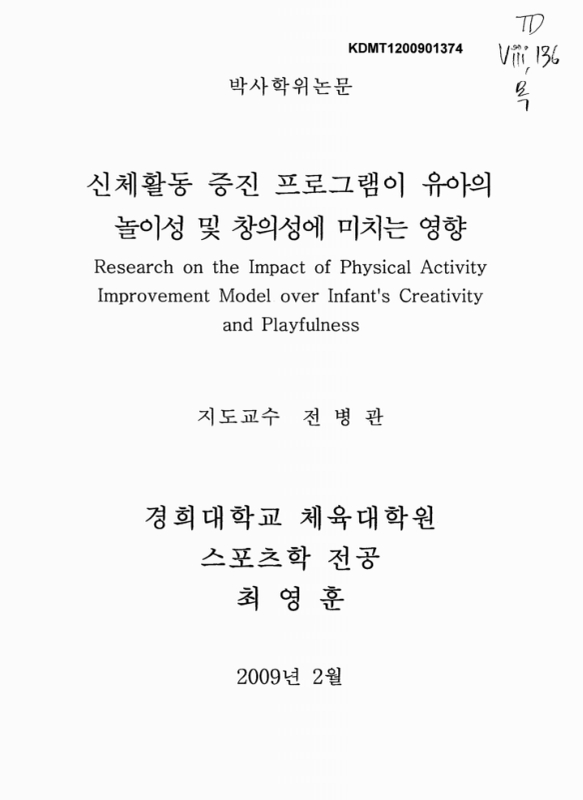
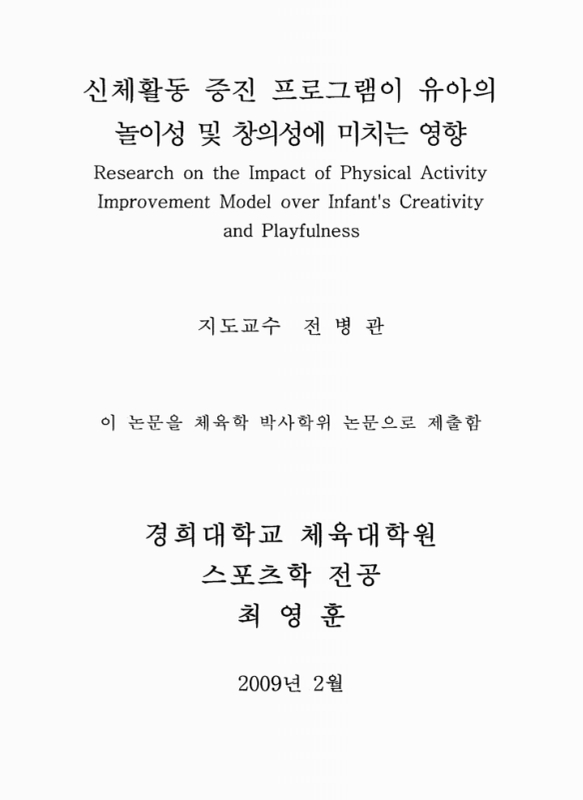
표제지
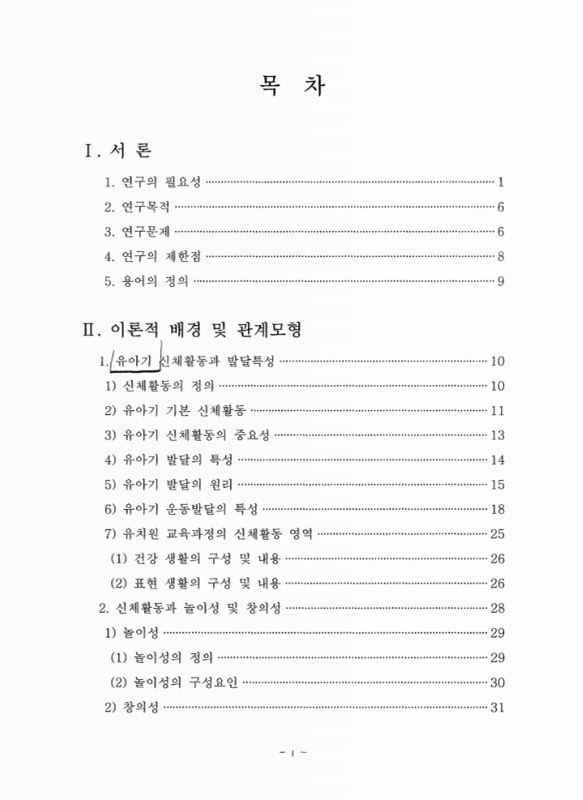
목차
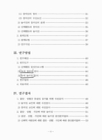
I. 서론 12
1. 연구의 필요성 12
2. 연구목적 17
3. 연구문제 17
4. 연구의 제한점 19
5. 용어의 정의 20
II. 이론적 배경 및 관계모형 21
1. 유아기 신체활동과 발달특성 21
1) 신체활동의 정의 21
2) 유아기 기본 신체활동 22
3) 유아기 신체활동의 중요성 24
4) 유아기 발달특성 25
5) 유아기 발달의 원리 26
6) 유아기 운동 발달특성 29
7) 유치원 교육과정의 신체활동 영역 36
(1) 건강생활의 구성 및 내용 37
(2) 표현생활의 구성 및 내용 37
2. 신체활동과 놀이성 및 창의성 39
1) 놀이성 40
(1) 놀이성의 정의 40
(2) 놀이성 구성요인 41
2) 창의성 42
(1) 창의성의 정의 42
(2) 창의성 구성요인 43
3) 놀이성과 창의성과 관계 44
4) 신체활동과 창의성 46
5) 신체활동과 놀이성 47
3. 관계모형 48
1) 관계모형 48
2) 연구가설 49
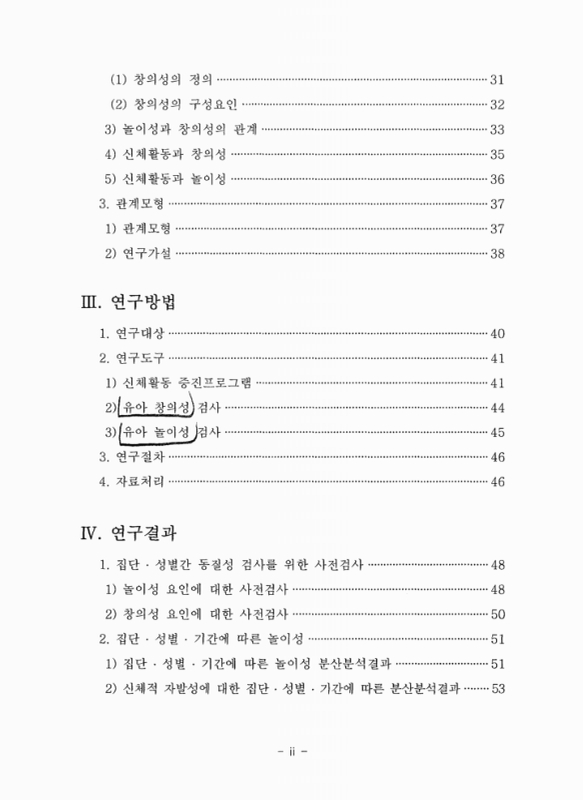
III. 연구방법 51
1. 연구대상 51
2. 연구도구 52
1) 신체활동 증진 프로그램 52
2) 유아 창의성 검사(TTCT;Torrance Tests of Creative Thinking) 55
3) 놀이성 검사(CPS) 56
3. 연구절차 57
4. 자료처리 57
IV. 연구결과 59
1. 집단·성별간 동질성 검사를 위한 사전검사 59
1) 놀이성 요인에 대한 사전검사 59
2) 창의성 요인에 대한 사전검사 61
2. 집단·성별·기간에 따른 놀이성 62
1) 집단·성별·기간에 따른 분산분석결과 62
2) 신체적 자발성에 대한 집단·성별·기간에 따른 분산분석결과 64
3) 사회적 자발성에 대한 집단·성별·기간에 따른 분산분석결과 65
4) 인지적 자발성에 대한 집단·성별·기간에 따른 분산분석결과 67
5) 즐거움의 표현에 대한 집단·성별·기간에 따른 분산분석결과 68
6) 유머감각에 대한 집단·성별·기간에 따른 분산분석결과 69
3. 집단·성별·기간에 따른 창의성 71
1) 집단·성별·기간에 따른 창의성 분산분석결과 71
2) 유창성에 대한 집단·성별·기간에 따른 분산분석결과 73
3) 독창성에 대한 집단·성별·기간에 따른 분산분석결과 74
4) 추상성에 대한 집단·성별·기간에 따른 분산분석결과 75
5) 정교성에 대한 집단·성별·기간에 따른 분산분석결과 76
6) 개방성에 대한 집단·성별·기간에 따른 분산분석결과 78
4. 놀이성과 창의성의 관계 79
1) 놀이성과 창의성의 상관관계 분석결과 79
2) 놀이성과 창의성의 회귀분석결과 81
(1) 신체적 자발성이 창의성에 미치는 영향 81
(2) 사회적 자발성이 창의성에 미치는 영향 81
(3) 인지적 자발성이 창의성에 미치는 영향 82
(4) 즐거움의 표현이 창의성에 미치는 영향 84
(5) 유머감각 창의성에 미치는 영향 85
V. 논의 86
VI. 결론 및 제언 94
1. 결론 94
2. 제언 96
참고문헌 97
부록 104
[부록1] 신체활동 증진 프로그램 20회 안. 105
1-1. 신체활동 증진프로그램 수업 사진 125
[부록2] 유아 창의성 검사(TTCT;Torrance Tests of Creative Thinking) 127
2-1. 유아 창의성 검사(TTCT;Torrance Tests of Creative Thinking) 128
2-2. 유아 창의성 검사 사진 137
2-3. 유아 창의성 검사 내용(유아 작성) 138
2-4. 유아 창의성 검사 결과지(창의력 한국 FPSP/ 현곡 R&D 연구소) 140
[부록3] 놀이성 검사(CPS; Children's Playfulness Scale) 141
3-1. 놀이성 검사지(CPS) 142
3-2. 놀이성 관찰지 검사 사진(3명의 관찰자 체크) 143
3-3. 놀이성 관찰 검사 결과지 144
[부록4] 학부모 실험 참가 동의서 145
ABSTRACT 146
그림 1. 신체활동 움직임의 기초(방예선, 2007) 23
그림 2. 운동발달의 단계(Gallahue, 1982). 30
그림 3. 변인간 관계모형 49
그림 4. 집단과 기간에 따른 상호작용효과 65
그림 5. 사회적 자발성에 대한 상호작용효과 66
그림 6. 인지적 자발성에 대한 상호작용효과 68
그림 7. 즐거움의 표현에 대한 상호작용효과 69
그림 8. 유머감각에 대한 상호작용효과 71
그림 9. 추상성에 대한 상호작용효과 76
그림 10. 정교성에 대한 상호작용효과 77
그림 11. 개방성에 대한 상호작용효과 79
그림 12. 개방성의 회귀식 도표 83
그림 13. 추상성의 회귀식 도표 84
This study aims to analyze the impact of Physical Activity Improvement Model(hereafter called PAIM) over infant's playfulness and creativity which are the motive force of infant's potentials. With a hypothesis based on former researches, this study has conducted three analyses. Firstly, infant's playfulness was analyzed by viewer's assesment scales with a focus on the different impacts of PAIM according to the target group, periods of time, and gender. Secondly, infant's creativity was verified by a creativity test, which also analyzed the different impacts of PAIM according to the target group, periods of time, and gender. Thirdly, the relationship between playfulness and creativity has been compared and analyzed with regard to PAIM.
The hypothesis coupled with analyses led to the following conclusions. Firstly, PAIM resulted in improving physical, social and cognitive voluntariness that are subordinate factors of playfulness. These factors show a tendency to increase as periods of time increase. It is also found that the comparison group tends to have a higher interaction effect between groups and periods of time than the control group. This could be translated that PAIM and ordinary programs of kindergartens can improve factors of physical voluntariness. No difference has been found among groups concerning the expression of joyfulness and a sense of humor, while education effect was found over periods of time. Indeed, this signals at the fact that PAIM as well as ordinary programs of kindergartens can improve the two factors in which interaction effect between groups and periods of time also takes place. This means that PAIM shows much more substantial education effects.
Secondly, PAIM also led to the increasing of levels of fluency, originality, abstractness, detailedness and openness. Varying periods of time may affect each factor. Particularly in abstractness, detailedness and openness, interaction effect between groups and periods of time was found. This interaction effect shows that PAIM can be more conducive than ordinary programs of kindergartens to increasing male infant's levels of abstractness, detailedness and openness. Male infants received a higher score in openness, but male infants in the control group received a lower score. This shows that ordinary programs of kindergartens can be negative to the male infant's openness and detailedness.
Thirdly, as far as the relationship between playfulness and creativity is concerned, fluency, a subordinate factor of creativity, is proportional to physical voluntariness that is a subordinate factor of playfulness. While openness has a proportional relationship with physical and cognitive voluntariness, and a sense of humor, it is partially proportional to creativity and playfulness. Regression Analysis revealed that openness can have an impact on cognitive voluntariness, and abstractness can also have an impact on the expression of joyfulness.| 번호 | 참고문헌 | 국회도서관 소장유무 |
|---|---|---|
| 1 | Effects of Preschool Physical Education on the Sociality and Emotionality | 소장 |
| 2 | (1996). 유아체육. 서울: 한국사회체육진흥회. | 미소장 |
| 3 | (1996). 유아 및 아동체육. 서울: 보경문화사. | 미소장 |
| 4 | 국립국어 연구원(1999). 표준국어대사전. 서울 : 두산동아. | 미소장 |
| 5 | 교육부(1992). 제5차 유치원 교육과정. 대한교과서 주식회사 | 미소장 |
| 6 | 교육부(1998). 제6차 유치원 교육과정. 대학교과서 주식회사 | 미소장 |
| 7 | 교육인적자원부(2007). 제7차 유치원 교육과정. 교육인적자원부 고시 제 2007-153호 | 미소장 |
| 8 | (1996). 유아 및 아동체육. 보경 문화사. | 미소장 |
| 9 | 부모의 양육태도와 창의성과의 관계 연구 | 소장 |
| 10 | (1997). 놀이지도. 서울: 동문사 | 미소장 |
| 11 | (1999). Torrance 창의적 검사 요강. 중앙적성출판사. | 미소장 |
| 12 | (1995). 아동의 놀이성 군확인과 관련변인 탐색연구. 숙명여자 대학교 박사 학위논문 | 미소장 |
| 13 | 통합적 동작교수방법이 유아의 기본동작능력과 창의적 사고 및 신체표현능력에 미치는 효과 | 소장 |
| 14 | (2001). 유아 교사를 위한 창의적 동작교육. 정민사 | 미소장 |
| 15 | (1999). 유아의 놀이성과 창의성의 관계 경원대학교 교육대학원 석사학위논문. | 미소장 |
| 16 | (1994). 교육과 창의성. 서울:배영사 | 미소장 |
| 17 | 유아의 신체활동 프로그램이 감성지수에 미치는 영향 | 소장 |
| 18 | 21세기 新천재들 : IQ보다 재능이다 | 소장 |
| 19 | (1999). 유아의 신체발달에 적합한 신체활동. 서울: 양서원. | 미소장 |
| 20 | 교육부 유치원 지도자료집과 상업용 자료집의 신체활동 비교 분석 | 소장 |
| 21 | 유아의 놀이성에 관한 연구 | 소장 |
| 22 | 유아의 창의성에 대한 관련 변인 연구 | 소장 |
| 23 | (1999). 아동발달,동문사 | 미소장 |
| 24 | 줄넘기 신체활동이 유아의 자기효능감에 미치는 영향 | 소장 |
| 25 | (1998). 유아의 놀이성과 창의성의 관계. 이화여자대학교 대학원. 석사학위논문. | 미소장 |
| 26 | (2000). 유아 동작교육의 이론과 실제. 창지사. | 미소장 |
| 27 | 유아의 상상놀이와 교사개입에 관한 관찰연구 | 소장 |
| 28 | 유아의 창의성과 가정환경 및 놀이성과의 관계 | 소장 |
| 29 | 유아 신체활동 프로그램의 개발 및 효과 : 대근육 운동능력과 신체적 자아개념을 중심으로 | 소장 |
| 30 | (1989). 표준화 간편 창의성검사 실시 요강 및 규준. 서울: 교육 개발원 | 미소장 |
| 31 | (2008). 유아의 창의성과 놀이성,다중지증과의 관계. 한국가정과학학회지 제9권 제1호 p 15-24 | 미소장 |
| 32 | The Effect of Physical Activity on the Creativity of Kindergarteners | 소장 |
| 33 | 동작활동이 유아 그림그리기에 있어서 창의적 표현력에 미치는 영향 | 소장 |
| 34 | (1999). 영유아의 발달과 교육. 창지사. | 미소장 |
| 35 | (1999) 유아 종합 창의성 검사요강. 서울:학지사. | 미소장 |
| 36 | 신체활동놀이가 유아의 창의성 발달에 미치는 영향 | 소장 |
| 37 | Implicit Knowledge of Interest and the Relationship between Interest and Flow in Children | 소장 |
| 38 | 유아의 창의성과 유아의 놀이성 및 어머니의 성격유형과의 관계 | 소장 |
| 39 | 신체 놀이 활동을 이용한 유아의 창의성 증진 프로그램 개발과 효과 | 소장 |
| 40 | 유아의 창의성과 놀이성의 관계연구 | 소장 |
| 41 | 신체 놀이 활동을 이용한 유아의 창의성 증진 프로그램 개발과 효과 | 소장 |
| 42 | 창의성을 이해하기 위한 여섯 가지 질문 | 소장 |
| 43 | The research on the Problems and the Improving Methods in Preschool Physical Education  |
미소장 |
| 44 | 유아의 창의성, 놀이성 및 정서지능과의 관계 | 소장 |
| 45 | (2005),유아기 신체활동 프로그램이 체력발달에 미치는 영향,원광대학교 교육대학원 석사학위논문. | 미소장 |
| 46 | 유아 신체활동 프로그램의 구성 및 효과 : 유아의 지각운동능력과 신체적 자아개념을 중심으로 | 소장 |
| 47 | (1996). 스포츠 프로그램 참여가 유아의 창의성 발달에 미치는 영향. 서울여자대학교 대학원 석사학위논문 . | 미소장 |
| 48 | (1999). 유아의 창의성과 대인문제 해결사고에 미치는 영향. 중앙대학교 대학원 석사학위논문. | 미소장 |
| 49 | Concomitants of Playfulness in Early Childhood: Cognitive Abilities and Gender |
미소장 |
| 50 | Developmental Benefits of Play for Children. |
미소장 |
| 51 | (1972). Intratask interference as a source of facilitation in transfer and retention. In R. F. Thompson, & J. F. Voss(Eds.),Topics in learning and performance(pp.l31_159). New York: Academic Press. | 미소장 |
| 52 | (1979). The fle x ib ility of human memory. In L.S. Cermak & F.I.M. Craik(Eds.). Levels of processing in human memory(pp.23-44). Hillsdale, NJ : Erlbaum. | 미소장 |
| 53 | (1964). Taxonmy of Eduactional Objectivesi The classification of educational goals handbook 1: The cogritive domain. New York:Mckay | 미소장 |
| 54 | (1982). Individual differences in the imagenation of children. Pedagogical Seminary. Csikszentmihalyi, M.(1996). Creativity: Flow and the psychology of discovery and invention, NY: harper Collins. | 미소장 |
| 55 | (1993). How we Think Chicago: Regney. | 미소장 |
| 56 | (1968). Playfulness and divergent thinking among mexican American Children. Journal of home Economics, 60. | 미소장 |
| 57 | Ownership and Converging: Essential Ingredients of Creative Problem Solving |
미소장 |
| 58 | (1987). Physical education for childem:Building the foundation. Englewood Ciffs, NJ : Prentice- -hall, Inc, 67. | 미소장 |
| 59 | (1982). Undestanding motor development in children. NY : John Wiley & Sons. | 미소장 |
| 60 | Adult-level insulin binding is present in term fetal rat CNS membranes |
미소장 |
| 61 | (1996). Developmental Physical Education for Today's Children, USA:Times M irror Higher Education Group, Inc. | 미소장 |
| 62 | (1993). Multiple intelligence: The theory of multiple intelligence. New York; Basic Book. | 미소장 |
| 63 | (1967). The Nature of Intelligence. New York: MoGraw—Hill. | 미소장 |
| 64 | (1978). Child development. New York: MoGraw—Hill. | 미소장 |
| 65 | (1971). Exploration and play in children. In R. E. Herron and B. Sutton-Smith (Eds)., Child's play (pp.231-251). New York: Jhon Wiley & Sons. | 미소장 |
| 66 | Creativity in Open and Traditional Classrooms |
미소장 |
| 67 | (1986). Creative Child and Adult Quarterly, 113,138-155 | 미소장 |
| 68 | (2000). Enhancing creativity of gifted children; a guide for parents and teachers. Hanoton Press. | 미소장 |
| 69 | (1971). The slow learner in the classroom. Charles. E. M errill Publishung Company. | 미소장 |
| 70 | Playfulness and divergent thinking: an investigation of their relationship at the kindergarten level. |
미소장 |
| 71 | (1977). Playfulness, Its relationship to imagination and creativity. New York. San Francisco. London. Academic press. | 미소장 |
| 72 | Groups: Interaction and Performance by Joseph E. McGrath; |
미소장 |
| 73 | (1959) To word a theory of creativity. In Asource book for creative thinking, ed. by S. J. Parries & H. F. Harding. New York: Scribners. | 미소장 |
| 74 | The Relationship Between the Cognitive Styles and Play Behaviours of Preschool Children |
미소장 |
| 75 | (1989). Crativity leadership, and chance. In R. J. Sternberg (2nd ed.), the nature of creativity (386—426). NY: Cambridge University Press. | 미소장 |
| 76 | (1993). Ideational creativity and behaviral style in kindergarten-Age Children. Developmental Psychology, 8,154-161 | 미소장 |
| 77 | (1969) A developmental Study of children's construction of Stories Paper presnted at the meeting for the Society of Research In Child Development. New Orleans. | 미소장 |
| 78 | (1961). Grouth at Adoleseence. 2th ed., Blackwell Scientifici Oxford. | 미소장 |
| 79 | Development and Application of Tests of Creativity |
미소장 |
| 80 | (1962). Guiding creative talent. New jersery : prentice-Hall. | 미소장 |
| 81 | (1963). Guiding creative talent. Engle wood cliffs. N.J. : Prentice-Hall. | 미소장 |
| 82 | (1967). Creativity and Learning Boston : Houhton M ifflin. | 미소장 |
| 83 | (2000). Preschool creativity In Bruse A. Bracken(eds.). The Psychoeducationnal Assessment of Preschool Children. MA : A llyn & Bacon. | 미소장 |
| 84 | (1952). The Psychology of intelligence. New York: Harcourt Brace. The origins of Intelligence in Children. New York: ntemational University press. | 미소장 |
| 85 | (1999). 이동의 상상력과 창조 Vaobraszeniye [I tvorchestvo v deskom voraste: Imagination and creativity in childhood]. | 미소장 |
| 86 | (1965). Modes of thinking in young children: A study of the creativity intelligence distinction. NY: Holt. | 미소장 |
*표시는 필수 입력사항입니다.
| 전화번호 |
|---|
| 기사명 | 저자명 | 페이지 | 원문 | 기사목차 |
|---|
| 번호 | 발행일자 | 권호명 | 제본정보 | 자료실 | 원문 | 신청 페이지 |
|---|
도서위치안내: / 서가번호:

우편복사 목록담기를 완료하였습니다.
*표시는 필수 입력사항입니다.
저장 되었습니다.
