
 대표어
대표어
권호기사보기
| 기사명 | 저자명 | 페이지 | 원문 | 기사목차 |
|---|
결과 내 검색
동의어 포함
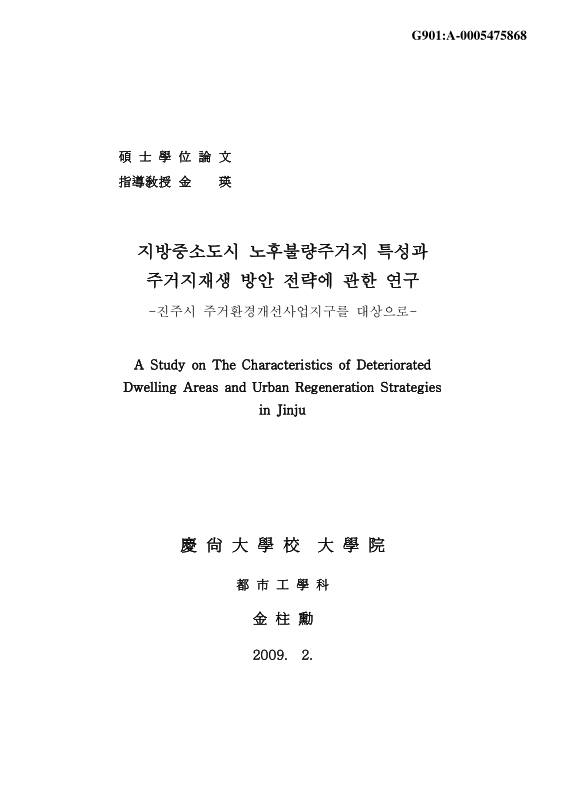
표제지
감사의 글
목차
Abstract 10
I. 서론 12
1.1. 연구의 배경 및 목적 12
1.2. 선행연구 14
1.3. 연구방법 14
II. 주거환경개선사업 이론적 배경 17
2.1. 주거환경개선사업의 도입배경 17
2.2. 주거환경개선사업의 의의 19
2.3. 주거환경개선사업의 사업방식 20
2.4. 주거환경개선사업 현황 26
III. 주거환경개선사업의 문제점 29
3.1. 문제의 근원 30
IV. 진주시 주거환경개선사업지구 분석 34
4.1. 주거환경개선사업지구 분석 34
4.2. 진주시 주거환경 개선사업지구 정량적 분석 37
4.3. 대상지 현황 50
가) 강남지구 50
나) 상봉서지구 51
다) 평거3지구 53
V. 대표적 노후불량 주거지의 특성 분석 56
5.1. 분석에 따른 주민 설문조사 분석 56
5.2. 노후 불량주택의 사회적 특성 56
5.3. 노후불량주거지 거주민의 복지적 특성 58
5.4. 노후불량주거지 거주민의 경제적 특성 59
5.5. 노후 불량주거지의 물리적 특성 60
5.6. 설문에 따른 노후불량 주거지의 특성과 재생전략 65
VI. 결론 66
참고문헌 69
부록 71
부록 1 71
〈부록 1〉 진주시 주거환경개선사업 후 건축물 현황 71
〈부록 2〉 진주시 주거환경개선사업 후 건축물 현황 72
〈부록 3〉 진주시 주거환경개선사업 후 건축물 현황 73
〈부록 4〉 진주시 주거환경개선사업 후 건축물 현황 74
〈부록 5〉 진주시 주거환경개선사업 후 건축물 현황 75
부록 2. 노후불량 주거지 재생을 위한 거주자 의식조사 76
〈그림 2-1〉 주택재건축사업의 추진절차도 23
〈그림 2-2〉 주택재개발사업의 추진절차도 24
〈그림 2-3〉 주거환경개선사업의 추진 절차도 25
〈그림 3-1〉 주거환경개선사업 문제점 33
〈그림 4-1〉 진주시 주거환경개선사업 현황 35
〈그림 4-2〉 지표별 물리적 비교 Z-Score 값 (1) 40
〈그림 4-3〉 지표별 물리적 비교 Z-Score 값 (2) 41
〈그림 4-4〉 지표별 물리적 비교 Z-Score 값 (3) 42
〈그림 4-5〉 노후건축물 비율 43
〈그림 4-6〉 도로율 44
〈그림 4-7〉 무허가 건축물 비율 45
〈그림 4-8〉 생활보호 대상자 비율 46
〈그림 4-9〉 세입자 비율 47
〈그림 4-10〉 인구 분포 현황 48
〈그림 4-11〉 필지당 면적 49
〈그림 4-12〉 필지수 50
〈그림 4-13〉 강남지구 주거환경개선계획도 51
〈그림 4-14〉 상봉서 지구 주거환경개선계획도 53
〈그림 4-15〉 평거3지구 주거환경개선계획도 55
〈그림 5-1〉 노후불량주거지 사회적 특성 현황 (1) 57
〈그림 5-2〉 노후불량지 노후도 현황 (강남, 상봉서, 평거3) 62
〈그림 5-3〉 노후불량지 구조별 현황 (강남, 상봉서, 평거3) 63
〈그림 5-4〉 노후불량지 층수 현황 (강남, 상봉서, 평거3) 64
Recently, much attention has been paid to urban slums and deteriorated residential environment due to vacant/abandoned houses in medium-and- small cities in Korea. Since 1989, the Korean Government has established and implemented some special urban policies particularly in order to improve residential environment for low-income peoples as well as weak and old peoples. However, most polices have been focused on physical improvement of the deteriorated residential areas in metropolitan cities without considering the social environment of residential communities in small cities.
This study aims to analyze the characteristics of residential environment improvement and to suggest some strategic alternatives for renewal of residential areas in terms of economic and social/welfare regeneration considering residents income and welfare. For this study, a medium-and-small city, Jinju in Gyeongnam Province, has been chosen and 18 districts have been selected for residential environment improvement in city center and inner city. The sites survey has been implemented to explore the physical characteristics of residential areas from 1991 to 2006. In addition, a questionnaire survey has been investigated focusing on potential characteristics to improve the efficiency. Finally, we suggest diverse planning and regeneration techniques and policies based on physical and social/welfare improvement with resident participation in deteriorated areas.*표시는 필수 입력사항입니다.
| 전화번호 |
|---|
| 기사명 | 저자명 | 페이지 | 원문 | 기사목차 |
|---|
| 번호 | 발행일자 | 권호명 | 제본정보 | 자료실 | 원문 | 신청 페이지 |
|---|
도서위치안내: / 서가번호:

우편복사 목록담기를 완료하였습니다.
*표시는 필수 입력사항입니다.
저장 되었습니다.
