
 대표어
대표어
권호기사보기
| 기사명 | 저자명 | 페이지 | 원문 | 기사목차 |
|---|
결과 내 검색
동의어 포함
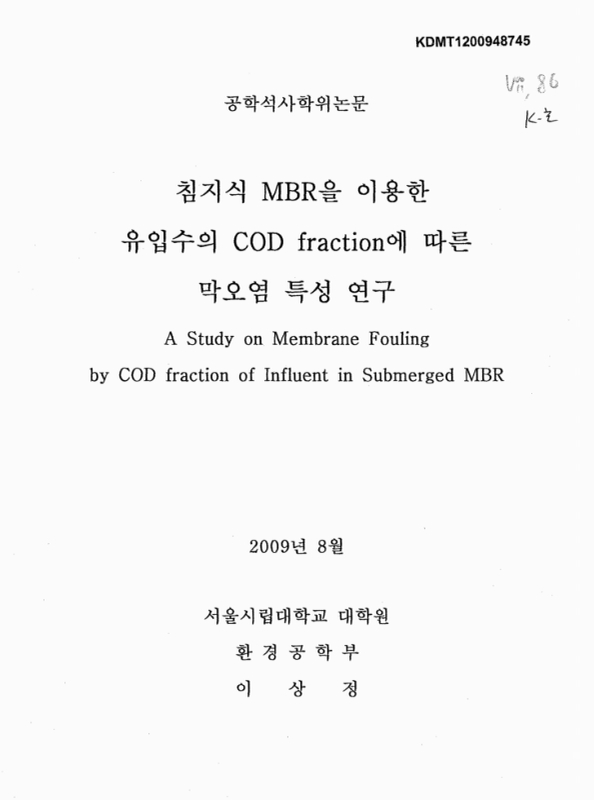
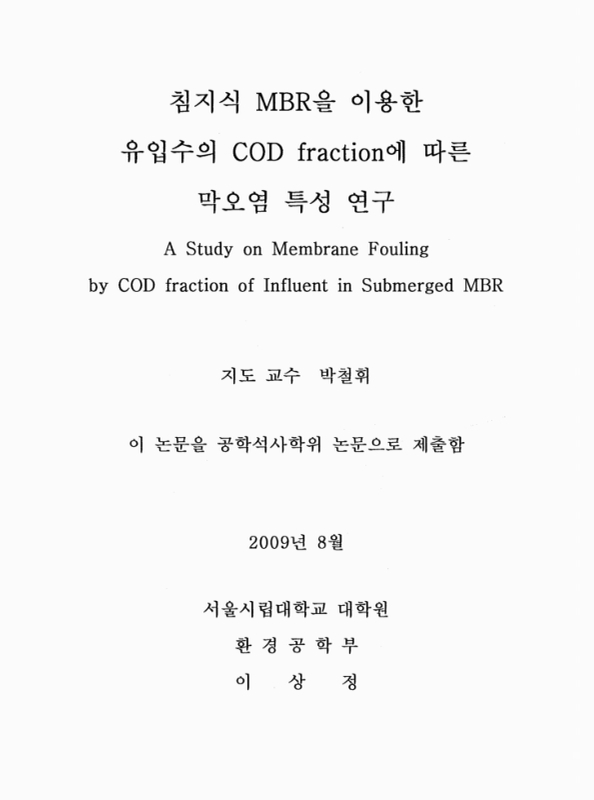
표제지
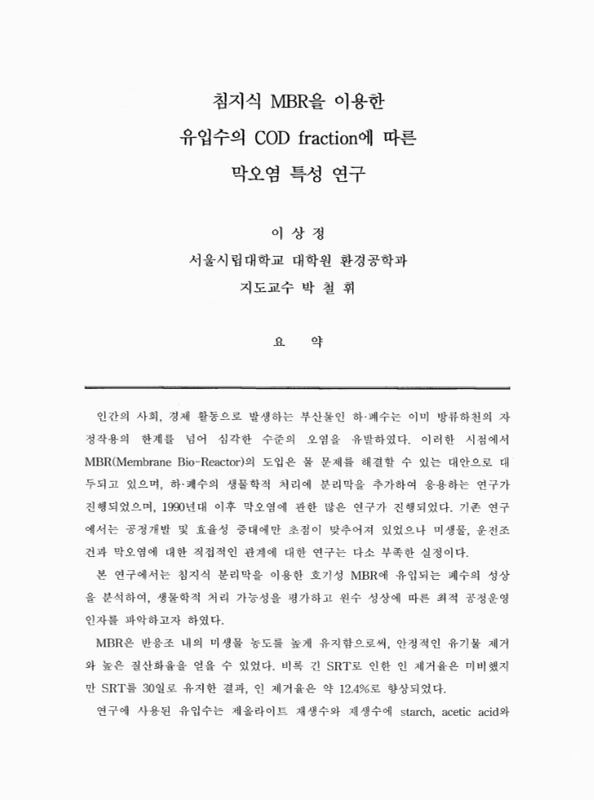
요약
목차
1. 서론 14
1.1. 연구배경 및 목적 14
1.2. 연구내용 및 범위 15
2. 이론적 배경 16
2.1. 유입수의 특성과 화학 양론적 계수의 결정 16
2.1.1. 유입수의 COD 구성 16
2.1.2. 동역학 계수와 화학 양론적 계수의 결정 21
2.2. 막결합형 활성슬러지 공정 24
2.2.1. MBR의 개요 24
2.2.2. 막의 종류와 이용 24
2.2.3. 막분리 활성슬러지 공정 28
2.3. 막오염(Fouling) 32
2.4. 생물학적 질소처리 38
2.4.1. 질산화 39
2.4.2. 질산화 저해인자 40
3. 실험장치 및 방법 43
3.1. 실험장치 43
3.2. 운전 mode 설정 45
3.3. 실험방법 47
3.3.1. 유입수 성상분석 47
3.3.2. EPS 분석 49
3.3.3. 막 저항 측정 50
3.3.4. 주사전자현미경(S.E.M.) 분석방법 53
3.3.5. 분석항목 및 방법 54
4. 연구결과 및 고찰 55
4.1. MBR 공정의 처리수질 및 제거효율 55
4.1.1. 유기물 거동 55
4.1.2. 질소, 인 거동 58
4.2. 동역학계수 62
4.2.1. YH 산정(이미지참조) 62
4.2.2. bH 산정(이미지참조) 64
4.3. 유입폐수 성상 67
4.4. 막오염 74
4.4.1. 임계플럭스(Critical flux) 74
4.4.2. 유입원수의 입경 76
4.4.3. 유입수의 양이온 77
4.4.4. 여과저항 78
4.5. 막 표면 분석 86
5. 결론 88
References 90
ABSTRACT 97
Figure 2.1. Two modeling approaches for the activated sludge process (a) Death-regeneration (b) traditional 17
Figure 2.2. Division of organics by biodegradability(Wentzel et al., 1995) 17
Figure 2.3. Graph of OUR curve 20
Figure 2.4. Oxygen consumption and COD 23
Figure 2.5. Membrane classification pore size 25
Figure 2.6. Schematic diagram of cross flow MBR 29
Figure 2.7. Schematic diagram of submerged MBR 30
Figure 2.8. Factors of influencing membrane fouling in MBR(Chang et al, 2002) 32
Figure 2.9. Schematic fouling process 34
Figure 2.10. Schematic of model for biomass, EPS, SMP(Laspidou, 2002) 37
Figure 2.11. Concept on the behaviour of EPS in the mixed liquor and on the membrane surface in MBR 37
Figure 2.12. Nitrogen cycle in surface water(U. S. EPA. 1993) 38
Figure 2.13. Nitrogen transformation in biological nitrification 39
Figure 3.1. Apparatus for this MBR study 43
Figure 3.2. Schematic of lab-scale MBR and photograph of membrane 44
Figure 3.3. Apparatus for YH and SI estimation(이미지참조) 47
Figure 3.4. Apparatus for respirometric test 48
Figure 3.5. Photographs of microplate reader and 96 well plate 49
Figure 3.6. Steps to measure the filtration resistance 50
Figure 3.7. Photographs of Scanning Electron Microscope 53
Figure 4.1. CODcr conc. and removal efficiency during the operation period(이미지참조) 56
Figure 4.2. BOD conc. and removal efficiency during the operation period 56
Figure 4.3. Variation of MLSS and MLVSS conc. during the operation period 57
Figure 4.4. SS conc. and removal efficiency during the operation period 58
Figure 4.5. TKN and NO3--N conc. during the operation period(이미지참조) 59
Figure 4.6. TN conc. during the operation period 59
Figure 4.7. Variation of alkalinity consumption rate during the operation period 60
Figure 4.8. TP conc. and removal efficiency during the operation period 61
Figure 4.9. Relation between BCOD and SCOD in MBR for estimating 63
Figure 4.10. Estimation of YH using △BCOD/△SCOD(이미지참조) 63
Figure 4.11. Change of In OUR according to time for bH(이미지참조) 65
Figure 4.12. Effects of the F/M ratios 68
Figure 4.13. Respirometric test result according to modes 69
Figure 4.14. Batch test result of SI conc. according to modes(이미지참조) 70
Figure 4.15. Comparison of COD fraction according to modes 73
Figure 4.16. Change of TMP under flux-step increase 75
Figure 4.17. Distribution of particle size in the influent 76
Figure 4.18. Variation of cation conc. 77
Figure 4.19. Comparison of membrane fouling resistance values according to modes 79
Figure 4.20. Comparison of protein and polysaccharide according to modes 81
Figure 4.21. Comparison of membrane fouling resistance values according to HRT 82
Figure 4.22. Comparison of protein and polysaccharide according to HRT 83
Figure 4.23. The change of flux and TMP during the operation period 84
Figure 4.24. Flux recovery rate during the operation period 85
Figure 4.25. SEM image of uncontaminated membrane surface 86
Figure 4.26. SEM images of contaminated membrane surface 87
*표시는 필수 입력사항입니다.
| 전화번호 |
|---|
| 기사명 | 저자명 | 페이지 | 원문 | 기사목차 |
|---|
| 번호 | 발행일자 | 권호명 | 제본정보 | 자료실 | 원문 | 신청 페이지 |
|---|
도서위치안내: / 서가번호:

우편복사 목록담기를 완료하였습니다.
*표시는 필수 입력사항입니다.
저장 되었습니다.
