
 대표어
대표어


권호기사보기
| 기사명 | 저자명 | 페이지 | 원문 | 기사목차 |
|---|
결과 내 검색
동의어 포함
표제지
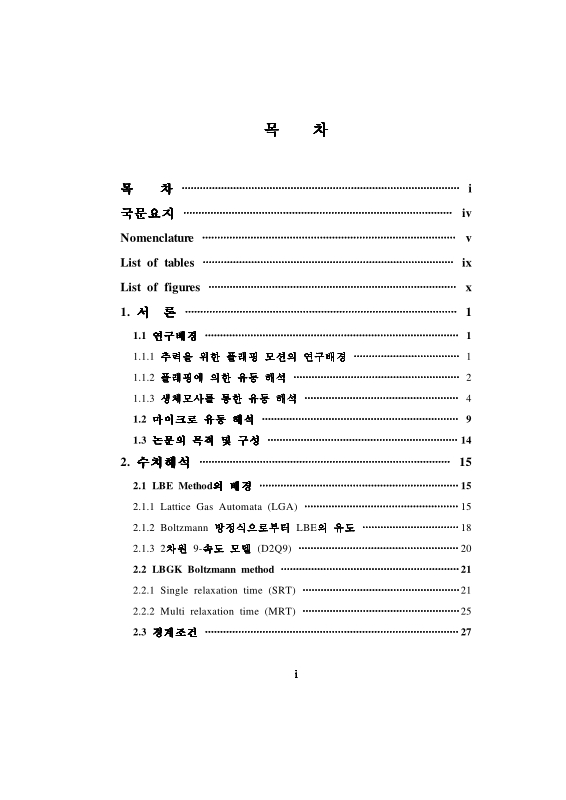
목차
국문요지 7
Nomenclature 8
1. 서론 17
1.1. 연구 배경 17
1.1.1. 추력을 위한 플래핑 모션의 연구배경 17
1.1.2. 플래핑에 의한 유동 해석 20
1.1.3. 생체모사를 통한 유동 해석 21
1.2. 마이크로 유동의 해석 25
1.3. 논문의 목적 및 구성 30
2. 수치 해석 31
2.1. LBE Method의 배경 31
2.1.1. Lattice Gas Automata (LGA) 31
2.1.2. Boltzmann 방정식으로 LBE의 유도 34
2.1.3. 2차원 9-속도 모델(D2Q9) 36
2.2. LBGK Boltzmann method 37
2.2.1. Single relaxation time (SRT) 37
2.2.2. Multi relaxation time (MRT) 41
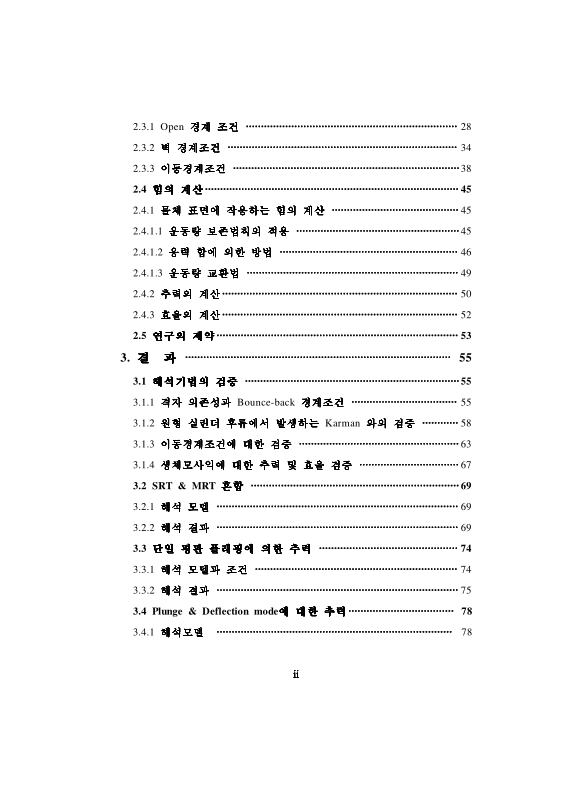
2.3. 경계 조건 43
2.3.1. Open 경계 조건 44
2.3.2. 벽 경계조건 50
2.3.3. 이동 경계조건 54
2.4. 힘의 계산 61
2.4.1. 물체 표면에 작용하는 힘의 계산 61
2.4.2. 추력의 계산 (계산 조건) 66
2.4.3. 효율의 계산 68
2.5. 연구의 제약 69
3. 결과 71
3.1. 해석 기법의 검증 71
3.1.1. 격자 의존성과 Bounce-back 경계조건 71
3.1.2. 원형 실린더 후류에서 발생하는 Karman 와의 검증 74
3.1.3. 이동경계조건에 대한 검증 79
3.1.4. 생체모사익에 대한 추력 및 효율 검증 83
3.2. SRT & MRT 혼합 격자볼츠만법 모델 85
3.2.1. 해석 모델 85
3.2.2. 해석 결과 85
3.3. 단일 평판 플래핑에 의한 추력 90
3.3.1. 해석 모델 및 조건 90
3.3.2. 해석 결과 91
3.4. Plunge & Deflection mode에 대한 추력 94
3.4.1. 해석 모델 94
3.4.2. 해석 결과 95
3.5. Amplitude change에 대한 추력추력 100
3.5.1. 해석 모델 100
3.5.2. 해석 결과 101
4. 결론 106
Reference 108
ABSTRACT 116
감사의 글 117
연구 윤리 서약서 119
Declaration of Ethical Conduct in Research 120
Fig. 1.1. The size of creatures in nature and its flapping frequencies 18
Fig. 1.2. Knudsen number regimes and its adequate simulation methods 26
Fig. 1.3. Each Equation and its characteristics 26
Fig. 1.4. Schematic view of classification of flow modeling 28
Fig. 2.1. Modeling of molecular dynamics in lattice gas automata 31
Fig. 2.2. The FHP hexagonal lattice 33
Fig. 2.3. A FHP collision with two equivalent states 33
Fig. 2.4. 2-dimensional 9-velocity model(D2Q9) 36
Fig. 2.5. Schematic view of streaming step in LBM 40
Fig. 2.6. Schematic view of momentum exchange during collision step 41
Fig. 2.7. Schematic view of periodic boundary condition 45
Fig. 2.8. Configuration of particle distribution at inlet 48
Fig. 2.9. Schematic views of the boundary condition on curved cylinder 50
Fig. 2.10. Illustration of a moving boundary with velocity uw.(이미지참조) 52
Fig. 2.11. Illustration of the boundary conditions for a rigid wall located arbitrarily between two grid sites in one dimension. The thin solid lines are the grid lines, the dashed is the boundary location situated arbitrarily between two grids. 56
Fig. 2.12. The generation of a new solid node in a moving boundary problem 58
Fig. 2.13. The generation of a new fluid node in a moving boundary problem 58
Fig. 2.14. Extrapolation to new fluid node from solid node by neighboring fluid nodes 60
Fig. 2.15. Control volume for momentum analysis 61
Fig. 2.16. Friction and pressure forces on the surface 63
Fig. 2.17. Extrapolation from the virtual points which were interpolated 64
Fig. 2.18. Schematics of momentum exchange on the surface between solid and fluid nodes 65
Fig. 2.19. Domain of this study and boundary conditions 67
Fig. 2.20. Each drag period by a sinusoidal motion of obstacle 67
Fig. 2.21. Coefficient of drag for fixed circular cylinders. 69
Fig. 3.1. A pair vortex behind the circular cylinder in Re=40 71
Fig. 3.2. Grid dependency test for half and mid grid through the length of pair vortex behind the circular cylinder in Re=40 72
Fig. 3.3. Pressure coefficient distributions on the circular cylinder in Re=40 73
Fig. 3.4. X-directional forces at each pressure and friction force on the circular cylinder in Re=200 75
Fig. 3.5. Y-directional forces at each pressure and friction force on the circular cylinder in Re=200 75
Fig. 3.6. Drag and lift coefficient on the circular cylinder in Re=200 76
Fig. 3.7. Strouhal number for various Reynolds number with other numerical and experimental methods 78
Fig. 3.8. Vorticity contour of a fixed circular cylinder in Re=185 79
Fig. 3.9. Time-averaged values of CD(mean) and r.m.s values of CD and CL for Re=185(이미지참조) 80
Fig. 3.10. Phase angle between cylinder and CL for Re=185(이미지참조) 81
Fig. 3.11. Graph for tendency of CD and CL for Re=185(이미지참조) 82
Fig. 3.12. Effect of reduced frequency on thrust power coefficient and efficiency at Re=100 84
Fig. 3.13. Pressure for moving cylinder(Fе/Fθ=0.8)(이미지참조) 88
Fig. 3.14. Pressure for moving cylinder(Fе/Fθ=1.0)(이미지참조) 89
Fig. 3.15. Nomenclature for a Heaving Flat Plate 90
Fig. 3.16. Thrust Coefficients and Efficiencies of the Flat Plate Due to the Change in the Reynolds and Strouhal Numbers 92
Fig. 3.17. Vorticity Distributions Behind the Plate 93
Fig. 3.18. Vorticity Distributions Behind the Plate(h/C=0.5, Re=100, St=0.6) 93
Fig. 3.19. Plunge & Deflection models nomenclature 94
Fig. 3.20. Effect of flexure amplitude on the thrust coefficient when Re=50 and k=2. 97
Fig. 3.21. Time evolution of the vorticity behind the flapping foil (Re=50 and k=2.0). 98
Fig. 3.22. Effect of flexure amplitude on the thrust coefficient when Re=50 and k=5. 99
Fig. 3.23. Nomenclature of propulsion device types. 100
Fig. 3.24. Comparison of thrust coefficient values among the several propulsion types. 102
Fig. 3.25. Time evolution of the vorticity behind the moving foil(Re=50). 104
Fig. 3.26. Comparison of propulsive efficiencies among the several propulsion types 105
최근 Micro Air Vehicle(MAV)이나 Nano Air Vehicle(NAV)의 활발한 연구로 플래핑에 의한 추력발생의 메카니즘이 새로운 관심의 대상이 되고 있다. 또한, 인체 혈관 내 약물의 이송이나 비절개 수술(Minimally invasive surgeries, MIS)을 목표로 마이크로 유동에서의 추력발생에 대한 연구들이 시작되고 있다. 하지만, 아직 마이크로 유동에 대한 플래핑 추력발생에 대한 연구는 시도되지 않고 있다. 따라서 본 연구에서는 향후 마이크로 단위의 초소형 비행체나 혈관 내 유영 등의 응용을 위한 기초 연구로써 마이크로 유동 내 플래핑에 의한 추력발생 조건들을 수치적인 모사를 통해 고찰하고자 한다.
마이크로 유동에서 작동하는 플래핑 모션을 수치적으로 정확하고 효과적으로 모사하기 위해 본 연구에서는 격자볼츠만법을 사용하였다. 격자볼츠만법은 마이크로 유동의 모사에 있어서 기존 연속체 기반의 CFD 해석 방법에 비하여 수학적, 물리적으로 더욱 타당한 해석방법이다. 또한 격자 볼츠만법 중 SRT 뿐만 아니라 MRT를 혼합하여 계산의 안정성과 결과의 정확성을 높이고자 하였다.
먼저, 마이크로 유동(Re≤100) 내에서 레이놀즈수 감소에 따른 급격한 추력 감소를 단일 평판의 플래핑에 대한 Strouhal수를 증가시켜 추력을 생성시킬 수 있는 조건들을 규명하였다. 추력생성의 최적 히브진폭은 레이놀즈수가 감소함에 따라 더 크게 나타나는 것을 확인하므로써 마이크로 유동 내 플래핑을 이용한 추력발생의 응용에서 설계변수의 선정 기준으로 활용이 가능하도록 하였다.
다음으로 마이크로 유동에서 급격하게 감소되는 추력을 향상시키기 위한 방법으로 여러 가지 변화된 생체모사익을 시뮬레이션 해 보았으며 그 효과를 규명하였다.*표시는 필수 입력사항입니다.
| 전화번호 |
|---|
| 기사명 | 저자명 | 페이지 | 원문 | 기사목차 |
|---|
| 번호 | 발행일자 | 권호명 | 제본정보 | 자료실 | 원문 | 신청 페이지 |
|---|
도서위치안내: / 서가번호:

우편복사 목록담기를 완료하였습니다.
*표시는 필수 입력사항입니다.
저장 되었습니다.
