
 대표어
대표어

권호기사보기
| 기사명 | 저자명 | 페이지 | 원문 | 기사목차 |
|---|
결과 내 검색
동의어 포함
Title Page
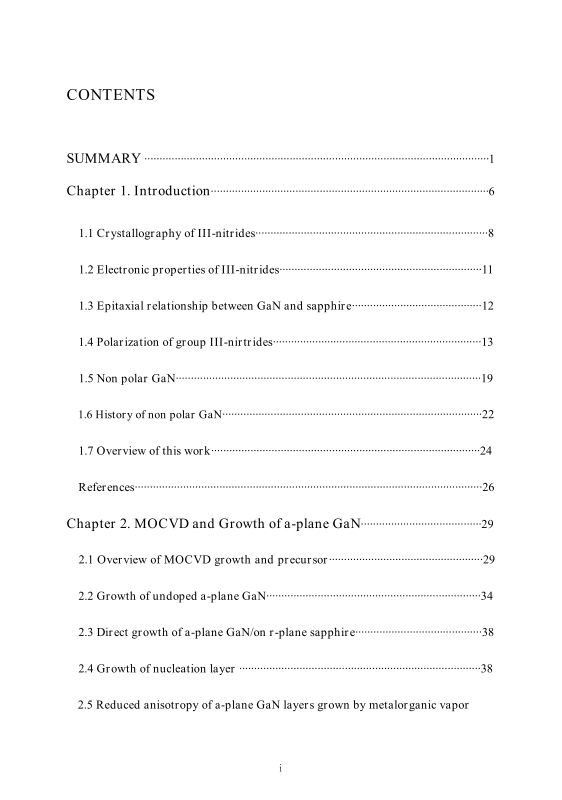
Contents
SUMMARY 15
Chapter 1. Introduction 20
1.1. Crystallography of III-nitrides 22
1.2. Electronic properties of III-nitrides 25
1.3. Epitaxial relationship between GaN and sapphire 26
1.4. Polarization of group III-nirtrides 27
1.5. Nonpolar GaN 33
1.6. History of nonpolar GaN 36
1.7. Overview of this work 38
References 40
Chapter 2. MOCVD and Growth of a-plane GaN 43
2.1. Overview of MOCVD growth and precursor 43
2.2. Growth of undoped a-plane GaN 48
2.3. Direct growth of a-plane GaN/on r-plane sapphire 52
2.4. Growth of nucleation layer 52
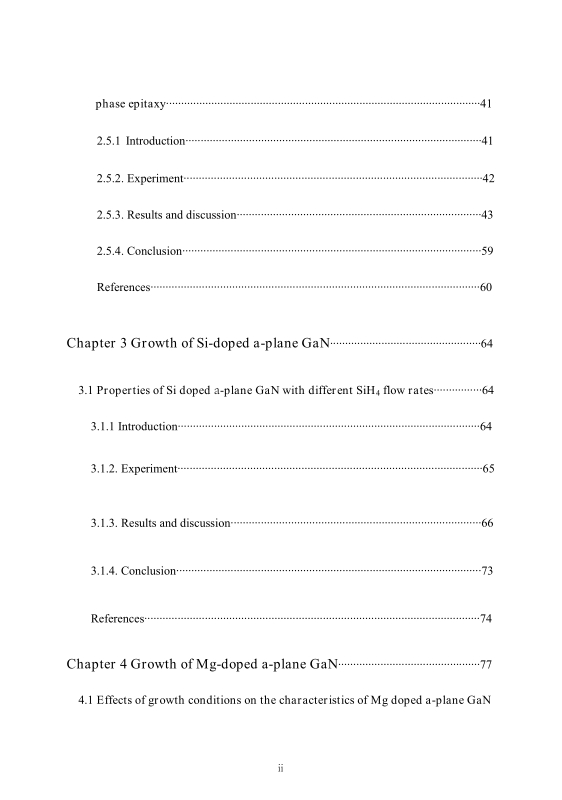
2.5. Reduced anisotropy of a-plane GaN layers grown by metalorganic vapor phase epitaxy 55
2.5.1. Introduction 55
2.5.2. Experiment 56
2.5.3. Results and discussion 57
2.5.4. Conclusion 73
References 74
Chapter 3. Growth of Si-doped a-plane GaN 78
3.1. Properties of Si doped a-plane GaN with different SiH₄ flow rates 78
3.1.1. Introduction 78
3.1.2. Experiment 79
3.1.3. Results and discussion 80
3.1.4. Conclusion 88
References 88
Chapter 4. Growth of Mg-doped a-plane GaN 92
4.1. Effects of growth conditions on the characteristics of Mg doped a-plane GaN 92
4.1.1. Introduction 92
4.1.2. Experiment 94
4.1.3. Results and Discussion 95
4.1.4. Conclusion 108
References 109
4.2. Growth behavior and growth rate dependency in LEDs performance for Mg doped a-plane GaN 111
4.2.1. Introduction 111
4.2.2. Experiment 113
4.2.3. Results and discussion 114
4.2.4 Conclusion 126
References 128
Chapter 5. Growth of a-plane InGaN/GaN MQW and LEDs 131
5.1. Growth pressure dependence of optical and structural properties of a-plane InGaN/GaN multi-quantum on r-plane sapphire 131
5.1.1. Introduction 131
5.1.2. Experiment 133
5.1.3. Results and discussion 134
5.1.4. Conclusion 145
5.2. Structural and optical properties of InGaN/GaN multiple quantum wells : The effect of NH₃ flow and structural parameters for MQWs 146
5.2.1. Experiment 146
5.2.2. Effect of NH₃ flow rate 146
5.2.3. Effect of InGaN well width 147
5.2.4. Effect of the number of InGaN well 149
5.3. Nonpolar InGaN/GaN LEDs 150
5.3.1. Introduction 150
5.3.2. Experiment 151
5.3.3. Characteristics of a-plane LEDs 152
References 155
Chapter 6. Conclusion 158
초록 163
PUBLICATIONS 168
Fig. 1.1. Enery bandgap and lattice constant of compound semiconductor materials. Recently the bandgap energy of InN is reported as 0.7eV. 21
Fig. 1.2. The wurtzite structure of III-nitride 22
Fig. 1.3. Atomic arrangement in Ga-face and N-face GaN. 23
Fig. 1.4. Schematic representation of the in-plane atomic arangement in the case of a (0001) GaN grown on c plane sapphire [15]. White: III-plane of GaN, black: Oplane of sapphire. 27
Fig. 1.5. Schematic illustration of the Spontaneous polarization in wurtzite GaN. The small and large spheres indicate Ga and N, respectively. The arrows indicate the directions of dipole moments, pointing from the anion (N) to the cation (Ga). 28
Fig. 1.6. Spontaneous and piezoelectric polarization effects on different faces of GaN under compressive and tensile strain. 29
Fig. 1.7. Band profiles in 5 nm GaN and 10 nm Al0.1Ga0.9N quantum wells. (a) Growth direction is assumed along (0001) direction and the polarizations fields result in a quantum confined Stark effect and poor electron-hole overlap. (b) (1100) oriented structure is free of electrostatic fields, therefore flat-band conditions are...(이미지참조) 32
Fig. 1.8. Schematic bandstructure diagram of GaInN/GaN QW oriented along different crystal axes (a, c, e). Sketch of QW plane in the hexagonal crystal structure (b, d, f). Situation of polar c-axis (a, b), non-polar m-axis (c, d), and nonpolar a-axis growth (e, f) [25]. 35
Fig. 1.9. Schematic illustration of the epitaxial relationship between GaN and r-plane sapphire. The positive GaN c-axis points in same direction as the sapphire c-axis projection on the growth surface. 36
Fig. 2.1. Crystallography of sapphire substrate 50
Fig. 2.2. Schematic growth temperature profile of (112-0) nonpolar a-plane GaN by using MOCVD(이미지참조) 51
Fig. 2.3. 1 μm × 1 μm AFM images of GaN nucleus grown on r-plane sapphire substrates with thickness of (a) 50 nm, (b) 120 nm, (c) 150 nm, and (d) 250 nm, respectively [23]. 54
Fig. 2.4. Changes of the full width at half maximum (FWHM) of the X-ray rocking curves for the (a) on-axis (112-0) and (b) off-axis (101-1) plane of a-plane GaN grown with different initial growth pressure.(이미지참조) 59
Fig. 2.5. Measurements of reflectance intensity during the a-plane GaN growth with different initial growth pressure. 61
Fig. 2.6. AFM surface morphologies for the nucleation layers grown with different initial growth pressure, (a) 200 mbar, (b) 400 mbar, (c) 500 mbar, (d) 600 mbar. The scale of AFM image is 5 μm × 5 μm. 63
Fig. 2.7. The results of X-ray diffraction (XRD) measurements with (a) 2θ-ω scan of the nucleation layers grown at 200 mbar and 600 mbar. (b) Change of the full width at half maximum (FWHM) of the X-ray rocking curves for the on-axis (112_0) plane of the nucleation layers grown at 200 mbar and 600 mbar.(이미지참조) 66
Fig. 2.8. Room temperature PL spectra of the a-plane GaN grown with different initial growth pressure. 67
Fig. 2.9. The evolution of surface morphology obtained by SEM during the early stage of direct growth of a-plane GaN 69
Fig. 2.10. AFM results of surface morphology (20 ㎛ × 20㎛) during the early stage of direct growth of a-plane GaN, corresponding to the SEM results. 70
Fig. 2.11. Plan-view TEM images revealing threading dislocation densities ((a) and (b)) and basal stacking faults ((c) and (d)) for the sample A ((a) and (c)) and B ((c) and (d)). The diffraction conditions for (a) and (b), and (c) and (d) are g=0002 and 11_00, respectively.(이미지참조) 72
Fig. 3.1. Nomarski optical microscope images of a-plane GaN films with different SiH₄ flow rates: (a) 0, (b) 6.61, (c) 64.9 and (d) 81.1 nmol/min. The images were taken at a 100× magnification. 81
Fig. 3.2. (a) On-axis full width at half maximum (FWHM) values of the X-ray rocking curves measured along c- and m-axis directions and (b) off-axis FWHM values of a-plane GaN. 83
Fig. 3.3. Room temperature carrier concentration and mobility of a-plane GaN with different SiH₄ flow rates. 84
Fig. 3.4. Room temperature photoluminescence (PL) spectra of a-plane GaN with different SiH₄ flow rates. 86
Fig. 3.5. Peak position of near band edge (NBE) emission as a function of carrier concentration with a solid guideline for the eye. 87
Fig. 4.1. Hole concentration and mobility of Mg doped a-plane GaN at room temperature as a function of growth pressure. 96
Fig. 4.2. The plan view SEM images for Mg-doped a-plane GaN layers as a function of growth pressure of (a) 100 mbar, (b) 200 mbar, and (c) 300 mabr, respectively. 98
Fig. 4.3. Hole concentration and mobility of Mg-doped a-plane GaN at room temperature with different NH₃ flow rate. 100
Fig. 4.4. The plan view SEM images for Mg-doped a-plane GaN layers with different NH₃ flow rate of (a) 6000 sccm, (b) 8000 sccm, and (c) 10000 sccm, respectively. 101
Fig. 4.5. Hole concentration and mobility of Mg-doped a-plane GaN at room temperature with increasing Cp₂Mg flow rate. 103
Fig. 4.6. The plan view SEM images for Mg-doped a-plane GaN layers with increasing Cp₂Mg flow rate of (a) 420 sccm, (b) 450 sccm, (c) 475 sccm, and (d) 500 sccm, respectively. 105
Fig. 4.7. The panchromatic CL mapping images with NH₃ flow rate of (a) 6000 sccm, (b) 10000 sccm, respectively. Plan view TEM results of Mg doped a-plane GaN with Cp₂Mg flow rate of 475 sccm. (c) The stacking faults with g vectors 11-00, and (d) the partial dislocations with g vector 0002, respectively.(이미지참조) 107
Fig. 4.8. SEM surface images of Mg-doped a-plane GaN with a growth rate of (a) 0.8 Å/sec, (b) 1.2 Å/sec, (c) 1.5 Å/sec, and (d) 2.2 Å/sec, respectively. 116
Fig. 4.9. Cross-sectional STEM images of Mg-doped a-plane GaN with a growth rate of (a) 0.8 Å/sec, (b) 1.5 Å/sec, and (c) 2.2 Å/sec, respectively. 118
Fig. 4.10. (a) A plan view SEM, and (b) panchromatic mapping CL result of Mg-doped a-plane GaN with at a growth rate of 0.8 Å/sec, and (c) crosssectional TEM image of Mg-doped a-plane GaN with a growth rate of 2.2 Å/sec. 120
Fig. 4.11. Hole concentration and mobility of Mg-doped a-plane GaN at room temperature as a function of growth rate. 123
Fig. 4.12. (a) Current-voltage (I-V) characteristics, (b) Electroluminescence (EL) intensity, and (c) EL spectra of LEDs with p-GaN growth rate of 0.8 Å/sec and 2.2 Å/sec for different drive current. 125
Fig. 5.1. High resolution TEM (HRTEM) image and CBED patterns which were obtained with Z = [1-100] from the a-plane GaN grown on r-plane sapphire.(이미지참조) 135
Fig. 5.2. The room temperature PL peak wavelength and intensity of MQWs grown at different growth pressure. 136
Fig. 5.3. The XRD ω-2θ scan for (112-0) of MQWs grown at different growth pressure.(이미지참조) 138
Fig. 5.4. The thickness of well and barrier (one pair) of MQWs grown at different growth pressure, which was obtained from XRD ω-2θ scan for (112-0) plane.(이미지참조) 139
Fig. 5.5. PL spectra of MQWs grown at 100 mbar and 400 mbar with the same thickness (18nm) of well and barrier (one pair). 140
Fig. 5.6. The variation of wafer temperature at susceptor temperature 800 ℃, and temperature difference, ΔT = susceptor temperature - wafer temperature, as a function of growth pressure. 142
Fig. 5.7. The room temperature PL spectra for MQWs grown at 100 mbar and 400 mbar with wafer temperature 667 ℃. 144
Fig. 5.8. The characteristics of room temperature PL spectra with different NH₃ flow. 147
Fig. 5.9. The characteristics of PL spectra with different well width in MQWs. 148
Fig. 5.10. The characteristics of room temperature PL spectra with different number of InGaN well. 149
Fig. 5.11. Schematic cross-section of the a-plane LED structure grown on r-plane sapphire. 152
Fig. 5.12. (a) Electroluminescence (EL) spectra, and (b) current-voltage (I-V) characteristic of LED with for different drive current, from 20 mA to 100 mA, emitting image of nonpolar LED (c) after chip process, and (d) package 153
밴드갭이 큰 GaN 반도체와 이와 관련된 질화물계 화합물 반도체는 직접 천이형 반도체로써 InN의 경우 0.65 eV, GaN 3.4 eV, 그리고 AlN 6.2 eV의 밴드갭을 가지고 있기 때문에 발광다이오드, 반도체 레이저, 광감지기 등 광소자 응용에 적합한 유망한 물질이다. 따라서 질화물계 반도체는 3원계 또는 4원계 화합물 형성을 통해 짧은 자외선 영역부터 가시광선 영역, 적외선 영역에 이르는 넓은 스팩트럼 영역에 걸쳐 광소자 응용이 가능하다. 최근 질화물계 반도체 산업은 빠른 기술적 진보를 통해 이미 발광다이오드나 반도체 레이저 소자의 양산 수준에 도달해 있다. 이러한 소자는 백색발광다이오드를 통해 기존의 BLU와 조명시장을 대체해 나가고 있으며, 저에너지 소모, 높은 발광효율 구현을 통해 차세대 광원으로 큰 각광을 받고 있다.
상업적으로 적용 가능한 질화물계 발광다이오드는 조밀육방구조(hcp)의 c-축 방향으로 성장이 된다. 이러한 c-축 질화물 반도체는 자발분극과 압전분극 성질이 있어 원하지 않는 내부적으로 강한 전계가 존재하게 된다. 이러한 분극에 기인한 전계는 전자와 정공의 분포를 공간적으로 분리를 시켜 발광 효율을 감소시키고, 내부 전계가 없을 때에 비해 발광 파장이 길어지는 현상이 관찰된다. 이런 분극에 기인한 전계는 무분극 a-축 또는 반분극 m-축 질화물 반도체 박막 성장을 통하여 제거 될 수 있다. 그러나 c-축 질화물 반도체와 달리 이런 무분극 또는 반분극 질화물 반도체의 성장은 적층결함(stacking fault) 또는 전위결함(dislocation)과 같은 결정 결함으로 인하여 성장이 매우 어려운 단점이 있다. 이런 단점을 극복하기 위하여 핵성장 층으로 저온성장 GaN 버퍼층, 고온 성장 AlGaN 버퍼층, 고온 성장 AlN/AlGaN 버퍼층 등 다양한 성장 방법들이 연구되어 시도되고 있다. 하지만 기존의 이러한 방법들을 통하여 매끄러운 표면의 고품질 GaN 성장에는 한계가 있다. 초기 성장 시 거친 표면의 3D 성장과 이어지는 2D 성장 모드로 이루어지는 2 단계 성장 방법은 r-면 사파이어 기판 위에 매끄러운 표면과 고품질의 무분극 GaN 성장 구현을 위한 주요한 방법으로 여겨지고 있다. 고효율의 발광다이오드 규현을 위해서는 고품질의 GaN 성장은 필수적이다. 본 논문에서는 기존의 성장 모드를 개선해 r-면 사파이어 기판 위에 저온성장 버퍼층 없이 고온의 질소분위기에서 GaN 성장과 3D-2D 성장 모드 변화를 통한 새로운 방법의 2 단계 GaN 성장 방법을 사용하였다.
본 연구에서 무분극 GaN는 r-면 사파이어 기판 위에 저온 버퍼층 없이 직접 성장하는 새로운 방법의 2 단계 성장 법을 적용하였으며, MOCVD를 이용한 무분극 GaN 성장 시 3D 성장단계 동안 성장 압력이 결정학적 이방성과 결정성에 미치는 영향을 연구 고찰하였다. 초기 1 단계 성장 동안 성장 압력은 200 mbar ~ 600 mbar로 변화시켰으며, 이어지는 2 단계 성장에서는 수평성장을 통한 매끄러운 표면 특성을 얻기 위하여 성장압력을 100 mbar로 일정하게 고정하였다. X-선 회절, in-situ 반사도 측정, 표면형상관찰(AFM), 광학적 발광특성(PL) 결과는 초기 성장 단계의 성장압력이 결정학적 등방성과 고품질의 무분극 GaN 성장에 있어서 매우 중요한 역할을 수행함을 보여주고 있다.
Si 유량을 변화시키며 Si이 도핑 된 무분극 n 형 GaN를 MOCVD를 이용하여 성장하였다. Si 유량에 따른 (110) XRD rocking 측정 결과 c-축과 m-축 방향에 걸쳐 FWHM의 값은 큰 변화를 보이지 않았다. Si의 도핑 유량이 증가함에 따라 (101) XRD rocking의 FWHM은 점차 감소하는 모습을 보였는데, 이는 egde 성분의 dislocation 감소를 의미한다. Si 유량이 증가함에 따라 전자농도와 이동도가 증가하는 모습을 보이는데, 이는 edge 성분의 dislocation의 감소로 설명 될 수 있다. PL 발광특성 관찰 결과 Si 유량이 증가함에 따라 PL 피크는 장파장 쪽으로 이동했다가 단파장 쪽으로 이동하는 모습을 관찰 할 수 있었다.
Mg이 도핑된 p형 무분극 GaN를 MOCVD의 성장 조건을 다양하게 변화시키며 특성을 관찰하였다. 홀 효과와 SEM을 통한 표면 관찰 결과 MOCVD 성장 시 성장압력, Ⅴ/Ⅲ 비율, Mg 유량에 따라 특성은 매우 민감하게 변하였다. 성장압력이 증가함에 따라 정공의 전도도와 표면 형상은 삼각형 모양의 pit을 가지며 매끄럽게 변하였다. 암모니아 유량에 따라 pit이 많은 표면 형상은 매끄럽게 개선되었고, Mg 유량은 성장 표면 반응기들의 표면확산을 용이하게 하여, 표면 형상을 변화시켰다. 최고의 정공 농도는 Mg 유량이 475 sccm일 경우 얻을 수 있었고, 음극선발광(CL)과 투과전자현미경을 이용해 결정성을 평가하였다.
Mg이 도핑된 p형 GaN을 성장할 때 성장속도가 표면형상, 전기적 특성과 InGaN 기반의 LED 특성에 미치는 영향을 연구하였다. Mg이 도핑 된 무분극 GaN의 성장은 MOCVD를 이용하였다. 주사전자현미경(SEM), 투과전자현미경(TEM)과 음극선 발광(CL) 측정결과를 통하여 성장속도가 증가됨에 따라 줄무늬 패턴과 큰 삼각형 pit을 갖는 표면 형상은 V형태의 pit을 갖는 매우 거친 표면으로 변화였다. 성장 속도가 증가함에 따라 Mg의 농도는 증가되었지만 도펀트의 정공으로 활성화 비율은 감소하였다. Mg이 도핑 된 무분극 p형 GaN 표면 형상에 따른 LED 소자를 평가해 본 결과, 성장속도가 낮을 경우 동작전압은 감소하였지만, 전기발광(EL) 특성은 성장 속도가 높을 경우 발광세기가 증가하였다.
MOCVD를 이용하여 InGaN 기반의 MQW를 성장 할 때 성장 압력이 MQW의 특성에 미치는 영향을 연구하였다. MQW 성장 시 성장 압력은 100 mbar ~ 400 mbar로 변화시켰으며, 그 밖의 다른 성장 조건은 일정하게 고정하였다. CBED 측정을 통하여 r-면 사파이어 기판의 표면과 a-면 무분극 GaN의 극성이 평행한 관계에 있음을 확인하였다. 성장압력이 100 mbar에서 400 mbar로 증가됨에 따라 PL 발광피크는 단파장 쪽으로 이동하고, 피크의 FWHM은 감소되는 모습을 보였다. 반면 성장 압력이 증가함에 따라 PL 발광세기는 크게 증가하는 특성을 보였다. 이것은 MOCVD 성장 시 히터의 설정 온도가 동일함에도 불구하고 기판 표면 온도의 변화로 설명된다. 성장압력의 증가는 가스 전도에 의한 기판가열의 기여가 증가되므로 기판의 온도가 증가된다. 기판온도의 증가는 InGaN에서 In의 함량을 감소시켜 PL 피크 파장이 짧아지고, PL 발광 세기가 증가된다. 같은 기판온도에서 성장 압력이 증가됨에 따라 InGaN 기반의 MQW에서 In의 함량과 PL 발광 세기가 증가되었다.
MQW의 성장 조건과 구조를 최적화하기 위하여 암모니아 유량, InGaN 양자우물층의 두께, InGaN 양자우물층의 개수를 변화시키며 PL 발광 특성을 연구하였다. 성장된 LED 에피는 LED 소자 공정을 통하여 LED 칩으로 제작되었으며, 이렇게 제작된 LED 칩에 대하여 전기적, 광학적 (L-I-V) 특성 평가를 수행하였다.*표시는 필수 입력사항입니다.
| 전화번호 |
|---|
| 기사명 | 저자명 | 페이지 | 원문 | 기사목차 |
|---|
| 번호 | 발행일자 | 권호명 | 제본정보 | 자료실 | 원문 | 신청 페이지 |
|---|
도서위치안내: / 서가번호:

우편복사 목록담기를 완료하였습니다.
*표시는 필수 입력사항입니다.
저장 되었습니다.
