
 대표어
대표어

권호기사보기
| 기사명 | 저자명 | 페이지 | 원문 | 기사목차 |
|---|
결과 내 검색
동의어 포함
Title Page
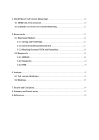
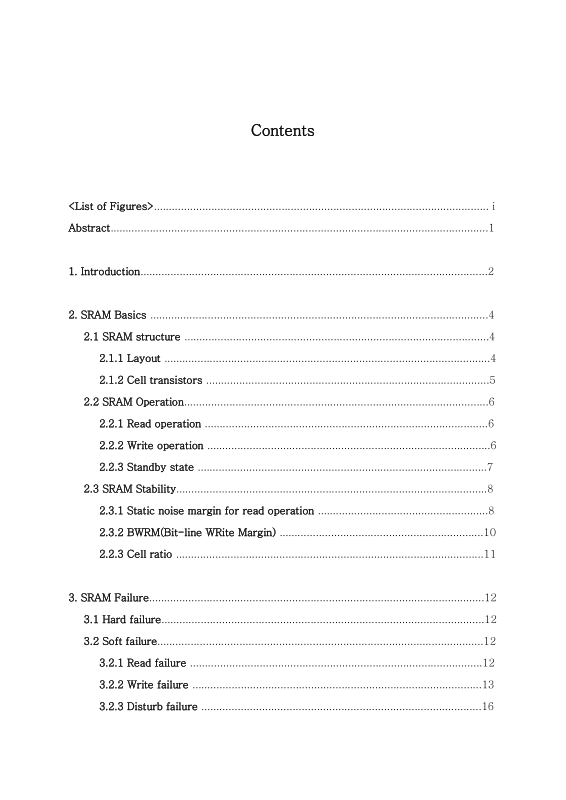
Contents
Abstract 8
1. Introduction 9
2. SRAM Basics 11
2.1. SRAM Structure 11
2.1.1. Layout 11
2.1.2. Cell Transistors 13
2.2. SRAM Operation 13
2.2.1. Read operation 13
2.2.2. Write operation 14
2.2.3. Standby State 15
2.3. SRAM Stability 16
2.3.1. Static noise margin for read operation (SNM) 16
2.3.2. BWRM(Bit-line Write Margin) 18
2.3.3. Cell Ratio 20
3. SRAM Failures 21
3.1. Hard Failures 21
3.2. Soft Failures 21
3.2.1. Read Failure 21
3.2.2. Write Failure 22
3.2.3. Disturb Failure 23
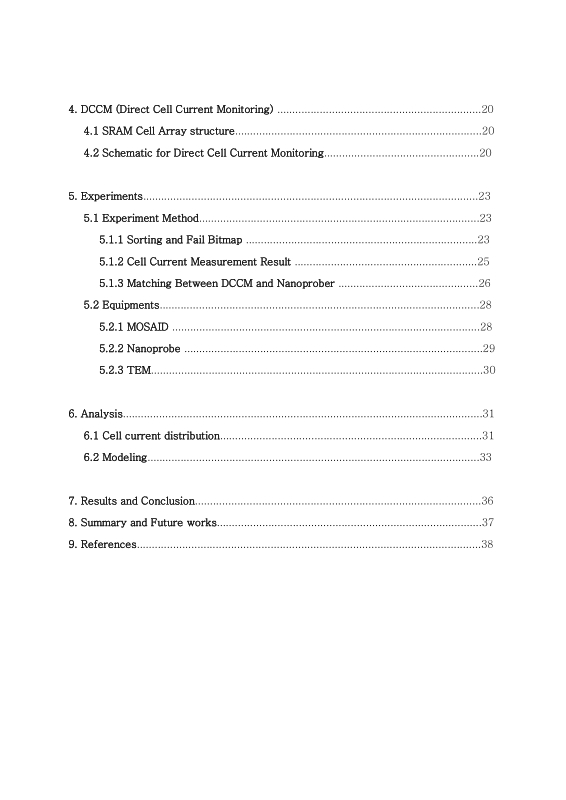
4. DCCM(Direct Cell Current Monitoring) 27
4.1. SRAM Cell Array Structure 27
4.2. Schematic for Direct Cell Current Monitoring(DCCM) 27
5. Experiments 30
5.1. Experiment Method 30
5.1.1. Sorting and Failure Bitmap test 30
5.1.2. Cell Current Measurement Result 32
5.1.3. Matching Between DCCM and Nanoprober 33
5.2. Equipment 35
5.2.1. Memory Test System (MOSAID) 35
5.2.2. Nanoprober 36
5.2.3. TEM(Transmission Electro Microscopy) 37
6. Analysis 38
6.1. Cell Current Distribution 38
6.2. Modeling 40
7. Results and Conclusion 43
8. Summary and Future work 44
References 45
한글요약 46
Fig. 1. Cell size trend comparison with DRAM and SRAM 10
Fig. 2. SRAM bitcell circuit schematic 11
Fig. 3. SRAM bitcell Layout 13
Fig. 4. schematic for Read data “0” 14
Fig. 5. schematic for Write data “0” 14
Fig. 6. schematic for standby state 15
Fig. 7. shows a conceptual setup for modeling SNM 16
Fig. 8. The length of the side of the largest embedded square in the curve is the SNM 17
Fig. 9. (a) Schematic of the 6T bitcell at the onset of a read access 18
Fig. 9. (b) Example butterfly curve plots for SNM during hold and read 18
Fig. 10. (a) Schematic for write margin measurement setup 19
Fig. 10. (b) measured waveforms for write margin using BL sweep 20
Fig. 11. (a) schematic of Soft Read Failure of SRAM And (b) Failure modeling 22
Fig. 12. (a) Schematic of Soft Write Failure of SRAM 23
Fig. 12. (b) Modeling of Soft Write Failure of SRAM 23
Fig. 13. Disturb Failure of SRAM 25
Fig. 14. Mechanism of SRAM DNM Failure 26
Fig. 15. Cell current distribution of SRAM 26
Fig. 16. SRAM Cell array 27
Fig. 17. Two currents paths for a bit cell storing a 0 and a 1 28
Fig. 18. Cell current measuring schematic 29
Fig. 19. 8M SRAM device Sorting Bitmap 30
Fig. 20. Fail bitmap vs Vcc(process B) 31
Fig. 21. Fail bit counts vs Vcc(process B) 31
Fig. 22. Read current on real cell array 32
Fig. 23. Nanoprobing image in the real cell array 33
Fig. 24. Id-Vg curve by Nanoprobing 34
Fig. 25. MS4205 system 35
Fig. 26. The configuration of Nanoprobe's measurement environment 36
Fig. 27. TEM(Transmission Electro Microscopy) 37
Fig. 28. Test Bitmap of Single bit failures(process A) 39
Fig. 29. Pass Tr. cell current distributions by using DCCM 40
Fig. 30. abnormal cell current flip point 41
Fig. 31. Physical TEM image of abnormal flipped cell 42
Fig. 32. Failure mechanism Circuit 42
*표시는 필수 입력사항입니다.
| 전화번호 |
|---|
| 기사명 | 저자명 | 페이지 | 원문 | 기사목차 |
|---|
| 번호 | 발행일자 | 권호명 | 제본정보 | 자료실 | 원문 | 신청 페이지 |
|---|
도서위치안내: / 서가번호:

우편복사 목록담기를 완료하였습니다.
*표시는 필수 입력사항입니다.
저장 되었습니다.
