
 대표어
대표어

권호기사보기
| 기사명 | 저자명 | 페이지 | 원문 | 기사목차 |
|---|
결과 내 검색
동의어 포함
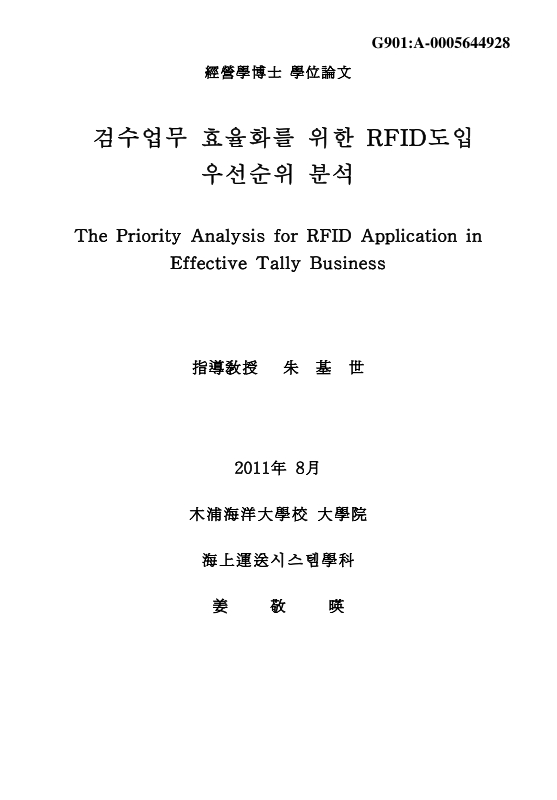
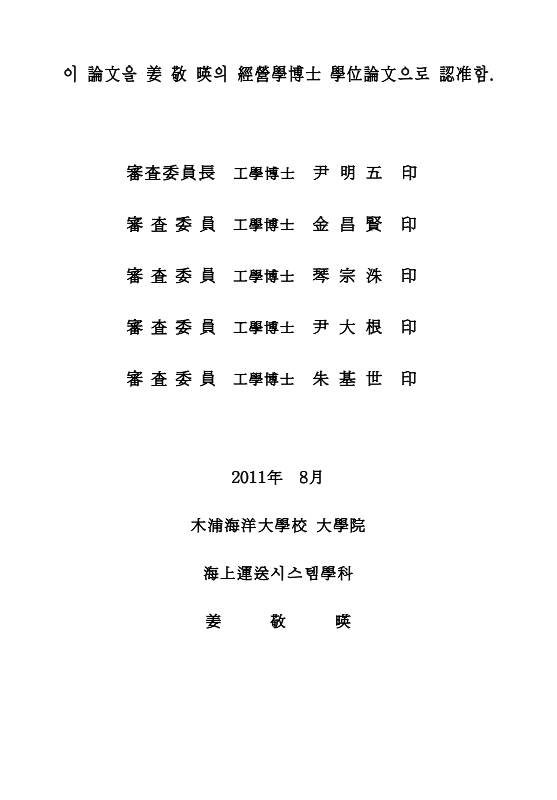
표제지
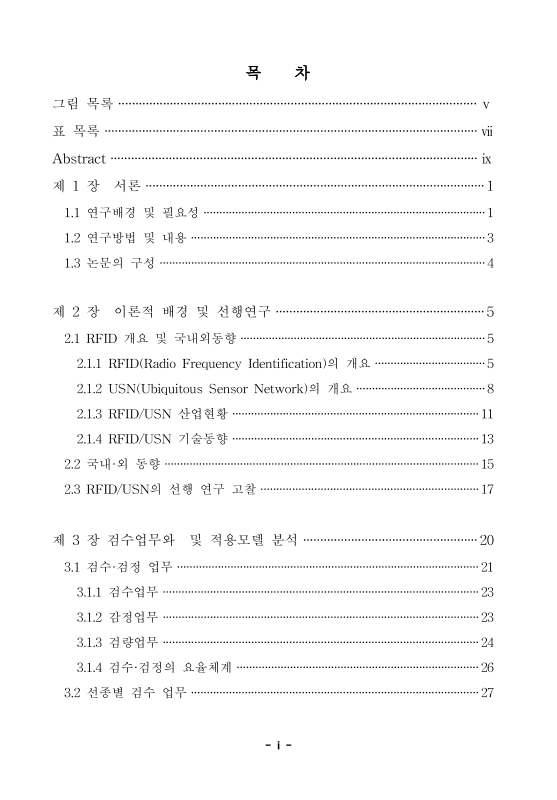
목차
Abstract 11
제1장 서론 13
1.1. 연구배경 및 필요성 13
1.2. 연구방법 및 내용 15
1.3. 논문의 구성 16
제2장 이론적 배경 및 선행연구 17
2.1. RFID/USN 개요와 및 국내·외 현황 17
2.1.1. RFID의 개요 17
2.1.2. USN(Ubiquitous Sensor Network)의 개요 20
2.1.3. RFID/USN 산업 현황 23
2.1.4. RFID/USN 기술동향 25
2.2. 국내·외 동향 27
2.3. RFID/USN의 선행 연구고찰 29
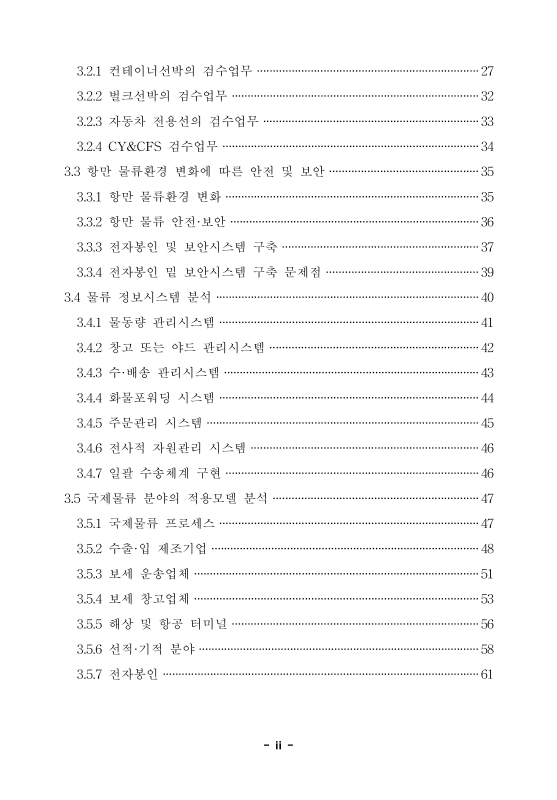
제3장 검수업무 및 국제물류 분야의 적용모델 분석 33
3.1. 검수·검정 업무 34
3.1.1. 검수업무 35
3.1.2. 감정업무 36
3.1.3. 검량업무 37
3.1.4. 검수·검정의 요율체계 39
3.2. 선종별 검수업무 39
3.2.1. 컨테이너선박의 검수업무 39
3.2.2. 벌크선박의 검수업무 45
3.2.3. 자동차 전용선의 검수업무 46
3.2.4. CY(container yard) & CFS(container freight station) 검수업무 47
3.3. 항만물류 환경 변화에 따른 안전 및 보안 48
3.3.1. 항만물류 환경 변화 48
3.3.2. 항만 물류 안전·보안 49
3.3.3. 전자봉인 및 보안 시스템 구축 50
3.3.4. 전자봉인 및 보안 시스템 구축 문제점 52
3.4. 물류 정보시스템 분석 53
3.4.1. 물동량 관리 시스템 54
3.4.2. 창고 또는 야드관리 시스템(WMS) 55
3.4.3. 수·배송 관리 시스템(TMS) 56
3.4.4. 화물포워딩 시스템 57
3.4.5. 주문관리 시스템 (OMS) 58
3.4.6. 전사적 자원관리 시스템(ERP) 59
3.4.7. 일관 수송체계 구현 59
3.5. 국제 물류분야의 적용모델 분석 60
3.5.1. 국제 물류프로세스 60
3.5.2. 수·출입 제조기업(화주) 61
3.5.3. 보세운송업체 64
3.5.4. 보세창고업체 66
3.5.5. 해상 및 항공 터미널 69
3.5.6. 선적·기적분야 71
3.5.7. 전자 봉인(E-Seal 분야) 74
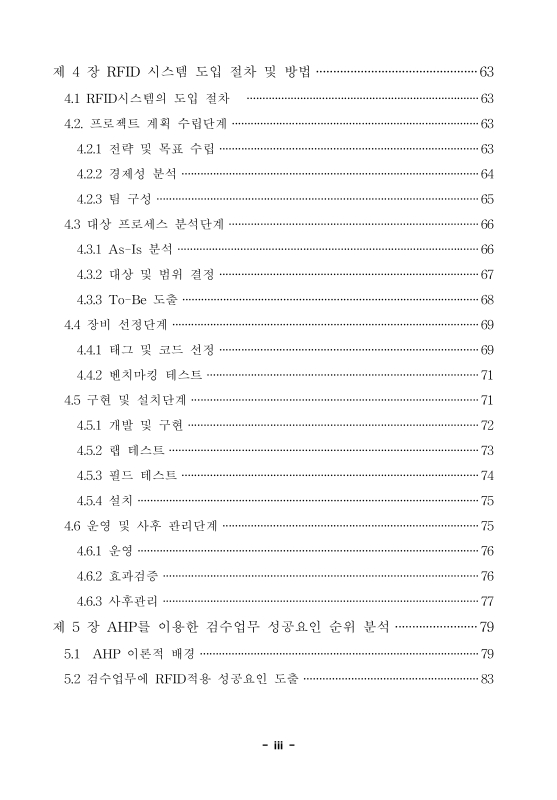
제4장 RFID 시스템 도입 절차 및 방법 76
4.1. RFID 시스템 도입 절차 76
4.2. 프로젝트 계획수립단계 76
4.2.1. 전략 및 목표 수립 76
4.2.2. 경제성 분석 77
4.2.3. 팀 구성 78
4.3. 대상 프로세스 분석 단계 79
4.3.1. As-Is 분석 79
4.3.2. 대상 및 범위 결정 80
4.3.3. To-Be 도출 81
4.4. 장비선정 단계 82
4.4.1. 태그 및 코드 선정 82
4.4.2. 벤치마킹 테스트(Bench Marking Test : BMT) 84
4.5. 구현 및 설치 단계 84
4.5.1. 개발 및 구현 85
4.5.2. 랩 테스트 86
4.5.3. 필드 테스트 87
4.5.4. 설치 88
4.6. 운영 및 사후관리 단계 88
4.6.1. 운영 89
4.6.2. 효과 검증 89
4.6.3. 사후관리(유지 보수) 90
제5장 AHP를 이용한 검수업무 성공요인 순위 분석 92
5.1. AHP 이론적 배경 92
5.2. 검수업무에 RFID 적용 성공 요인 도출 96
5.3. 연구모형 및 조사 설계 100
5.3.1. 계층화 의사결정법(AHP) 선정 배경 100
5.3.2. RFID 도입 주요성공요인 도출 모형 설계 103
5.3.3. 조사 설계 105
5.4. 실증 분석 106
5.4.1. 일관성 검증 106
5.4.2. 계층적 분석 결과 107
5.4.3. 1차 구조화된 계층 모형의 비교 분석 110
5.4.4. 2차 구조화된 계층모형의 비교분석 111
제6장 결론 116
참고문헌 118
그림 3-1. 컨테이너 선박의 검수 업무 40
그림 3-2. 자동차 선박의 검수 업무 46
그림 3-3. CY&CFS의 검수 업무 47
그림 3-4. U-Port 개념도 54
그림 3-5. 국제물류 프로세스의 흐름도 61
그림 3-6. RFID 도입전 수출입 제조기업(화주)의 물류관리 흐름도(As-Is모델) 63
그림 3-7. RFID적용 수출입 제조기업 국제물류 관리(To-Be 모델) 64
그림 3-8. RFID 도입전 항공보세운송 업무 흐름도(As-Is 모델) 65
그림 3-9. RFID적용 항공보세운송 업무 흐름도(To-Be 모델) 67
그림 3-10. RFID 도입전 보세창고 업무 흐름도(As-Is모델) 68
그림 3-11. RFID적용 보세창고 업무 흐름도(To-Be 모델) 69
그림 3-12. RFID 도입전 항공터미널 업무처리 흐름도(As-Is 모델) 70
그림 3-13. RFID적용 항공터미널 업무 흐름도(To-Be 모델) 71
그림 3-14. RFID 도입전 해상화물 선적업무 흐름도(As-Is모델) 72
그림 3-15. RFID적용 선적업무 흐름도 73
그림 5-1. 연구모형을 위한 RFID 도입 성공요인 도출 과정 98
그림 5-2. 2차적으로 구조화된 계층 모형 104
그림 5-3. 1차적 성공요인 중요도 비교 110
그림 5-4. 2차 구조화된 계층 모형 중 정보관리 요인 중요도 비교 111
그림 5-5. 2차 구조화된 계층 모형 중 활성화 지원 요인 중요도 비교 112
그림 5-6. 2차 구조화된 계층 모형 중 파트너쉽 요인 중요도 비교 113
그림 5-7. 2차 구조화된 계층 모형 중 계획 및 협업 요인 중요도 비교 114
그림 5-8. 2차 구조화된 계층 모형 중 성과관리 요인 중요도 비교 115
The rapidly developed environment by IT makes the paradigm from e-trade to u-trade. Especially, the RFID(Radio Frequency Identification) is being used extensively and gaining widespread acceptance. RFID technology is considered as an effective tool for the business efficiency of logistics sector and the improvement of competitive power. And also it provides benefits such as cost saving, revenue and operational effectiveness.
The purpose of this paper is to improve competitiveness of tally business through RFID technology. RFID development is creating an environment which can bring about convenient logistics and economic benefits for all industry. RFID technology allows tracing and real-time information delivery for the entire international logistics process.
This study utilized and applied concepts of tally business by business analysis. It looked into how tally business should be through categorized and analyzed the success factors in terms of tally business. To extract the success factors for introducing RFID in tally business, the AHP(Analytic Hierarchy Process) is used. The two step structured model which consists of 6 success factors in the first step and totally 30 success factors in the second step is constructed. The importance weights are calculated by AHP method. The weights of the first step are such as partner ship(0.0331), information control(0.216), plan and cooperative work(0.186), activation support(0.168), and outcome management(0.10).
This paper will contribute to competitiveness improvement and effectiveness of tally enterprise to introduce RFID system. The introduction of RFID system is option factor but essential factor. Therefore, this study is very useful for tally company in introduction of RFID system.| 번호 | 참고문헌 | 국회도서관 소장유무 |
|---|---|---|
| 1 | 항만물류분야에서의 RFID기술 활용에 대한 고찰 | 소장 |
| 2 | “항만물류 선진화를 위한 RFID 기술도입 방안”, 한국해양수산개발원,2007. | 미소장 |
| 3 | “RTLS/USN 기반 U-Port 국축국토해양부,2008 | 미소장 |
| 4 | Development of Middleware System for Logistic Information Recognition using the RFID | 소장 |
| 5 | The Application Models of RFID on International Trade Logistics Process | 소장 |
| 6 | “수출입물류 보안을 위한 RFID Network에서의 정보시스템 통합모델 연구”,대한산업공학회 추계 학술발표대회 발표논문집,2007 | 미소장 |
| 7 | 전자봉인과 RFID | 소장 |
| 8 | 한국무역정보통신,“RFID기반 국제물류 통합 Platform 구축 연구기획 보고^ 2006, pp20-40 | 미소장 |
| 9 | 산업자원부,“RFED기반 국제물류 통합 Platform 구축 연구기획보고서”,2007 | 미소장 |
| 10 | “항만컨테이너터미널 게이트 입/출입 관리에서의 RFID적용에 관한 승증 연구”,산업공학회지,제20권,제 1호,2007’ pp69-78 | 미소장 |
| 11 | “RFID 기술을 활용한 수출입물류시스템의 구축방안” 무역학회지,제31권,제5호,2006, pp285-304 | 미소장 |
| 12 | WRFID기반 물류시스템의 최근 논의 동향과 전망”,물류유통학회지 t 제10권, 제3호,2007,pp29-52 | 미소장 |
| 13 | Study of RFID Enabled Air Baggage Handling Process | 소장 |
| 14 | “RFID를 이용한 항만 컨테이너 관리 시스템 설계 및 구현” r 한국컨텐츠학회논문지,제6권,제2호,2006, ppl-8 | 미소장 |
| 15 | “AHP Model를 이 용한 은행 IT System 구축 및 검중 방안”, 한국경영과학회,2006 | 미소장 |
| 16 | “Radio Frequency Identification(RFID)’’,Communication & Security, Vol. 25, No. 1, 2006,18 - 26 | 미소장 |
| 17 | “Security Implication in RFID and Authentication Processing Framework ? Communication & Security, VoL 25, No. 3, 2006, 207-212 | 미소장 |
| 18 | “Challenges to Global RFID Adoption” , Technovation, vol 26,No. 12, pp1317-1323 | 미소장 |
| 19 | Design of a RFID case-based resource management system for warehouse operations  |
미소장 |
| 20 | Mobile commerce integrated with RFID technology in a container depot |
미소장 |
| 21 | “Future studies and prospect of RFID” , IITA , 1164 | 미소장 |
| 22 | “RFID labeling” , GreenTeaf Book Group Lie, 2005 | 미소장 |
| 23 | “A Study on methodology for establishing u—business strategy in logistics and distribution industries", Korean Operation Research and Management Society/Korean Institute of Industrial Engineer Spring Joint Conference Journal, 2005, pp497-505 | 미소장 |
| 24 | “RFID for dummies' Wiely, 2005 | 미소장 |
| 25 | “Building a business case for RFID at Dell”, Dell, 2004 | 미소장 |
| 26 | “RFED Forecasts” , Players and Opportunities -2005,IDTechEx, 2005 | 미소장 |
| 27 | Korea Institute of Distribution Logistics, “Passive RFID guideline in department of defense”, Ministry of Commerce, Indusyrt and Energy, 2005 | 미소장 |
| 28 | National Information Society Agency, “A study on the activation strategy and privacy for RFID” , 2004 | 미소장 |
| 29 | A scaling method for priorities in hierarchical structures |
미소장 |
| 30 | How to make a decision: The analytic hierarchy process |
미소장 |
| 31 | “An Analytic Approach to Marketing Decisions” , Prentice-Hall, 1991 | 미소장 |
| 32 | “An Analytic Hierarchy Approach to the Allocation of Resources within a Target Product/Market/Distribution Portfolio”, Proceeding of the First ORSA/TIMS Special Interest Conference on Market Measurement and Analysis, Stanford University, 1980, pp279-297 | 미소장 |
| 33 | Assessing Risk and Uncertainty in New Technology Investments |
미소장 |
| 34 | “ Decision Support Software for Capital Budgeting”, Management Accounting, Vol. 73, 1991,pp50-53 | 미소장 |
| 35 | Using the Analytic Hierarchy Process to Structure the Supplier Selection Procedure |
미소장 |
| 36 | The Analytic Hierarchy Process: A Survey of the Method and Its Applications |
미소장 |
| 37 | Assimilation and Diffusion of Web Technologies in Supply-Chain Management: An Examination of Key Drivers and Performance Impacts |
미소장 |
*표시는 필수 입력사항입니다.
| 전화번호 |
|---|
| 기사명 | 저자명 | 페이지 | 원문 | 기사목차 |
|---|
| 번호 | 발행일자 | 권호명 | 제본정보 | 자료실 | 원문 | 신청 페이지 |
|---|
도서위치안내: / 서가번호:

우편복사 목록담기를 완료하였습니다.
*표시는 필수 입력사항입니다.
저장 되었습니다.
