

본문 바로가기 주메뉴 바로가기
국회도서관 홈으로 정보검색 소장정보 검색

결과 내 검색

동의어 포함

목차보기

표제지

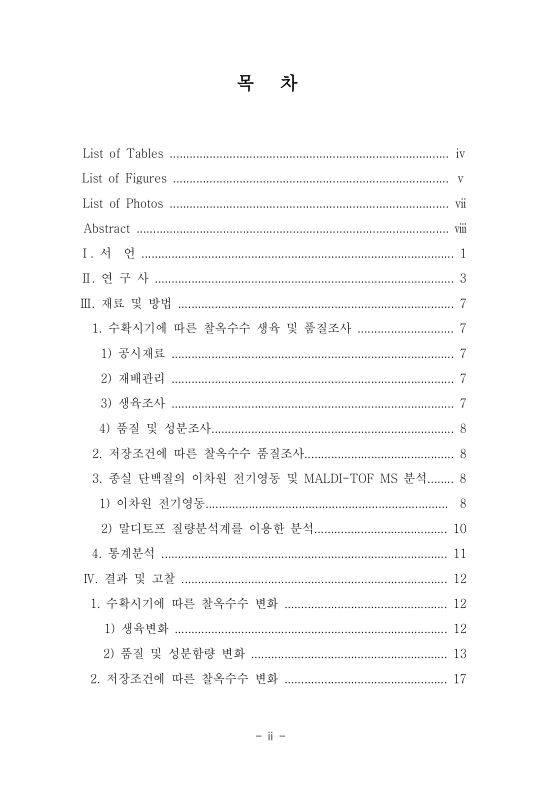
목차

Abstract 10

I. 서언 13

II. 연구사 15

III. 재료 및 방법 19

1. 수확시기에 따른 찰옥수수 생육 및 품질조사 19

1) 공시재료 19

2) 재배관리 19

3) 생육조사 19

4) 품질 및 성분조사 20

2. 저장조건에 따른 찰옥수수 품질조사 20

3. 종실 단백질의 이차원 전기영동 및 MALDI-TOF MS 분석 20

1) 이차원 전기영동 20

2) 말디토프 질량분석계를 이용한 분석 22

4. 통계분석 23

IV. 결과 및 고찰 24

1. 수확시기에 따른 찰옥수수 변화 24

1) 생육변화 24

2) 품질 및 성분함량 변화 25

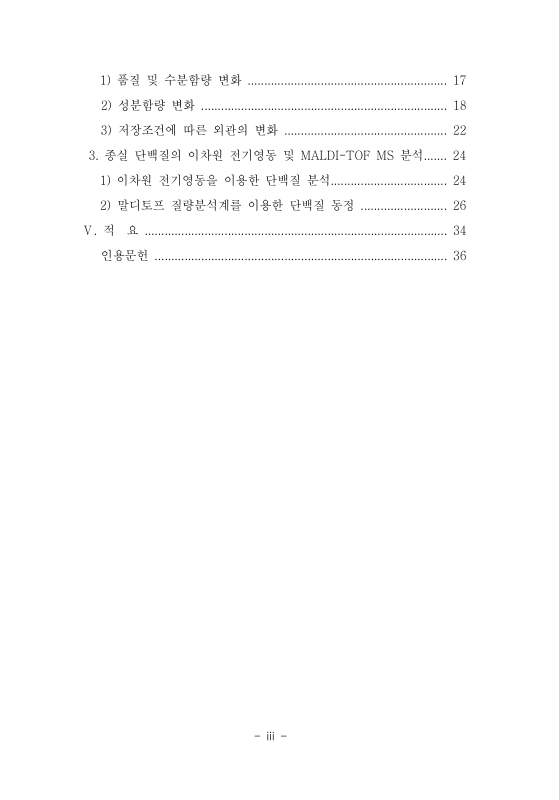
2. 저장조건에 따른 찰옥수수 변화 29

1) 품질 및 수분함량 변화 29

2) 성분함량 변화 30

3) 저장조건에 따른 외관의 변화 34

3. 종실 단백질의 이차원 전기영동 및 MALDI-TOF MS 분석 36

1) 이차원 전기영동을 이용한 단백질 분석 36

2) 말디토프 질량분석계를 이용한 단백질 동정 38

V. 적요 46

인용문헌 48

List of Tables

Table 1. Changes in growth characteristics during ear development in waxy corn 25

Table 2. Identification of up-regulated protein in waxy corn kernel by 2-DE and MALDI-TOF mass spectrometry 39

Table 3. Identification of up-regulated or down-regulated protein in waxy corn kernel by 2-DE and MALDI-TOF mass spectrometry 40

Table 4. The functional distribution of proteins identified in corn kernel stored after harvest 45

List of Figures

Fig. 1. Changes in corn kernel hardness during ear development from 5 days after silking (DAS) to 35 DAS. 26

Fig. 2. Changes in total sugar content of corn kernel during ear development from 5 DAS 35 DAS. 27

Fig. 3. Changes of nutrients in corn kernel during ear development from 5 days after silking (DAS) to 35 DAS. 28

Fig. 4. Changes in moisture content of corn kernel stored at different temperatures. 30

Fig. 5. Changes in total starch (A) and total sugar content (B) of corn kernel stored at different temperatures. 31

Fig. 6. Changes in total protein content of corn kernel stored at different temperatures. 32

Fig. 7. Changes in total lipid content of corn kernel stored at different temperatures. 33

Fig. 8. MALDI-TOF MS of proteins identified as cytosolic triose phosphate isomerase in corn kernel. 41

Fig. 9. MALDI-TOF MS of proteins identified as cytosolic triose phosphate isomerase in corn kernel. 42

Fig. 10. Histogram for the protein expression level of cytosolic triose phosphate isomerase from corn kernel stored for seven days at different temperatures. A: control; B: 0℃; C: 4℃; D: 10℃. 43

List of Photos

Photo. 1. Appearances of waxy corn harvested at different ear development stages (DAS: days after silking). 24

Photo. 2. Appearances of corn kernel stored at different temperatures. 34

Photo. 3. Appearances of corn ear stored at different temperatures. 35

Photo. 4. 2-DE protein expressions from corn kernels stored for seven days at different temperatures. Filled arrows and empty arrows indicate up-regulation and down-regulation, respectively. A: control; B: 0℃; C: 4℃; D: 10℃. 37

Photo. 5. Two-dimensional gel electrophoresis image map of proteins identified in waxy corn kernel. 44

초록보기

Waxy corn is commonly consumed as fresh ear in Korea. In particular, glutinous and sweet corn is preferred due to high palatability. Because the kernel properties can be changed rapidly after harvest, the optimal condition to maintain the quality of corn kernel should be identified. In addition, timing to harvest the ear at the most appropriate time should be determined based on the quality condition of corn. During storage of corn ear, there are various occur in the content of storage materials. Because waxy corn is consumed as fresh condition and stored as fresh ear during which lots of changes in palatability including sweetness and hardness occur. So far, the information on the changes of proteins in kernels related to grain palatability is rare for waxy corn. Therefore, we used a combined two-dimensional gel electrophoresis and mass spectrometry approach to clarify the proteome profile of corn kernels (Zea mays L. cv. Daehakchal). In this research, proteomic approach to the changes was performed to know the quality changes at different storage temperature (0, 4, 10 ℃). Total sugar content was decreased from 12.5% at 10 days after silking (DAS) to 3.5% at 35 DAS reflecting a conversion of sugars to starch during ear development. Kjeldahl nitrogen did not show remarkable change as compared to kernel hardness. Soluble protein level in kernel increased until 10 DAS then decrease slightly. The content was decrease from 1.85% at 5 DAS to 1.45 at 35 DAS. The kernel hardness increased 2.5 fold from 15 DAS to 30 DAS. During storage period, kernel hardness was increased from 726 to 1894 g/㎠ at day 28 at low temperature (0 ℃). Total sugar content decreased regardless of temperature, however, the reduction rate was lower at 0°C than higher storage temperature 3 and 10℃. Reduction rate of moisture content was lower at 0℃ than 4℃ and 10℃ The corn kernels stored at 4℃ showed stable value after 7 days. General changes in kernel chemical components were an increase in starch content and decrease in sugar content during storage. We identified specific thirty proteins that showed obvious changes in level. The remarkable proteins decreased in level as the storage temperature increased were cytosolic triose phosphate isomerase that functions in gluconeogenesis, late embryogenesis abundant protein EMB564 that related to the response to stress, cytosolic malate dehydrogenase, mitochondrial ATP synthase α-subunit, and viviparous-1 protein that functions multicellular osganismal development. On the other hand, 17.8 kDa class II heat shock protein that known as related to stress response was increased as the storage temperature increased. In conclusion, cytosolic triose phosphate isomerase was considered as crucial role in the changes of palatability of corn kernel stored at less favorable condition in which sweetness was lowered and hardness was increased more rapidly. The proteomic examination will facilitate future researches addressing the physiological episodes during corn ear storage under various conditions.

