
 대표어
대표어
권호기사보기
| 기사명 | 저자명 | 페이지 | 원문 | 기사목차 |
|---|
결과 내 검색
동의어 포함
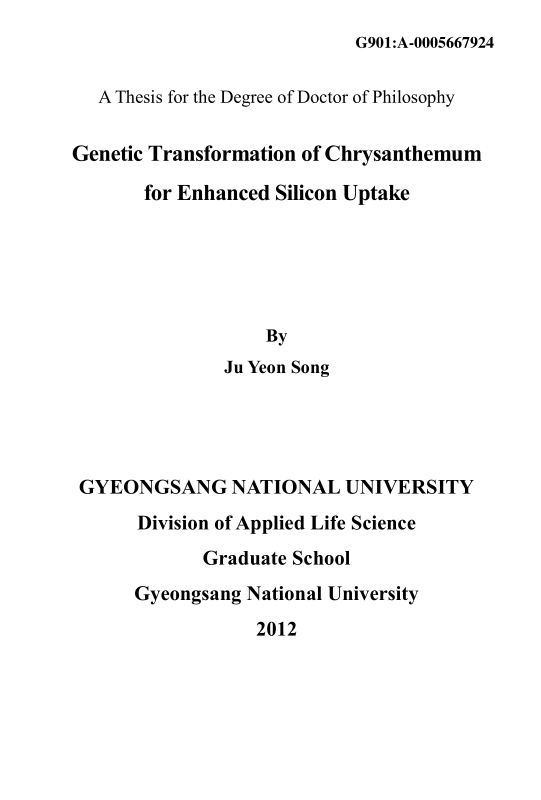
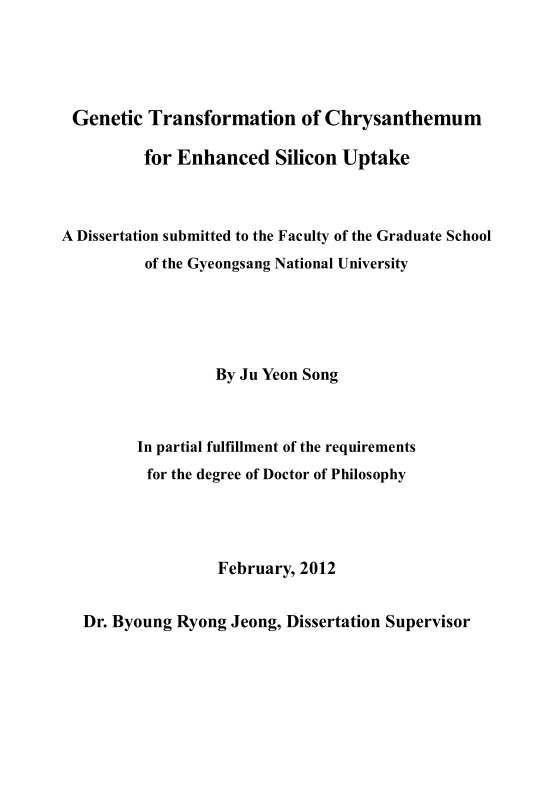
Title Page
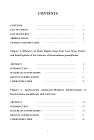
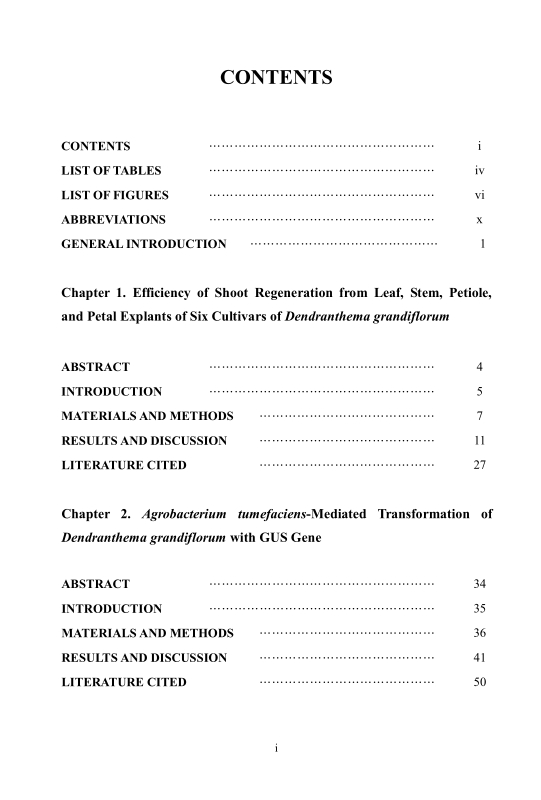
Contents
ABBREVIATIONS 11
GENERAL INTRODUCTION 12
Chapter 1. Efficiency of Shoot Regeneration from Leaf, Stem, Petiole, and Petal Explants of Six Cultivars of Dendranthema grandiflorum 14
ABSTRACT 15
INTRODUCTION 16
MATERIALS AND METHODS 18
Plant materials 18
Shoot induction 20
Rooting and acclimatization 20
Experimental design and statistical analysis 21
RESULTS AND DISCUSSION 22
Shoot induction 22
Rooting and acclimatization 34
LITERATURE CITED 38
Chapter 2. Agrobacterium tumefaciens-Mediated Transformation of Dendranthema grandiflorum with GUS Gene 44
ABSTRACT 45
INTRODUCTION 46
MATERIALS AND METHODS 47
Plant materials, culture media and experimental conditions 47
Agrobacterium strain and culture for transformation 47
Antibiotics used in shoot regeneration and rooting 48
Agrobacterium-mediated transformation 49
GUS assay 50
Genomic DNA isolation and polymerase chain reaction (PCR) analysis 50
Statistical analysis 51
RESULTS AND DISCUSSION 52
Effect of antibiotics on shoot regeneration and rooting 52
Regeneration of transgenic shoots 54
Gus assay 57
PCR analysis 58
LITERATURE CITED 61
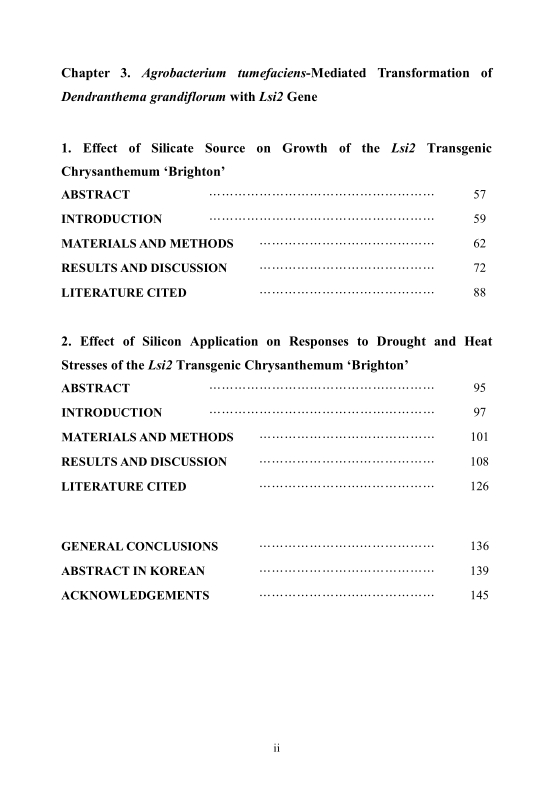
Chapter 3. Agrobacterium tumefaciens-Mediated Transformation of Dendranthema grandiflorum with Lsi2 Gene 67
1. Effect of Silicate Source on Growth of the Lsi2 Transgenic Chrysanthemum 'Brighton' 68
ABSTRACT 68
INTRODUCTION 70
MATERIALS AND METHODS 73
RESULTS AND DISCUSSION 83
LITERATURE CITED 99
2. Effect of Silicon Application on Responses to Drought and Heat Stresses of the Lsi2 Transgenic Chrysanthemum 'Brighton' 106
ABSTRACT 106
INTRODUCTION 108
MATERIALS AND METHODS 112
RESULTS AND DISCUSSION 119
LITERATURE CITED 137
GENERAL CONCLUSIONS 147
초록 150
Fig. 1. Six cultivars used in the experiment for establishment of a plant regeneration protocol 19
Fig. 2. Adventitious shoot development in the petal explant of ‘Brighton’ 29
Fig. 3. Multiple shoots formation in ‘Brighton’ after four weeks in culture on the MS medium containing 1.5 mg·L-1 BA, 1.5 mg·L-1 IAA, and 0.1 mg·L-1 kinetin from the leaf (A), petiole (B), petal (C), and stem (D) explants(이미지참조) 33
Fig. 4. Rooting of shoots cultured on the MS medium containing 1.5 mg·L-1 IAA and acclimatization ex vitro of ‘Brighton’(이미지참조) 36
Fig. 5. A linear map of pCAMBIA 2301 with GUS gene used for plant transformation 48
Fig. 6. The GUS expression on a leaf of a putative transgenic plantlet 58
Fig. 7. A PCR analysis of putative transgenic lines with GUS gene primers 59
Fig. 8. Regeneration protocol of putative trasgenic plantlets from the petal explant 60
Fig. 9. A linear map of pGPTV with the Lsi2 gene used for plant transformation 74
Fig. 10. Photograph showing the culture boxes used in this experiment to air the nutrient solution (A) with a plant of ‘Brighton’ growing (B) 78
Fig. 11. Photograph showing the culture boxes used in this experiment to aerate the nutrient solution (A) with the Lsi2 transgenic ‘Brighton’ growing (B) 81
Fig. 12. A protocol for transformation for the Lsi2 transgenic ‘Brighton’ 84
Fig. 13. The Si content of the non-transgenic ‘Brighton’ shoot measured after 15 days of culture at different K₂SiO₃ concentrations 86
Fig. 14. Effect of four different silicate sources supplied at 0, 50 or 100 mg·L- 1 on root growth of the Lsi2 transgenic ‘Brighton’(이미지참조) 90
Fig. 15. Morphological differences on the SEM and EDS analyses of roots of the Lsi2 transgenic ‘Brighton’ with (+Si) and without (-Si) Si applications 91
Fig. 16. The SEM and WDS analyses showing containment of Si in leaves of the Lsi2 transgenic ‘Brighton’ with and without Si treatments 92
Fig. 17. Effect of Si application on drought tolerance in the Lsi2 transgenic ‘Brighton’ grown in a recirculated nutrient solution in an ebb and flow system for a month and then maintained without irrigation for 7 days 121
Fig. 18. Difference between the -Si and +Si treatments on the development of axillary shoots at the base of the stem after exposure of the plant to a 40℃ temperature for 30 h 124
Fig. 19. Effect of Si application on heat tolerance in the Lsi2 transgenic ‘Brighton’ grown in a recirculated nutrient solution in an ebb and flow system for a month then exposed to a 40℃ temperature for 30 h 125
Fig. 20. Effect of Si application on specific activities of enzymatic antioxidants of the Lsi2 transgenic ‘Brighton’ grown in a recirculated nutrient solution in an ebb and flow system for a month and then maintained without irrigation for 7 days 129
Fig. 21. Effect of Si application on specific activities of enzymatic antioxidants of the Lsi2 transgenic ‘Brighton’ grown in a recirculated nutrient solution in an ebb and flow system for a month and then exposed to a 40℃ temperature for 30 h 130
Fig. 22. Effect of Si application on specific activities of non-enzymatic antioxidant of the Lsi2 transgenic ‘Brighton’ grown in a recirculated nutrient solution in an ebb and flow system for a month and then maintained without irrigation for 7 days 131
Fig. 23. Effect of Si application on specific activities of non-enzymatic antioxidantsof the Lsi2 transgenic ‘Brighton’ grown in a recirculated nutrient solution in an ebband flow system for a month and then exposed to a 40℃ temperature for 30 h. 131
국화는 세계적으로 절화, 분화, 그리고 초본성 화단식물로 주로 재배되는 아주 인기 있는 작물로, 상업적 및 관상적 가치가 커 시장이 빠르게 증가하고 있다. 국화의 식물체 재분화 능력을 이용한 대량증식, 품질개선, 그리고 유전적 특성을 개선하기 위한 형질전환에 대한 연구가 많이 이루어지고 있다.
규소는 토양 내에서 산소 다음으로 풍부한 원소이다. 현재까지 규소는 식물의 필수원소에는 포함되지 않지만 여러 작물에서 규소 시용에 따른 생물적, 비생물적 스트레스에 대한 저항성 증대, 그리고 작물의 생산성과 품질 향상과 같은 효과가 인정되고 있다. 하지만 무토양 배지에서 재배되는 원예작물에서의 규소시용 효과에 대한 연구는 아직 부족하다. 규소흡수를 증진시켜 줄 수 있는 transporter 유전자(Lsi gene)을 삽입한 형질전환 국화를 만들면 규소를 빨리 흡수할 뿐만 아니라 흡수된 규소의 뿌리로부터 지상부로의 이동도 촉진할 것으로 예상된다. 본 연구는 규소 흡수를 증진시키기 위하여 Lsi2 유전자를 국화에 삽입하여 형질전환된 식물체를 얻고 이 식물체의 규소 흡수 능력과 스트레스에 대한 반응을 조사하기 위하여 수행하였다.
제 1장 몇 가지 국화 품종에서 절편제와 생장조절제가 신초 재분화에 미치는 영향
국화 6품종의 잎, 꽃잎, 엽병, 그리고 줄기를 BA를 단용 또는 IAA와 kinetin과 혼용 처리하여 재분화 정도를 조사하였다. 식물생장조절제에 따른 각 품종들의 재분화 효율은 유의적으로 달랐다. 네 가지 다른 절편체(잎, 줄기, 엽병, 그리고 꽃잎) 중에서는 'Brighton' 품종의 꽃잎절편체에서 절편체당 발생한 신초수와 신초발생율이 가장 높았다. 재분화된 신초의 발근을 위해 IAA를 처리한 결과 0.5~1.5mg·L-1 농도에서 식물체당 발생한 뿌리수와 발근율이 가장 높았다. 정상적으로 발근한 식물체를 1주일간 순화과정을 거친 후 온실에서 재배하는데 성공하였다.
제 2장 Agrobacterium tumefaciens을 이용한 국화의 GUS 유전자 형질전환
꽃잎 절편체에 Agrobacterium을 이용한 GUS 유전자의 효율적인 형질전환 체계를 확립하였다. 온실에서 재배되고 있는 국화의 꽃잎을 기내에서 소독한 후, 세 부분으로 나누어 아랫부분을 position 1, 중간부분을 position 2, 그리고 끝부분을 position 3으로 칭하고 position 1과 2의 절편체를 이틀 동안 1.0mg·L-1 IAA, 1.0mg·L-1 BA, 그리고 0.1mg·L-1 kinetin을 함유한 MS배지에서 전배양하였다. 전배양된 절편체를 pCAMBIA 2301을 가지는 Agrobacterium LBA4404로 감염시킨 후, kanamycin 농도와 공동배양기간이 형질전환된 식물체의 재분화에 미치는 영향을 조사하였다. Position 2(꽃잎 절편체의 중간 부분)절편체를 2일 동안 공동배양시 재분화 효율이 가장 높았다. 형질전환된 식물의 선발을 위해 첨가한 kanamycin 농도로는 신초 발생시에는 7.5mg·L-1, 뿌리 발생시에는 20.0mg·L-1가 적합하였다. kanamycin에 내성을 가지는 식물체를 GUS assay와 PCR 분석을 통해 형질전환 여부를 확인한 결과 꽃잎을 절편체로 사용한 국화 형질전환이 성공적으로 이루어졌음을 알 수 있었다.
제 3장 Agrobacterium를 이용한 국화의 Lsi2 유전자 형질전환
1. 네 가지 규산염 처리가 Lsi2 형질전환된 국화 'Brighton'의 생장에 미치는 영향
앞에서 확립된 GUS 유전자 형질전환 프로토콜을 이용하여 Lsi2 유전자를 국화에 삽입한 형질전환체를 선발하고, 4종류의 규산염 처리가 이들의 생장에 미치는 영향을 조사하였다. 온실에서 재배되고 있는 국화의 잎을 채취하여 기내에서 소독한 후, 1.5mg·L-1 IAA, 1.5mg·L-1 BA, 그리고 0.1mg·L-1 kinetin이 함유된 MS배지에서 2일 동안 전배양하였다. Lsi2 유전자가 재조합된 binary vector를 운반하는 Agrobacterium GV3101을 전배양된 절편체에 접종시켰다. 약 2달 후 kanamycin에 내성을 가지는 식물을 선발하여 PCR 분석을 통해 형질전환 여부를 확인하였다. 형질전환된 식물체의 규소 시용효과를 검증하기 위하여 4종의 규산염(CaSiO₃, fumed silicate, K₂SiO₃, 그리고 Na₂SiO₃)을 이용하여 0, 50, 또는 100mg·L-1 Si 농도로 처리하였고, 양액의 EC는 1.8mS·cm-1, pH는 6.0으로 조절하였다. 식물체는 300mL의 양액이 든 350mL 마젠타박스에서 재배하면서 튜브를 에어펌프에 연결하여 공기를 공급하였다. 재배 개시 14일 후 형질전환된 국화를 energy dispersive spectroscopy(EDS)를 이용하여 뿌리, 그리고 wavelength dispersive spectroscopy(WDS)를 이용하여 잎에 축척된 규소 입자를 관찰하였고, inductively coupled plasma atomic emission spectroscopy(ICP-AES)를 이용하여 식물체 내에 존재하는 규소와 다른 원소들의 함량을 조사하였다. 형질전환된 국화에 첨가된 모든 규산염에 의해 식물체의 규소 함량이 높아졌다. CaSiO₃ 처리에서 전반적으로 Ca, K, P, Mg, 그리고 S의 함량이 증가하였고, Fe와 Na의 �t량이 감소하였다. 그 다음으로는 Na₂SiO₃, K₂SiO₃, 그리고 fumed silicate의 순으로 Ca, K, P, Mg, 그리고 S의 함량이 증가하였고, Fe와 Na의 �t량이 감소하였다 또한 규소 처리구에서 뿌리털이 매우 발달하였는데, 그 뿌리털을 EDS로 관찰한 결과 높은 양의 규소가 검출되었다. WDS로 잎 표면을 관찰한 결과 규소 처리구에서 규소 입자가 검출되었다.
2. Lsi2 형질전환된 국화 'Brighton'에 처리한 규소가 건조와 고온 스트레스 내성에 미치는 영향
Lsi2 형질전환된 'Brighton'을 약 한 달간 K₂SiO₃를 이용해 0(-Si), 50(+Si 50), 또는 100(+Si 100)mg·L-1 농도의 Si를 공급하면서 순환식 저면베드에서 재배한 후 건조와 고온 스트레스에 미치는 영향을 조사하였다. 건조처리를 하기 위해 식물체를 식물생장상에서 약 7일 동안 단수된 환경에 노출시켰고, 고온처리를 하기 위해서는 40℃의 온도에 약 30시간 동안 두었다. 식물체의 손상 정도는 electrolyte leakage percent(ELP), Fv/Fm, 그리고 잎이 시든 정도(줄기와 잎이 이루는 각도)로 표기하고, 황산화효소[(superoxide dismutase)SOD, (peroxidase)POD, (catalase)CAT, (glutathione reductase)GR, (ascorbate peroxidase)APX, (guaiacol peroxidase)GPX, (ascorbic oxidase)AO, 그리고 (malondialdehyde)MDA]의 활성분석 및 ICP-AES를 이용한 지상부와 지하부에 축척된 Ca, K, Mg, Na, Mn, Fe, S, P, 그리고 Si 함량을 조사하였다. 건조와 고온에 노출된 형질전환된 식물체에서는 효소적 황산화효소(SOD, POD, CAT, GR, APX, 그리고 GPX)의 활성이 증가하고, 비효소적 황산화효소(ELP, AO, 그리고 MDA)의 활성이 감소하였으며, Fv/Fm와 잎의 각도가 증가하였다. 또한 모든 규소 처리구에서 지상부와 지하부의 규소함량이 증가하였다. 규소처리에 의해 식물체의 Ca함량은 증가하였고 K함량은 감소하였다. 결론적으로, 이 연구를 통해 Lsi2 유전자를 삽입한 형질전환을 통하여 국화의 특성과 생산성 향상의 가능성을 보았다.*표시는 필수 입력사항입니다.
| 전화번호 |
|---|
| 기사명 | 저자명 | 페이지 | 원문 | 기사목차 |
|---|
| 번호 | 발행일자 | 권호명 | 제본정보 | 자료실 | 원문 | 신청 페이지 |
|---|
도서위치안내: / 서가번호:

우편복사 목록담기를 완료하였습니다.
*표시는 필수 입력사항입니다.
저장 되었습니다.
