
 대표어
대표어

권호기사보기
| 기사명 | 저자명 | 페이지 | 원문 | 기사목차 |
|---|
결과 내 검색
동의어 포함
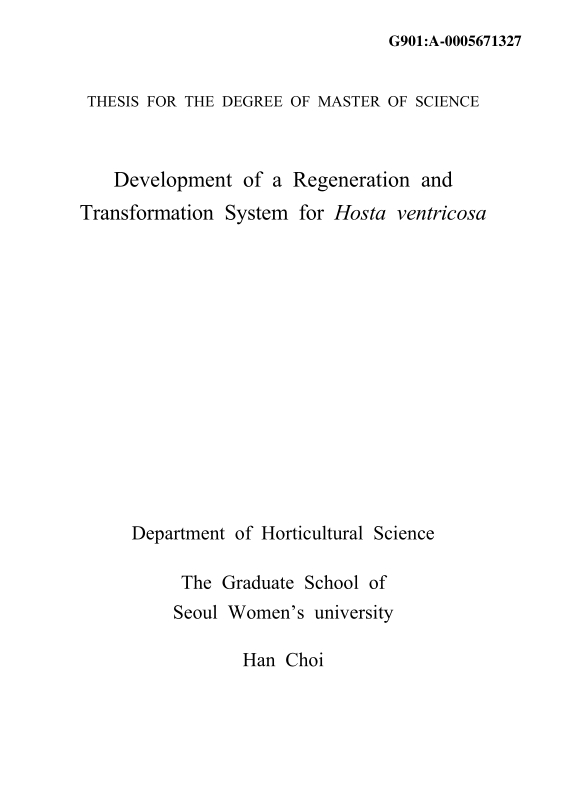
Title Page
Contents
LIST OF ABBREVIATIONS 9
ABSTRACT 14
Ⅰ. INTRODUCTION 16
1. The genus Hosta and Hosta-infecting viruses 16
2. Regeneration and transformation of Hosta ventricosa 19
3. Analysis of RNA interference (RNAi) vector for resistance to viruses in infected Hosta 20
4. Purpose of this study 21
Ⅱ. MATERIALS AND METHODS 22
1. Sources of plants 22
2. Seed sterilization and in vitro germination 22
3. Plant culture and maintenance 23
4. Virus sources and maintenance 24
5. Plasmid construction for plant transformation 24
5.1. GUS 24
5.2. RNAi vectors for virus resistance 26
6 . Culture media for Agrobacteria 27
7. Regeneration of H. ventricosa 27
7.1. Explant parts and plant growth regulators (PGRs) 27
7.2. Callus induction and plant regeneration in combination with multiple PGRs 28
7.3. Sensitivity of H. ventricosa to kanamycin and phosphinothricin 29
8. Plant transformation 30
8.1. Agrobacterium-mediated transformation 30
8.2. Paticle bombardment transformation of H. ventricosa 32
9. DNA extraction and polymerase chain reaction (PCR) 34
10. Viral RNA extraction and reverse transcription-polymerase chain reaction (RT-PCR) 36
11. Histochemical GUS assay 39
Ⅲ. RESULTS 40
1. Development of regeneration protocols using diffenet in vitro explant source of H. ventricosa 40
1.1. Callus formation from different tissue types using single plant growth regulators 40
1.2. Developing shoots and roots from callus cultures 43
1.3. Sensitivity of H. ventricosa to kanamycin and phosphinothricin used as selection agents 49
2. Transformation of H. ventricosa 51
2.1. Agrobacterium-mediated transformation 51
2.2. Particle bombarment and analysis of GUS expression 52
3. Confirmation of transgenic N. benthamiana by Agrobacterium-mediated 54
3.1. BBWV2 RNAi vector 54
3.2. TSWV RNAi vector 59
3.3. HVX RNAi vectors 63
Ⅳ. DISCUSSION 65
Ⅴ. REFERENCES 68
Ⅵ. 국문요약문 75
Fig. 1. Symptoms of virus-infected Hosta spp. 18
Fig. 2. Map of constructed vectors used for plant transformation in this study. 25
Fig. 3. Explants of leaf and petiole of H. ventricosa callus induction with combination of PGRs. 44
Fig. 4. Effect of silver thiosulfate (STS) on callus formation of H. ventricosa cultured after 8 weeks. 45
Fig. 5. Callus formation and shoot regeneration of H. ventricosa in regeneration medium (containing 20 mM STS, 0.1mg/l 2,4D and 0.1mg/l TDZ). 48
Fig. 6. Sensitivity of H. ventricosa to kanamycin (KM) and phosphinothricin (PPT) in culture medium containing different selection agents. 50
Fig. 7. H. ventricosa of GUS assay 7 days after bombardment. 53
Fig. 8. Detection of introduced gene of BBWV from the BBWV2 RNAi vector transgenic N. benthamiana. 56
Fig. 9. Comparison of symptoms on N. benthamiana transgenics and wild-type control inoculated with BBWV, 36 dpi. 57
Fig. 10. Detection of BBWV in upper leaves of inoculated N. benthamiana transgenic and wild-type nontransgenic plants. 58
Fig. 11. Detection of introduced gene of TSWV from the TSWV RNAi vector transgenic N. benthamiana T0. 60
Fig. 12. Detection of virus in upper leaves of transgenic and wild-type N. benthamiana inoculated with TSWV. 61
Fig. 13. Comparison of symptoms on transgenic and wild-type N. benthamiana inoculated with TSWV, 21 dpi. 62
Fig. 14. Detection of introduced gene of HVX from the HVX RNAi vectors transgenic N. benthamiana T1. 64
본 연구에서는 Hosta ventricosa의 petiole 절편조직을 이용하여 재분화와 형질전환의 조건을 높은 확률로 최적화한 체계를 확립하였다. 재분화 실험에서는 어리고 연한 petiole 절편이 사용되었고, 형질전환 실험에서는 재분화 실험에서 유도된 캘러스가 사용되었다. Hosta ventricosa의 캘러스와 부정아는 0.1mg/l 2,4D와 0.1mg/l TDZ가 포함된 MS 배지에서 가장 잘 유도되었다. 기내 조건에서 절편 조직에서의 에틸렌의 활성을 억제하기 위해 20mM STS의 처리가 필요하였다. 형질전환은 유전자 분사방식으로 gus 유전자와 npt-II을 포함하고 있는 binary vector pBI 121를 분사하여 연구되었다. GUS 반응을 통해 petiole에서 유도된 캘러스에 분사한 GUS 유전자의 형질전환 여부를 확인하였다. 호스타에 감염되는 바이러스에 대해 바이러스 유래 저항성을 확립하고자, 세 가지 바이러스, Broad bean wilt virus(BBWV), Hosta virus X(HVX) 와 Tomato spotted wilt virus(TSWV)의 부분 유전자를 포함하여 RNAi 벡터를 제작하였다. 이 세가지 RNAi 벡터는 지표식물인 Nicotiana benthamiana에서 저항성 발현 능력을 검정하였다.
BBWV2 RNAi 벡터의 형질전환체는 바이러스 감염 시에 높은 수준의 저항성을 확인하였고 TSWV RNAi 벡터의 형질전환체는 TSWV에 대해 감수성을 나타내었다. 그리고 HVX RNAi 벡터에서는 각 벡터 별로 세 개씩의 형질전환체로 보이는 개체를 얻었고 PCR로 형질전환한 유전자를 확인하였다.*표시는 필수 입력사항입니다.
| 전화번호 |
|---|
| 기사명 | 저자명 | 페이지 | 원문 | 기사목차 |
|---|
| 번호 | 발행일자 | 권호명 | 제본정보 | 자료실 | 원문 | 신청 페이지 |
|---|
도서위치안내: / 서가번호:

우편복사 목록담기를 완료하였습니다.
*표시는 필수 입력사항입니다.
저장 되었습니다.
