
 대표어
대표어
권호기사보기
| 기사명 | 저자명 | 페이지 | 원문 | 기사목차 |
|---|
결과 내 검색
동의어 포함
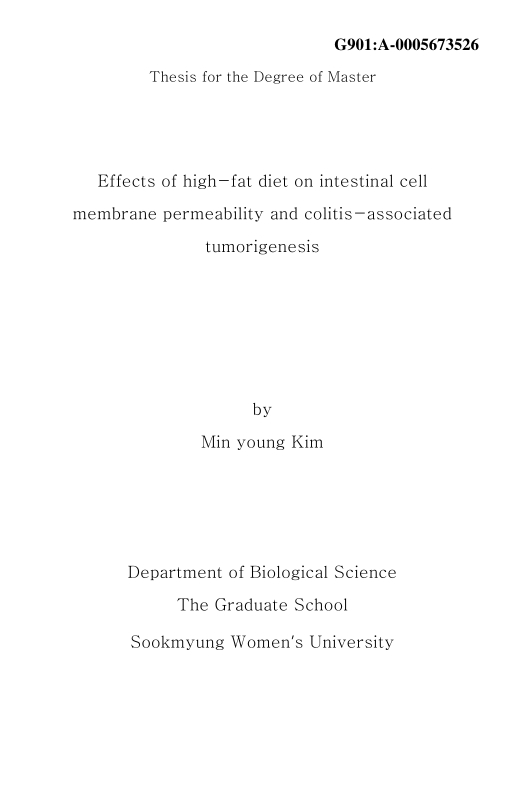
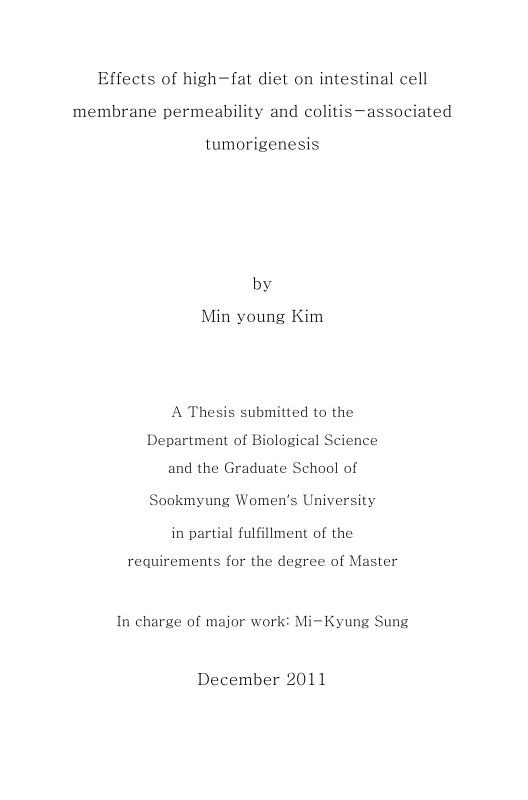
Title Page
Contents
ABSTRACT 12
Ⅰ. Introduction 14
Ⅱ. LITERATURE REVIEW 18
1. Western style diet habit and incidence of colorectal cancer 18
1) Incidence of colorectal cancer 18
2) Dietary pattern and colorectal cancer 20
2. High-fat diet as a causative factor in colon tumorigenensis 21
1) Metabolic stress and colon cancer 21
2) Leaky gut and colon cancer 24
3. Animal models of colon cancer 27
Ⅲ. Materials and Methods 29
1. Experimental procedure 29
2. Animals and diets 31
3. Intestinal permeability determination 33
4. Serum CD14 determination 34
5. RT-PCR analysis of TLR4 mRNA expression in colon 34
6. IL-6 concentration in plasma 35
7. MPO concentration in plasma 36
8. 8-OHdG concentration in colon tissue 36
9. Protein extraction and western blot analysis in colon 36
10. Statistical analysis 37
Ⅳ. RESULTS 39
1. Body weight 39
2. Epididymal fat pad weight 39
3. Total tumors formation 41
4. Intestinal permeability 42
5. Serum CD14 concentration and colon TLR4 mRNA expression in mice 43
6. Plasma IL-6 concentration in mice 45
7. MPO level in plasma 46
8. Total antioxidant capacity in serum and 8-OHdG in colon tissue 48
9. Colon claudin-1, occludin and ZO-1 protein expression 50
Ⅴ. DISCUSSION 52
Ⅵ. SUMMARY AND CONCLUSION 61
Ⅶ. REFERENCES 63
ABSTRACT IN KOREAN 73
Figure 1. Ten leading cancer types for the estimated cancer cases and deaths, South Korea 2009 19
Figure 2. Free radical generation, cellular stress and tumorigenessis 23
Figure 3. Schematic overview of the link between high-fat diet, permeability and colon carcinogenesis 26
Figure 4. Molecular pathogenesis of sporadic colon cancer and colitis-associated colorectal 28
Figure 5. Experimental design 30
Figure 6. Effect of high-fat diet on intestinal permeability 42
Figure 7. Effects of high-fat diet on CD14 level and TLR4 mRNA expression 44
Figure 8. Effects of high-fat diet on IL-6 concentration 45
Figure 9. Effects of high-fat diet on MPO activity 47
Figure 10. Effect of high-fat diet on oxidative stress 49
Figure 11. Effect of high-fat diet on tight junction proteins 51
지속적인 고지방 식이의 섭취는 만성 저 염증 상태를 일으키며 과도한 산화적 스트레스를 생성한다. 소장 장벽은 체내 항상성을 유지하는데 중요한 역할을 한다. 소장 장벽의 붕괴는 장막 투과도를 증가시켜 박테리아 또는 이물질의 투과를 야기하며 이는 식품 알레르기, 염증성 장 질환 그리고 대장암 등의 질환을 증가시키는 요인이 된다.
과도한 지방의 지속적인 섭취가 장막 투과도와 대장 종양 형성에 미치는 영향을 검증하고자 본 연구를 수행하였다. In vivo에서 염증관련 산발성 대장암 모델인 APC Min/+ 마우스를 이용하여 일반 식이군과 고지방 식이군으로 나누어 12주간 사육한 후 장막 투과도와 종양 형성도를 측정하였다.
In vivo에서 고지방 식이군과 저지방 식이군 사이에서 체중은 유의적이지 않았지만 종양 개수는 고지방 식이군에서 유의적으로 높았다. 염증지표인 IL-6와 MPO activity 역시 고지방 식이군에서 유의적으로 높았으며 이는 고지방 식이군에서 염증이 활발히 일어나고 있음을 암시한다. 장 투과도에 영향을 주는 tight junction 단백질인 occluding, ZO-1 그리고 claudin-1의 단백질 발현은 고지방 식이군에서 저하되어 있었다. LPS 결합 단백질이자 macrophage scavenger 수용체인 CD14의 수치는 고지방 식이군에서 유의적으로 높았으며 이와 함께 세포내 신호전달을 하는 TLR4의 대장조직에서의 mRNA 발현 역시 고지방 식이군에서 유의적으로 높았다. 산화적 스트레스의 정도를 반영하는 total antioxidant capacity는 고지방 식이군에서 저하되었으며 이와 더불어 산화적 스트레스로 인한 DNA 손상 지표인 8-OHdG는 고지방 식이군에서 유의적으로 증가되어 있었다.
이러한 결과들을 종합하여 보면, 과도한 지방섭취는 산화적 스트레스와 endotoxemia를 야기하게 된다. 이로 인해 장 투과도에 영향을 미치는 tight junction 단백질이 붕괴되며 발현이 저하되고 이는 장 투과도를 증가시켜 CD14-dependent한 염증반응을 초래한다. 지속적인 염증으로 장 투과도는 계속 증가하며 이러한 과정이 순환되어 대장 종양 형성을 촉진하게 된다.*표시는 필수 입력사항입니다.
| 전화번호 |
|---|
| 기사명 | 저자명 | 페이지 | 원문 | 기사목차 |
|---|
| 번호 | 발행일자 | 권호명 | 제본정보 | 자료실 | 원문 | 신청 페이지 |
|---|
도서위치안내: / 서가번호:

우편복사 목록담기를 완료하였습니다.
*표시는 필수 입력사항입니다.
저장 되었습니다.
