
 대표어
대표어
권호기사보기
| 기사명 | 저자명 | 페이지 | 원문 | 기사목차 |
|---|
결과 내 검색
동의어 포함
Title Page
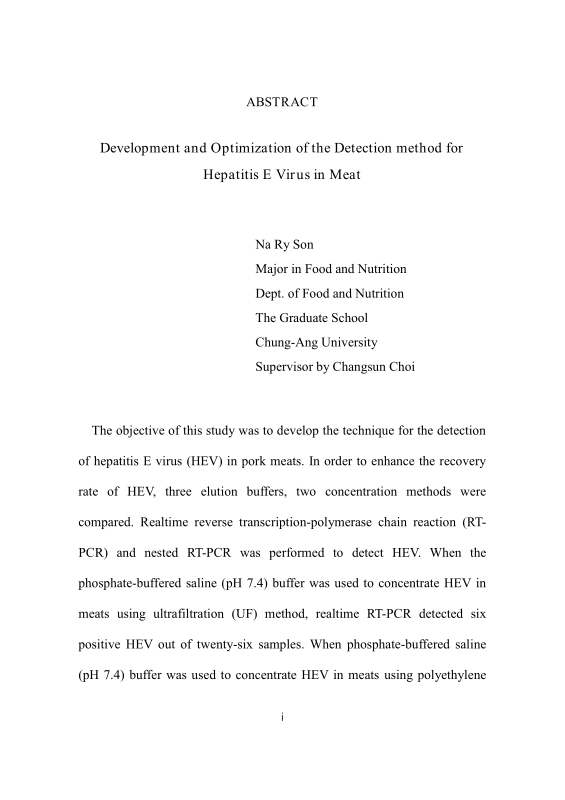
ABSTRACT
Contents
1. Introduction 9
2. Materials and Methods 11
2.1. Sample collection 11
2.1.1. Liver tissue 11
2.1.2. Bile juice 12
2.1.3. Swine Feces 12
2.2. Elution buffer 12
2.3. Virus concentration 13
2.3.1. Polyethylene glycol (PEG) precipitation 13
2.3.2. Ultrafiltration (UF) method 14
2.4. RNA extraction 15
2.5. Nested reverse transcription-polymerase chain reaction 16
2.6. Realtime reverse transcription polymerase chain reaction 17
2.7. Sensitivity and Specificity of realtime RT-PCR 18
3. Results 21
Compared the sensitivity of realtime RT-PCR primer sets 21
Object for screening 21
Polyethylene glycol (PEG) precipitation 25
Ultrafiltration (UF) method 29
Measurement of the specificity of HEV for realtime RT-PCR primer 32
Recovery rate of HEV for realtime RT-PCR primer 34
4. Discussion 38
References 42
국문초록 48
Figure 1. Comparison of the sensitivity of realtime RT-PCR in swine fecal samples. 22
Figure 2. Mornitoring of HEV by realtime RT-PCR in fourty-five swine bile juice samples and seventy-nine fecal samples. 23
Figure 3. Comparison of phosphate-buffered saline (pH 7.4), 0.25M Threonine buffer(0.14M NaCl, pH 7.5) and 0.25M glycine buffer (0.14M NaCl, pH 7.5) to detect HEV by realtime RT-PCR with PEG concentration. 28
Figure 4. Comparison of phosphate-buffered saline (pH 7.4), 0.25M Threonine buffer (0.14M NaCl, pH 7.5) and 0.25M glycine buffer (0.14M NaCl, pH 7.5) to detect HEV by realtime RT-PCR with PEG concentration. 31
Figure 5. Specificity of realtime RT-PCR in two HEV positive samples and NoV, RoV, HAV, FCV, MNV samples. 33
Figure 6. Standard curve of quantitative realtime RT-PCR. 35
Figure 7. Comparison of viral concentration rate according to concentration method and the type of buffer for isolation and concentration. 37
*표시는 필수 입력사항입니다.
| 전화번호 |
|---|
| 기사명 | 저자명 | 페이지 | 원문 | 기사목차 |
|---|
| 번호 | 발행일자 | 권호명 | 제본정보 | 자료실 | 원문 | 신청 페이지 |
|---|
도서위치안내: / 서가번호:

우편복사 목록담기를 완료하였습니다.
*표시는 필수 입력사항입니다.
저장 되었습니다.
