권호기사보기
| 기사명 | 저자명 | 페이지 | 원문 | 기사목차 |
|---|
| 대표형(전거형, Authority) | 생물정보 | 이형(異形, Variant) | 소속 | 직위 | 직업 | 활동분야 | 주기 | 서지 | |
|---|---|---|---|---|---|---|---|---|---|
| 연구/단체명을 입력해주세요. | |||||||||
|
|
|
|
|
|
* 주제를 선택하시면 검색 상세로 이동합니다.
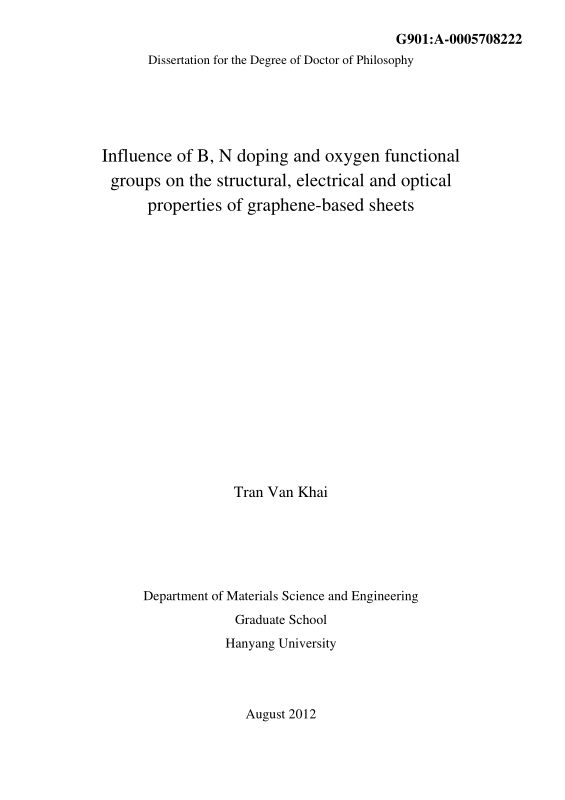
Title Page
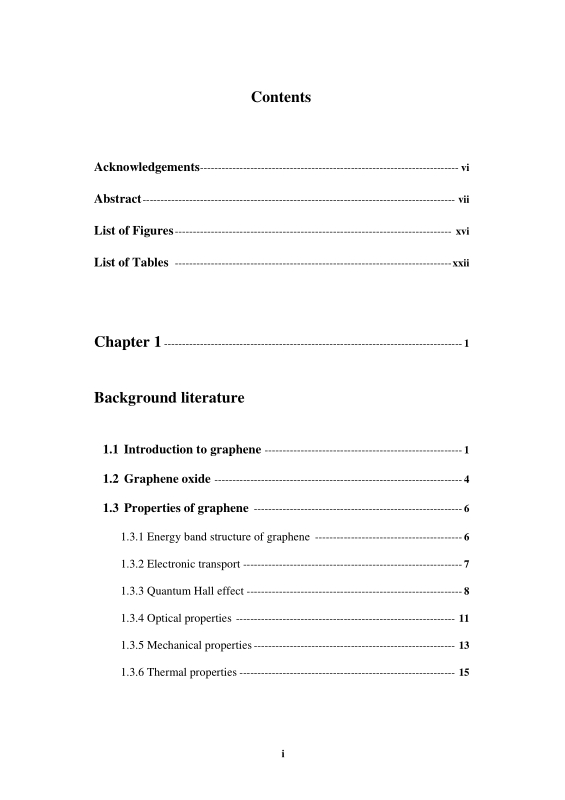
Contents
Abstract 11
국문요지 16
Chapter 1. Background literature 27
1.1. Introduction to graphene 27
1.2. Graphene oxide 30
1.3. Properties of graphene layers 32
1.3.1. Energy band structure of graphene 32
1.3.2. Electronic transport 33
1.3.3. Quantum Hall effect 34
1.3.4. Optical properties 37
1.3.5. Mechanical properties 39
1.3.6. Thermal properties 41
1.4. Graphene synthesis methods 42
1.4.1. Micromechanical exfoliation 43
1.4.2. Liquid-phase exfoliation 44
1.4.3. Epitaxial growth on carbides 45
1.4.4. Chemical vapor deposition (CVD) technique 45
1.4.5. Plasma-enhanced chemical vapor deposition (PECVD) 46
1.4.6. Chemically derived graphene 47
1.4.7. Un-zipping carbon nanotubes (CNTs) 47
1.5. Potential applications of graphene 49
Reference 50
Chapter 2. Influence of oxygenated functional groups on the structural and electrical properties of graphene films 54
2.1. Introduction 54
2.2. Experiment 56
2.2.1. Materials 56
2.2.2. Preparation of the graphene films on quartz substrates 58
2.2.3. Characterization 59
2.3. Results and discussion 60
2.4. Summary 78
Reference 78
Chapter 3. Influence of N-doping on the structural and photoluminescence properties of graphene oxide films 81
3.1. Introduction 81
3.2. Experiment 82
3.3. Results and discussion 84
3.4. Summary 97
Reference 98
Chapter 4. Enhanced blue emission and electrical conductivities of N-doped graphene 101
4.1. Introduction 101
4.2. Experiment 103
4.2.1. Materials 103
4.2.2. Annealing RGO in NH₃ 103
4.3. Results and discussion 104
4.4. Conclusion 128
Reference 129
Chapter 5. Structural and optical properties of boron-doped graphene oxide films in comparison to as-synthesized and annealed graphene oxides 134
5.1. Introduction 134
5.2. Experiment 136
5.2.1. Materials 136
5.2.2. Preparation of thermally reduced graphene oxide film (TRG) and B-doped GO films 136
5.2.3. Characterization 137
5.3. Results and discussion 138
5.4. Conclusion 153
Reference 154
Chapter 6. Conclusions 157
Figure 1.1. Graphene is an atomic-scale honeycomb lattice made of carbon atoms. 28
Figure 1.2. Hexagonal crystal lattice of graphene sheet 29
Figure 1.3. Graphene (top) consist of a 2D hexagonal lattice of carbon atoms. Each atom is covalently bonded to three others; but since carbon has four valence electrons, one is left free-allowing graphene to conduct electricity. Other well-know form of carbon all derive from graphene: graphite is stack of graphene layers (bottom right); carbon nanotubes are rolled-up... 30
Figure 1.4. Idealized structure proposed for graphene oxide (GO) 31
Figure 1.5. The band structure of graphene. The conduction band and valence band touch at the K point or six corners of the Brillouin zone. 33
Figure 1.6. QHE for massless Dirac fermions in single layer graphene. Hall conductivity (σxy) and longitudinal resistivity (ρxx) of graphene as a function of their concentration at B = 14T and T = 4K. The plateau occur half integer for high energy level results in a ladder of equidistant steps in Hall conductivity. Inset shows the σxy in...(이미지참조) 36
Figure 1.7. Quantum Hall effect in bilayer graphene. 37
Figure 1.8. (a) Photograph of a 50-μ m aperture partially covered by graphene and its bilayer. The line scan profile shows the intensity of transmitted white light along the yellow line. Inset shows the sample design: a 20-μm thick metal support structure has apertures 20, 30, and 50 μm in diameter with graphene flakes deposited over them; (b) Optical image of graphene flakes... 39
Figure 1.9. Mechanical exfoliation of graphene using scotch tape from HOPG. 43
Figure 1.10. (a) Schematic illustration of the graphene exfoliation process. Graphite flakes are combined with sodium cholate (SC) Horn-ultrasonication exfoliates few-layer graphene flakes that are encapsulated by SC micelles. (b) Photograph of 90 μmL-1 graphene dispersion in SC 6 weeks after it was prepared. (c) Schematic illustrating an...(이미지참조) 44
Figure 1.11. Schematic of (left side) thermal CVD and (right side) plasma-enhanced CVD (PECVD) 46
Figure 1.12. (a) Scheme showing the chemical route to the synthesis of aqueous graphene dispersions. (1) Oxidation of graphite (black blocks) to graphite oxide with greater interlayer distance. (2) Exfoliation of graphite oxide in water by sonication to obtain GO colloids that are stabilized by electrostatic repulsion. (3) Controlled conversion of GO colloids to conducting... 48
Figure 1.13. Unzipping of carbon nanotubes. (a, b) Representation of the gradual unzipping of a carbon nanotube by chemical attack method, and TEM image of a resulting nanoribbon. (c, d) The process to produce nanoribbons by plasma etching of nanotubes and an AFM image of a resulting nanoribbon. 49
Figure 2.1. (a) Graphene oxide colloid (1 mg/mL) and (b) the corresponding reduced graphene oxide colloid. 57
Figure 2.2. SEM images of (a) graphite powders (b) GO, (c) TEM image of GOand (d) AMF image of GO and the height profile in selected location 61
Figure 2.3 TEM image of RGO, the inset is the resultant SAED pattern, (b) two- and (c) three dimensional AFM images of the RGO-1100˚C film. 62
Figure 2.4. XRD patterns of raw graphite powder, GO, R-GO, thermally annealed GO and R-GO films at 1100˚C for 30min. 64
Figure 2.5. XRD patterns of raw graphitepowder, GO, R-GO, thermally annealed GO and R-GO films at 1100˚C for 30min. 66
Figure 2.6. UV-vis spectra of GO and R-GO, thermally annealed GO and R-GO films at 1100 ˚C for 30min. 67
Figure 2.7. FT-IR spectra of raw graphite material, dried GO, RGO and RGO filmsannealed at 1100˚C for 30 min 68
Figure 2.8. Raw XPS spectra of (a) GO, (b) RGO, (c) GO-1100oC and (d) RGO-1100˚C annealed for 30 min. 70
Figure 2.9. High resolution XPS spectra of (a) GO, (b) RGO, (c) GO and RGO annealed at 1100˚C for 30 min. 72
Figure 2.10. (a) Sheet resistance of GO and R-GO varied as a function of annealing temperature. (b) Variation sheet resistance of R-GO film with H₂ flow rate, annealing at 1100˚C for 30 min. (c) Sheet resistance of R-GO films as a function of annealing time. 74
Figure 2.11. Current-voltage curves of R-GO, thermally reduced GO and RGO films. 76
Figure 3.1. (a) Two-dimensional and (b) three-dimensional AFM images of N-doped graphene films 84
Figure 3.2. XRD patterns of graphite, intact GO and N-doped graphene at different temperatures. 85
Figure 3.3. Raw scan XPS spectra of graphite, GO and N-doped graphene at different temperatures. 87
Figure 3.4. High resolution C1s XPS spectra of graphite, intact GO and N-doped graphene at 600˚C, 700˚C, 800˚C and 900˚C. 89
Figure 3.5. N1s XPS spectra of graphite, intact GO and N-doped graphene at 600˚C, 700˚C, 800˚C and 900˚C. 90
Figure 3.6. FTIR spectra of graphite, intact GO, N-doping graphene at 600, 700, 800 and 900˚C. 92
Figure 3.7. Raman scattering spectra of graphite, intact GO, and N-doped graphene at different temperatures. 95
Figure 3.8. PL spectra of intact GO, 600oC-annealed GO, 700˚C-annealed GO, 800˚C-annealed GO, and 900˚C-annealed GO. 96
Figure 4.1. Raw scan XPS spectra of (a) graphite powders, (b) GO, (c) RGO and RGO annealed for (d) 0.5h, (e) 1h, (f) 2h, (g) 3h and (h) 4h; and their corresponding contents (bottom). 106
Figure 4.2. High resolution C1s XPS spectra of graphite and GO. 107
Figure 4.3. High resolution C1s XPS spectra of RGO and RGO annealed for different times at 1100˚C. 109
Figure 4.4. High resolution N1s XPS spectra of RGO and RGO annealed for different times at 1100˚C. 112
Figure 4.5. FTIR spectra of (a) graphite powders, (b) GO, (c) RGO and RGO annealed for (d) 0.5h, (e) 1h, (f) 2h, (g) 3h and (h) 4h at 1100˚C. 114
Figure 4.6. Raman spectra of (a) graphite powders, (b) GO, (c) RGO and RGO annealed for (d) 0.5h, (e) 1h, (f) 2h, (g) 3h and (h) 4h at 1100oC; and their corresponding intensity ratio ID/IG (bottom).(이미지참조) 116
Figure 4.7. XRD patterns of (a) graphite powders, (b) GO, (c) RGO and RGO annealed for (d) 0.5h, (e) 1h, (f) 2h, (g) 3h and (h) 4h at 1100˚C. 118
Figure 4.8. (a) Cross-section FE-SEM image of a graphene film on glass substrate, (b) optical microscopy image of the four-point probe measurement setup. The digital images of as-prepared GO, RGO, and N-doped RGO films (top right). 121
Figure 4.9. Current-voltage curves of (a) GO, (b) RGO and RGO annealed for (c) 0.5h, (d) 1h, (e) 2h, (f) 3h and (g) 4h at 1100˚C. 122
Figure 4.10. Room temperature PL spectrum of GO. 124
Figure 4.11. Room temperature PL spectra of RGO and RGO annealed for different times at 1100˚C. 127
Figure 5.1. (a) SEM images of GO, (b) TEM image of single layer GO and (c) HRTEM image of a single layer GO. 139
Figure 5.2. Non-contact mode AMF images of GO sheets deposited on Si wafer show the presence of single or bi-layer obtained from exfoliation in ethanol via sonication. 140
Figure 5.3. (a) Two-dimensional and (b) three-dimensional AFM images of B-dopedgraphene oxide films 141
Figure 5.4. XRD patterns of as-synthesized GO, 1100˚C-annealed GO, and B-doped GO. 142
Figure 5.5. (a) First-order Raman spectra of graphite, GO, 1100oC-annealed GO, and B-doped GO. (b) Second-order Raman spectrum of B-doped GO. 143
Figure 5.6. Raw scan XPS spectra of graphite, as-synthesized GO, 1100oC-annealed GO, and B-doped GO. 145
Figure 5.7. C1s XPS spectra of (a) graphite, (b) GO, (c) 1100oC-annealed GO, and (d) B-doped GO. 147
Figure 5.8. Figure 7 B1s XPS spectrum of B-doped GO. 148
Figure 5.9. FTIR spectra of GO, GO-annealed 1100oC and B-doped GO. 149
Figure 5.10. PL spectra of GO, 1100˚C-annealed GO, and B-doped GO. 152
Graphene, graphene oxide (GO) 그리고 reduced graphene oxide (RGO) 와 같은 graphene-based sheets (GBS) 는 그 특별한 구조 및 우수한 물리적, 화학적 특성으로 인해 기초 과학 및 잠재적인 응용 프로그램 모두에서 엄청난 주목을 받고 있다. 보통 재료의 특성은 구조와 관련되므로 전기적 특성의 변화 및 graphene 의 밴드 갭 조정과 같은 많은 효과를 나타낼 수 있다. 다른 원자의 화학적 도핑은 본질적으로 원재료의 특성을 변화시킬 수 있는 효과적인 방법이다. 수많은 도펀트 중 (Li, P, B 및 N), 질소 (N)와 붕소는 (B) 탄소 재료의 우수한 도핑 물질 중 하나이다. 이는 탄소 원자와 크기가 유사하고 탄소 원자와 5개, 3개의 전자를 통하여 강력한 본드를 형성할 수 있기 때문에 각각 p와 n형 반도체의 거동을 보인다. 더 중요한 건, 탄소 네트워크에 B타입과 N타입의 다양한 결합과 기능성 그룹을 통해 B-및 N-도핑된 graphene의 특성을 변화 시킬 수 있다는 것이다. B-및 N-도핑된 graphene의 구조, 전기적 촉매 및 전계 방출 특성의 연구는 많이 이루어진 반면, 전기적 광학적 특성에 대한 연구는 거의 없다. 본 논문에서는 도핑 되지 않은 GBS와 B/N-도핑된 GBS의 구조적, 전기적, 광학적 특성에 초점을 맞추어 연구했다. 첫 번째 실험에서는 GO 필름의 기능성 그룹이 구조적 전기적 성질에 미치는 영향을 연구했다. 단일층 또는 이중층의 GO는 수정된 Hummers 방법으로 합성했으며, 이는 전기 절연체이다. 고전도도의 GO 필름은 화학적으로 환원된 GO 분산액을 스프레이 증착법으로 석영 기판에 필름을 형성한 뒤 H₂ 분위기에서 열처리를 통하여 합성한다. GO 필름의 기능성 그룹이 구조적 전기적 성질에 미치는 영향은 SEM, TEM, AFM, XRD, FTIR, UV-vis, XPS 그리고 전기전도도 측정기를 통하여 분석했다. 화학적으로 감소된 GO (RGO)는 graphene 시트의 산소 기능성 그룹과 SP₂ 탄소 네트워크의 환원으로 인해 전기 전도성이 크게 향상 되는 것으로 나타났다. 또한, H₂ 분위기에서 열처리 후 RGO 필름의 전도성도 RGO 의 잔류 산소 기능성 그룹과 SP₂ 탄소 네트워크의 환원으로 인해 향상 되는 것으로 나타났다. 열처리된 RGO 필름은 1.25×10³ Ohm/□의 낮은 저항을 나타내며 550 nm 의 파장에서 80%의 투과율을 갖는다. 이러한 특성은 고감도 가스 센서, 투명 전극, 태양 전지 및 전계 방사 트랜지스터와 같은 광범위한 기술 분야의 어플리케이션으로 사용될 것으로 예상된다. 두 번째 실험에서는 N-도핑된 GO 필름의 구조적 광학적 성질에 대하여 연구했다. N 은 600-900℃ 의 온도와 NH3 가스 분위기에서 도핑 되었다(3.63-7.45%). XPS 와 FTIR 분석을 통하여 GO sheet 의 주된 결합은 C-N 과 C=N 본드임을 밝혀냈다. 라만스펙트라 분석을 통해 G 밴드는 도핑 온도의 증가에 따라 흑연의 G 밴드와 가까워짐을 알 수 있었고, N-도핑은 G 밴드의 blue-shift 를 야기함을 알 수 있었다. 상온 PL 분석을 통해서 N-도핑은 최대 파장뿐만 아니라 전체적인 PL intensity 의 증가를 야기함을 알 수 있었다. N-도핑된 graphene 의 PL 이동은 N 도핑 농도 증가에 기인함을 알 수 있었다. 세 번째 실험에서는 RGO 를 1100℃ 와 NH₃ 분위기에서 열처리를 통하여 합성된 N-도핑 graphene 의 기능, 전기전도도 그리고 광학적 성질에 대하여 연구했다. 다른 농도로 도핑된 (2.3-4.7%) N-도핑 graphene 은 시간을 변수로 하여 합성했다. 이는 다양한 분석 기술을 통하여 체계적으로 분석했다. XPS, FTIR, Raman, XRD 분석을 통하여 N-도핑된 graphene 은 열처리 시간의 변화에 따라 구조적으로 변화가 생김을 알 수 있었으며, 이는 상대적으로 C 의 양의 증가와 O 과 N 의 감소로 나타났다. 고해상도 N1s XPS 에서는 열처리 시간의 증가에 따라 pyridine-N 과 pyrrolic-N 은 감소하는 것으로 나타났고, quaternary-N 은 크게 증가함을 알 수 있었다. 중요한 것은, 어닐링 시간의 변화가 N-도핑된 graphene 의 전기적 광학적 특성 모두에서 큰 변화를 일으킨 것으로 확인되었다. N-도핑된 graphene 의 전기적 저항은 GO 와 RGO 에 비해 크게 감소하였고, 열처리 시간의 증가에 따라 감소하였다. 이는 sp² 탄소 네트워크의 증가와 산소의 감소 그리고 N-도핑과 관련된 결함에 기인하는 것으로 예상된다. GO, RGO 그리고 N-도핑된 graphene 의 상온 PL 특성은 열처리 시간에 따라 분석하였다. 결과에 의하면 GO 의 최대 PL 픽은 700 nm 근처이며, 동일조건에서 RGO 는 두 개의 뚜렷한 픽: green emission (485-500 nm), blue emission (420-428 nm)과 함께 강하게 blue-shift 됨을 알 수 있었다. N-도핑된 graphene 의 경우, blue emission 의 intensity 는 열처리 시간의 증가에 따라 강화 되었으며 이는 blue- 와 green light-emission 의 광학적 성질을 컨트롤 할 수 있음을 보인다. 마지막 실험에서는 B-도핑된 GO 필름의 구조적 광학적 성질에 대하여 연구했다. B-도핑된 graphene 은 GO 와 H₃BO₃를 N, N-Dimethylformamide 용매에 녹인 뒤 열처리를 통하여 합성하였다. XRD 에서 B-도핑된 GO 와 도핑되지 않은 GO 의 거리는 열처리를 통해 감소되었다. 라만스펙트라 분석에서 B-도핑된 GO 의 D 와 G 밴드의 intensity 비율은 도핑없이 열처리된 GO 보다 낮았다. 이는 도핑으로 인하여 좀 더 탄화가 이루어졌을 것이라 예상된다. B-도핑된 GO필름의 C1s XPS 에서는 많은 양의 기능성 그룹뿐만 아니라 283.7 eV 근처의 C-B밴드도 제거되었다. 또한 B-도핑된 GO 필름의 B1s XPS 에서는 187.2, 188.9, 190.3, 192.0 그리고 193.7 eV 으로 deconvolution 할 수 있었으며, 이는 B₄C, Bsub-C, BC₂O, BCO² 그리고 B²O₃ 에 기인한다. B-도핑된 GO 를 1100℃ 에서 열처리된 GO 와 PL intensity 를 비교한 결과 전체적으로 감소함을 알 수 있었으며, 이는 B-도핑으로 인한 탄화에 기인함이라 예상된다. B-도핑된 GO 의 600-700 nm 근처의 다른 밴드는 BC 상의 여기에 기인한다.
| 번호 | 참고문헌 | 국회도서관 소장유무 |
|---|---|---|
| 1 | Phys. Rev. 71, 622, 1947 | 미소장 |
| 2 | Phys. Rev. B 44, 13237, 1991 | 미소장 |
| 3 | in Science and Application of Nanotubes, Fundamental Materials Research Series, edited by Tomanek, Enbody (Kluwer Academic, Plenum Publishers, NY, 2000), pp. 275-295 | 미소장 |
| 4 | Phys. Rev. Lett. 97, 016801, 2006 | 미소장 |
| 5 | Phys. Rev. B 78, 201408 (R), 2008 | 미소장 |
| 6 | Phys. Rev. Lett. 53 (26), 2449, 1984 | 미소장 |
| 7 | Nature Nanotechnol. 2 (10), 605, 2007 | 미소장 |
| 8 | Nature Mater. 6 (3), 183, 2007 | 미소장 |
| 9 | Topics in Appl. Phys. 111, 673, 2008 | 미소장 |
| 10 | Nature 438 (7065), 197, 2005 | 미소장 |
| 11 | Phys. Rev. Lett. 100 (1), 016602, 2008 | 미소장 |
| 12 | 3 (4), 206, 2008 | 미소장 |
| 13 | J. Appl. Phys.103 (5), 053702, 2008 | 미소장 |
| 14 | Nature Phys. 4 (5),377, 2008 | 미소장 |
| 15 | Nature Mater. 6 (9), 652, 2007 | 미소장 |
| 16 | Proc. Nat. Acad. Sci. USA 104 (47), 18392, 2007 | 미소장 |
| 17 | Nature Phys. 4 (2), 116, 2008 | 미소장 |
| 18 | Contemporary Physics 50 (2), 375, 2009 | 미소장 |
| 19 | Proc.Nat. Acad. Sci. USA 102, 10451, 2005 | 미소장 |
| 20 | Nature 438, 201, 2005 | 미소장 |
| 21 | Science 315, 1379, 2007 | 미소장 |
| 22 | Nature Phys. 2, 177, 2006 | 미소장 |
| 23 | Phys. Rev. B 73, 125411, 2006 | 미소장 |
| 24 | Phys. Rev. Lett. 96, 256802, 2006 | 미소장 |
| 25 | J. Phys.: Condens. Matter 21, 323201, 2009 | 미소장 |
| 26 | Computer science. Science 2.0.  |
미소장 |
| 27 | Nano Lett. 7, 2758, 2007 | 미소장 |
| 28 | Phys. Rev. Lett. 101, 196405, 2008 | 미소장 |
| 29 | Computer science. Science 2.0. |
미소장 |
| 30 | Nano Lett. 8, 4248, 2008 | 미소장 |
| 31 | Phys. Rev. B 79, 115447, 2009 | 미소장 |
| 32 | Nanotechnology impact on sensors. |
미소장 |
| 33 | Nanotechnology impact on sensors. |
미소장 |
| 34 | ACS Nano 3, 3963, 2009 | 미소장 |
| 35 | Appl. Phys. Lett. 94, 111909, 2009 | 미소장 |
| 36 | Science: The Broader Context |
미소장 |
| 37 | Res |
미소장 |
| 38 | Adv. Mater. 22, 505, 2010 | 미소장 |
| 39 | J. Phys. Chem. C 112, 12602, 2008 | 미소장 |
| 40 | ACS Nano 2, 2301, 2008 | 미소장 |
| 41 | Phys. Rev. B 79, 205433, 2009 | 미소장 |
| 42 | Phys. Rev. B 77, 115416, 2008 | 미소장 |
| 43 | Science 2.0 |
미소장 |
| 44 | Small 5, 2397, 2009 | 미소장 |
| 45 | Phys. Status Solidi B 246, 2562, 2009 | 미소장 |
| 46 | Phys. Rev. Lett. 87, 215502, 2001 | 미소장 |
| 47 | Nano Lett. 6, 96, 2005 | 미소장 |
| 48 | Nano Lett. 8, 902, 2008 | 미소장 |
| 49 | Int. J. Thermophys. 22, 265, 2001 | 미소장 |
| 50 | Appl. Phys. Lett. 92, 151911, 2008 | 미소장 |
| 51 | Phys. Rev. B 79, 155413, 2009 | 미소장 |
| 52 | J Appl Phys 107, 054314, 2010 | 미소장 |
| 53 | Science-Rights Coalition Has Global Impact in First Year |
미소장 |
| 54 | Nanotechnology 20, 405704, 2009 | 미소장 |
| 55 | Science 306, 666, 2004 | 미소장 |
| 56 | J. Mater. Sci. 37, 1475, 2002 | 미소장 |
| 57 | Nano Lett. 9, 4031, 2009 | 미소장 |
| 58 | Nanotechnology at the interface of cell biology, materials science and medicine |
미소장 |
| 59 | J. Phys.: Condens. Matter 20, 323202, 2008 | 미소장 |
| 60 | Nano Lett. 9, 2605, 2009 | 미소장 |
| 61 | Phys. Rev. Lett. 64, 768, 1990 | 미소장 |
| 62 | Prog. Surf. Sci. 38, 201, 1991 | 미소장 |
| 63 | Int. J. Mod. Phys. B 11, 1865, 1997 | 미소장 |
| 64 | Nature 457, 706, 2009 | 미소장 |
| 65 | Nano Lett. 9, 30, 2009 | 미소장 |
| 66 | Nano Lett. 10, 490, 2010 | 미소장 |
| 67 | Nature Mater. 7, 406, 2008 | 미소장 |
| 68 | Appl. Phys. Lett. 85, 1265, 2004 | 미소장 |
| 69 | Nano Lett. 8, 2012, 2008 | 미소장 |
| 70 | Nano Lett. 8, 2773, 2008 | 미소장 |
| 71 | Nanotechnology impact on sensors. |
미소장 |
| 72 | J. Am. Chem. Soc. 80, 1339, 1958 | 미소장 |
| 73 | Nano Lett. 7, 3499, 2007 | 미소장 |
| 74 | Nano Lett. 10, 1144, 2010 | 미소장 |
| 75 | ACS Nano 2, 463, 2008 | 미소장 |
| 76 | Carbon-coated mesoporous silica with hydrophobicity and electrical conductivity |
미소장 |
| 77 | Nature Nanotechnol. 3, 101, 2008 | 미소장 |
| 78 | Nature 458, 872, 2009 | 미소장 |
| 79 | Nature 458, 877, 2009 | 미소장 |
| 80 | Nature 457, 706, 2009 | 미소장 |
| 81 | Science-Savvy Physicians |
미소장 |
| 82 | Nano Lett. 7, 3394, 2007 | 미소장 |
| 83 | Nature Nanotechnol. 3, 538, 2008 | 미소장 |
| 84 | Nature 442, 282, 2006 | 미소장 |
| 85 | J. Cell Biol. 39, 733, 1968 | 미소장 |
| 86 | Appl. Phys. Lett. 98, 183111, 2011 | 미소장 |
| 87 | Nano Lett. 1039, 9, 2009 | 미소장 |
| 88 | J. Phys. Chem. C 112, 5447, 2008 | 미소장 |
| 89 | Science-Savvy Physicians |
미소장 |
| 90 | Appl. Catal. B: Environ 79, 89, 2008 | 미소장 |
| 91 | Appl. Phys. Lett., 84, 2877, 2004 | 미소장 |
| 92 | J. Phys Chem. C 113, 16603, 2011 | 미소장 |
| 93 | ACS Nano 1, 494, 2007 | 미소장 |
| 94 | ACS Nano 1, 369, 2007 | 미소장 |
| 95 | Nano Lett 6,1609, 2006 | 미소장 |
| 96 | Biosens Bioelectrons 25, 373, 2009 | 미소장 |
| 97 | Phys. Rev. B 77, 165427, 2008 | 미소장 |
| 98 | Nano Lett 11, 2472, 2011 | 미소장 |
| 99 | Phys. Chem. Chem. Phys.12, 12055, 2010 | 미소장 |
| 100 | ACS Nano 4, 6337, 2010 | 미소장 |
| 101 | Langmuir-Blodgett film of hydrophobin protein from Pleurotus ostreatus at the air-water interface. |
미소장 |
| 102 | Science-Savvy Physicians |
미소장 |
| 103 | J. Am. Chem. Soc. 80, 1339,1958 | 미소장 |
| 104 | Carbon-coated mesoporous silica with hydrophobicity and electrical conductivity |
미소장 |
| 105 | J. Am. Chem. Soc.130,1362, 2008 | 미소장 |
| 106 | J. Power Sources 187, 93, 2009 | 미소장 |
| 107 | J. Mater Chem. 20, 7491, 2010 | 미소장 |
| 108 | ACS Nano 5, 4350, 2011 | 미소장 |
| 109 | Carbon-13 materials as models for NOx and N2O release during coal char combustion |
미소장 |
| 110 | Carbon K-edge XANES spectromicroscopy of natural graphite |
미소장 |
| 111 | J. Electro. Mater. 25, 57,1996 | 미소장 |
| 112 | Surf. Coat. Technol.125, 308, 2000 | 미소장 |
| 113 | J. Mater. Res. 8, 480, 1993 | 미소장 |
| 114 | Polymer Chemistry |
미소장 |
| 115 | Thin Solid Films 333, 29, 1998 | 미소장 |
| 116 | Nanotechnology impact on sensors. |
미소장 |
| 117 | J. Phys. Chem. B 114, 832, 2010 | 미소장 |
| 118 | J. Am. Chem. Soc.131,15939, 2009 | 미소장 |
| 119 | Nano Lett. 10, 4975, 2010 | 미소장 |
| 120 | Nano Lett. 8, 36, 2008 | 미소장 |
| 121 | Chemo-mechanical coupling in molecular motors interpreted through the uncertainty relations |
미소장 |
| 122 | Nanoscale Res. Lett. 4, 197, 2009 | 미소장 |
| 123 | Phys. Rev. Lett. 93, 247401, 2004 | 미소장 |
| 124 | Nano Lett. 9,1752, 2009 | 미소장 |
| 125 | Chem. Phys. Lett. 412, 269, 2005 | 미소장 |
| 126 | Nano Lett. 5, 2465, 2005 | 미소장 |
| 127 | J. Phys. Chem. C 113, 7985, 2009 | 미소장 |
| 128 | Adv. Mater. 22, 505, 2010 | 미소장 |
| 129 | J. Phys. Rev. B 53,16302, 1996 | 미소장 |
| 130 | Adv. Funct. Mater. 19, 2577, 2009 | 미소장 |
| 131 | Appl. Phys. Lett., 99, 041905, 2011 | 미소장 |
| 132 | J. Phys. Chem. C115,12329, 2011 | 미소장 |
| 133 | Small 6, 711, 2010 | 미소장 |
| 134 | Nature Mater. 6, 183, 2007 | 미소장 |
| 135 | Science 2.0 |
미소장 |
| 136 | Nano Lett. 8, 902, 2008 | 미소장 |
| 137 | Nano Lett. 8, 3498, 2008 | 미소장 |
| 138 | Nature 438, 201, 2005 | 미소장 |
| 139 | J. Phys.: Condens. Matter 20, 384204, 2008 | 미소장 |
| 140 | Nano Lett. 10, 4285, 2010 | 미소장 |
| 141 | Adv. Mater. 21, 4726, 2009 | 미소장 |
| 142 | Science-Savvy Physicians |
미소장 |
| 143 | Small 5, 1769, 2009 | 미소장 |
| 144 | ASC Nano 4, 1790, 2010 | 미소장 |
| 145 | Small-caliber vascular prosthesis prototype based on controlled release of heparin from mesochannels and its enhanced biocompatibility. |
미소장 |
| 146 | Analytica Chimica Acta 711, 24, 2012 | 미소장 |
| 147 | ASC Nano 5, 4350, 2011 | 미소장 |
| 148 | Nano Lett. 11, 2472, 2011 | 미소장 |
| 149 | , ACS Nano 4, 6337, 2010 | 미소장 |
| 150 | ACS Nano 4, 1321, 2010 | 미소장 |
| 151 | J. Am. Chem. Soc. 131, 15939, 2009 | 미소장 |
| 152 | J. Mater. Chem. 21, 17635, 2011 | 미소장 |
| 153 | Chem. Commun. 46, 4920, 2010 | 미소장 |
| 154 | Nanotechnology impact on sensors. |
미소장 |
| 155 | Nanotechnology at the interface of cell biology, materials science and medicine |
미소장 |
| 156 | Chem. Mater. 20, 6592, 2008 | 미소장 |
| 157 | J. Mater. Chem. 16, 155, 2006 | 미소장 |
| 158 | Adv. Mater. 22, 892, 2010 | 미소장 |
| 159 | Nano Lett. 9, 1752, 2009 | 미소장 |
| 160 | Nano Lett. 9, 1427, 2009 | 미소장 |
| 161 | Carbon K-edge XANES spectromicroscopy of natural graphite |
미소장 |
| 162 | Green Chem. 13, 406, 2011 | 미소장 |
| 163 | ACS Nano 4, 6337, 2010 | 미소장 |
| 164 | Carbon-13 materials as models for NOx and N2O release during coal char combustion |
미소장 |
| 165 | Carbon-13 materials as models for NOx and N2O release during coal char combustion |
미소장 |
| 166 | Carbon-13 materials as models for NOx and N2O release during coal char combustion |
미소장 |
| 167 | J. Am. Chem. Soc. 130, 5856, 2008 | 미소장 |
| 168 | J. Solid State Chem., 185, 191, 2012 | 미소장 |
| 169 | Chem. Commun. 47, 3942, 2011 | 미소장 |
| 170 | J. Electro. Mater. 25, 57, 1996 | 미소장 |
| 171 | Surf. Coat. Technol. 125, 308, 2000 | 미소장 |
| 172 | J. Mater. Res. 8, 480, 1993 | 미소장 |
| 173 | Adv. Appl. Ceramics 105, 73, 2006 | 미소장 |
| 174 | J. Phys. Chem. C 114, 18790, 2010 | 미소장 |
| 175 | Soft Nanoscience Lett. 1, 16, 2011 | 미소장 |
| 176 | Phys. Rev. Lett. 97, 187401, 2006 | 미소장 |
| 177 | Langmuir 25th anniversary. |
미소장 |
| 178 | Appl. Surf. Sci. 258, 1704, 2011 | 미소장 |
| 179 | Energy Environ. Sci. 4, 760, 2011 | 미소장 |
| 180 | Nanocale. Lett. 4, 197, 2009 | 미소장 |
| 181 | Chem. Mater. 19, 4396, 2007 | 미소장 |
| 182 | J. Mater. Chem. 18, 1517, 2008 | 미소장 |
| 183 | Integrated Ferroelectrics, 2010,117, 40 | 미소장 |
| 184 | Surf. Coat. Technol., 2000, 127, 260 | 미소장 |
| 185 | Solid State Commun., 1997, 103, 193 | 미소장 |
| 186 | Diamond and Related Mater., 1999, 8, 1175 | 미소장 |
| 187 | Thin Solid Films, 1999, 349, 10 | 미소장 |
| 188 | Nano Lett. 11, 3499, 2007 | 미소장 |
| 189 | Nano-biotechnology: carbon nanofibres as improved neural and orthopaedic implants |
미소장 |
| 190 | Carbon-coated mesoporous silica with hydrophobicity and electrical conductivity |
미소장 |
| 191 | ACS Nano 2, 463, 2008 | 미소장 |
| 192 | in Carbon: Electrochemical and physicochemical properties, Wiley, New York 1988 | 미소장 |
| 193 | Adv. Funct. Mater. 21, 3496, 2011 | 미소장 |
| 194 | Carbon-coated SnO2/graphene nanosheets as highly reversible anode materials for lithium ion batteries |
미소장 |
| 195 | Chem. Phys. Lett., 2006, 424, 345 | 미소장 |
| 196 | J. Phys. Chem. C, 2009, 113, 19082. | 미소장 |
| 197 | Nat. Commun., 2010, 73, 1 | 미소장 |
| 198 | Adv. Mater. 21, 4683, 2009 | 미소장 |
| 199 | Appl. Phys. Lett. 85, 6236, 2004 | 미소장 |
| 200 | Appl. Phys. Lett. 94, 111909, 2009 | 미소장 |
| 201 | App. Phys. Lett. 99, 041905, 2011 | 미소장 |
| 202 | Phys. Rev. B 51, 2143, 1995 | 미소장 |
| 203 | Philos. Mag. B 74, 369, 1996 | 미소장 |
| 204 | Adv. Mater. 22, 505, 2010 | 미소장 |
| 205 | Raman spectroscopy in art and archaeology |
미소장 |
| 206 | Adv. Mater. 22, 4467, 2010, | 미소장 |
| 207 | Adv. Mater. 22, 2392, 2010 | 미소장 |
| 208 | Adv. Funct. Mater. 19, 2577, 2009 | 미소장 |
| 209 | Adv. Mater. 22, 734, 2010 | 미소장 |
| 210 | 2,2-Bis(ethoxycarbonyl)vinyl (BECV) as a versatile amine protecting group for selective functional-group transformations. |
미소장 |
| 211 | Chem. Int. Ed. 46, 6473, 2007 | 미소장 |
| 212 | J. Am. Chem. Soc. 129, 744, 2007 | 미소장 |
| 213 | J. Solid State Chem. 180, 1928, 2007 | 미소장 |
| 214 | Phys. Rev. B 55, R7375, 1997 | 미소장 |
| 215 | Solid State Commun. 150, 1774, 2010 | 미소장 |
| 216 | J. Mater. Chem. 20, 4328, 2010 | 미소장 |
| 217 | Phys. Rev. B 58, 6756, 1998 | 미소장 |
| 218 | J. Phys. Chem. C 113, 15768, 2009 | 미소장 |
| 219 | J. Phys. Chem. C 115, 12329, 2011 | 미소장 |
| 220 | Adv. Mater. 22, 505, 2010 | 미소장 |
| 221 | Adv. Mater. 20, 3440, 2008 | 미소장 |
| 222 | Nano Lett. 9, 1058, 2009 | 미소장 |
| 223 | Thermochim. Acta 78, 113, 1984 | 미소장 |
| 224 | J. Phys. Chem. B 102, 4477,1998 | 미소장 |
| 225 | Chem. Mater. 18, 2740, 2006 | 미소장 |
| 226 | Nat. Nanotech. 3, 270, 2008 | 미소장 |
| 227 | Phys. Rev. Lett. 98 196803, 2007 | 미소장 |
| 228 | J. Phys. Chem. B, 112, 1333, 2008 | 미소장 |
| 229 | Appl. Phys. Lett. 91, 253112 2007 | 미소장 |
| 230 | Nano Lett. 7, 1469, 2007 | 미소장 |
| 231 | Appl. Phys. Lett. 95, 183103, 2009 | 미소장 |
| 232 | Chem. Phys. Lett. 299, 368, 1999 | 미소장 |
| 233 | J. Appl. Phys. 90, 5670, 2001 | 미소장 |
| 234 | J. Am. Chem. Soc. 80, 1339, 1958 | 미소장 |
| 235 | C. Pham-Huu Nano Res. 3, 126, 2010 | 미소장 |
| 236 | Nature - the Maddox years |
미소장 |
| 237 | J. Am. Chem. Soc. 131, 1752, 2009 | 미소장 |
| 238 | Langmuir-Blodgett film of hydrophobin protein from Pleurotus ostreatus at the air-water interface. |
미소장 |
| 239 | Carbon-coated mesoporous silica with hydrophobicity and electrical conductivity |
미소장 |
| 240 | J. Am. Chem. Soc. 130, 1362, 2008 | 미소장 |
| 241 | Nano Lett. 8, 36, 2008 | 미소장 |
| 242 | Carbon-encapsulated Fe nanoparticles from detonation-induced pyrolysis of ferrocene |
미소장 |
| 243 | J. Appl. Phys. 90, 5670, 2001 | 미소장 |
| 244 | Carbon-13 materials as models for NOx and N2O release during coal char combustion |
미소장 |
| 245 | ELECTROCHEMISTRY CALENDAR |
미소장 |
| 246 | Carbon-layer stacking sequences in stage-2 graphite hexafluoroarsenates C xAsF 6 |
미소장 |
| 247 | Carbon-13 materials as models for NOx and N2O release during coal char combustion |
미소장 |
| 248 | Carbon-13 materials as models for NOx and N2O release during coal char combustion |
미소장 |
| 249 | J. Am. Chem. Soc. 130, 5856, 2008 | 미소장 |
| 250 | J. Solid State Chem.185, 191, 2012 | 미소장 |
| 251 | Chem. Commun. 47, 3942, 2011 | 미소장 |
| 252 | J. Electro. Mater. 25, 57,1996 | 미소장 |
| 253 | Rev.Adv.Mater.Sci. 7, 55, 2004 | 미소장 |
| 254 | J. Solid State Chem. 154, 79, 1999 | 미소장 |
| 255 | J. Appl. Phys. 78(5), 3392, 1995 | 미소장 |
| 256 | Appl. Phys. Lett. 85, 6236, 2004 | 미소장 |
| 257 | Appl. Phys. Lett. 94, 111909, 2009 | 미소장 |
| 258 | App. Phys. Lett. 99, 041905 2011 | 미소장 |
| 259 | Phys. Rev. B 51, 2143,1995 | 미소장 |
| 260 | J. Philos. Mag. B 74, 369, 1996 | 미소장 |
| 261 | Raman spectroscopy in art and archaeology |
미소장 |
| 262 | Adv. Mater. 22, 4467, 2010 | 미소장 |
| 263 | Adv. Mater. 22, 2392, 2010 | 미소장 |
| 264 | Adv. Funct. Mater. 19, 2577, 2009 | 미소장 |
| 265 | ACS Nano 5, 5463, 2011 | 미소장 |
| 266 | Phys. Rev. B 53, 16302,1996 | 미소장 |
| 267 | Chem. Phys. Lett. 260, 465, 1996 | 미소장 |
| 268 | J. Sol. Stat. Chem. 177, 566, 2004 | 미소장 |
| 269 | Phys. Stat. Sol. (b) 248, 1275, 2011 | 미소장 |
*표시는 필수 입력사항입니다.
| 전화번호 |
|---|
| 기사명 | 저자명 | 페이지 | 원문 | 기사목차 |
|---|
| 번호 | 발행일자 | 권호명 | 제본정보 | 자료실 | 원문 | 신청 페이지 |
|---|
도서위치안내: / 서가번호:

우편복사 목록담기를 완료하였습니다.
*표시는 필수 입력사항입니다.
저장 되었습니다.
