
 대표어
대표어


권호기사보기
| 기사명 | 저자명 | 페이지 | 원문 | 기사목차 |
|---|
결과 내 검색
동의어 포함
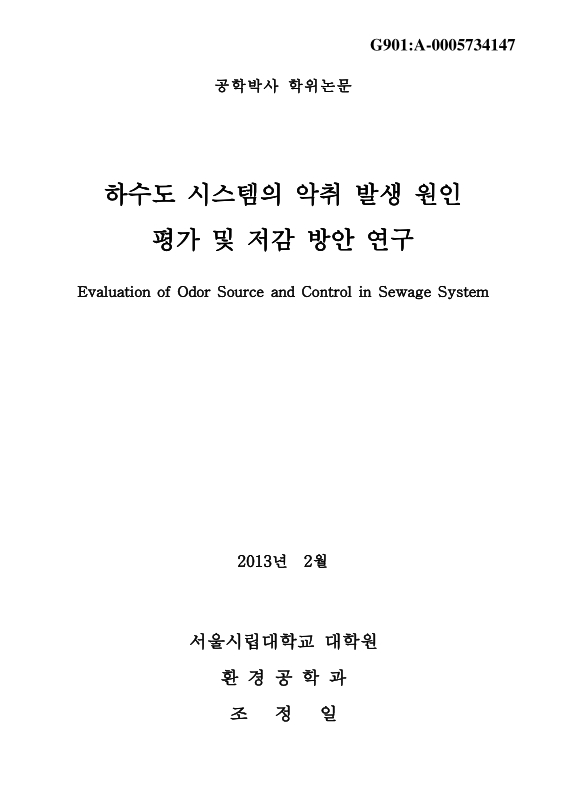
표제지
요약
목차
1. 서론 16
1.1. 연구 배경 및 목적 16
1.2. 연구 내용 및 범위 19
2. 이론적 배경 22
2.1. 하수도의 악취 발생 및 연구 동향 22
2.2. 하수도의 악취 물질 24
2.2.1. 악취 물질의 측정 단위 26
2.2.2. 악취대표물질 선정 29
2.3. 악취의 발생원 및 악취물질의 생성에 대한 고찰 33
2.3.1. 하수도 시설의 악취 발생원 33
2.3.2. 악취유발물질인 황화수소의 특성 34
2.3.3. 악취발생원별 황화수소의 생성 38
2.3.4. 악취발생원별 황화수소 발생량 산정 방법 44
2.4. 국내·외 악취 처리 프로세스에 대한 고찰 46
2.4.1. 발생원 대책 48
2.4.2. 발산 대책 54
2.4.3. 배출 차단 54
2.4.4. 관내 가스 저감 55
2.4.5. 악취 저감 프로세스 적용 56
3. 실험 및 분석 방법 61
3.1. 악취대표물질 선정 실험 61
3.1.1. 시료 채취 61
3.1.2. 실험 방법 61
3.2. 악취 발생원별 악취 발생량 산정 실험 64
3.2.1. 정화조에서 발생하는 황화수소 64
3.2.2. 관내 퇴적물에서 발생하는 황화수소 65
3.2.3. 관벽 생물막 층에서 발생하는 황화수소 68
3.3. 하수도 시스템의 악취 발생 유형 조사 70
3.3.1. 악취 조사 대상 지역 선정 70
3.3.2. 악취 조사 및 분석 방법 72
3.4. 하수도에서 발생하는 악취 저감 실험 방법 75
3.4.1. Lab-test를 통한 황화수소 제거 속도 실험 75
3.4.2. 현장 적용 평가 78
4. 실험 결과 및 고찰 80
4.1. 하수도의 악취대표물질 선정 및 고찰 80
4.1.1. 공기주입 전 악취물질 분석 81
4.1.2. 공기주입 후 악취물질 분석 90
4.1.3. 악취대표물질 선정 결과 및 고찰 94
4.2. 악취 발생원별 악취 발생량 산정 및 분석 97
4.2.1. 정화조에서 발생하는 황화수소 99
4.2.2. 관내 퇴적물에서 발생하는 황화수소 113
4.2.3. 관벽 생물막 층에서 발생하는 황화수소 124
4.2.4. 하수도 시스템의 악취 발생원별 악취발생정도 분석 129
4.3. 하수도 시스템의 악취 발생 유형 분석 및 고찰 142
4.3.1. 펌프식 정화조에 의한 영향 144
4.3.2. 펌프식+자연유하식 정화조에 의한 영향 149
4.3.3. 펌프식+자연유하식 정화조+퇴적물 및 정체하수에 의한 영향 153
4.4. 하수도에서 발생하는 악취 저감 결과 분석 및 고찰 156
4.4.1. Lab-test를 통한 수중황화수소 제거 속도 실험 156
4.4.2. 현장 적용 평가 161
5. 결론 178
References 181
ABSTRACT 188
Fig.1-1. Flow chart of this dissertation 21
Fig.2-1. The flow of sewage and odor in sewer system 33
Fig.2-2. Distribution of hydrogen sulfide components in aqueous solution at 25℃ 37
Fig.2-3. Proportions of H₂S and HS- in dissolved sulfide(이미지참조) 37
Fig.2-4. Septic tank 38
Fig.2-5. Mechanism for preventing H₂S production in aerobic sewer 41
Fig.2-6. Mechanism for H₂S production in anaerobic sewer 42
Fig.2-7. Air supply equipment 58
Fig.2-8. SOB media equipment by air supply 60
Fig.3-1. Culture of SOB in media 75
Fig.3-2. Experimental apparatus for H₂S(in water)removal by air and SOB media 76
Fig.4-1. Flow chart for selection of odor indicator substances in sewer system 80
Fig.4-2. The ratio of odor substances in septic tank 87
Fig.4-3. The ratio of odor substances in sewer pipe 87
Fig.4-4. Correlation of odorous compounds and methyl mercaptan 89
Fig.4-5. Correlation of odorous compounds and hydrogen sulfide 89
Fig.4-6. The ratio of odor substances in house inlet 94
Fig.4-7. A Comparison of odor substances before and after air supply 96
Fig.4-8. Flow chart for analysis of odor generation amount 98
Fig.4-9. Correlation of HRT and H₂S(in water)in septic tank(housing area) 102
Fig.4-10. Correlation of HRT and H₂S(in water)in septic tank(commercial Area) 105
Fig.4-11. Results of leaching test in housing area 114
Fig.4-12. Results of leaching test in commercial area 119
Fig.4-13. Calculation of cross sectional areas in circuler pipe 122
Fig.4-14. Calculation of hydraulic radius in circuler pipe 126
Fig.4-15. The ratio of H₂S in housing area(sediment 3cm) 131
Fig.4-16. The ratio of H₂S in housing area(sediment 5cm) 131
Fig.4-17. The ratio of H₂S in commercial area(sediment 3cm) 134
Fig.4-18. The ratio of H₂S in commercial area(sediment 5cm) 134
Fig.4-19. The Influence of H₂S(in water) in Housing Area 136
Fig.4-20. The influence of H₂S(in water) in commercial area 137
Fig.4-21. Sensitivity analysis of H₂S generation amount by sediment depth in housing area 140
Fig.4-22. Sensitivity analysis of H₂S generation amount by sediment depth in commercial area 141
Fig.4-23. Types and ratios of odor occurring in manhole 143
Fig.4-24. Type ① by pump type septic tank 146
Fig.4-25. Divisions of type ① by pump type septic tank 147
Fig.4-26. The 'Ga-2' division of type ① by pump type septic tank 148
Fig.4-27. Type ② by pump and gravity flow type septic tank 151
Fig.4-28. Divisions of type ② by pump and gravity flow type septic tank 152
Fig.4-29. Type ③ by pump, gravity flow type septic tank and sediment 154
Fig.4-30. Sediment in manhole 154
Fig.4-31. Divisions of type ③ by pump, gravity flow type septic tank and sediment 155
Fig.4-32. Results of experimental for H₂S(in water) removal by air and SOB media 157
Fig.4-33. Variations of H₂S by air supply of ring blower type 162
Fig.4-34. Variations of H₂S by air supply of underwater aeration type 163
Fig.4-35. Variations of H₂S by air supply and SOB media 164
Fig.4-36. Mass balance of H₂S in air and SOB media equipment 166
Fig.4-37. Variations of total-S by air supply of ring blower type 168
Fig.4-38. Variations of total-S by air supply and SOB media equipment 171
Fig.4-39. Removed total-S in water and air by air supply and SOB media 174
Fig.4-40. Discharged S to outside in air(g) by air supply 174
Fig.4-41. Removed S in water by air supply and SOB media 175
Fig.4-42. Removed S in water by air supply and SOB media(per unit volume(㎥) of SOB) 175
하수도 시스템에서 발생하는 악취는 두통, 구토 등 불쾌감과 혐오감을 유발하여 정신적 스트레스를 증가시키며, 주민들의 쾌적한 생활을 방해한다. 이러한 악취는 합류식 하수처리 구역에서 주로 발생하며, 정화조와 같은 개인하수처리시설에서 생성되어 하수관거로 유입되며, 맨홀과 받이 등을 통하여 외부로 배출되어 사람들에게 악취를 유발시킨다. 악취를 유발하는 물질로는 황화수소, 메틸메르캅탄, 암모니아 등의 물질들이며, 부패 방식의 정화조를 적용하고 있기 때문에 더욱 심각한 악취 문제가 발생하고 있다.
이러한 악취 문제를 해결하기 위한 악취저감 대책을 수립하기 위해서는 우선 악취발생원별 악취 물질의 발생 정도를 분석하여, 이에 맞는 대책 방안을 수립하여야 한다. 그러나 현재 우리나라에서는 정화조를 비롯한 악취발생원에서 악취의 원인 물질 및 정화조가 하수관거의 악취 발생에 어느 정도 영향을 미치는지에 대한 연구가 전무한 실정이다. 따라서 본 연구에서는 악취발생원인 정화조, 관내 퇴적물, 관벽 생물막층이 하수도 시스템의 악취에 미치는 영향에 대해서 평가한 후, 정화조에서 발생하는 악취 유발 물질의 저감 대책을 적용하였다. 그리고 악취저감효율을 분석한 후, 하수도 시스템에서 발생하는 악취를 저감하기 위한 악취 대책 방안을 제시하였다.
연구의 효율성을 위하여 악취대표물질로는 황화수소를 선정하였으며, 황화수소를 이용하여 분석한 본 연구의 결론은 다음과 같다.
악취 발생원별 악취 발생량 산정 결과, 정화조에서 발생하는 악취물질인 황화수소는 정화조의 수중황화수소 농도와 퇴적물의 양에 따라 하수도 시스템에 미치는 영향이 달라지지만, 일반적인 정화조 수중황화수소 농도의 범위인 2~4mg/L일 때, 하수도 시스템에 정화조가 미치는 기여도는 85~95% 정도 되는 것으로 조사되었다. 따라서 하수도 시스템에서 발생하는 악취를 저감시키기 위해서는 정화조에서 발생하는 악취에 대한 대책이 선행되어야 한다. 또한 주택단지와 상업단지 모두 퇴적물이 관경의 10%를 초과하면, 퇴적물에서 발생하는 황화수소의 기여도가 전체의 10%를 넘는 것으로 나타났으며, 관경의 20%일 때, 전체의 20%를 넘는 것으로 나타났다. 따라서 하수도 시스템에서 발생하는 악취를 감소하기 위해서는 악취의 주원인인 정화조에서의 저감과 더불어, 하수관의 구배를 양호하게 설계하여 유속을 확보하고, 이에 따른 퇴적물의 발생을 방지하여야 한다.
상업지역인 S지역과 Sn지역을 대상으로 하수관거의 맨홀에서 발생하는 기상중 황화수소를 측정하여 하수도 시스템의 악취에 영향을 미치는 원인을 조사한 결과, 악취발생유형은 발생원에 따라 펌프식 정화조에 의한 영향(17개소(20.7%)), 펌프식+자연유하식 정화조에 의한 영향(45개소(59.8%)), 펌프식+자연유하식 정화조+퇴적물 및 정체하수에 의한 영향(16개소(19.5%)) 등 3가지 유형으로 구분하였다.
하수도 시스템의 악취에 약 85~95% 정도의 영향을 미치는 정화조에서 발생하는 수중 황화수소의 저감 방안인 공기공급장치(ring blower 방식, 수중포기방식)와 공기주입식 황산화세균(Sulfur-Oxidizing Bacteria ; SOB) media 장치의 lab-test 결과, 공기만 주입한 경우와 비교하여, SOB media에 공기를 주입한 경우가 평균 3.4배 황화수소 제거 속도가 높았다. 현장 적용 결과, 수중 황화수소 제거율은 ring blower 방식 95.2%, 수중포기방식 86.0%, 공기주입식 SOB media 장치 94.3%로 조사되었다. 현장에서 장치 가동 후 공기공급장치의 기상중 황화수소 농도는 가동 초기에 125ppm까지 급격하게 증가한 이후로 지속적으로 60ppm 이상의 고농도를 유지하고 있으나, 공기주입식 SOB media 장치 가동 후 약 35분 정도까지 상승하여 125ppm까지 발생하였으나 그 이후에는 급격하게 감소하여 약 50분 이후에는 10ppm 이하로 유지되었다. 또한 SOB 단위 부피(㎥)당 시간에 따른 SOB에 의하여 제거된 총 S 양의 상관관계식은 Y = 20.386 ln(X) - 18.574(Y : 제거된 총 S 양(g), X : 시간(min))이었다. 한편 전력소비량 대비 수중황화수소 저감량 산정 결과, ring blower 방식의 공기공급장치는 89.42g·S/kWh, 수중포기방식의 공기공급장치는 85.02g·S/kWh, 공기주입식 SOB media 장치는 247.26g·S/kWh로 나타났다. 따라서 공기주입식 SOB media 장치의 저감량이 공기공급장치에 비해 약 3배 정도 효율이 높은 것으로 나타났다.
본 연구 결과, 우리나라 합류식 하수도 시스템에서 발생하는 악취의 85~95% 정도는 정화조에서 발생하는 악취가 주원인이며, 하수도 시스템에서 발생하는 악취를 저감하기 위해서는 정화조에 공기주입식 SOB 장치를 적용하면, 하수도에서 발생하는 악취를 현재의 약 10% 이하로 관리할 수 있을 것으로 판단된다.*표시는 필수 입력사항입니다.
| 전화번호 |
|---|
| 기사명 | 저자명 | 페이지 | 원문 | 기사목차 |
|---|
| 번호 | 발행일자 | 권호명 | 제본정보 | 자료실 | 원문 | 신청 페이지 |
|---|
도서위치안내: / 서가번호:

우편복사 목록담기를 완료하였습니다.
*표시는 필수 입력사항입니다.
저장 되었습니다.
