
 대표어
대표어
권호기사보기
| 기사명 | 저자명 | 페이지 | 원문 | 기사목차 |
|---|
결과 내 검색
동의어 포함
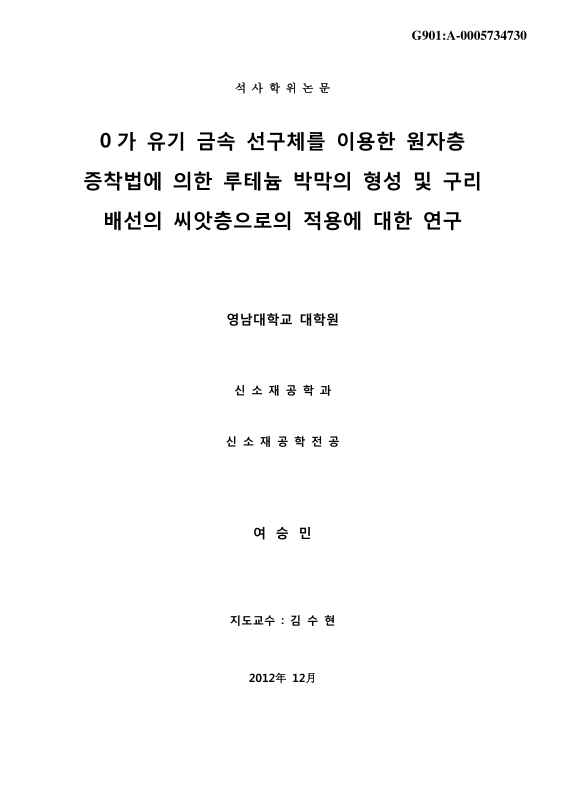
표제지
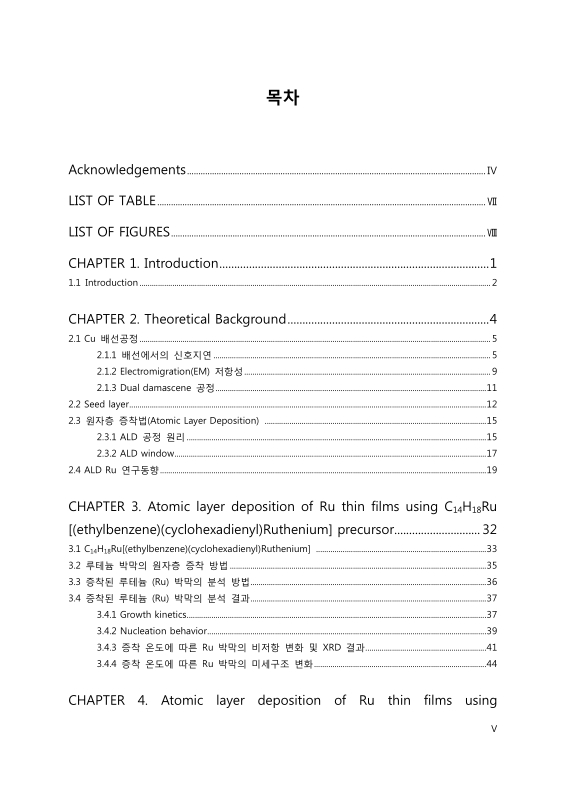
목차
CHAPTER 1. Introduction 11
1.1. Introduction 12
CHAPTER 2. Theoretical Background 14
2.1. Cu 배선공정 15
2.1.1. 배선에서의 신호 지연 15
2.1.2. Electromigration(EM) 저항성 19
2.1.3. Dual damascene 공정 21
2.2. Seed layer 22
2.3. 원자층 증착법(Atomic Layer Deposition) 25
2.3.1. ALD 공정 원리 25
2.3.2. ALD window 27
2.4. ALD Ru 연구동향 29
CHAPTER 3. Atomic Layer Deposition of Ru thin films using C14H18Ru[(ethylbenzene)(cyclohexadienyl)Ruthenium] precursor(이미지참조) 42
3.1. C14H18Ru[(ethylbenzene)(cyclohexadienyl)Ruthenium](이미지참조) 43
3.2. 루테늄 박막의 원자층 증착 방법 45
3.3. 증착된 루테늄 (Ru) 박막의 분석 방법 46
3.4. 증착된 루테늄 (Ru) 박막의 분석 결과 47
3.4.1. Growth kinetics 47
3.4.2. Nucleation behavior 49
3.4.3. 증착온도에 따른 Ru 박막의 비저항 변화 및 XRD 결과 51
3.4.4. 증착 온도에 따른 Ru 막의 미세구조 변화 54
CHAPTER 4. Atomic Layer Deposition of Ru thin films using C12H16Ru[(ethylbenzene)(1, 3-butadiene)Ruthenium] precursor(이미지참조) 58
4.1. C12H16Ru[(ethylbenzene)(1, 3-butadiene)Ruthenium](이미지참조) 59
4.2. 루테늄 (Ru) 박막의 원자층 증착 방법 61
4.3. 증착 된 루테늄 (Ru) 박막의 분석 방법 62
4.4. ALD Ru 박막의 실험 결과 63
4.4.1. Growth kinetics 63
4.4.2. Thermal stability 67
CHAPTER 5. Application of ALD Ru for microelectronics 72
5.1. 구리 전해 도금의 실험 및 분석 방법 73
5.2. 구리 전해 도금의 실험 결과 75
5.2.1. ALD Ru 박막 위에서의 구리 전해도금 75
5.2.2. ALD Ru 박막의 구리와의 계면 접착력 77
5.3. Capacitor의 Bottom electrode로의 실험 및 분석방법 80
5.4. Capacitor의 Bottom electrode로의 실험 결과 82
CHAPTER 6. Summary & Conclusion 86
6.1. Summary & conclusion 87
CHAPTER 7. Future works 89
7.1. Nucleation behavior 90
7.2. ALD Ru 박막 위에서의 구리 직접 전해도금 90
7.3. Capacitor의 Bottom electrode로의 평가 91
CHAPTER 8. Reference 92
ABSTRACT 96
Fig. 2-1. Schematic diagram of the conventional Al interconnect. 17
Fig. 2-2. Electromigration data at 295℃, 2.5 MA/cm² for Cu vs. AlCu 0.3 mm multilevel lines. 20
Fig. 2-3. Resistance change of stress-migration test structure vs. (time)1/2 for Cu vs. AlCu 0.3 mm lines.(이미지참조) 20
Fig. 2-4. Schematic diagram of Dual Damascene Process. 21
Fig. 2-5. Influences of Cu seed layer on Cu electroplating process. 23
Fig. 2-6. Comparison of seed layer deposited using (a) PVD and (b) ALD. 24
Fig. 2-7. Schematic of atomic layer deposition process. 26
Fig. 2-8. Schematic of advantages of atomic layer deposition process. 26
Fig. 2-9. ALD acceptable temperature window 28
Fig. 2-10. The molecular structure of the Ru precursor (a) RuCp₂, (b) Ru(EtCp)₂, (c) Ru(thd)₃. 31
Fig. 2-11. Ru film thickness as a function of the number of ALD cycles using Ru(EtCp)₂. 31
Fig. 2-12. Plan-view TEM image of ALD-Ru deposited on SiO₂ for 500 ALD cycles. 32
Fig. 2-13. Ru film thickness as a function of the number of ALD cycles using Ru(thd)₃. 32
Fig. 2-14. Cross-sectional view SEM (XSEM) image to show the step coverage. 33
Fig. 2-15. Ru film thickness as a function of the number of ALD cycles. 34
Fig. 2-16. Plan-view TEM image as a function of the number of ALD cycles. 34
Fig. 2-17. The molecular structure of Ru precursor. 37
Fig. 2-18. Ru film thickness of as a function of number of ALD cycles. 37
Fig. 2-19. Plan-view TEM image as a function of the number of ALD cycles. 39
Fig. 2-20. Cross-sectional view TEM (XTEM) images to show the step coverage of ALD-Ru film. 40
Fig. 3-1. The TGA of C16H22Ru and C14H18Ru(이미지참조) 44
Fig. 3-2. The photography of ALD system used in this study. 45
Fig. 3-3. Ru film thickness as a function of the Ru precursor pulsing time. The film thicknesses were measured by XRR. 48
Fig. 3-4. Ru film thickness as a function of the number of the reactant pulsing time. The film thicknesses were measured by XRR. 48
Fig. 3-5. Ru film thickness as a function of the number of ALD cycles. The lines indicate the linearly fitted line for the thickness data. 50
Fig. 3-6. Plan-view TEM image as a function of the number of ALD cycles 50
Fig. 3-7. Growth rate of ALD-Ru as a function of deposition temperature. 52
Fig. 3-8. Resistivity of ALD-Ru as a function of deposition temperature 52
Fig. 3-9. XRD results of ALD-Ru as a function of deposition temperature 53
Fig. 3-10. Plan-view TEM image of as a function of deposition temperature. 55
Fig. 3-11. Density of as a function of deposition temperature 56
Fig. 3-12. Cross-sectional view TEM image to show the step coverage of ALD-Ru film at trench. 57
Fig. 4-1. The TGA of C14H18Ru and C12H16Ru.(이미지참조) 60
Fig. 4-2. The photography of ALD system used in this study. 61
Fig. 4-3. Ru film thickness as a function of the Ru precursor pulsing time. The film thicknesses were measured by XRR. 64
Fig. 4-4. Ru film thickness as a function of the number of the reactant pulsing time. The film thicknesses were measured by XRR. 64
Fig. 4-5. Ru film thickness as a function of the number of ALD cycles. The lines indicate the linearly fitted line for the thickness data. 65
Fig. 4-6. Cross-sectional view TEM image to show the step coverage of ALD-Ru film at trench. Here, aspect ratio of trench is 4.5, top opening diameter is 25 nm, and height is 110 nm. 66
Fig. 4-7. XRD results of as a function of annealing temperature. 69
Fig. 4-8. Plan-view SEM image of as a annealing condition at 700℃. 70
Fig. 4-9. Cross-sectional view SEM image of as a annealing condition at 700℃. 71
Fig. 5-1. Schematic diagram of a Cu electroplating process. 74
Fig. 5-2. XRD results of a Cu electroplating Ru. 75
Fig. 5-3. Cross-sectional view SEM image of a Cu film electroplating deposited on ALD-Ru film. 76
Fig. 5-4. Schematic of 4-point bending test. 77
Fig. 5-5. Comparison of adhesion energy results of ALD and PVD. 79
Fig. 5-6. (a) The capacitance-voltage curve, (b) The current-voltage curve. 83
Fig. 5-7. (a) Cross-sectional view TEM images of MIM capacitor structure, (b) High resolution (HR) image of TiO₂ film. 84
Fig. 5-8. Inverse Fast Fourier Transformation of HR images. 85
*표시는 필수 입력사항입니다.
| 전화번호 |
|---|
| 기사명 | 저자명 | 페이지 | 원문 | 기사목차 |
|---|
| 번호 | 발행일자 | 권호명 | 제본정보 | 자료실 | 원문 | 신청 페이지 |
|---|
도서위치안내: / 서가번호:

우편복사 목록담기를 완료하였습니다.
*표시는 필수 입력사항입니다.
저장 되었습니다.
