
 대표어
대표어
권호기사보기
| 기사명 | 저자명 | 페이지 | 원문 | 기사목차 |
|---|
결과 내 검색
동의어 포함
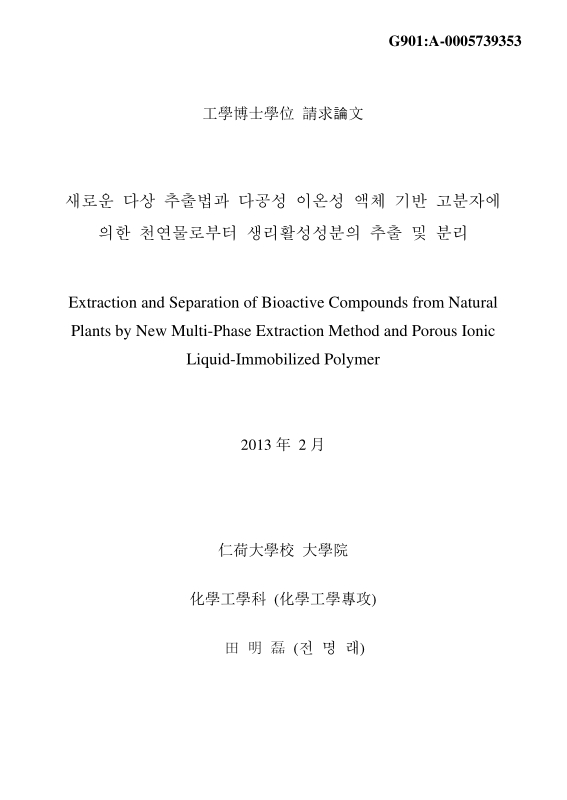
Title Page
Abstract
Contents
CHAPTER 1. Optimized Extraction and Purification Conditions for Bioactive Compounds from Natural Plants 16
1.1. Introduction 17
1.1.1. Extraction Methodologies 17
1.1.2. Purification using Solid-Phase Extraction 21
1.1.3. Application of New Solid-Phase Extraction Sorbent 22
1.1.4. Investigation of New Method 30
1.2. Theoretical Background 33
1.2.1. Assisted Extraction Methods 33
1.2.2. Response Surface Methodology 34
1.2.3. Solid-Phase Extraction 35
1.2.4. Molecular Imprinted Technology 35
1.3. Experimental 36
1.3.1. Optimization of Extraction Conditions 36
1.3.2. Response Surface Methodology 37
1.3.3. Solid-Phase Extraction 39
1.3.4. Molecularly Imprinted Solid-Phase Extraction 39
1.3.5. Multi-Phase Extraction 42
1.4. Results and Discussions 44
1.4.1. Optimization of Extraction Conditions 44
1.4.2. Optimized Extraction Condition by RSM 52
1.4.3. Purification of flavones by SPE 57
1.4.4. Molecularly Imprinted Solid-Phase Extraction 59
1.4.5. Multi-Phase Extraction 64
1.5. References 68
CHAPTER 2. Porous Ionic Liquid-Immobilized Polymer Sorbents 77
2.1. Introduction 78
2.1.1. Different Ionic Liquid-Modified Sorbents 78
2.1.2. Evaluation of the Adsorption Efficiency of Ionic Liquid-Immobilized Polymer 81
2.1.3. Ionic Liquid-Immbilized Polymers in SPE Method 84
2.1.4. Ionic Liquid-Immbilized Microporous Polymers with MIP 87
2.1.5. Application of Ionic Liquid-Immbilized Porous Polymers in MPE 88
2.2. Experimental 90
2.2.1. Adsorption Isotherms 90
2.2.2. Solid-Phase Extraction 91
2.2.3. Molecularly Imprinted Ionic Liquid-Modified Porous Polymers 95
2.2.4. Ionic Liquid-Modified Microporous Polymers 98
2.2.5. Application of Ionic Liquid-Immbilized Porous Polymers in MPE 99
2.3. Results and Discussion 101
2.3.1. Adsorption Isotherms 101
2.3.2. SPE with IL-polymer 113
2.3.3. Molecular Imprinted Ionic Liquid-Immobilized Polymers 123
2.3.4. Ionic Liquid-Modified Microporous Polymers 126
2.3.5. Application of Ionic Liquid-Immbilized Porous Polymers in MPE 128
2.4. References 133
Conclusions 138
Summary in Korean 139
Summary in Chinese 140
Appendix 141
Appendix 1. Removal of Toxic Essential Oils in Chamaecyparis obtusa by Headspace Single-Drop Microextraction 141
Appendix 2. Adsorption Isotherm of Caffeine and Theophylline on the Metal- Organic Frameworks 142
Appendix 3. Investigation of Ofloxacin Enantioseparation by Ligand Exchange Chromatography 143
Appendix 4. Ionic liquid-Assisted Extraction and Separation of Astaxanthin from Shrimp Waste 144
List of Publications 145
Figure 1-1. The molecular structure of ET-743 21
Figure 1-2. Basic theory of MIP and SPE 23
Figure 1-3. Structures of (1) quercitrin, (2) myricetin and (3) amentoflavone 30
Figure 1-4. Process of mutil-phase extraction 31
Figure 1-5. Chemical structures of four bioactive compounds. 37
Figure 1-6. Schematic illustrations of the imprint formation and molecular recognition 40
Figure 1-7. Effect of different ultrasonic and dipping times on the extracted amount 45
Figure 1-8. Effect of volumes of methanol on the extracted amount of LQ 46
Figure 1-9. Effect of different dipping time on the extraction amount of four compounds 49
Figure 1-10. Effect of different dipping temperature on the extraction amount 49
Figure 1-11. Effect of different concentration of NaOH on the extraction amount 50
Figure 1-12. Effect of component of acetone in methanol, liquid/solid ratio and their reciprocal interaction on extraction amount 55
Figure 1-13. Effect of component of dipping time, liquid/solid ratio and their reciprocal interaction on extraction amount 55
Figure 1-14. Effect of component of dipping time, component of acetone in methanol and their reciprocal interaction on extraction amount 56
Figure 1-15. Chromatograms of (a) extract sample, (b) SPE by 15% methanol aqueous solution at first step and (c) SPE by 50% methanol aqueous solution at second step 58
Figure 1-16. Chromatograms of different SPE processes (a) SPE using C18 sorbent and (b) SPE using MIP sorbent 60
Figure 1-17. Chromatographam of C. obtusa after different extraction process 62
Figure 1-18. The amount of myricetin in collected methanol with different repetitions of MPE extraction. 65
Figure 1-19. Chromatograms of dipping extraction, washing and elution stage of MPE 66
Figure 2-1. Molecular structures of four monosaccharides 88
Figure 2-2. The preparation scheme of alkyl pyridinium polymer 93
Figure 2-3. Preparation scheme for the amino-imidazolium polymer 94
Figure 2-4. Molecular structures of target compounds (A) cryptotanshinone, (B) tanshinone I, (C) tashinone IIA and template (D) 9, 10-phenanthrenequinone 96
Figure 2-5. Chemical structures of all ionic liquid-based porous polymers 97
Figure 2-6. Chemical structures of all ionic liquid-based porous polymers 98
Figure 2-7. The preparation scheme of all functionalized microsphere polymers 99
Figure 2-8. Process of multi-phase extraction 100
Figure 2-9. Effect of the amount of adsorbents on the adsorption of lactic acid 103
Figure 2-10. Proposed scheme of the anion exchange mechanism on porous polymers 105
Figure 2-11. Adsoprtion efficiency at different temperatures on three sorbents 107
Figure 2-12. Adsorbed amounts of three flavones on different sorbents 111
Figure 2-13. Chromatograms of extracts from green tea after different extraction processes 114
Figure 2-14. Chromatogram of extract from licorice 115
Figure 2-15. Chromatograms of SPE after different extraction processes 119
Figure 2-16. Chromatograms of SPE after different extraction processes 120
Figure 2-17. Chromatograms of SPE after different extraction process 124
Figure 2-18. Chromatograms of SPE separation 127
Figure 2-19. Process of multi-phase extraction 130
Figure 2-20. Chromatograms of standards, extraction with methanol and with MPE after different extraction process 132
천연식물에서 중요한 화합물 중 하나는 생리활성성분으로 매우 적은양으로 존재한다. 천연식물의 전통적인 응용 방법 (제분, 삶기 또는 증발)의 효율은 아주 낮다. 천연 식물의 치료상의 효율을 증가시키기 위해서 생리활성성분은 추출, 농축되고 정제되어야 한다.
◆ 추출조건은 최적화 되었다. 또한 추출 효율은 수학적 방법을 사용하여 증가하였다.
◆ SPE 기술로 다른 생리활성 성분의 정제와 SPE 를 기반으로한 새로운 방법은 효율을 증가시키기 위해 개발되었다.
◆ 다공성 폴리머의 작용기가 이온성 액체로 치환되어 수정되었다. 수정된 다공성 폴리머 흡착제와 생리활성 성분 사이의 상호작용이 증가되었다.
◆ 새로운 방법에서 일반적인 흡착제의 응용은 분리 효율을 증가시켰다. 그리고 새로운 흡착제와 방법은 생리활성 성분의 분리에 많은 장점을 가지는 것으로 확인 되었다.
결론적으로, 추출과 분리 효율을 증가시킬 필요가 있으며, 모든 과정에서 유기용매의 양을 감소시킬 필요가 있다. 이 후 연구에서,
1. 다른 방법으로 일반적인 재료를 확인하고, 추출 효율을 증가 시키기 위해 새로운 방법을 개발 할 것이다.
2. 생리활성 성분의 분리 재료는 분리와 흡착 효율을 증가시킬 필요가있다. 또한 모든 과정에서 유기용매를 감소시킬 필요가 있다.*표시는 필수 입력사항입니다.
| 전화번호 |
|---|
| 기사명 | 저자명 | 페이지 | 원문 | 기사목차 |
|---|
| 번호 | 발행일자 | 권호명 | 제본정보 | 자료실 | 원문 | 신청 페이지 |
|---|
도서위치안내: / 서가번호:

우편복사 목록담기를 완료하였습니다.
*표시는 필수 입력사항입니다.
저장 되었습니다.
