
 대표어
대표어
권호기사보기
| 기사명 | 저자명 | 페이지 | 원문 | 기사목차 |
|---|
결과 내 검색
동의어 포함
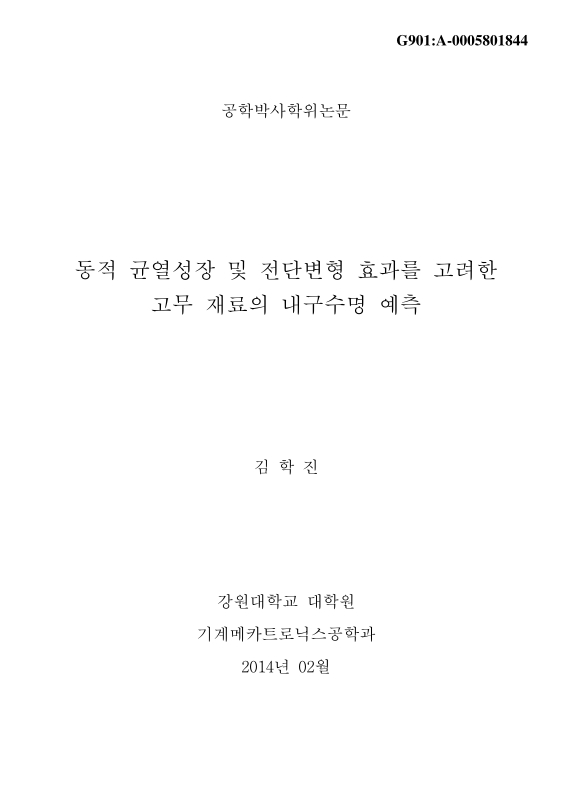
표제지
요약
목차
1. 서론 13
1.1. 연구개요 13
1.2. 문헌연구 15
1.3. 연구내용 24
2. 고무의 구조와 특성 26
2.1. 고무 일반 26
2.2. 고무 특징 30
2.2.1. 초탄성 거동 30
2.2.2. 불완전 탄성 거동 38
3. 찢김 에너지를 이용한 고무 재료의 내구수명 평가 42
3.1. 파괴역학적 관점의 균열 성장 42
3.2. 찢김 에너지 정의 43
3.3. 균열 성장 속도식 45
3.4. 동적 찢김 시험 47
3.5. 찢김 에너지와 균열 성장 속도를 이용한 내구수명 예측식 53
4. 유한요소해석을 이용한 고무재료의 내구수명 예측 55
4.1. 개요 55
4.2. 찢김 에너지의 유한요소 정식화 56
4.3. 유한요소해석의 찢김 에너지 검증 59
4.4. 유한요소해석을 이용한 내구수명 예측식 63
4.5. 내구수명 예측식의 적용 65
4.5.1. 장구형 시편에 대한 내구수명 예측식 적용 65
4.5.2. 장구형 시편의 내구시험 결과 및 예측값 비교 68
4.5.3. 내구시험 결과 및 예측값 분석 70
4.6. 내구수명 예측식의 보완 72
4.6.1. 전단 변형을 고려하기 위한 판별식 72
4.6.2. 전단 변형에 대한 찢김 에너지의 사용 비율 74
4.6.3. 찢김 에너지 사용 비율에 대한 가중치 함수 77
4.6.4. 보완된 내구수명 예측식의 적용 79
4.6.5. 최종 균열 길이를 피로 파괴 기준으로 한 내구수명 예측식 84
5. 내구수명 예측식의 적용 90
5.1. 내구수명 예측 프로세스 90
5.2. 서스펜션 부시에 대한 내구수명 예측 92
5.3. 내구시험 결과 및 예측값의 비교 98
6. 결론 99
참고문헌 101
Appendix 8
Appendix A : UVARM 105
Appendix B : ABAQUS Input file 113
Abstract 122
Figure 1.1. Biaxial fatigue test for mount bush 14
Figure 1.2. Crack growth of lower arm bush 14
Figure 1.3. Crack length of lower arm bush on belgian load test 15
Figure 1.4. Test pieces for tearing energy 17
Figure 1.5. Cyclic crack growth rate versus tearing energy 19
Figure 1.6. Fatigue crack growth curves for rubber 20
Figure 2.1. Classification of rubber 27
Figure 2.2. Manufacturing process of rubber 27
Figure 2.3. Structure of polymer chain in rubber material 28
Figure 2.4. Crystal and non-crystal structure of typical polymer material 29
Figure 2.5. Hysteresis curve of rubber 29
Figure 2.6. Deformation modes for test specimen 33
Figure 2.7. Strain energy function for uniaxial test data 36
Figure 2.8. Strain energy density function for planar test data 36
Figure 2.9. Hysteresis loops for natural rubber 39
Figure 2.10. A plot that demonstrates the phenomenon of cyclic stress relaxation 40
Figure 2.11. The creep behavior of rubber material 41
Figure 2.12. The stress relaxation behavior of rubber material 41
Figure 3.1. Fatigue crack growth curves for rubber 46
Figure 3.2. Configuration of tensile strip specimen 48
Figure 3.3. The micro fatigue tester used for the cyclic crack growth tests using a tensile strip specimen 48
Figure 3.4. Measurement of crack size 49
Figure 3.5. The tearing energy versus crack growth rate for NR60 using a tensile strip specimen 50
Figure 3.6. The tearing energy versus crack growth rate on log scale 52
Figure 4.1. The progress of the virtual crack 58
Figure 4.2. F.E. modeling for element type 60
Figure 4.3. Calculated tearing energy 61
Figure 4.4. Comparison between test and analysis for tensile strip specimen 62
Figure 4.5. Comparison between test and analysis for pure shear specimen 62
Figure 4.6. Fatigue crack growth curves for rubber 64
Figure 4.7. Shape of the 3D dumbbell specimens used in the durability tests 66
Figure 4.8. The stress-strain curve of uniaxial tension and planar test for NR50 66
Figure 4.9. F.E. modeling for 3D dumbbell specimen 67
Figure 4.10. Analysis of fatigue life for 3D dumbbell specimen 68
Figure 4.11. Comparison between experiment and analysis for fatigue life 69
Figure 4.12. Schematic representation of the sequence of crack growth for bonded rubber units in compression 71
Figure 4.13. Percentage of shear mode for unit element 73
Figure 4.14. F.E. modeling for planar test piece 74
Figure 4.15. Configuration of shear mode increase 75
Figure 4.16. Using ratio of tearing energy as shear ratio 78
Figure 4.17. Comparison between experiment and analysis for fatigue life 80
Figure 4.18. Calculation of fatigue life 83
Figure 4.19. Fatigue crack growth curves for rubber at tearing initiation 85
Figure 4.20. The curve of crack growth rate 86
Figure 4.21. Prediction of fatigue life 88
Figure 4.22. Prediction of crack length 88
Figure 4.23. Program GUI for fatigue life calculation 89
Figure 5.1. The FEM fatigue life calculation process for rubber components 91
Figure 5.2. F.E. modeling for suspension bush 93
Figure 5.3. Boundary conditions for suspension bush 94
Figure 5.4. Production model 95
Figure 5.5. Improved model #1 95
Figure 5.6. Improved model #2 96
Figure 5.7. Maximum strain energy density for each cases 97
| 번호 | 참고문헌 | 국회도서관 소장유무 |
|---|---|---|
| 1 | Engineering with Rubber; How to Design Rubber Components”, 3rd edition, HANSER Cincinnati, 2012 | 미소장 |
| 2 | Formulation of Tearing Energy for Fatigue Life Evaluation of Rubber Material | 소장 |
| 3 | A literature survey on fatigue analysis approaches for rubber  |
미소장 |
| 4 | 가상 균열을 이용한 고무 내구 수명 예측”, 박사학위 논문, 강원대학교 대학원, 2004 | 미소장 |
| 5 | The relationship between uniaxial and equibiaxial fatigue in gum and carbon black filled vulcaizates”, In: Proceedings of Rubbercon ’77, vol.2.1, pp.2.1-2.13, 1977 | 미소장 |
| 6 | Crack growth in elastomers under biaxial stresses”, Ph. D. Dissertation, University of Akron, USA, 1982 | 미소장 |
| 7 | The phenomena of rupture and flow in solids”,Philosophical Transactions of the Royal Society of London, Series A 1920, pp.163-98, 1920 | 미소장 |
| 8 | Rupture of rubber. I. Characteristic energy for tearing |
미소장 |
| 9 | Rupture of rubber. II. The strain concentration at an incision |
미소장 |
| 10 | Rupture of rubber. III. Determination of tear properties |
미소장 |
| 11 | Rupture of rubber. IV. Tear properties of vulcanizates containing carbon black |
미소장 |
| 12 | Rupture of rubber. V. Cut growth in natural rubber vulcanizates |
미소장 |
| 13 | Application of fracture mechanics to failure in ruvver articles, with particular reference to groove cracking in tyres”, Conf. Yield, deformation and fracture of polymers, 1970 | 미소장 |
| 14 | Truck tyre groove cracking theory and practice”, Rubber of fracture, vol.153, No.12, pp.36, 1970 | 미소장 |
| 15 | Energy for crack growth in model rubber components |
미소장 |
| 16 | Aspects of fatigue and fracture of rubber”, Progress of Rubber Technology, Vol.45, pp.89-143, 1983 | 미소장 |
| 17 | Effects of Fillers on Fatigue Crack Growth Rate of Ethylene Propylene Diene Monomer | 소장 |
| 18 | The Strength of Highly Elastic Materials |
미소장 |
| 19 | Intrinsic Defects and the Failure Properties of c/s-1,4-Polyisoprenes |
미소장 |
| 20 | The Effect of Carbon Black Parameters on the Fatigue Life of Filled Rubber Compounds |
미소장 |
| 21 | p,p′-DDE-induced changes in the organic and inorganic structure of eggshells of the Mallard, Anas platyrhynchos |
미소장 |
| 22 | Defect Accumulation in Rubber |
미소장 |
| 23 | p,p′-DDE-induced changes in the organic and inorganic structure of eggshells of the Mallard, Anas platyrhynchos |
미소장 |
| 24 | Strength of Sulfur-Linked Elastomers |
미소장 |
| 25 | Fatigue life prediction of rubber materials using tearing energy | 소장 |
| 26 | Fatigue Life Prediction for Automotive Vibroisolating Rubber Component Using Tearing Energy | 소장 |
| 27 | Crack Growth in Twisted Rubber Disks. Part II: Experimental Results |
미소장 |
| 28 | http://ko.wikipedia.org/wiki/%EA%B3%A0%EB%AC%B4, 고무” | 미소장 |
| 29 | Predicting the fatigue life of elastomer components”, Ph. D. Dissertation, University of Queen Mary, London, 2005 | 미소장 |
| 30 | A Theory of Large Elastic Deformation |
미소장 |
| 31 | Large Elastic Deformations of Isotropic Materials. I. Fundamental Concepts |
미소장 |
| 32 | Recent Advances in the Phenomenological Theory of Rubber Elasticity |
미소장 |
| 33 | Engineering Design with Natural Rubber”, 4th Edition, The Malaysian Rubber Producers, Research Association, Hertford, 1974 | 미소장 |
| 34 | Effect of stretching on the properties of rubber”, Journal of Rubber Research, Vol.16, pp.275, 1947 | 미소장 |
| 35 | The physics of Rubber Elasticity”, Oxford at the Clarendon press, 1975 | 미소장 |
| 36 | Natural rubber science and technology”, Oxford University Press, England, pp.731-772, 1988 | 미소장 |
| 37 | DDS Simulia, ABAQUS 6.12 Reference manual”, 2012 | 미소장 |
| 38 | A Study on the fatigue life prediction and evaluation of the rubber components”, Ph. D. Dissertation, Yeungnam University, Korea, 2004 | 미소장 |
| 39 | A fracture mechanics study of the fatigue of rubber in compression |
미소장 |
| 40 | Energy for crack growth at the bonds of rubber springs”, Plastics & Rubber: Materials & Application, Vol.4, No.29, 1979 | 미소장 |
*표시는 필수 입력사항입니다.
| 전화번호 |
|---|
| 기사명 | 저자명 | 페이지 | 원문 | 기사목차 |
|---|
| 번호 | 발행일자 | 권호명 | 제본정보 | 자료실 | 원문 | 신청 페이지 |
|---|
도서위치안내: / 서가번호:

우편복사 목록담기를 완료하였습니다.
*표시는 필수 입력사항입니다.
저장 되었습니다.
