
 대표어
대표어

권호기사보기
| 기사명 | 저자명 | 페이지 | 원문 | 기사목차 |
|---|
결과 내 검색
동의어 포함
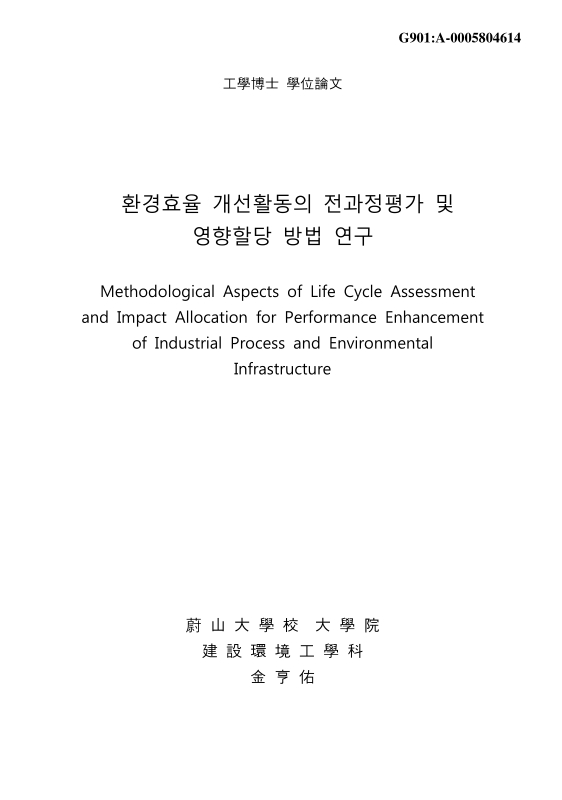
표제지
국문요약
목차
제1장 서론 20
1.1. 연구배경 및 목적 20
1.2. 연구내용 22
(1) 환경개선활동의 환경영향 평가 및 영향할당 방법 개발 22
(2) 환경기초시설의 전과정 환경영향 평가 23
(3) 산업공생의 전과정 환경영향 평가 23
(4) 공정개선의 전과정 환경영향 평가 23
(5) 산업공생의 전과정 환경영향 및 전과정 경제성 분석 23
제2장 문헌연구 24
2.1. 전과정평가 24
2.1.1. 전과정평가의 개요 24
2.1.2. 전과정평가의 구성 28
2.1.3. 전과정 목록분석 방법 37
2.1.4. 전과정 영향평가 방법 40
2.1.5. 전과정평가의 할당 42
2.1.6. 전과정평가 간략화 47
2.2. 전과정평가 관련 연구 49
2.2.1. 전과정평가의 시대별 이슈 49
2.2.2. 전과정평가 연구동향 52
2.3. 환경개선활동 79
2.3.1. 산업공생의 개요 79
2.3.2. 산업공생의 적용 80
2.3.3. 울산지역 산업공생 대표 사례 81
제3장 환경개선활동의 간략 전과정평가 및 환경영향 할당방법 제안 87
3.1. 환경개선활동의 간략 전과정평가 방법 87
3.1.1. 간략 전과정평가의 필요성 87
3.1.2. 환경기초시설의 전과정영향 특성 88
3.1.3. 환경개선활동의 간략 전과정평가 방법제안 91
3.2. 환경개선활동의 환경영향 할당방법 105
3.2.1. 환경영향 할당의 문제점 105
3.2.2. 환경개선활동의 환경영향 할당방법 제안 107
제4장 환경기초시설의 전과정 환경영향 평가 108
4.1. 목적 및 범위정의 108
4.1.1. 연구목적 108
4.1.2. 연구범위 108
4.2. 전과정 목록분석 111
4.2.1. 데이터 수집 112
4.2.2. 전과정목록표 작성 113
4.3. 전과정 영향평가 및 해석 114
4.3.1. 전과정 영향평가 115
4.3.2. 해석 120
4.4. 고찰 및 결론 125
4.4.1. 고찰 125
4.4.2. 결론 126
제5장 산업공생의 전과정 환경영향 평가 127
5.1. 연구 대상시스템 127
5.2. 목적 및 범위정의 132
5.2.1. 연구목적 132
5.2.2. 연구범위 133
5.3. 전과정 목록분석 136
5.3.1. 데이터 수집 136
5.3.2. 전과정목록표 작성 138
5.4. 전과정 영향평가 및 해석 140
5.4.1. 산업공생 전의 전과정 영향평가 140
5.4.2. 산업공생 후의 전과정 영향평가 146
5.4.3. 해석 151
5.5. 고찰 및 결론 154
5.5.1. 고찰 154
5.5.2. 결론 155
제6장 공정개선의 전과정 환경영향 평가 157
6.1. 연구 대상시스템 157
6.1.1. 아연 생산공정 157
6.1.2. 납 (연) 생산공정 159
6.1.3. 구리 생산공정 160
6.1.4. Fumer 시스템 160
6.2. 목적 및 범위정의 166
6.2.1. 연구목적 166
6.2.2. 연구범위 166
6.3. 전과정 목록분석 169
6.3.1. 데이터 수집 169
6.3.2. 전과정목록표 작성 171
6.4. 전과정 영향평가 및 해석 172
6.4.1. 공정개선 전의 전과정 영향평가 172
6.4.2. 공정개선 후의 전과정 영향평가 177
6.4.3. 해석 182
6.5. 고찰 및 결론 189
6.5.1. 고찰 189
6.5.2. 결론 189
제7장 산업공생의 전과정 환경영향 및 전과정 경제성 분석 191
7.1. 산업공생의 전과정 환경영향 191
7.1.1. 전과정 환경영향을 위한 대상 산업공생 191
7.1.2. 전과정 환경영향의 평가 및 할당 192
7.1.3. 온실가스 감축의 평가 및 할당 198
7.1.4. 배출계수와 전과정평가를 통한 온실가스의 평가 비교 209
7.2. 산업공생의 전과정 경제성 평가 213
7.2.1. 전과정 경제성 평가를 위한 대상 산업공생 213
7.2.2. 대상 산업공생의 투자비 및 스팀생산단가 214
7.2.3. 대상 산업공생의 이익과 투자비 회수 218
7.3. 고찰 및 결론 220
7.3.1. 고찰 220
7.3.2. 결론 221
제8장 결론 222
참고문헌 224
영문요약(Abstract) 238
[Fig. 2-1] Phases of a life cycle assessment 29
[Fig. 2-2] Operational procedures for life cycle inventory analysis 32
[Fig. 2-3] Elements of LCI analysis and relationship among them 35
[Fig. 2-4] Open-loop recycling scheme applied to three product systems 43
[Fig. 2-5] Status and plan of industrial symbiotic networks among industries situated at Ulsan Eco-industrial Park, Ulsan 81
[Fig. 2-6] Layout of steam business network between paper industry and waste incinerator facility 82
[Fig. 2-7] Layout of steam business network between a chemical industry and Ulsan municipal waste incinerator facility 83
[Fig. 2-8] Layout of industrial symbiosis network between chemical industries for the utilization of byproduct gas (H₂S) 84
[Fig. 2-9] Layout of industrial symbiosis network between petrochemical industry and wastewater treatment facility for resource recycling (organic byproducts) 85
[Fig. 2-10] Layout of industrial symbiosis network between chemical industries for resource recovery and recycling (excess nitrogenous compounds) 86
[Fig. 3-1] Schematic diagram of (a) a generalized infrastructure system including production facilities, and (b) an environmental infrastructure with their inputs and outputs 89
[Fig. 3-2] Layout of manufacturing system of a product under life cycle assessment 89
[Fig. 3-3] Layout of environmental infrastructure under life cycle assessment 90
[Fig. 3-4] System layout (a) before and (b) after the environmental enhancement activities 92
[Fig. 3-5] Establishment case of system boundary during life cycle assessment 103
[Fig. 3-6] Establishment of (a) an integrated system boundary (for systems A and B), and (b) separate system boundaries (for systems A and B) 104
[Fig. 3-7] Separation of total environmental impact in direct and indirect impacts during life cycle assessment 105
[Fig. 3-8] Diagrammatic representation of industrial symbiosis for resource utilization that leads the improvement of total environmental impacts 106
[Fig. 4-1] System boundary and process flow of an industrial waste incineration plant 110
[Fig. 4-2] Characterization of environmental impacts in different steps of incineration process with respect to various impact categories 116
[Fig. 4-3] Direct and indirect impacts of an industrial waste incineration plant 120
[Fig. 4-4] Cumulative environmental impacts of direct and indirect emissions during different unit processes 121
[Fig. 4-5] Cumulative environmental impacts of incineration plant during energy recovery 124
[Fig. 4-6] Sensitive analysis of different inputs and outputs of industrial waste incineration plant 125
[Fig. 5-1] Panoramic view of an industrial symbiosis system 127
[Fig. 5-2] System diagram of waste heat utilization before the industrial symbiosis 128
[Fig. 5-3] System diagram of heat/steam supply company (waste incinerator) under LCA study 128
[Fig. 5-4] Photos of distribution of waste heat generated in an incinerator ['before' adopted the industrial symbiosis] 129
[Fig. 5-5] Photos of a) upgraded boiler, b) pipe line, c) existing pipe line ['after' adopted the industrial symbiosis] 131
[Fig. 5-6] Schematic diagram of energy network between an incinerator and paper industry 'after' adopting the symbiosis 132
[Fig. 5-7] Outline of industrial symbiosis system between supply and demand company 134
[Fig. 5-8] System boundary and flow chart of (a) before and (b) after the industrial symbiosis 135
[Fig. 5-9] The major contribution of factors under various impact categories 'before' the industrial symbiosis 141
[Fig. 5-10] The major contribution of factors under various impact categories 'before' the industrial symbiosis 145
[Fig. 5-11] The major contribution of factors under various impact categories 'after' the industrial symbiosis 147
[Fig. 5-12] The contributions of direct and indirect impacts under various categories 'after' the industrial symbiosis 151
[Fig. 6-1] Schematic diagram of an process improvement in non ferrous metal smelting process 157
[Fig. 6-2] Diagrammatic representation of hydro-metallurgical process of Zinc 158
[Fig. 6-3] Integrated process of Zinc and Lead smelting 160
[Fig. 6-4] Concept of a fumer system 162
[Fig. 6-5] Smelting furnace and fuming furnace in a TSL lead Fumer system 164
[Fig. 6-6] Process flow diagram of a TSL lead fumer system 164
[Fig. 6-7] Process diagram of a TSL lead fumer system 165
[Fig. 6-8] Flow diagram of target system under process improvement 167
[Fig. 6-9] Simplified diagram of the target system under process improvement 167
[Fig. 6-10] Schematic diagram of system 'before' and 'after' the process improvement 168
[Fig. 6-11] Inventories contributing to various impact categories 'before' the process improvement 174
[Fig. 6-12] Direct and indirect impact of various categories 'before' the process improvement 176
[Fig. 6-13] Inventories contributing to various categories 'after' the process improvement 178
[Fig. 6-14] Direct and indirect impact of various categories 'after' the process improvement 181
[Fig. 7-1] Schematic diagram of industrial symbiosis between paper and pulp and non-ferrous metal smelting industries 192
[Fig. 7-2] Pay-back period of industrial symbiosis 220
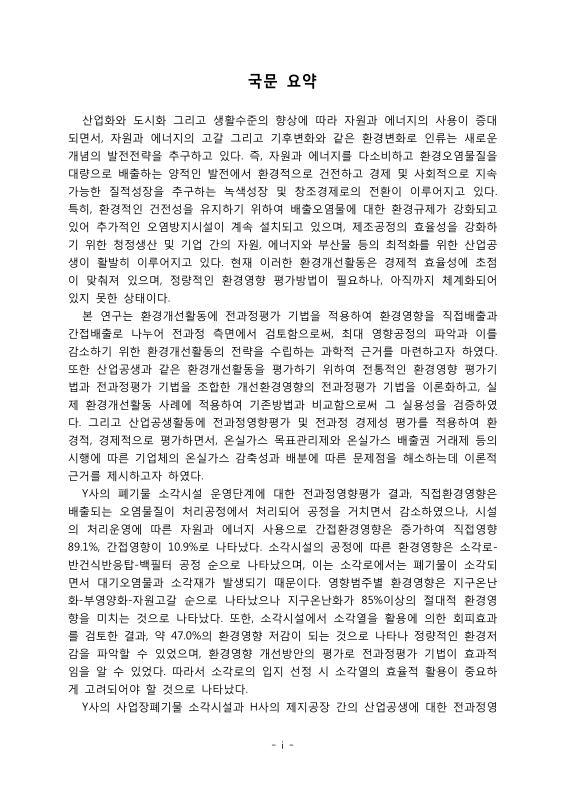
산업화와 도시화 그리고 생활수준의 향상에 따라 자원과 에너지의 사용이 증대되면서, 자원과 에너지의 고갈 그리고 기후변화와 같은 환경변화로 인류는 새로운 개념의 발전전략을 추구하고 있다. 즉, 자원과 에너지를 다소비하고 환경오염물질을 대량으로 배출하는 양적인 발전에서 환경적으로 건전하고 경제 및 사회적으로 지속가능한 질적성장을 추구하는 녹색성장 및 창조경제로의 전환이 이루어지고 있다. 특히, 환경적인 건전성을 유지하기 위하여 배출오염물에 대한 환경규제가 강화되고 있어 추가적인 오염방지시설이 계속 설치되고 있으며, 제조공정의 효율성을 강화하기 위한 청정생산 및 기업 간의 자원, 에너지와 부산물 등의 최적화를 위한 산업공생이 활발히 이루어지고 있다. 현재 이러한 환경개선활동은 경제적 효율성에 초점이 맞춰져 있으며, 정량적인 환경영향 평가방법이 필요하나, 아직까지 체계화되어 있지 못한 상태이다.
본 연구는 환경개선활동에 전과정평가 기법을 적용하여 환경영향을 직접배출과 간접배출로 나누어 전과정 측면에서 검토함으로써, 최대 영향공정의 파악과 이를 감소하기 위한 환경개선활동의 전략을 수립하는 과학적 근거를 마련하고자 하였다. 또한 산업공생과 같은 환경개선활동을 평가하기 위하여 전통적인 환경영향 평가기법과 전과정평가 기법을 조합한 개선환경영향의 전과정평가 기법을 이론화하고, 실제 환경개선활동 사례에 적용하여 기존방법과 비교함으로써 그 실용성을 검증하였다. 그리고 산업공생활동에 전과정영향평가 및 전과정 경제성 평가를 적용하여 환경적, 경제적으로 평가하면서, 온실가스 목표관리제와 온실가스 배출권 거래제 등의 시행에 따른 기업체의 온실가스 감축성과 배분에 따른 문제점을 해소하는데 이론적 근거를 제시하고자 하였다.
Y사의 폐기물 소각시설 운영단계에 대한 전과정영향평가 결과, 직접환경영향은 배출되는 오염물질이 처리공정에서 처리되어 공정을 거치면서 감소하였으나, 시설의 처리운영에 따른 자원과 에너지 사용으로 간접환경영향은 증가하여 직접영향 89.1%, 간접영향이 10.9%로 나타났다. 소각시설의 공정에 따른 환경영향은 소각로-반건식반응탑-백필터 공정 순으로 나타났으며, 이는 소각로에서는 폐기물이 소각되면서 대기오염물과 소각재가 발생되기 때문이다. 영향범주별 환경영향은 지구온난화-부영양화-자원고갈 순으로 나타났으나 지구온난화가 85%이상의 절대적 환경영향을 미치는 것으로 나타났다. 또한, 소각시설에서 소각열을 활용에 의한 회피효과를 검토한 결과, 약 47.0%의 환경영향 저감이 되는 것으로 나타나 정량적인 환경저감을 파악할 수 있었으며, 환경영향 개선방안의 평가로 전과정평가 기법이 효과적임을 알 수 있었다. 따라서 소각로의 입지 선정 시 소각열의 효율적 활용이 중요하게 고려되어야 할 것으로 나타났다.
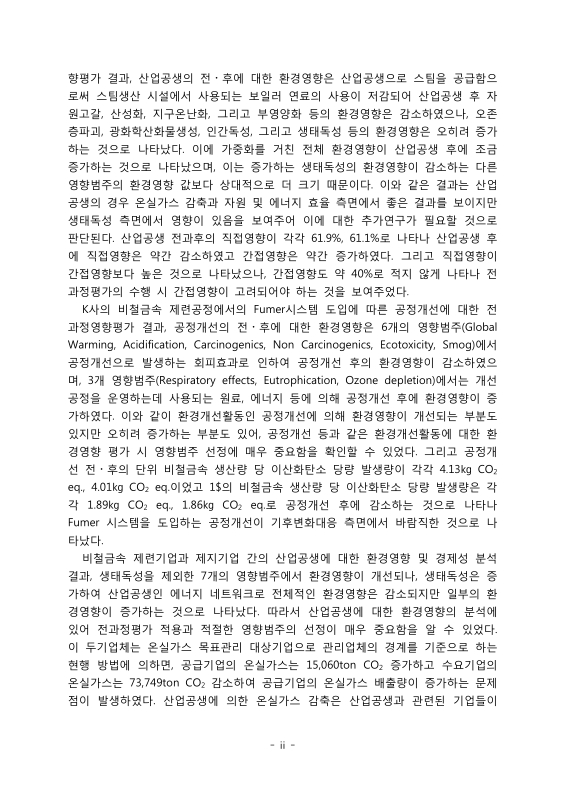
Y사의 사업장폐기물 소각시설과 H사의 제지공장 간의 산업공생에 대한 전과정영향평가 결과, 산업공생의 전·후에 대한 환경영향은 산업공생으로 스팀을 공급함으로써 스팀생산 시설에서 사용되는 보일러 연료의 사용이 저감되어 산업공생 후 자원고갈, 산성화, 지구온난화, 그리고 부영양화 등의 환경영향은 감소하였으나, 오존층파괴, 광화학산화물생성, 인간독성, 그리고 생태독성 등의 환경영향은 오히려 증가하는 것으로 나타났다. 이에 가중화를 거친 전체 환경영향이 산업공생 후에 조금 증가하는 것으로 나타났으며, 이는 증가하는 생태독성의 환경영향이 감소하는 다른 영향범주의 환경영향 값보다 상대적으로 더 크기 때문이다. 이와 같은 결과는 산업공생의 경우 온실가스 감축과 자원 및 에너지 효율 측면에서 좋은 결과를 보이지만 생태독성 측면에서 영향이 있음을 보여주어 이에 대한 추가연구가 필요할 것으로 판단된다. 산업공생 전과후의 직접영향이 각각 61.9%, 61.1%로 나타나 산업공생 후에 직접영향은 약간 감소하였고 간접영향은 약간 증가하였다. 그리고 직접영향이 간접영향보다 높은 것으로 나타났으나, 간접영향도 약 40%로 적지 않게 나타나 전과정평가의 수행 시 간접영향이 고려되어야 하는 것을 보여주었다.
K사의 비철금속 제련공정에서의 Fumer시스템 도입에 따른 공정개선에 대한 전과정영향평가 결과, 공정개선의 전·후에 대한 환경영향은 6개의 영향범주(Global Warming, Acidification, Carcinogenics, Non Carcinogenics, Ecotoxicity, Smog)에서 공정개선으로 발생하는 회피효과로 인하여 공정개선 후의 환경영향이 감소하였으며, 3개 영향범주(Respiratory effects, Eutrophication, Ozone depletion)에서는 개선공정을 운영하는데 사용되는 원료, 에너지 등에 의해 공정개선 후에 환경영향이 증가하였다. 이와 같이 환경개선활동인 공정개선에 의해 환경영향이 개선되는 부분도 있지만 오히려 증가하는 부분도 있어, 공정개선 등과 같은 환경개선활동에 대한 환경영향 평가 시 영향범주 선정에 매우 중요함을 확인할 수 있었다. 그리고 공정개선 전·후의 단위 비철금속 생산량 당 이산화탄소 당량 발생량이 각각 4.13㎏ CO₂ eq., 4.01㎏ CO₂ eq.이었고 1$의 비철금속 생산량 당 이산화탄소 당량 발생량은 각각 1.89㎏ CO₂ eq., 1.86㎏ CO₂ eq.로 공정개선 후에 감소하는 것으로 나타나 Fumer 시스템을 도입하는 공정개선이 기후변화대응 측면에서 바람직한 것으로 나타났다.
비철금속 제련기업과 제지기업 간의 산업공생에 대한 환경영향 및 경제성 분석 결과, 생태독성을 제외한 7개의 영향범주에서 환경영향이 개선되나, 생태독성은 증가하여 산업공생인 에너지 네트워크로 전체적인 환경영향은 감소되지만 일부의 환경영향이 증가하는 것으로 나타났다. 따라서 산업공생에 대한 환경영향의 분석에 있어 전과정평가 적용과 적절한 영향범주의 선정이 매우 중요함을 알 수 있었다. 이 두기업체는 온실가스 목표관리 대상기업으로 관리업체의 경계를 기준으로 하는 현행 방법에 의하면, 공급기업의 온실가스는 15,060ton CO₂ 증가하고 수요기업의 온실가스는 73,749ton CO₂ 감소하여 공급기업의 온실가스 배출량이 증가하는 문제점이 발생하였다. 산업공생에 의한 온실가스 감축은 산업공생과 관련된 기업들이 공동으로 이루어낸 것이므로, 온실가스 감축은 총 배출량 감소범위 내에서 상호 협의하여 할당하는 유연성을 가지도록 제도개선이 필요하다고 판단된다. 또한, 소각시설과 인근기업간의 스팀 산업공생에 대한 전과정 경제성 분석 결과, 약 1년 6개월 만에 투자비를 회수할 수 있는 것으로 나타나 산업공생의 적용이 환경적으로나 경제적으로 타당하다는 것을 알 수 있었다.| 번호 | 참고문헌 | 국회도서관 소장유무 |
|---|---|---|
| 1 | (주)알씨씨, 비철금속산업 온실가스․에너지 관리시스템 표준화 연구사업, 한국비철금속협회, 2011. | 미소장 |
| 2 | Academic Papers : Research about the management of CCS control with specific consideration of Life Cycle  |
미소장 |
| 3 | 국내 생태산업단지 구축사업의 개선방안에 관한 연구 | 소장 |
| 4 | Environmental Strategy for Sustainability of Tire Industry Using Life Cycle Assessment and Carbon Footprint |
미소장 |
| 5 | 캔 산업의 전과정평가를 통한 청정생산 적용에 관한 연구 | 소장 |
| 6 | 전과정평가(LCA) 기반 친환경 선박재활용 방안에 관한 연구 | 소장 |
| 7 | The Economic Efficiency Assessment of Infrastructure considering Environmental Cost | 소장 |
| 8 | 환경친화적인 제품 설계를 위한 Simplified LCA 및 반정량적 Matrix 방법론 개발에 관한 연구 | 소장 |
| 9 | Academic Papers : Study on Eco-design process in automobile development phase |
미소장 |
| 10 | Benefit analysis of environmental and economic aspects on Photovoltaic and Wind power applying LCA and LCC methodologies |
미소장 |
| 11 | 전과정 평가(LCA) 기법에 의한 강구조 교량과 콘크리트 교량의 환경성과 경제성의 기초적 비교 | 소장 |
| 12 | 특별기획 4 : 영국 국가산업공생 프로그램(NISP) |
미소장 |
| 13 | 하수관거 전과정을 고려한 환경성 평가: PVC관, Concrete관, Cast iron관의 비교, 한국물환경학회・대한상하수도학회 공동춘계 학술발표논문집, 2012(0), pp. 330-331, 2012. | 미소장 |
| 14 | Analysis of Environmental Impacts using LCA for the Carcass Burial | 소장 |
| 15 | 국내 산업동향과 청정생산기술개발의 필요성, 환경보전, 18(4), pp. 13-19, 1996. | 미소장 |
| 16 | 청정생산을 위한 전과정평가의 적용, 한국전과정평가학회지, 2(2), pp. 35-39, 2002. | 미소장 |
| 17 | 환경산업체를 위한 수출 실무 가이드북, 한국환경산업기술원, pp. 2, 2009. | 미소장 |
| 18 | 산업단지 내 유틸리티 네트워크 최적화를 위한 모델 개발 | 소장 |
| 19 | 저탄소 녹색산업 기반구축을 위한 중소기업 생산환경 혁신전략, 중소기업연구원, pp.2-27, 2009. | 미소장 |
| 20 | LCA의 방법론 및 적용에 관한 연구, 서울시립대 대학원 박사학위논문, 1994. | 미소장 |
| 21 | Bioenergy and Material Production Potential by Life Cycle Assessment in Swine Waste Biomass | 소장 |
| 22 | Comparison of Environmental Impact of Agricultural Reservoir & Pumping Station using LCA |
미소장 |
| 23 | 전과정평가 기법을 이용한 친환경적 벽지 생산 전략 수립 | 소장 |
| 24 | Life cycle assessment of drinking water treatment process |
미소장 |
| 25 | 전과정평가를 이용한 탄소발자국 계산, 한국환경산업기술원, 2010. | 미소장 |
| 26 | Cleaner Production and Sustainable Development of Chemical Industry | 소장 |
| 27 | 울산지역 산업체의 온실가스 감축 대응활동 분석 : 자발적 협약의 역할과 산업체의 특성 차이를 중심으로 | 소장 |
| 28 | 지속가능발전을 위한 청정생산기술, 나남출판, 2004. | 미소장 |
| 29 | 산업공생을 통한 생태산업공단 조성방안, 한국환경과학회지, 9(2), pp. 177-183, 2000. | 미소장 |
| 30 | 지정폐기물 소각공정에 대한 전과정평가 연구, 경기도 보건환경연구원, 2005. | 미소장 |
| 31 | 전과정평가를 이용한 산업공생 효과분석, 한국환경과학회 2011년 정기학술발표회 논문집, 20, 2011. | 미소장 |
| 32 | Life Cycle Assessment of Concrete sleeper and Study on Environmental Improvement |
미소장 |
| 33 | 콘크리트 전과정 CO2 배출량 및 경제성 평가 시스템(SUSB-CLAS) 개발, 대한건축학회논문집, 27(12), pp. 131-138, 2011. | 미소장 |
| 34 | A comparison study on physical water treatment facilities using LCA |
미소장 |
| 35 | Characterization of Wastewater Sludges Collected from Ulsan Industrial Complexes for Energy Recovery | 소장 |
| 36 | Greenhouse Gas Mitigation Policies and National Emission Targets of Korea | 소장 |
| 37 | Life cycle assessment of Tap water treatment process: A Comparison of Tap water, Industrial water and Bottled water |
미소장 |
| 38 | 대한상공회의소 지속가능경영원, 대중소상생의 국내 크레딧제도 도입방안과 기대효과, 2010 | 미소장 |
| 39 | 발전실적에 의한 20kW 태양광시스템의 전과정평가 및 경제성분석 | 소장 |
| 40 | 도로건설공사의 환경요인 전과정평가(LCA) 분석 및 사례 연구 | 소장 |
| 41 | Life cycle assessment of the carbon emissions of MLE process and denitrification proces using granular sulfur | 소장 |
| 42 | study on the life cycle impact assessment for the food waste recycling facilities | 소장 |
| 43 | 고속도로의 전과정에 따른 환경부하 평가를 위한 데이터베이스 구축 | 소장 |
| 44 | Environmental Impact Assessment for Sustainable Urban Infrastructure Construction | 소장 |
| 45 | Development of greenhouse gas (GHG) emissions inventory and evaluation of GHG reduction plans of Kangwon national university | 소장 |
| 46 | 고재경, 국내 온실가스감축과 지역별 할당, 지역연구, 28(1), pp. 39-57, 2012. | 미소장 |
| 47 | Life Cycle Assessment on the Incineration Process of Specified Wastes |
미소장 |
| 48 | Development of A Methodology for An Approximate Life Cycle Assessment |
미소장 |
| 49 | '지탱가능한 경영' 담론 비판 : '환경경영', '청정생산', '녹색성장'에 대한 논의를 중심으로 | 소장 |
| 50 | (A) study on the application of life cycle assessment for estimating the emissions edditionality in clean development mechanism : focusing on the field of substitute energy | 소장 |
| 51 | 국가 중기 온실가스 감축목표의 효율적 평가를 위한 체계구축, 한국환경산업기술원, 2012. | 미소장 |
| 52 | 건축폐기물의 재활용을 고려한 철골 및 철근콘크리트 구조체의 전과정 평가에 관한 연구 | 소장 |
| 53 | Investigation on environmental impact of water supply polyethylene pipe by LCA | 소장 |
| 54 | Investigation on environmental impact of poly ethylene film using agricultural by LCA | 소장 |
| 55 | A Study on Environmental Impact Evaluation of Metallic Can Using Life Cycle Assessment | 소장 |
| 56 | 삼화회계법인, 온실가스 감축활동 관련 회계처리방안에 관한 연구, 에너지관리공단, 2012. | 미소장 |
| 57 | Academic Papers : Integrated management of spent zinc-carbon batteries and Lithium ion batteries using innovative recycling technology |
미소장 |
| 58 | 지속가능한 산림경영을 위한 주요 수종의 전과정목록 구축 및 환경영향평가, 한국목재공학 학술발표논문집, 2013(0), pp. 154-155, 2013. | 미소장 |
| 59 | Life Cycle Assessment and Eco-efficiency Analysis for the Resource-circulation Network of Waste Heat Generated from Industrial Process |
미소장 |
| 60 | 에너지관리공단, 13년 온실가스・에너지목표관리제 운영 및 지원계획, 2013. | 미소장 |
| 61 | 에너지관리공단, 기업을 위한 CDM 사업지침서, 2007. | 미소장 |
| 62 | 에너지관리공단, 에너지원별 대기오염물질 배출량 환산계수, 2002. | 미소장 |
| 63 | 에너지관리공단, 온실가스 배출감축사업 사업계획서 및 모니터링 보고서 작성지침, 2012. | 미소장 |
| 64 | 식품 제조 과정 중 이산화탄소 발생량 정량을 위한 전과정평가법의 활용, Safe Food, 6(3), pp. 17-23, 2011. | 미소장 |
| 65 | 전과정평가 기법을 이용한 생활폐기물 관리지원 시스템 개발(1): 수집・운반을 중심으로, 국립환경과학원, 2008. | 미소장 |
| 66 | 2012년 이후 국제탄소시장 전망 및 활용전략 연구, 에너지경제연구원, 2010. | 미소장 |
| 67 | Technology Development Trends : Recycling Technologies of Spent Liquid Crystal Display; A Review |
미소장 |
| 68 | 쌀 생산체계에 대한 영농방법별 전과정평가 | 소장 |
| 69 | LCA of rice cropping system by bottom-up methodology in conventional cultivation |
미소장 |
| 70 | LCA for Estimation Carbon Footprint from Lettuce (Lactuca sativa L.) Production System in Protected Cultivation |
미소장 |
| 71 | MFCA(물질흐름원가회계)와 LCA(전과정평가)의 비교가능성에 관한 시험적 연구 | 소장 |
| 72 | 전과정평가 방법을 이용한 카본블랙 공정의 원료 조합 모델개발 연구 | 소장 |
| 73 | AtsushiInaba, Life cycle assessment: ISO1404 0시리즈 실무지침, 아시아-태평양경제협력기구, 2004. | 미소장 |
| 74 | 허탁, 김승도, 환경전과정평가의 이론과 지침, 한국품질환경인증협회, 1998. | 미소장 |
| 75 | Overview and Future Direction of Cleaner Production System | 소장 |
| 76 | 지속가능한 미래를 위한 대안: 청정생산, 유엡한국위원회, 2005. | 미소장 |
| 77 | The Effect of Molecular Weight of PP-g-MA/Layered Silicate the Nanocomposites | 소장 |
| 78 | 환경경영시스템 이론과 실무, 상학당, 2010. | 미소장 |
| 79 | 환경경영론, 비봉출판사, 1997. | 미소장 |
| 80 | 환경경영: 21세기 신경영패러다임, 에코리브르, 2005. | 미소장 |
| 81 | Study on NAP for Greenhouse Gas Mitigation 2 |
미소장 |
| 82 | 산업부문 온실가스 인벤토리 구축을 위한 배출특성 연구- 석유화학 및 불소화합물배출원 중심으로-, 국립환경과학원, 2010. | 미소장 |
| 83 | Material Life Cycle Assessment for ITO Electrode of used Touch Screen Panel according to disposal methods |
미소장 |
| 84 | 전과정평가기법을 활용한 폐기물 관리의 지속가능성 및 청정개발체제 적용성 평가 | 소장 |
| 85 | 환경정책의 가치기준에 관한 시론 : 유형화와 체계구성 | 소장 |
| 86 | 전과정평가(LCA)를 이용한 공공시설물에서의 환경부하량에 따른 환경영향평가에 관한 연구 : S-댐 비상여수로 건설사업 사례연구 | 소장 |
| 87 | Environment Impact Assessment of a Wastewater Reuse Facility Using Life-Cycle Cost Analysis (LCA) |
미소장 |
| 88 | 친환경설계를 위한 하수처리수 재이용시설의 전과정평가, 대학토목학회논문집, 31(2), pp. 255-266, 2011. | 미소장 |
| 89 | 전과정평가를 이용한 하수처리수 재이용시설의 환경영향 평가 | 소장 |
| 90 | Cost Effectiveness Analysis of GHG Mitigation Technologies for the Participation Enlargement of Voluntary GHG Reduction Project in Korea | 소장 |
| 91 | 제조사업장 온실가스 배출량 산정 및 저감 방안 | 소장 |
| 92 | 전과정 평가를 이용한 컴퓨터에 대한 환경성 평가 | 소장 |
| 93 | 전과정평가를 통한 스탠드형 전기온풍기의 친환경적 제품설계 개선전략, 대한산업공학회 춘계학술대회 논문집, 24, pp. 2049-2053, 2012. | 미소장 |
| 94 | A Quantitative Analysis of GHG Emissions from the Korean Offshore Large Scale Fisheries Using an LCA Method | 소장 |
| 95 | 선진환경경영기법과 기업의 대응: 전과정평가를 중심으로, 대한상공회의소, 1995. | 미소장 |
| 96 | 온실가스 감축사업 등록제도(KVER)의 개도국 이전사업, 에코시안 리포트, 2011. | 미소장 |
| 97 | 하수슬러지 탄화공정 전과정에 대한 평가 및 환경효율성에대한 분석, 한국환경과학회 학술발표논문집, 21(1), pp. 481-483, 2012. | 미소장 |
| 98 | 폐플라스틱 재활용에 대한 전과정평가와 비용편익분석에 관한 연구,건국대 대학원 석사학위논문, 2003. | 미소장 |
| 99 | NAMA 관련 협상 및 논의 동향, 교통부분 NAMA 세미나, 에너지경제연구원, 2012. | 미소장 |
| 100 | Eco-Friendly Mechanical Design of Touch-Screen Monitor Stand through Life-Cycle Assessment(LCA) |
미소장 |
| 101 | 생활폐기물 소각 및 매립 공정에 대한 전과정평가 연구 | 소장 |
| 102 | 탄소라벨링시대의 도래: 농수산식품분야의 경우, GS&Jinstitute, 2009. | 미소장 |
| 103 | 세계주요국의 자발적 온실가스 감축목표가 경제와 환경에 미치는 파급효과와 시사점, 환경정책연구, 9(3), pp. 115-142, 2010. | 미소장 |
| 104 | 환경경영을 위한 전과정평가의 고찰 및 사례연구, 산학경영연구, 18(1), pp. 59-79, 2005. | 미소장 |
| 105 | LCA기법을 이용한 철도차량 재제조 부품에 대한 환경성평가 | 소장 |
| 106 | Enviromnemtal Analysis and Improvement of PET Production Systems Using Life Cycle Assessment |
미소장 |
| 107 | 전기압력밥솥의 전과정평가 | 소장 |
| 108 | A Study on the Effects of Governmental Support on KERRP: Case of Descending Clock Auction | 소장 |
| 109 | 중소기업의 온실가스 감축활동 활성화방안, 에코시안 리포트, 2011. | 미소장 |
| 110 | Greenhouse gas emissions along cellular phone parts life cycle assessment | 소장 |
| 111 | 친환경적 설계를 위한 전과정평가(LCA), 대우엔지니어링기술보, 22(1), pp. 48-58, 2006. | 미소장 |
| 112 | Life Cycle Assessment on Incineration Process of Waste Paper |
미소장 |
| 113 | 전과정평가를 이용한 폐리튬이온전지의 소각에 대한 장/단기 환경영향 평가 | 소장 |
| 114 | 전과정평가를 이용한 폐리튬이온전지의 폐기방법별 환경성평가,건국대 대학원 석사학위논문, 2004. | 미소장 |
| 115 | Carbon Footprint of Customized Fertilizer, No. 16 and Its Comparison with Single Fertilizers |
미소장 |
| 116 | Assessment of Environmental Impacts and CO_2 Emissions from Soil Remediation Technologies using Life Cycle Assessment - Case Studies on SVE and Biopile Systems - | 소장 |
| 117 | 주거건물의 전과정에 따른 이산화탄소 배출량 예측모델에 관한 연구 | 소장 |
| 118 | 生活廢棄物 燒却 處理工程의 全科程 平價에 의한 比較 | 소장 |
| 119 | 생활폐기물 소각공정에 대한 전과정평가(LCA), 한국환경공단, 2004. | 미소장 |
| 120 | 국내환경정책에 전과정평가의 적용에 관한 연구 | 소장 |
| 121 | 지식경제부, 중소기업 온실가스감축 지원방안, 2010. | 미소장 |
| 122 | Life cycle assessment on pump and treatment remediation of contaminated groundwater | 소장 |
| 123 | 건물의 통합환경성능 평가모델 및 프로그램 개발에 관한 연구 | 소장 |
| 124 | 환경 및 경제성을 고려한 창호의 통합성능 평가모델 및 프로그램 개발에 관한 연구 | 소장 |
| 125 | 친환경상품진흥원, 전과정평가 기법을 적용한 전과정 위해성 평가 방법론 표준화 및 관련데이터베이스 구축, 환경부, 2007. | 미소장 |
| 126 | 편집실, 지속가능한 개발을 위한 청정생산기술 개념, 골판지 포장・물류, 2002(9), pp. 108-118, 2 002. | 미소장 |
| 127 | Assessment for Life Cycle CO2 Emission and Economic Efficiency ofFlexible Apartment Buildings Using Plaster Board Drywall | 소장 |
| 128 | 한국그린비즈니스협회, 중소기업의 온실가스・에너지 자가진단 및 경영관리 실무지침 개발연구, 에너지관리공단, 2012. | 미소장 |
| 129 | 한국기후변화대응 전략연구소, KVER의 MRV체계를 활용한 NAMA 연계방안 연구, 2012. | 미소장 |
| 130 | 한국비철금속협회, LCA기법을 이용한 아연, 연, 동 등의 종합비철제련공정의 기후변화대응방안, 에너지관리공단, 2012. | 미소장 |
| 131 | 한국비철금속협회, 비철금속산업대책반 자율과제 활동보고서: LCA기법을 이용한 아연, 연, 동 등의 종합비철제련공정의 기후변화 대응방안, 에너지관리공단, 2012. | 미소장 |
| 132 | 한국비철금속협회, 비철금속산업 온실가스․에너지 관리시스템 표준화 연구사업, 에너지관리공단, 2011. | 미소장 |
| 133 | 한국산업단지공단, 2단계 생태산업단지 구축사업-4차년도, 2013. | 미소장 |
| 134 | 한국산업단지공단, 생태산업단지 구축사업 우수사례집, 지식경제부, 2011. | 미소장 |
| 135 | 한국인정원, 환경친화적 산업기반구축을 위한 환경경영 표준화, 2003. | 미소장 |
| 136 | 한국철도기술연구원, 전동차 전과정평가 시스템 개발, 건설교통부/한국건설교통기술평가원, 2007. | 미소장 |
| 137 | 음식물폐기물 건식사료화공정의 전과정평가(LCA) |
미소장 |
| 138 | 下水슬러지 處理工程에 대한 全過程評價(LCA) | 소장 |
| 139 | 환경경영과 전과정평가 |
미소장 |
| 140 | Environmental Impact Assessment of Rapeseed Cultivation by Life Cycle Assessment | 소장 |
| 141 | 전과정평가기법을 이용한 겨울논 유채 및 보리 재배의 환경영향 비교평가 | 소장 |
| 142 | 전과정평가를 이용한 창호의 환경성능평가방법론 정립에 관한 연구, 수원대학교 대학원 석사학위논문, 2005. | 미소장 |
| 143 | 전과정평가 방법론을 고려한 프로세스 최적화, 한국과학기술정보연구원, 2012. | 미소장 |
| 144 | 환경부, 제품의 환경성적표지제도 도입운영 방법개발, 1999. | 미소장 |
| 145 | 환경부, 지속가능한 개발을 위한 생태산업단지(Eco-Industrial Park) 구축방안, 2002. | 미소장 |
| 146 | 환경신기술지정서 제 55 호, Top Submerged Lance(TSL) 시스템을 이용하여 비철제련 공정의 유해 부산물에서 유가금속 회수 및 슬래그 안정화 기술, 환경신기술 검증요약서. | 미소장 |
| 147 | 산업생태학과 지속가능공학, 한산, 2012. | 미소장 |
| 148 | Life Cycle Assessment as a Tool for Improving Process Performance: A Case Study on Boron Products^* |
미소장 |
| 149 | Comparative life cycle assessment of water treatment plants |
미소장 |
| 150 | Environmental performance of wastewater treatment plants for small populations |
미소장 |
| 151 | A comparison of municipal wastewater treatment plants for big centres of population in Galicia (Spain) |
미소장 |
| 152 | Environmental performance of a municipal wastewater treatment plant |
미소장 |
| 153 | Assessment of cleaner production uptake: method development and trial with small businesses in Western Australia |
미소장 |
| 154 | Environmental effects from a recycling rate increase of cardboard of aseptic packaging system for milk using life cycle approach |
미소장 |
| 155 | Modelling approaches for consequential life-cycle assessment (C-LCA) of bioenergy: Critical review and proposed framework for biogas production, Renewable and Sustainable Energy Reviews, 25, pp. 768-781, 2013. | 미소장 |
| 156 | Life cycle assessment of energy from solid waste—part 2: landfilling compared to other treatment methods |
미소장 |
| 157 | Limitations of applying life cycle assessment to complex co-product systems: The case of an integrated precious metals smelter-refinery |
미소장 |
| 158 | Life Cycle Assessment of Municipal Waste Water Systems |
미소장 |
| 159 | Life cycle assessment of coupling household biogas production to agricultural industry: A case study of biogas-linked persimmon cultivation and processing system, Energy Policy, 62, pp. 707-716, 2013. | 미소장 |
| 160 | What is the relationship between cleaner production, pollution prevention, waste minimization and ISO 14000, Paper for presentation at the 1st asian conference on cleaner production in the chemical industry, Taiwan, 1996. | 미소장 |
| 161 | Environmental impact assessment of tomato and cucumber cultivation in greenhouses using life cycle assessment and adaptive neuro-fuzzy inference system |
미소장 |
| 162 | Environmental assessment of energy production from municipal solid waste incineration |
미소장 |
| 163 | LCA: A decision support tool for environmental assessment of MSW management systems |
미소장 |
| 164 | Life cycle assessment of biohydrogen production as a transportation fuel in Germany, Bioresource Technology, 150, pp. 466-475, 2013. | 미소장 |
| 165 | Integrated earth system dynamic modeling for life cycle impact assessment of ecosystem services |
미소장 |
| 166 | Barriers towards cleaner production for optimizing energy use and pollution control for foundry sector in Howrah, India |
미소장 |
| 167 | DTI, Cleaner technology in the U.K., PA consulting group, HMSO, 1991. | 미소장 |
| 168 | From waste minimization to resources use optimization: Definitions and legislative background, In: Pongrácz E (ed.) Proceedings of the Waste Minimization and Resources Use Optimization Conference, pp. 85-109, 2004. | 미소장 |
| 169 | European environment agency, Life cycle assessment: a guide to approaches, experiences and information sources, Environmental issues series/no.6, 1998. | 미소장 |
| 170 | Life cycle assessment (LCA) of waste management strategies: Landfilling, sorting plant and incineration |
미소장 |
| 171 | Supply chain sustainability assessment of the U.S. food manufacturing sectors: A life cycle-based frontier approach |
미소장 |
| 172 | Life cycle assessment of Brassica carinata biomass conversion to bioenergy and platform chemicals |
미소장 |
| 173 | Life cycle assessment of waste paper management: The importance of technology data and system boundaries in assessing recycling and incineration |
미소장 |
| 174 | Cleaner production in industry: integrating business goals and environmental management, Policy Studies Institute, pp. 41, 1995. | 미소장 |
| 175 | LCA and ecodesign in the toy industry: case study of a teddy bear incorporating electric and electronic components |
미소장 |
| 176 | Using LCA to Assess Eco-design in the Automotive Sector: Case Study of a Polyolefinic Door Panel (12 pp) |
미소장 |
| 177 | LCA application to integrated waste management planning in Gipuzkoa (Spain) |
미소장 |
| 178 | International Organization for Standardization, 2000. | 미소장 |
| 179 | IPCC, 2006 IPCC guidelines for national greenhouse gas inventories, IPCC national greenhouse gas inventories programme, 2006. | 미소장 |
| 180 | ISO14040, Environmental management: Life cycle assessment: Principals and framework, International Organization for Standardization, 1997. | 미소장 |
| 181 | ISO14041, Environmental management: Life cycle assessment: Goal and scope definition and inventory analysis, International Organization for Standardization, 1999. | 미소장 |
| 182 | ISO14042, Environmental management: Life cycle assessment: Impact Assessment, 2000. | 미소장 |
| 183 | ISO14043, Environmental management: Life cycle assessment: Life cycle interpretation, International Organization for Standardization, 2000. | 미소장 |
| 184 | ISO14044, Environmental management: Life cycle assessment: Requirements and guidelines, International Organization for Standardization, 2006. | 미소장 |
| 185 | Handbook on Life Cycle Assessment Operational Guide to the ISO Standards: Jeroen B. Guinee, Kluwer Academic, Hardback, 692 pages, Cost: €275 or US$253, ISBN 1402002289, Order details: http://www.wkap.nl/prod/b/1-4020-0228-9 |
미소장 |
| 186 | Life cycle assessment: past, present, and future. |
미소장 |
| 187 | Application of life-cycle assessment to early stage building design for reduced embodied environmental impacts, Building and Environment, 60, pp. 81-92, 2013. | 미소장 |
| 188 | Implementation of cleaner production strategies towards a sustainable city |
미소장 |
| 189 | Energy–environment–economy assessment of waste management systems from a life cycle perspective: Model development and case study |
미소장 |
| 190 | Sustainability Ltd and Business in the Environment, The LCA Sourcebook: A European business Guide to Life Cycle Assessment. SustainAbility Limited, 1993. | 미소장 |
| 191 | Comprehensive life cycle inventories of alternative wastewater treatment systems |
미소장 |
| 192 | Cleaner production as a means for effective environmental management, Journal of Cleaner Production, 6(3-4), pp. 171-179, 1998. | 미소장 |
| 193 | Comparative life cycle assessment of two landfill technologies for the treatment of municipal solid waste |
미소장 |
| 194 | A generalized multistage optimization modeling framework for life cycle assessment-based integrated solid waste management |
미소장 |
| 195 | Life cycle assessment in a historical perspective, Proceedings of life cycle assessment: from inventory to action, 1993. | 미소장 |
| 196 | Life Cycle Assessment of pork production: Adata inventory for the case of Germany, Livestock Science, 157(2-3), pp. 586-596, 2013. | 미소장 |
| 197 | Overview of Waste Management Options: Their Efficacy and Acceptability |
미소장 |
| 198 | Assessment of initiatives to prevent waste from building and construction sectors, Nordic Council of Ministers, pp. 12, 2011. | 미소장 |
| 199 | The Application of the Environmental Product Declaration to Waste Disposal in a Sanitary Landfill |
미소장 |
| 200 | Analyzing the Environmental Benefits of Industrial Symbiosis |
미소장 |
| 201 | LCA application to Russian Conditions |
미소장 |
| 202 | Life cycle assessment of water reuse systems in an industrial park |
미소장 |
| 203 | Quantifying life cycle environmental benefits from the reuse of industrial materials in Pennsylvania. |
미소장 |
| 204 | Life cycle energy and environmental benefits of a US industrial symbiosis |
미소장 |
| 205 | Quantification of social equity in life cycle assessment for increased sustainable production of sanitary products in Uganda |
미소장 |
| 206 | Who gets the benefits? An approach for assessing the environmental performance of industrial symbiosis |
미소장 |
| 207 | Life cycle assessment of water treatment technologies: wastewater and water-reuse in a small town, Desalination, 204(1-3), pp. 121-131, 2007. | 미소장 |
| 208 | Cleaner production : basic principles and development | 소장 |
| 209 | Environmental life cycle assessment of seawater reverse osmosis desalination plant powered by renewable energy |
미소장 |
| 210 | Combining life cycle costing and life cycle assessment for an analysis of a new residential district energy system design |
미소장 |
| 211 | Life cycle assessment of pig slurry treatment technologies for nutrient redistribution in Denmark |
미소장 |
| 212 | Energy policy: The flip side |
미소장 |
| 213 | Government strategies and policies for cleaner production, UNEP, pp. 6, 1994. | 미소장 |
| 214 | Industrial Symbiosis in Kalundborg, Denmark: A Quantitative Assessment of Economic and Environmental Aspects |
미소장 |
| 215 | Scope-based carbon footprint analysis of U.S. residential and commercial buildings: An input-output hybrid life cycle assessment approach, Building and Environment, 72, pp. 53-62, 2014. | 미소장 |
| 216 | PARDIS: Programmer-level abstractions for metacomputing |
미소장 |
| 217 | Subjective factors of Cleaner Production—parallel to risk perception? |
미소장 |
| 218 | Life cycle assessment of the production of bioactive compounds from Tetraselmis suecica at pilot scale, Journal of Cleaner Production, 64, pp. 323-331. | 미소장 |
| 219 | Life cycle assessment of ethanol derived from sawdust, Bioresource Technology, 150, pp. 407-411, 2013. | 미소장 |
| 220 | Production centres, Journal of Cleaner Production, 12(3), pp. 195-205, 2004. | 미소장 |
| 221 | Application of life cycle assessment for an evaluation of wastewater treatment and reuse project – Case study of Xi’an, China |
미소장 |
| 222 | Life cycle assessment of an industrial symbiosis based on energy recovery from dried sludge and used oil |
미소장 |
| 223 | Life cycle assessment for the direct synthesis of adipic acid in microreactors and benchmarking to the commercial process |
미소장 |
| 224 | A programmatic review of UNIDO/UNEP national cleaner | 미소장 |
| 225 | Life Cycle Assessment of Water: From the pumping station to the wastewater treatment plant (9 pp) |
미소장 |
| 226 | Life cycle assessment of stand-alone photovoltaic (SAPV) system under on-field conditions of New Delhi, India, Energy Policy, 63, pp. 272-282, 2013. | 미소장 |
| 227 | Life cycle assessment (LCA) of electricity generation technologies: Overview, comparability and limitations, Renewable and Sustainable Energy Reviews, 28, pp. 555-565, 2013. | 미소장 |
| 228 | Quantitative assessment of urban and industrial symbiosis in Kawasaki, Japan. |
미소장 |
| 229 | The Relationship between Cleaner Production and Industrial Ecology |
미소장 |
| 230 | Characterisation factors for life cycle impact assessment of sound emissions |
미소장 |
| 231 | Life cycle assessment of energy from waste via anaerobic digestion: A UK case study |
미소장 |
| 232 | Combined application of LCA and eco-design for the sustainable production of wood boxes for wine bottles storage |
미소장 |
| 233 | Environmental assessment and improvement alternatives of a ventilated wooden wall from LCA and DfE perspective |
미소장 |
| 234 | Economic and environmental optimization of a multi-site utility network for an industrial complex |
미소장 |
| 235 | Building and environment has continued to improve in all dimensions |
미소장 |
| 236 | Life cycle assessment of greenhouse gas emissions, water and land use for concentrated solar power plants with different energy backup systems, Energy Policy, 63, pp. 935-950, 2013. | 미소장 |
| 237 | Comparative streamlined life cycle assessment for two types of municipal solid waste incinerator |
미소장 |
| 238 | Life Cycle Assessment of Water: From the pumping station to the wastewater treatment plant (9 pp) |
미소장 |
| 239 | Environmental performance of kenaf-fiber reinforced polyurethane: a life cycle assessment approach |
미소장 |
| 240 | Influence of impact assessment methods in wastewater treatment LCA |
미소장 |
| 241 | SETAC, Life cycle assessment data quality; a conceptual framework, Workshop report, 1998. | 미소장 |
| 242 | Industrial ecology and sustainable engineering, Prentice Hall PTR, 2010. | 미소장 |
| 243 | Improving the environmental performance of bedding products by using life cycle assessment at the design stage, Journal of Cleaner Production, pp. 1-10, 2013. | 미소장 |
| 244 | Methodological Aspects of Applying Life Cycle Assessment to Industrial Symbioses |
미소장 |
| 245 | The environmental performance of alternative solid waste management options: a life cycle assessment study |
미소장 |
| 246 | Life cycle assessment of the potential carbon credit from no- and reduced-tillage winter wheat-based cropping systems in Eastern Washington State, Agricultural Systems, 122, pp. 73-78, 2013. | 미소장 |
| 247 | UNEP: the power of choice |
미소장 |
| 248 | UNEP, Government strategies and policies for cleaner production, United Nations Environment Programme, 1994. | 미소장 |
| 249 | UNIDO, Manual on the development of cleaner production policies-approaches and instruments, UNIDO CP Programme, 2002. | 미소장 |
| 250 | US EPA, Pollution Prevention Act of 1990, United States Environmental Protection Agency, 1990. | 미소장 |
| 251 | Life Cycle Assessment of Smithy Training Processes |
미소장 |
| 252 | Status report on nationally appropriate mitigation actions (NAMAs), ECN and Ecofys, 2012. | 미소장 |
| 253 | LCA Case Study of zinc hydro and pyro-metallurgical process in China |
미소장 |
| 254 | Life Cycle Assessment of a municipal wastewater treatment plant: a case study in Suzhou, China |
미소장 |
*표시는 필수 입력사항입니다.
| 전화번호 |
|---|
| 기사명 | 저자명 | 페이지 | 원문 | 기사목차 |
|---|
| 번호 | 발행일자 | 권호명 | 제본정보 | 자료실 | 원문 | 신청 페이지 |
|---|
도서위치안내: / 서가번호:

우편복사 목록담기를 완료하였습니다.
*표시는 필수 입력사항입니다.
저장 되었습니다.
