
 대표어
대표어

권호기사보기
| 기사명 | 저자명 | 페이지 | 원문 | 기사목차 |
|---|
결과 내 검색
동의어 포함
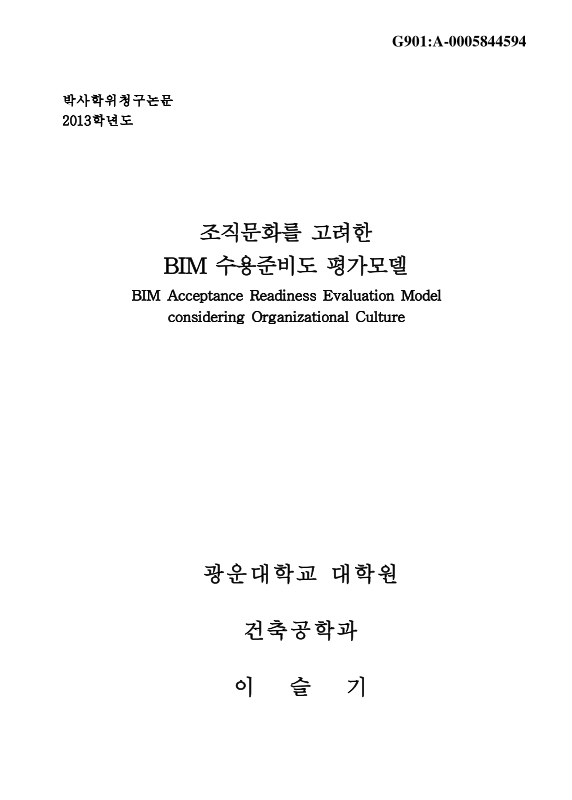
표제지
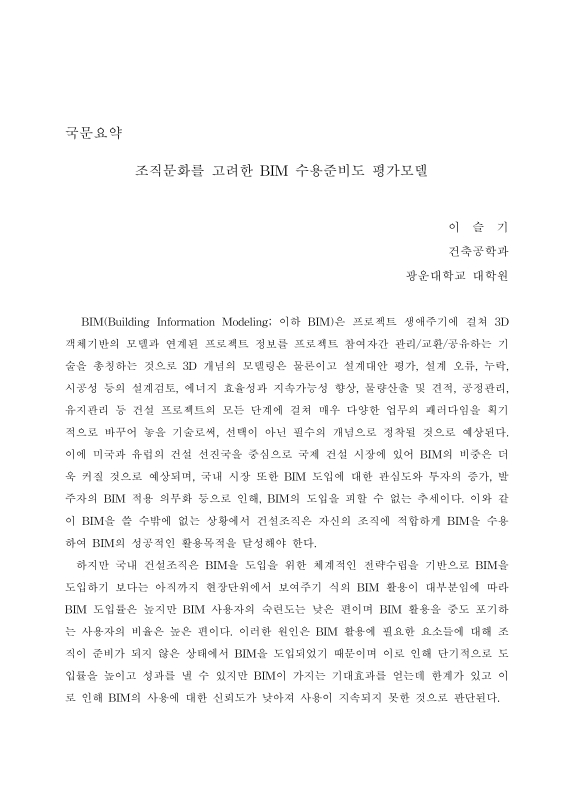
국문요약
ABSTRACT
목차
제1장 서론 17
1.1. 연구의 배경 및 목적 17
1.2. 연구의 절차 및 방법 19
제2장 선행연구 고찰 24
2.1. 건설산업에서의 BIM 활용현황 24
2.1.1. BIM의 개념 24
2.1.2. BIM의 활용현황 26
2.1.3. BIM 활용의 저해요인 29
2.2. BIM 관련 연구동향 32
2.2.1. BIM 관련 연구의 주제별 동향 32
2.2.2. BIM 수행역량 평가모델 관련 연구동향 35
2.2.3. 기존 BIM 수행역량 평가모델과의 차별성 41
2.3. BIM 성공과 BIM 수용 46
2.3.1. 정보시스템성공모델 46
2.3.2. 기술수용모델 49
2.3.3. 기존 기술수용모델과의 차별성 52
2.4. BIM 수용과 조직문화 55
2.4.1. 조직변화와 조직문화의 관계 55
2.4.2. 조직문화의 개념 55
2.4.3. 경쟁가치모형 58
제3장 조직문화를 고려한 BIM 수용준비도 평가모델 개발 62
3.1. 조직문화를 고려한 BIM 수용준비도 평가모델의 개요 62
3.2. 조직문화를 고려한 BIM 수용모델 65
3.2.1. BIM 수용과 BIM 성공간의 영향관계 분석 66
3.2.2. BIM 수용에 영향을 미치는 요인분석 69
3.2.3. BIM 수용에 대한 조직문화의 조절효과 분석 78
3.3. BIM 수용여부 판별모델 89
3.3.1. BIM 수용영향요인을 활용한 BIM 수용여부 판별분석 89
3.3.2. BIM 수용여부에 따른 BIM 성공의 차이분석 97
3.4. 조직문화를 고려한 BIM 수용준비도 평가모델의 구성요소 99
3.4.1. BIM 수용준비도 항목 99
3.4.2. 조직문화 가중치 103
3.4.3. BIM 수용준비도 종합점수 산정식 108
3.4.4. BIM 수용준비도 판정기준 108
3.5. 조직문화를 고려한 BIM 수용준비도 평가절차 110
제4장 조직문화를 고려한 BIM 수용준비도 평가모델 활용 사례연구 116
4.1. 사례연구 개요 116
4.2. 조직문화를 고려한 BIM 수용준비도 평가모델의 활용결과 118
4.2.1. A 조직의 BIM 수용준비도 평가결과 118
4.2.2. B 조직의 BIM 수용준비도 평가결과 125
4.3. 조직문화를 고려한 BIM 수용준비도 평가모델의 검증결과 132
4.3.1. 평가모델의 기능구현 검증 132
4.3.2. 평가모델의 필요성 및 유용성 검증 137
제5장 결론 141
5.1. 연구의 결과 141
5.2. 연구의 기여도 142
5.3. 향후 연구 146
참고문헌 148
부록 183
부록 1. 조직문화를 고려한 BIM 수용준비도 평가모델 개발을 위한 설문지 184
부록 2. 각 케이스별 판별분석 결과 189
부록 3. 조직문화를 고려한 BIM 수용준비도 평가지 198
부록 4. 조직문화를 고려한 BIM 수용준비도 평가모델을 위한 수식기호 201
〈그림 1-1〉 연구의 절차 20
〈그림 1-2〉 연구방법론 활용 개요 21
〈그림 2-1〉 BIM I-CMM을 활용한 성숙도 평가결과 -1 36
〈그림 2-2〉 BIM I-CMM을 활용한 성숙도 평가결과 -2 37
〈그림 2-3〉 평가시트 (예시: A-Physical Accuracy of Model, A. 1-Basic Model Geometry) 38
〈그림 2-4〉 BIM Proficiency Matrix을 활용한 평가결과 38
〈그림 2-5〉 VDC Scorecard 39
〈그림 2-6〉 bimSCORE을 활용한 평가결과 40
〈그림 2-7〉 DeLone & McLean의 성공모델(1992) 46
〈그림 2-8〉 Seddon & Kiew 성공모델(1994)과 Seddon 성공모델(1997) 47
〈그림 2-9〉 Pitt, Watson & Kavan의 성공모델(1995) 47
〈그림 2-10〉 Myers, Kappelman & Prybuton의 성공모델(1997) 48
〈그림 2-11〉 DeLone & McLean의 성공모델(2003) 48
〈그림 2-12〉 TAM (Davis, 1989) 49
〈그림 2-13〉 TAM 2 (Venkatesh & Davis, 2000) 50
〈그림 2-14〉 TAM 3 (Venkatesh & Bela, 2008) 50
〈그림 2-15〉 합리적 행동이론 (Fishbein & Ajzen ,1975) 51
〈그림 2-16〉 계획된 행동이론 (Ajzen, 1991) 52
〈그림 2-17〉 경쟁가치모형접근을 통한 조직문화유형 59
〈그림 3-1〉 조직문화를 고려한 BIM 수용준비도 평가를 위한 개념적 모델 63
〈그림 3-2〉 조직문화를 고려한 BIM 수용모델 66
〈그림 3-3〉 BIM 성공을 위한 BIM 수용의 필요성 검증을 위한 연구모형 67
〈그림 3-4〉 BIM 수용에 영향을 미치는 요인 도출을 위한 연구모형 75
〈그림 3-5〉 조직문화의 조절효과검증을 위한 연구모형 80
〈그림 3-6〉 개인효능감에 대한 위계문화의 조절효과 87
〈그림 3-7〉 조직효능감에 대한 위계문화의 조절효과 87
〈그림 3-8〉 개인효능감에 대한 합의문화의 조절효과 88
〈그림 3-9〉 조직효능감에 대한 합의문화의 조절효과 88
〈그림 3-10〉 BIM 수용여부 판별모델 89
〈그림 3-11〉 BIM 수용여부 판별분석을 위한 연구모형 90
〈그림 3-12〉 BIM 비수용 96
〈그림 3-13〉 BIM 수용 96
〈그림 3-14〉 BIM 성공의 차이검증을 위한 연구모형 97
〈그림 3-15〉 조직문화를 고려한 BIM 수용준비도 평가 절차 110
〈그림 3-16〉 조직문화가중치-개선시급도 매트릭스 115
〈그림 4-1〉 A 조직의 조직문화 유형별 점수 118
〈그림 4-2〉 A 조직의 BIM 수용준비도 평가결과 123
〈그림 4-3〉 A 조직의 BIM 수용준비도 개선우선순위 124
〈그림 4-4〉 B 조직의 조직문화 유형별 점수 125
〈그림 4-5〉 B 조직의 BIM 수용준비도 평가결과 130
〈그림 4-6〉 B 조직의 BIM 수용준비도 개선우선순위 131
〈그림 4-7〉 A 조직의 BIM 수용준비도 현재수준 135
〈그림 4-8〉 B 조직의 BIM 수용준비도 현재수준 136
〈그림 5-1〉 BIM 활용 저해요인과 BIM 수용준비도 항목 145
BIM(Building Information Modeling; 이하 BIM)은 프로젝트 생애주기에 걸쳐 3D 객체기반의 모델과 연계된 프로젝트 정보를 프로젝트 참여자간 관리/교환/공유하는 기술을 총칭하는 것으로 3D 개념의 모델링은 물론이고 설계대안 평가, 설계 오류, 누락, 시공성 등의 설계검토, 에너지 효율성과 지속가능성 향상, 물량산출 및 견적, 공정관리, 유지관리 등 건설 프로젝트의 모든 단계에 걸쳐 매우 다양한 업무의 패러다임을 획기적으로 바꾸어 놓을 기술로써, 선택이 아닌 필수의 개념으로 정착될 것으로 예상된다. 이에 미국과 유럽의 건설 선진국을 중심으로 국제 건설 시장에 있어 BIM의 비중은 더욱 커질 것으로 예상되며, 국내 시장 또한 BIM 도입에 대한 관심도와 투자의 증가, 발주자의 BIM 적용 의무화 등으로 인해, BIM의 도입을 피할 수 없는 추세이다. 이와 같이 BIM을 쓸 수밖에 없는 상황에서 건설조직은 자신의 조직에 적합하게 BIM을 수용하여 BIM의 성공적인 활용목적을 달성해야 한다.
하지만 국내 건설조직은 BIM을 도입을 위한 체계적인 전략수립을 기반으로 BIM을 도입하기 보다는 아직까지 현장단위에서 보여주기 식의 BIM 활용이 대부분임에 따라 BIM 도입률은 높지만 BIM 사용자의 숙련도는 낮은 편이며 BIM 활용을 중도 포기하는 사용자의 비율은 높은 편이다. 이러한 원인은 BIM 활용에 필요한 요소들에 대해 조직이 준비가 되지 않은 상태에서 BIM을 도입되었기 때문이며 이로 인해 단기적으로 도입률을 높이고 성과를 낼 수 있지만 BIM이 가지는 기대효과를 얻는데 한계가 있고 이로 인해 BIM의 사용에 대한 신뢰도가 낮아져 사용이 지속되지 못한 것으로 판단된다.
이를 위해서는 체계적인 건설조직의 BIM의 성공적인 도입전략 수립을 위해서는 조직이 BIM을 도입하는데 어떤 요소가 필요한지 파악하고 이들이 얼마큼 준비되었는지에 대한 평가가 선행되어야 한다. 한편 BIM 도입은 조직변화를 요구하며 조직변화는 조직 안에 보이지 않지만 공통적으로 받아들여지는 조직문화에 의해 영향을 받게 되므로 조직문화를 고려하여 BIM 도입전략이 수립되어야만 투자의 효율성과 효과성을 모두 얻을 수 있을 것이다.
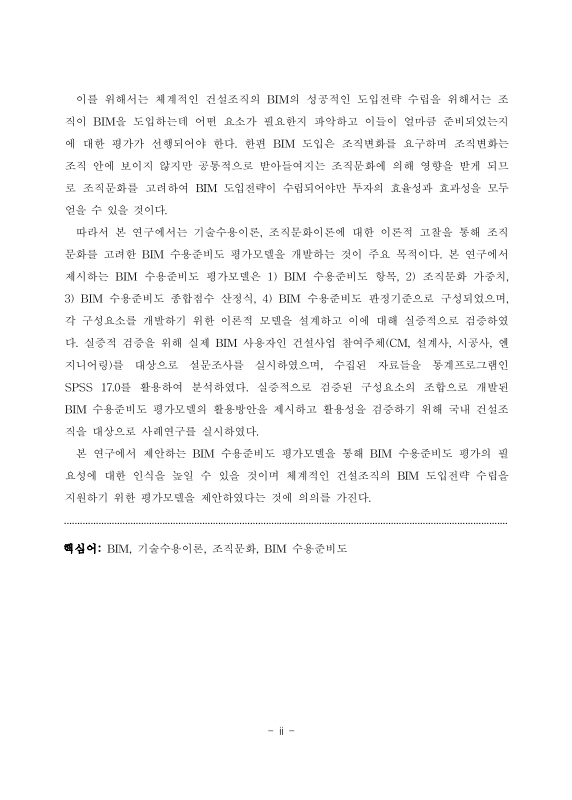
따라서 본 연구에서는 기술수용이론, 조직문화이론에 대한 이론적 고찰을 통해 조직문화를 고려한 BIM 수용준비도 평가모델을 개발하는 것이 주요 목적이다. 본 연구에서 제시하는 BIM 수용준비도 평가모델은 1) BIM 수용준비도 항목, 2) 조직문화 가중치, 3) BIM 수용준비도 종합점수 산정식, 4) BIM 수용준비도 판정기준으로 구성되었으며, 각 구성요소를 개발하기 위한 이론적 모델을 설계하고 이에 대해 실증적으로 검증하였다. 실증적 검증을 위해 실제 BIM 사용자인 건설사업 참여주체(CM, 설계사, 시공사, 엔지니어링)를 대상으로 설문조사를 실시하였으며, 수집된 자료들을 통계프로그램인 SPSS 17.0를 활용하여 분석하였다. 실증적으로 검증된 구성요소의 조합으로 개발된 BIM 수용준비도 평가모델의 활용방안을 제시하고 활용성을 검증하기 위해 국내 건설조직을 대상으로 사례연구를 실시하였다.
본 연구에서 제안하는 BIM 수용준비도 평가모델을 통해 BIM 수용준비도 평가의 필요성에 대한 인식을 높일 수 있을 것이며 체계적인 건설조직의 BIM 도입전략 수립을 지원하기 위한 평가모델을 제안하였다는 것에 의의를 가진다.| 번호 | 참고문헌 | 국회도서관 소장유무 |
|---|---|---|
| 1 | Usability Improvement of BIM for Construction Projects Using Active BIM Functions | 소장 |
| 2 | A Study on Development of BIM-based Asset Management Model for Maintenance of the Bridge | 소장 |
| 3 | (A)study on evaluation of the BIM capability maturity and recognition comparison analysis for construction organization | 소장 |
| 4 | A Survey on Priority of Elements of Development of BIM Template for Small and Middle Architectural Design Firms | 소장 |
| 5 | Study on BIM-based Sustainable Design Process using Building Performances and Energy Efficiency Evaluation | 소장 |
| 6 | Development of Automatic Design System for Steel Connection based on S-BIM | 소장 |
| 7 | Study on the Development of Process for BIM-Based CAFM System | 소장 |
| 8 | Study on the Application of 3D-based BIM for School Facilities to Increase Cost Management Efficiency | 소장 |
| 9 | A Study on the Systematization of Open BIM Data Quality Management | 소장 |
| 10 | A Scale Development for Measuring User Satisfaction with GKMS | 소장 |
| 11 | 고객만족 측정 지표와 고객 소개와의 상호 연관성에 관한 조사연구 : 부엌가구산업을 중심으로 | 소장 |
| 12 | Development of the Spatial Analysis Software for the Application to the Early Stage of BIM Design Process | 소장 |
| 13 | “지역문화재단의 조직문화유형이 직무만족과 조직몰입에 미치는 영향”, 숙명여자대학교 석사학위논문, 2011. | 미소장 |
| 14 | Study on the Development of an Architectural Inspection Process Model Applied Building Information Modeling | 소장 |
| 15 | An Exploratory Study on the Measurement of ASP Service Quality in Small Firm | 소장 |
| 16 | study on the school occupancy schedule for the realization of Green BIM in Korea | 소장 |
| 17 | Intelligent Digital Architecture Tools and BIM Paradigm | 소장 |
| 18 | Longitudinal Study on the Change of Organizational Culture and Performance in Korean Firms  |
미소장 |
| 19 | A Study for Derivation of Participant's Information Flow At Framework Construction based on BIM | 소장 |
| 20 | “건설회사의 BIM 활용 실태조사 및 시사점”, 한국건설산업연구원, 2012. | 미소장 |
| 21 | An Analysis of BIM Effectiveness in Architectural Competition - Based on Architectural Competition Evaluation Indices | 소장 |
| 22 | 한국건설관리학회 논문집 초록 |
미소장 |
| 23 | A Study on Building the Work Environment to Utilize BIM for Domestic Architectural Firms | 소장 |
| 24 | Database Management of Building Information for Structural Analysis by BIM/IFC | 소장 |
| 25 | “병무청 조직문화 진단에 관한 연구-조직문화진단평정지(OCAI)의 적용-”,충남대학교 석사학위논문, 2009. | 미소장 |
| 26 | A Methodology for Design Quality Control of Super-tall Buildings based on BIM : Focused on Quality Control for Evacuation Check | 소장 |
| 27 | framework of the open BIM-based integrated information system for the Korean traditional house | 소장 |
| 28 | study on the feature-based modeling of Han-ok and the development of a parametric BIM library browser | 소장 |
| 29 | study on the BIM-based automation of envelope form generation at the schematic design phase of super-tall buildings | 소장 |
| 30 | A Study on the Improvement Direction of BIM Design Fee Standard in Korea through Case Studies and Surveys | 소장 |
| 31 | Development of an open BIM-based Korean traditional house component library using an XML parametric information approach | 소장 |
| 32 | Proposition and Application of Mapping System for Input Data between Open BIM Data and Building Energy Simulation Software : Focused on Building Material Library and Energy Plus | 소장 |
| 33 | basic study on the establishment of open BIM information environment for super-tall buildings | 소장 |
| 34 | Exploring the Success Factors of ASP based Information System: From the Perspective of Two Factor Theory | 소장 |
| 35 | “조직문화와 조직효과성간 관계: 리더십의 조절효과를 중심으로”, 고려대학교 석사학위논문, 2010. | 미소장 |
| 36 | 택지개발 우선순위 결정모형 정립 및 청주시 사례 적용 | 소장 |
| 37 | Organizational culture, CEO leadership, and organizational innovation in local public enterprises | 소장 |
| 38 | A Methodology of Open BIM-Based Quantity Take-Off for Schematic Estimation of Frame Work in Super-Tall Buildings | 소장 |
| 39 | The Development of Data Model for Open BIM-Based Schematic Estimates - Focused on Construction Type for Actual Cost of Public Projects | 소장 |
| 40 | Development of BIM Functions and System for Construction Project Through Project Life Cycle -Focusing on Bridge Construction Project- | 소장 |
| 41 | “한국행정문화연구와 경쟁가치모형”. 한국행정학회보, 제11권 제3호, pp.219-238, 2002a. | 미소장 |
| 42 | Effects of Organizational Culture on Organizational Commitment and Job Satisfaction in the Public Sector | 소장 |
| 43 | A Study on Developing Evaluation Environment of Green Building Certification Criteria Using GBT(Green BIM Template) | 소장 |
| 44 | Study on the Factors and Elements Effecting Parking Area Expansion Plans in Apartment Complexes Remodeling | 소장 |
| 45 | The Analysis of the Research Trends about the Relation between Organizational Culture and Organizational Effectiveness: Focusing on the field of Public Administration | 소장 |
| 46 | 조직구조와 조직문화가 변혁적/거래적 리더십과 조직유효성 관계에 미치는 조절효과 연구 | 소장 |
| 47 | 리더십 유형과 조직문화가 혁신행동에 미치는 영향 | 소장 |
| 48 | “건설산업의 PMIS 개발현황과 발전방안”, 한국건설산업연구원, 2003. | 미소장 |
| 49 | Development of a BIM based energy performance evaluation method for buildings with a twisted shape in early design stage | 소장 |
| 50 | A Study on the Development of Application Technologies and a BIM based tool for Heating and Cooling Load Calculation | 소장 |
| 51 | Study of the organization performance according to the character of coporate culture |
미소장 |
| 52 | BIM design management process using the dependency structure matrix at the introduction phase | 소장 |
| 53 | study on the automatic generation of spatial analysis model with the gbXML format in BIM collaboration environment | 소장 |
| 54 | A Study on the BIM Design Collaboration in Block Residential Projects focused on the Combination Method of Unit Plan Models | 소장 |
| 55 | A Study on 3D BIM Collaborative Approximate Estimating Model of Structural Work for Apartment Projects | 소장 |
| 56 | Roadway Preliminary Cost Estimation Prototype based on BIMand GIS | 소장 |
| 57 | BIM기반 초고층 주상복합시설 유지관리 시스템 개발에 관한 연구 | 소장 |
| 58 | A Study on the Categorization System of the BIM-Library for Wooden Structure of the Korean Traditional Buildings | 소장 |
| 59 | Study on the Ontology-Based Representation Model for Interoperability of BIM(Building Information Model | 소장 |
| 60 | Suggesting Solutions when Applying Building Information Modeling (BIM) to the Korean Construction Industry through Case Studies | 소장 |
| 61 | Deriving an ASP Success Model: An Application to Small Businesses | 소장 |
| 62 | A Case Study on Developing and Applying Web-Based PMIS System to SOC Project | 소장 |
| 63 | Exploring integrated design strategies for the optimal use of BIM | 소장 |
| 64 | A Study on Developing BIM Template based on Public Procurement Service Standard Construction Code to Improve the Efficiency in Carbon Dioxide Assessment of Buildings |
미소장 |
| 65 | BIM based Optimize Method of Finish Material Placing for Modular Unit | 소장 |
| 66 | Open BIM-Based Quality Control for Enhancing the Design Quality in the Architectural Design Phase | 소장 |
| 67 | BIM-Based LCC Analysis Process for Exterior Skin System of Buildings | 소장 |
| 68 | The Analysis of Job Stress of Workers in the Architectural Design Firm After the Introduction of BIM | 소장 |
| 69 | BSC Based Measurement of Satisfaction Degree For Based BIM Construction Projets | 소장 |
| 70 | Development of marine dual fuel engine simulator | 소장 |
| 71 | Analysis of Assessment Indicator on Priorities for Budget Allocation of the National R&D Program | 소장 |
| 72 | Object-Oriented Modeling of Construction Operations for Schedule-Cost Integration, Based on BIM | 소장 |
| 73 | A Study on Improvement of Implementation Documents using DSM(Design Structure Matrix) | 소장 |
| 74 | Analysis of Modeling Errors for BIM-based Facility Management Systems | 소장 |
| 75 | Information requirements analysis for BIM-based facility management systems | 소장 |
| 76 | A Study on the Development Direction and Priority of the BIM-Based Hospital Design Validation Technology | 소장 |
| 77 | Building Energy Performance Assessment using Interoperability of BIM-based Simulation Model | 소장 |
| 78 | Study on the Structure Design Process and Modeling Guidelines Based on BIM | 소장 |
| 79 | A Guideline for Structural Drawings Based on BIM | 소장 |
| 80 | Development of BIM-based Work Process Model in Construction Phase | 소장 |
| 81 | Analysis of Quantified Characteristics of the Performance Indicators for Construction Companies | 소장 |
| 82 | Success Factors for Implementing Construction Project Management Information Sytems (PMIS) based on the Characteristics of Construction Management Tasks | 소장 |
| 83 | A Study of 4D Simulation System using Automatic Scheduling Process - The Focus on Steel Structural Construction |
미소장 |
| 84 | A BIM-Based Architectural Model Takes Advantage of the Estimate Model Process | 소장 |
| 85 | Architectural Design Considering the Composed Unit Cost of BIM Rough Estimation Research - Focused on the Office of Construction and Facilities Management BIM Basic Guidelines - | 소장 |
| 86 | Construction Process Analysis of Han-Ok for BIM Based Modern Han-Ok Construction Simulation | 소장 |
| 87 | Basic research on BIM-based quantity take-off guidelines | 소장 |
| 88 | A Fundamental Study on BIM Based Energy Performance Assessment System in Early Design Stage- Focused on Interface for Building Energy Simulation | 소장 |
| 89 | An RFID and BIM based Simulator for Construction Material Logistics and Progress Management | 소장 |
| 90 | A Survey of the Satisfaction Level of Construction Information System From Users' Viewpoints On Construction Site | 소장 |
| 91 | Diagnosing the Organizational Culture of Korea's Central Government with the Competing Values Model | 소장 |
| 92 | 발주자의 PMIS 성과 평가모델 개발에 관한 연구 | 소장 |
| 93 | 경영성과 제고를 위한 공공기관의 조직문화유형 분석 |
미소장 |
| 94 | An Analysis on affecting factors about lowly using 3D CAD by using the AHP | 소장 |
| 95 | Issues and Prospects of BIM-to-BEM (Building Energy Model) | 소장 |
| 96 | 한국건설관리학회 논문집 초록 |
미소장 |
| 97 | Automatic Inference of Standard BOQ(Bill of Quantities) Items using BIM and Ontology | 소장 |
| 98 | Key factors affecting BIM acceptance in construction | 소장 |
| 99 | Moderating Effect of Organizational Culture on the Relationship between Influence Factors and BIM Acceptance | 소장 |
| 100 | Study on the Application Methodology for BIM based Set-based Design Approach | 소장 |
| 101 | 고객만족 연구에 관한 종합적 고찰 | 소장 |
| 102 | basic study on the development of the technology of simulating the user’s behavior in the real time manner within the BIM-based design process | 소장 |
| 103 | Study on the Development of Automatic Generation System of Navigation Graph for Dynamic User Simulation Using Artificial Intelligence for Game based on BIM | 소장 |
| 104 | Study on a BIM Application in the Early Stage of Building Design Process Based on Social Information Visualization | 소장 |
| 105 | Work Efficiency Analysis of BIM Based Structural Drawing | 소장 |
| 106 | “국방과학기술 연구개발 우선순위 설정에 관한연구”, 한국국방경영분석학회지, 제30권 제2호, pp.122-132, 2004. | 미소장 |
| 107 | A Development Priority and Technology Roadmap for Construction Automation | 소장 |
| 108 | “조직문화 구성형태에 따른 조직구조의 차이분석: 경인지역 중소제조기업을 대상으로”. 대한경영학회지. 제19권, pp.231-248, 1988. | 미소장 |
| 109 | BIM Applicability Analysis of the PMIS Modules using Component Business Model | 소장 |
| 110 | Psychological Empowerment, Organizational Supports, and Innovative Work Behavior of General Hospital Employees | 소장 |
| 111 | “국내 건축설계조직의 BIM 수행능력 진단모델 개발”, 이화여자대학교 석사학위논문, 2010. | 미소장 |
| 112 | Study on BIM Capability Evaluation for Design Organizations | 소장 |
| 113 | A Framework Integrating Cost and Schedule based on BIM using IFC | 소장 |
| 114 | A Basic Study on Review the Classification System and the Process of BIM Information for an Automatic Review of Building Code | 소장 |
| 115 | An Index for Measuring the Degree of Completeness of BIM-based Quantity Take-Off | 소장 |
| 116 | The Deduction of the Success Factor in Construction Projects by Design Build Methods | 소장 |
| 117 | Derivation of High-Priority Items for BIM Adoption in CM Service | 소장 |
| 118 | “건설회사 PMIS 평가 및 발전 전략체계연구”, 한국건설산업연구원, 2005. | 미소장 |
| 119 | “성공적인 건설사업관리를 위한 건설사업관리자 직위별 개인역량개선우선순위”, 대한건축학회논문집(계획계), 제28권 제3호, pp.91-98, 2011. | 미소장 |
| 120 | Extended TAM including Organizational Culture as an External Variable |
미소장 |
| 121 | A Study on the Reinforcing Steel Detailing Methodology with Improvement of Interoperable System in the Structural BIM Environment focused on Flat Plate | 소장 |
| 122 | Analysis of significant factors for successful BIM technology application to Korean traditional house projects | 소장 |
| 123 | 거주자 특성을 고려한 공동주택의 주거환경평가 연구 : 세분계층의 거주경험에 따른 개선우선순위 도출을 중심으로 | 소장 |
| 124 | (The)influence of the elements of organizational culture on innovative behaviors : focused on mediating effect of shared leadership | 소장 |
| 125 | Performance Measurement Method and Case Study for BIM based Construction Simulation System | 소장 |
| 126 | Developing Construction Object Library for BIM based Building Construction Planning | 소장 |
| 127 | 변혁적 리더십과 협동행동, 창의성, 조직혁신성 간의 관계: 학습지향성의 조절효과 : 강원 영동지역 리조트산업체를 중심으로 | 소장 |
| 128 | Analysis on Domestic BIM Usage of Big Architectural Firms Regarding Effective Design Management | 소장 |
| 129 | Framework of Conceptual Estimation Model for BIM based Internal Finishes of High-rise Building Project | 소장 |
| 130 | Concept and Structure of Parametric Object Breakdown Structure (OBS) for Practical BIM | 소장 |
| 131 | An Empirical Analysis on the Success Factors of ASP Services | 소장 |
| 132 | A Study of Success Factors for Information System Outsourcing | 소장 |
| 133 | Analysis of core ability of BIM manager | 소장 |
| 134 | A Method to Build Daily Progress Management Model based on BIM Estimate Data in Construction Phase | 소장 |
| 135 | The Study on the Critical Success Factors of the Adoption and Use of the ASP-based ERP Systems | 소장 |
| 136 | 조달청, “BIM 가이드라인 개발”, 2010. | 미소장 |
| 137 | 정보시스템의 성공지표와 성공모형에 관한 실증적 연구 : 지방자치단체를 중심으로 | 소장 |
| 138 | BIM 적용 공공시설 프로젝트 단계별 유지관리 시스템 적용방안 연구 | 소장 |
| 139 | A Study on Automatic Reinforcement Placement System of Isolated Foundation based on S-BIM | 소장 |
| 140 | A Study on the Establishment of the Automatic Rebar Placement System for Reinforced Concrete Mat Foundation based on S-BIM | 소장 |
| 141 | A Study on Non-Territorial Workplaces Design Consideration though the Analysis of the Workers Satisfaction | 소장 |
| 142 | Study on the BIM based Architectural Construction Simulation System using Combinative Construction Schedule Creation Method | 소장 |
| 143 | A Study on Applying Green BIM to Sustainable Architecture at Early Design Stage - Focused on Energy Performance Analysis - | 소장 |
| 144 | 행정조직의 문화유형에 대한 실증적 분석 | 소장 |
| 145 | A Study on the Type of Organizational Culture in Daejeon Metropolitan Office of Education : Application of Organizational Culture Assessment Instrument(OCAI) | 소장 |
| 146 | Developing Measurement System for Key Performance Indicators on Building Construction Projects | 소장 |
| 147 | Study on the Problems and the Measurements for Improving Representations and Drafting Methods of Architectural Drawings by Adopting BIM | 소장 |
| 148 | 조직혁신에 관한 연구모형의 개발과 연구명제의 설정 | 소장 |
| 149 | 4D BIM based Workspace Planning Process in Building Construction Project | 소장 |
| 150 | A Basic Study on Hanok Wooden Structure Modeling Process based on BIM - Focused on Skeleton-Assembly Process by Wizard | 소장 |
| 151 | A Study on the Building Energy Evaluation Using Land Plus Mass Parameter Family of Building Information Modeling at the Early Design Stage | 소장 |
| 152 | “건설산업 BIM 활성화 저해 영향요인 도출에 관한 연구”, 한양대학교석사학위논문, 2010. | 미소장 |
| 153 | A Study on LOD(Level of Development) for Development of Green BIM Guidelines - Focused on Energy Performance Estimation | 소장 |
| 154 | 조직문화, 리더십, 직무만족, 조직몰입, 조직시민행동 간의 관계에 관한 연구 : 공공조직과 민간조직의 비교를 중심으로 | 소장 |
| 155 | "정보시스템의 효과성 측정에 대한 실증적 연구”, 학술지경영연구,제12권 제1호, pp.257-288, 1997. | 미소장 |
| 156 | The Impact of the Characteristics of Organizational Culture on the Bases for Organizational Commitment | 소장 |
| 157 | Design error classification and causation in BIM design | 소장 |
| 158 | Key Success Factors for the Fast-Track in Public Design-Build Project | 소장 |
| 159 | “사회조사분석사”, 3판, 다산출판사, 2000. | 미소장 |
| 160 | A Study on the Development and Application of BIM-Based Standard Library for LCCO₂ Assessment and the Green Building Certification - Centered on the Building Material Level | 소장 |
| 161 | The Analysis of Priority on Improvement of IT Systems for B2B Collaboration of Small and Medium-Sized Enterprise Using the Performance Model | 소장 |
| 162 | BIM Based Time-series Cost Model for Building Projects : Focusing on Construction Material Prices | 소장 |
| 163 | Perceived Usefulness, Ease of Use, and Usage of Information Technology: A Replication |
미소장 |
| 164 | The Role of Innovation Characteristics and Perceived Voluntariness in the Acceptance of Information Technologies |
미소장 |
| 165 | The theory of planned behavior |
미소장 |
| 166 | “Understanding Attitudes and Predicting Social Behavior.” Prentice Hall, Englewood Cliffs, New Jersey. 1980. | 미소장 |
| 167 | Economic and environmental assessment of deconstruction strategies using building information modeling |
미소장 |
| 168 | Critical success factors influencing safety program performance in Thai construction projects |
미소장 |
| 169 | Exploring how information exchanges can be enhanced through Cloud BIM |
미소장 |
| 170 | Knowledge-assisted BIM-based visual analytics for failure root cause detection in facilities management |
미소장 |
| 171 | Customer Satisfaction, Market Share, and Profitability: Findings from Sweden |
미소장 |
| 172 | Structural equation modeling in practice: A review and recommended two-step approach. |
미소장 |
| 173 | Strengthening the Satisfaction-Profit Chain |
미소장 |
| 174 | A survey on modeling guidelines for quantity takeoff-oriented BIM-based design |
미소장 |
| 175 | “Measurement of project success." Project Management Journal, Vol.6 No.3, pp.164~170, 1988. | 미소장 |
| 176 | Challenging electronic procurement in the AEC sector: A BIM-based integrated perspective |
미소장 |
| 177 | Value proposition on interoperability of BIM and collaborative working environments |
미소장 |
| 178 | A conceptual framework to support solar PV simulation using an open-BIM data exchange standard |
미소장 |
| 179 | Technology adoption in the BIM implementation for lean architectural practice |
미소장 |
| 180 | The social psychology of creativity: A componential conceptualization. |
미소장 |
| 181 | “Determinants of construction project success." Project Management Journal, Vol.18 No.2, pp.69~79, 1987. | 미소장 |
| 182 | No-no. Paradox and consistency |
미소장 |
| 183 | “Building Information Modeling (BIM) partnering framework for public construction projects." Automation in Construction, Vol.31, pp.204~214, 2013. | 미소장 |
| 184 | State of Practice of Building Information Modeling in Mechanical and Electrical Construction Industries |
미소장 |
| 185 | The Logical Framework Method for Defining Project Success |
미소장 |
| 186 | “Social Learning Theory." Prentice-Hall, Englewood Cliffs, 1977. | 미소장 |
| 187 | “A note on the multiplying factors for various chi square approximations." Journal of the Royal Statistical Society, Vol.16, pp.296~298, 1954. | 미소장 |
| 188 | Generation of a construction planning from a 3D CAD model |
미소장 |
| 189 | Applications of structural equation modeling in marketing and consumer research: A review |
미소장 |
| 190 | “Personal Administration: An Exceptional Skill Building Approach." Addison Wesley Publishing Co, 1981. | 미소장 |
| 191 | A new framework for determining critical success/failure factors in projects |
미소장 |
| 192 | “Regression Diagnostics: Identifying Influential Data And Source of collinearity." John Wiley and Sons, 1980. | 미소장 |
| 193 | “An integrated approach to BIM competency assessment, acquisition and application." Automation in Construction, Vol.35, pp.174-189, 2013. | 미소장 |
| 194 | A BIM-enabled information infrastructure for building energy Fault Detection and Diagnostics |
미소장 |
| 195 | Application Areas and Data Requirements for BIM-Enabled Facilities Management |
미소장 |
| 196 | “The VDC Scorecard: Formulation and Validation”, CIFE Working Paper #WP135. October 2013, Stanford University. 2013. | 미소장 |
| 197 | “Diagnosing and Changing Organizational Culture”. Addison Weslet Inc, NY, 1999. | 미소장 |
| 198 | Organizational Divisions in BIM-Enabled Commercial Construction |
미소장 |
| 199 | Factors Affecting the Success of a Construction Project |
미소장 |
| 200 | A BIM-based construction quality management model and its applications |
미소장 |
| 201 | Asynchronous online collaboration in BIM generation using hybrid client-server and P2P network |
미소장 |
| 202 | Identifying and assessing critical risk factors for BIM projects: Empirical study |
미소장 |
| 203 | Development of BIM-based evacuation regulation checking system for high-rise and complex buildings |
미소장 |
| 204 | Critical Success Factors for Different Project Objectives |
미소장 |
| 205 | “Statistical Power Analysis for the Behavioral Sciences(2nd Ed.)." Lawrence Erlbaum Associates, Inc, 1998. | 미소장 |
| 206 | “Landscape of Opportunities: Future Research on Shared Leadership". In Pearce, C. L. & Conger, J. A.. Shared Leadership: Reframing the How sand Whys of Leadership. Thousand, CA: Sage, 2003 | 미소장 |
| 207 | Measuring Service Quality: A Reexamination and Extension |
미소장 |
| 208 | “Consumer Satisfaction: Toward an Integrative Framework." Proceedings of the Southern Marketing Association, pp.169~171, 1976. | 미소장 |
| 209 | “Exploring the Concept of Loyalty in Service, in The Services Challenge: Integrating for Competitive Advantage." American Marketing Association, Chicago, 1987. | 미소장 |
| 210 | Perceived Usefulness, Perceived Ease of Use, and User Acceptance of Information Technology |
미소장 |
| 211 | Information Systems Success: The Quest for the Dependent Variable |
미소장 |
| 212 | The DeLone and McLean Model of Information Systems Success: A Ten-Year Update |
미소장 |
| 213 | Bringing corporate culture to the bottom line |
미소장 |
| 214 | Toward a Theory of Organizational Culture and Effectiveness |
미소장 |
| 215 | Manager-worker-based model for the parallelization of quantum Monte Carlo on heterogeneous and homogeneous networks |
미소장 |
| 216 | An experimental investigation of web-based information systems success in the context of electronic commerce |
미소장 |
| 217 | “Deviation analysis method for the assessment of the quality of the as-is Building Information Models generated from point cloud data." Original Research Article, Automation in Construction, Vol.35, pp.507~516, 2013. | 미소장 |
| 218 | Intellectual Property Rights in Building Information Modeling Application in Taiwan |
미소장 |
| 219 | “Predicting E-Service Adoption a Perceived Risk Facets Perspective." Eighth Americas Conference on Information Systems, pp.1034~1046, 2002. | 미소장 |
| 220 | Analysis of modeling effort and impact of different levels of detail in building information models |
미소장 |
| 221 | “Beliefs, Attitude, Intention, and Behavior:An Introduction to Theory and Research." Addison-Wesley, Reading, MA. 1975. | 미소장 |
| 222 | A Theory of Individual Creative Action in Multiple Social Domains |
미소장 |
| 223 | Evaluating Structural Equation Models with Unobservable Variables and Measurement Error |
미소장 |
| 224 | Framing of project critical success factors by a systems model |
미소장 |
| 225 | Early stage multi-level cost estimation for schematic BIM models |
미소장 |
| 226 | Automating surface flatness control using terrestrial laser scanning and building information models |
미소장 |
| 227 | “Industry Foundation Class Modelling For Estimating and Scheduling, Durability Of Building Materials And Components 8”. Vancouver, pp. 2825~2835. 1999. | 미소장 |
| 228 | Acceptance of electronic tax filing: A study of taxpayer intentions |
미소장 |
| 229 | The impact of developer responsiveness on perceptions of usefulness and ease of use |
미소장 |
| 230 | Organizational behavior implications of the congruence between preferred polychronicity and experienced work‐unit polychronicity |
미소장 |
| 231 | "The importance of customer satisfaction.." Direct Marketing, Vol.56 No.8, pp.23~29, 1993. | 미소장 |
| 232 | “Industry Determinants of Organizational Culture”. Academy og Management Review. Vol.16 No.2, pp.396~401, 1991 | 미소장 |
| 233 | “Multivariate Data Analysis with Readings." 3th edition, Prentice Hall, 1992. | 미소장 |
| 234 | “Multivariate Data Analysis with Readings." 5th edition, Prentice Hall, 1998. | 미소장 |
| 235 | Understanding adoption and use of BIM as the creation of actor networks |
미소장 |
| 236 | Understanding the Adoption of Multipurpose Information Appliances: The Case of Mobile Data Services |
미소장 |
| 237 | Determinants of User Acceptance of Digital Libraries: An Empirical Examination of Individual Differences and System Characteristics |
미소장 |
| 238 | “The theory of Buyer Behavior." John Wiley and sons, New york, 1969. | 미소장 |
| 239 | Users-orientated evaluation of building information model in the Chinese construction industry |
미소장 |
| 240 | A knowledge-based BIM system for building maintenance |
미소장 |
| 241 | Personal Computing Acceptance Factors in Small Firms: A Structural Equation Model |
미소장 |
| 242 | User Involvement and MIS Success: A Review of Research |
미소장 |
| 243 | The measurement of user information satisfaction |
미소장 |
| 244 | Toward an Understanding of the Behavioral Intention to Use an Information System |
미소장 |
| 245 | Building a Climate for Innovation Through Transformational Leadership and Organizational Culture |
미소장 |
| 246 | Integrating BIM and GIS to improve the visual monitoring of construction supply chain management |
미소장 |
| 247 | Reducing user-related risks during and prior to system development |
미소장 |
| 248 | LicA: A BIM based automated code-checking application for water distribution systems |
미소장 |
| 249 | “Transaction Cost, Property Rights and Organizational Culture: An Exchange Perspectives." American Society for Quality, Vol.28 No.3, pp.457~467, 1983. | 미소장 |
| 250 | Where to Focus for Successful Adoption of Building Information Modeling within Organization |
미소장 |
| 251 | “Measuring the success of the Greek Taxation Information System." International Journal of Information Management, Vol.30, pp.47~56, 2007. | 미소장 |
| 252 | Productive modeling for development of as-built BIM of existing indoor structures |
미소장 |
| 253 | Building information modelling (BIM) framework for practical implementation |
미소장 |
| 254 | A second generation little jiffy |
미소장 |
| 255 | Improvement of architectural engineering design education process through an analysis of BIM courses | 소장 |
| 256 | Organizational Configurations and Performance: A Comparison of Theoretical Approaches |
미소장 |
| 257 | Success criteria and factors for international development projects: A life‐cycle‐based framework |
미소장 |
| 258 | Value-based Adoption of Mobile Internet: An empirical investigation |
미소장 |
| 259 | “Automated construction progress measurement using a 4D building information model and 3D data." Automation in Construction, Vol.31, pp.75~82, 2013. | 미소장 |
| 260 | Generating construction schedules through automatic data extraction using open BIM (building information modeling) technology |
미소장 |
| 261 | “Marketing Management, The Millennium Edition." Prentice Hall International. New York, 2000. | 미소장 |
| 262 | “Corporate Culture and Performance. New York." The Free Press, 1992. | 미소장 |
| 263 | “How to measure the benefits of BIM-A case study approach." Automation in Construction, Vol.24, pp.149~159, 2012. | 미소장 |
| 264 | An extension of the technology acceptance model in an ERP implementation environment |
미소장 |
| 265 | Introduction of BIM Quality Standard for Quantity Take-off | 소장 |
| 266 | A defect management system for reinforced concrete work utilizing BIM, image-matching and augmented reality |
미소장 |
| 267 | “Automatic thermographic and RGB texture of as-built BIM for energy rehabilitation purposes." Automation in Construction, Vol.31, pp.230~240, 2013. | 미소장 |
| 268 | Determinants of Successful Design-Build Projects |
미소장 |
| 269 | An evolutionary perspective on strategic group emergence: a genetic algorithm‐based model |
미소장 |
| 270 | A Case Study of BIM-based Framework on Constructability Tasks | 소장 |
| 271 | Effects of intrinsic and extrinsic motivation factors on BIM acceptance | 소장 |
| 272 | “Exploring the key factors for BIM acceptance in construction organizations." ICCEPM 2013, 2013. | 미소장 |
| 273 | BIM and ontology-based approach for building cost estimation |
미소장 |
| 274 | JOURNAL OF THE KOREA INSTITUTE OF BUILDING CONSTRUCTION Vol.13 No.6 (December 2013) |
미소장 |
| 275 | “BIM Acceptance Model in Construction Organizations." Journal of Management in Engineering, Accepted | 미소장 |
| 276 | A BIM- and sensor-based tower crane navigation system for blind lifts |
미소장 |
| 277 | D3 City project — Economic impact of BIM-assisted design validation |
미소장 |
| 278 | “Building Information Modeling (BIM) application framework: The process of expanding from 3D to computable." Automation in Construction, In Press, 2014. | 미소장 |
| 279 | The influence of technology readiness on satisfaction and behavioral intentions toward self-service technologies |
미소장 |
| 280 | The role of technology readiness in customers' perception and adoption of self-service technologies |
미소장 |
| 281 | “Using neural network to predict performance of design-build project in Singapore." Journal of Building and Environment, Vol.39 No.10, pp.1263~1274, 2004. | 미소장 |
| 282 | “The impact of service level on the acceptance of application service oriented medical records." Information & Management, Vol.42 No.8, pp.1~15, 2005. | 미소장 |
| 283 | “Feasibility Analysis of BIM Based Information System for Facility Management at WPI." Worcester Polytechnic Institute, Worcester, Massachusetts, US, 2010. | 미소장 |
| 284 | Technology Use and Performance: A Field Study of Broker Workstations * |
미소장 |
| 285 | Real-time drill monitoring and control using building information models augmented with 3D imaging data |
미소장 |
| 286 | CA: A Cancer Journal for Clinicians--What's New and What's Not |
미소장 |
| 287 | “The Influence of Technology Anxiety on Consumer Use and Experiences with Self Service Technologies." Journal of Business Research, Vol.56 No.11, pp.899~906, 2005. | 미소장 |
| 288 | “The effects of alignment competitive strategy, culture and role behavior on organizational performance in service firms." International Journal of Organizational Innovation, Vol.1 No.4, pp.74~101, 2009. | 미소장 |
| 289 | BIM-based framework for managing performance of subway stations |
미소장 |
| 290 | Smart-BIM virtual prototype implementation |
미소장 |
| 291 | “Assessment of Critical Success Factors for Construction Projects in Pakistan." First International Conference on Construction in Developing Countries (ICCIDC-I), pp.392~404, 2008. | 미소장 |
| 292 | The role of project management in achieving project success |
미소장 |
| 293 | “A BIM centered indoor localization algorithm to support building fire emergency response operations." Automation in Construction, Vol.42, pp.78~89, 2014. | 미소장 |
| 294 | “The Effect of Building Information Modeling on the Accuracy of Estimates." http://ascpro.ascweb.org/chair/paper/CPRT155002010.pdf,2011. | 미소장 |
| 295 | Integrating resource production and construction using BIM |
미소장 |
| 296 | “Understanding and facilitating BIM adoption in the AEC industry." Automation in Construction, Vol.19 No.8, pp.988~999, 2010. | 미소장 |
| 297 | “Psychometric Theory”. New York, McGraw-Hill, 1978. | 미소장 |
| 298 | “Satisfaction: A Behavioral Perspective on the Consumer." McGraw-Hill, 1997. | 미소장 |
| 299 | Markets, Bureaucracies, and Clans |
미소장 |
| 300 | “SPSS Survival Manual." Open University Press, Buckingham and Philadelphia, 2001. | 미소장 |
| 301 | Technology Readiness Index (Tri) |
미소장 |
| 302 | “SERVQUAL: A multi-item scale for measuring consumer perceptions of service quality." Journal of Retailing, Vol.64 No.1, pp.13~30, 1998. | 미소장 |
| 303 | BIM-based simulator for rebar placement | 소장 |
| 304 | A framework for proactive construction defect management using BIM, augmented reality and ontology-based data collection template |
미소장 |
| 305 | Organisational culture in the public sector: evidence from six organisations |
미소장 |
| 306 | Building Information Modeling in Support of Sustainable Design and Construction |
미소장 |
| 307 | From justification to evaluation: Building information modeling for asset owners |
미소장 |
| 308 | “Benefits realization management building information modeling framework for asset owners." Automation in Construction, Vol.37, pp.1~10, 2014. | 미소장 |
| 309 | Teaching construction project management with BIM support: Experience and lessons learned |
미소장 |
| 310 | On Studying Organizational Cultures |
미소장 |
| 311 | Building Information Modeling Education for Construction Engineering and Management. II: Procedures and Implementation Case Study |
미소장 |
| 312 | “Automatic reconstruction of as-built building information models from laser-scanned point clouds: A review of related techniques." Automation in Construction, Vol.19 No.7, pp.829~843, 2010. | 미소장 |
| 313 | “Project management: achieving project bottom-line success." McGraw-Hill, New York, 2003. | 미소장 |
| 314 | “Critical Success Factors in Effective Project Implementation." IEEE Transformation on Engineering Management. Vol.34 No.1, pp.22~27, 1988. | 미소장 |
| 315 | “Behavior in Organizations." McGraw-Hill, 1975. | 미소장 |
| 316 | "The Psychometrics of the Competing Value Culture Instrument and an Analysis of the Impact of Organizational Culture on Quality of Life", Research in Organizational Change and Development. Vol.5, pp.115~142, 1991. | 미소장 |
| 317 | “Managing Organizational Transitions." Homewood IL, Dow Jones-Irwin, 1984. | 미소장 |
| 318 | The impact of cognitive absorption on perceived usefulness and perceived ease of use in on-line learning: an extension of the technology acceptance model |
미소장 |
| 319 | The Rosewood experiment — Building information modeling and interoperability for architectural precast facades |
미소장 |
| 320 | Interaction of Lean and Building Information Modeling in Construction |
미소장 |
| 321 | “Requirements for building information modeling based lean production management systems for construction." Automation in Construction, Vol.19 No.5, pp.641~655, 2010. | 미소장 |
| 322 | “Building Information Modeling (BIM) for existing buildings-Literature review and future needs." Automation in Construction, Vol.38, pp. 109~127, 2014. | 미소장 |
| 323 | Corrigendum to “Building Information Modeling (BIM) for existing buildings — Literature review and future needs” [Autom. Constr. 38 (March 2014) 109–127] |
미소장 |
| 324 | Beyond the BIM utopia: Approaches to the development and implementation of building information modeling |
미소장 |
| 325 | “Developing an image of the store-loyal customer." Journal of Retailing, Vol.50 No.4, pp.73~84, 1975. | 미소장 |
| 326 | Building information modeling and interoperability |
미소장 |
| 327 | SOA4BIM: Putting the building and construction industry in the Single European Information Space |
미소장 |
| 328 | Implementing ‘Site BIM’: A case study of ICT innovation on a large hospital project |
미소장 |
| 329 | Understanding it adoption decisions in small business: integrating current theories |
미소장 |
| 330 | “3D BIM—Virtual design and construction—Gehry Technologies experience” Proc., SimTecT 2007 Simulation Conference (SimTecT 2007), Lindfield, Queensland, Australia, 2007. | 미소장 |
| 331 | BIM implementation throughout the UK construction project lifecycle: An analysis |
미소장 |
| 332 | Case study of concrete surface design and construction method for freeform building based on BIM : focused on tri-bowl, Korea | 소장 |
| 333 | Building Information Modeling Education for Construction Engineering and Management. I: Industry Requirements, State of the Art, and Gap Analysis |
미소장 |
| 334 | Culture Traits, Strength, and Organizational Performance: Moving beyond "Strong" Culture |
미소장 |
| 335 | Building information modeling for sustainable design and LEED ® rating analysis |
미소장 |
| 336 | “Organizational Culture and Leadership." Jossey Bass, SanFrancisco, 1985. | 미소장 |
| 337 | Determinants of Innovative Behavior: A Path Model of Individual Innovation in the Workplace |
미소장 |
| 338 | Component based engineering of a mobile BIM-based augmented reality system |
미소장 |
| 339 | An Examination of the Effect of Product Performance on Brand Reputation, Satisfaction and Loyalty |
미소장 |
| 340 | An empirical study on predicting user acceptance of e-shopping on the Web |
미소장 |
| 341 | “Organization Culture.." American Psychologist, Vol.10, pp.657~693, 1993. | 미소장 |
| 342 | “Requirements for BIM platforms in the concrete reinforcement supply chain." Automation in Construction, Vol.35, pp. 1~17, 2013. | 미소장 |
| 343 | Building Information Modeling (BIM) and Safety: Automatic Safety Checking of Construction Models and Schedules |
미소장 |
| 344 | SmartMarket Report, “Building Information Modeling(BIM): Transforming Design and Construction to Achieve Greater Industry Productivity.”McGrawHill Construction. 2008 | 미소장 |
| 345 | SmartMarket Report, “The Business Value of BIM for Infrastructure." McGrawHill Construction. 2012. | 미소장 |
| 346 | “Breaking into BIM: Performing static and dynamic security analysis with the aid of BIM." Automation in Construction, Vol.40 No.15, pp.84~95, 2014. | 미소장 |
| 347 | Management Information Systems: Appreciation and Involvement |
미소장 |
| 348 | “Using Multivariate Statistics 3rd edition." Harper Collins, New York, 1996. | 미소장 |
| 349 | Understanding Information Technology Usage: A Test of Competing Models |
미소장 |
| 350 | “Aligning building information model tools and construction management methods." Automation in Construction, Vol.22, pp.605~613, 2012. | 미소장 |
| 351 | Construction Engineering Requirements for Integrating Laser Scanning Technology and Building Information Modeling |
미소장 |
| 352 | Models of Consumer Satisfaction Formation: An Extension |
미소장 |
| 353 | “A Dynamic Framework for Construction Scheduling based on BIM using IFC." Proc. 17th Congress of IABSE, Sept. 17~19, Chicago, USA, 2008. | 미소장 |
| 354 | “Design patterns for BIM-based service-oriented architectures." Automation in Construction, Vol.25, pp.59~71, 2012. | 미소장 |
| 355 | Two design patterns for facilitating Building Information Model-based synchronous collaboration |
미소장 |
| 356 | Examination of the effects of a KanBIM production control system on subcontractors' task selections in interior works |
미소장 |
| 357 | Decision Sciences Best Article Award for 2007 |
미소장 |
| 358 | A Theoretical Extension of the Technology Acceptance Model: Four Longitudinal Field Studies |
미소장 |
| 359 | A theoretical framework of a BIM-based multi-disciplinary collaboration platform |
미소장 |
| 360 | Assessing eGovernment systems success: A validation of the DeLone and McLean model of information systems success |
미소장 |
| 361 | Integrating BIM and gaming for real-time interactive architectural visualization |
미소장 |
| 362 | Integrating building information models with construction process simulations for project scheduling support |
미소장 |
| 363 | Building Information Modeling-based user activity simulation and evaluation method for improving designer–user communications |
미소장 |
| 364 | Generic Model for Measuring Benefits of BIM as a Learning Tool in Construction Tasks |
미소장 |
| 365 | “Building information modeling and discrete event simulation: Towards an integrated framework." Automation in Construction, Vol.44, pp.73~83, 2014. | 미소장 |
| 366 | Implementing ‘BEAM Plus’ for BIM-based sustainability analysis |
미소장 |
| 367 | Toward a Theory of Organizational Creativity |
미소장 |
| 368 | Integrating Augmented Reality with Building Information Modeling: Onsite construction process controlling for liquefied natural gas industry |
미소장 |
| 369 | A conceptual framework for integrating building information modeling with augmented reality |
미소장 |
| 370 | “Organizational Culture and Human Resource Practices: An Empirical Assessment." Research in Organizational Change and Development, Vol.5, pp.59~81, 1991. | 미소장 |
| 371 | “Towards cloud Augmented Reality for construction application by BIM and SNS integration." Automation in Construction, Vol. 33, pp.37~47, 2013. | 미소장 |
| 372 | “Building information modelling (BIM): Transforming design and construction to achieve greater industry productivity." McGraw Hill Construction, 2008. | 미소장 |
| 373 | “The business value of bim:Getting building information modeling to the bottom line” McGraw Hill Construction, 2009. | 미소장 |
| 374 | Investigation of Critical Success Factors in Construction Project Briefing by Way of Content Analysis |
미소장 |
| 375 | A development framework for data models for computer-integrated facilities management |
미소장 |
| 376 | CoSMoS: A BIM and wireless sensor based integrated solution for worker safety in confined spaces |
미소장 |
| 377 | “Quantitative and Qualitative Studies of Organizational Culture." Research in Organizational Change and Development.” Vol.5, pp.83~115, 1991. | 미소장 |
| 378 | BIM- and 4D-based integrated solution of analysis and management for conflicts and structural safety problems during construction: 1. Principles and methodologies |
미소장 |
| 379 | BIM- and 4D-based integrated solution of analysis and management for conflicts and structural safety problems during construction: 2. Development and site trials |
미소장 |
| 380 | Individual Differences and MIS Success: A Review of the Empirical Literature |
미소장 |
| 381 | https://www.bimscore.com/ | 미소장 |
*표시는 필수 입력사항입니다.
| 전화번호 |
|---|
| 기사명 | 저자명 | 페이지 | 원문 | 기사목차 |
|---|
| 번호 | 발행일자 | 권호명 | 제본정보 | 자료실 | 원문 | 신청 페이지 |
|---|
도서위치안내: / 서가번호:

우편복사 목록담기를 완료하였습니다.
*표시는 필수 입력사항입니다.
저장 되었습니다.
