본문 바로가기 주메뉴 바로가기
국회도서관 홈으로 정보검색 소장정보 검색

결과 내 검색

동의어 포함

목차보기

표제지

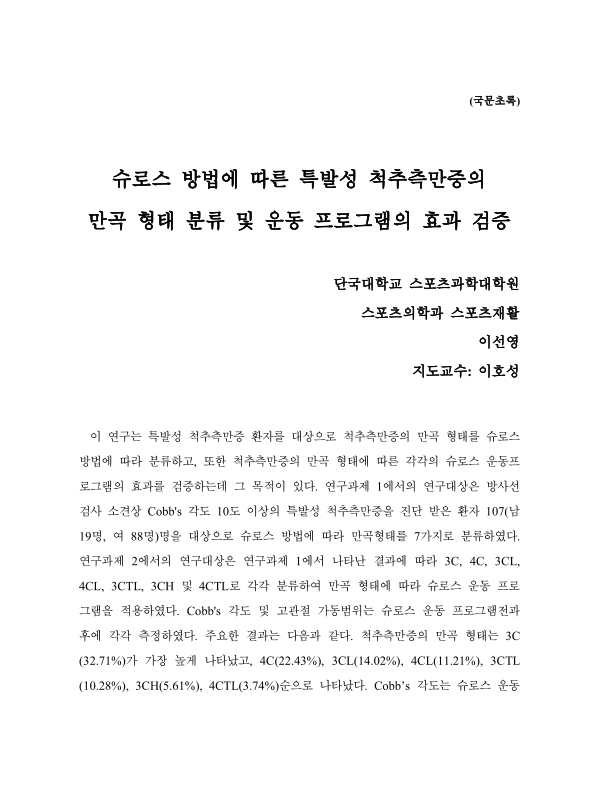
국문초록

목차

I. 서론 10

1. 연구의 필요성 10

2. 연구의 목적 12

3. 연구모형과 가설 12

4. 용어의 정의 14

5. 연구의 제한점 15

II. 이론적 배경 16

1. 척추측만증의 원인 및 분류 16

1) 척추측만증의 원인 16

2) 척추측만증의 분류 17

2. 척추측만증의 진단 및 치료방법 18

3. 슈로스 방법 18

III. 연구방법 22

1. 연구대상 22

2. 연구절차 23

3. 슈로스 운동 프로그램 24

4. 측정도구 및 방법 28

1) 만곡 형태 28

2) Cobb's 각도 28

3) 고관절 가동범위 29

6. 자료처리 30

IV. 결과 31

1. 척추측만증 만곡 형태의 분류 31

2. Cobb's 각도 및 고관절 가동범위의 변화 32

(1) 3CH 32

(2) 3CTL 33

(3) 3C 34

(4) 3CL 35

(5) 4C 36

(6) 4CL 37

(7) 4CTL 38

V. 논의 39

VI. 결론 45

참고문헌 46

Abstract 54

List of Tables

Table 1. Characteristics of the subject 22

Table 2. Characteristics of the subject 22

Table 3. 3CH Schroth exercise program 24

Table 4. 3CTL Schroth exercise program 25

Table 5. 3C Schroth exercise program 25

Table 6. 3CL Schroth exercise program 26

Table 7. 4C Schroth exercise program 26

Table 8. 4CL Schroth exercise program 27

Table 9. 4CTL Schroth exercise program 27

Table 10. Classification of idiopathic scoliosis curve type on schroth method 31

Table 11. Changes in cobb's angle and hip joint ROM before and after 3CH Schroth exercise program 32

Table 12. Changes in cobb's angle and hip joint ROM before and after 3CTL Schroth exercise program 33

Table 13. Changes in cobb's angle and hip joint ROM before and after 3C Schroth exercise program 34

Table 14. Changes in cobb's angle and hip joint ROM before and after 3CL Schroth exercise program 35

Table 15. Changes in cobb's angle and hip joint ROM before and after 4C Schroth exercise program 36

Table 16. Changes in cobb's angle and hip joint ROM before and after 4CL Schroth exercise program 37

Table 17. Changes in cobb's angle and hip joint ROM before and after 4CTL Schroth exercise program 38

List of Figures

Figure 1. Subject and curve in schroth method 13

Figure 2. Measured variables 13

Figure 3. Physio-logic 19

Figure 4. 3D made easy 20

Figure 5. Muscle cylinder and door hands out of schroth 20

Figure 6. ADL 21

Figure 7. Schroth method classification 21

Figure 8. Study procedure 23

Figure 9. Classification of schroth method x-ray view 28

Figure 10. Cobb's angle 29

Figure 11. Hip joint internal rotation ROM 29

Figure 12. Hip joint external rotation ROM 30

Figure 13. Classification of idiopathic scoliosis curve type on schroth method 31

초록보기

 이 연구는 특발성 척추측만증 환자를 대상으로 척추측만증의 만곡 형태를 슈로스 방법에 따라 분류하고, 또한 척추측만증의 만곡 형태에 따른 각각의 슈로스 운동프로그램의 효과를 검증하는데 그 목적이 있다. 연구과제 1에서의 연구대상은 방사선 검사 소견상 Cobb's 각도 10도 이상의 특발성 척추측만증을 진단 받은 환자 107(남 19명, 여 88명)명을 대상으로 슈로스 방법에 따라 만곡형태를 7가지로 분류하였다. 연구과제 2에서의 연구대상은 연구과제 1에서 나타난 결과에 따라 3C, 4C, 3CL, 4CL, 3CTL, 3CH 및 4CTL로 각각 분류하여 만곡 형태에 따라 슈로스 운동 프로그램을 적용하였다. Cobb's 각도 및 고관절 가동범위는 슈로스 운동 프로그램전과 후에 각각 측정하였다. 주요한 결과는 다음과 같다. 척추측만증의 만곡 형태는 3C (32.71%)가 가장 높게 나타났고, 4C(22.43%), 3CL(14.02%), 4CL(11.21%), 3CTL(10.28%), 3CH(5.61%), 4CTL(3.74%)순으로 나타났다. Cobb's 각도는 슈로스 운동전과 비교해서 운동 후에 3CH(L-Spine) 및 4CTL을 제외한, 모든 만곡 형태에서 유의하게 감소하였다. 고관절 내회전 가동범위는 3CH (Lt), 3C, 3CL 및 4C 만곡 형태에서 슈로스 운동전과 비교해서 운동 후에 유의하게 감소하였다. 고관절 외회전 가동범위는 고관절 좌·우측의 4CTL를 제외한 모든 만곡 형태에서 슈로스 운동전과 비교해서 운동 후에 유의하게 개선되었다. 이상의 결과 이 연구에서는 특발성 척추측만증의 만곡 형태는 3만곡 형태의 3C와 4만곡 형태의 4C가 가장 높게 나타났으며, 특발성 척추측만증의 운동은 만곡 형태를 분류하여 운동프로그램을 적용할 필요가 있다는 것을 증명하였다.

