
 대표어
대표어
권호기사보기
| 기사명 | 저자명 | 페이지 | 원문 | 기사목차 |
|---|
결과 내 검색
동의어 포함
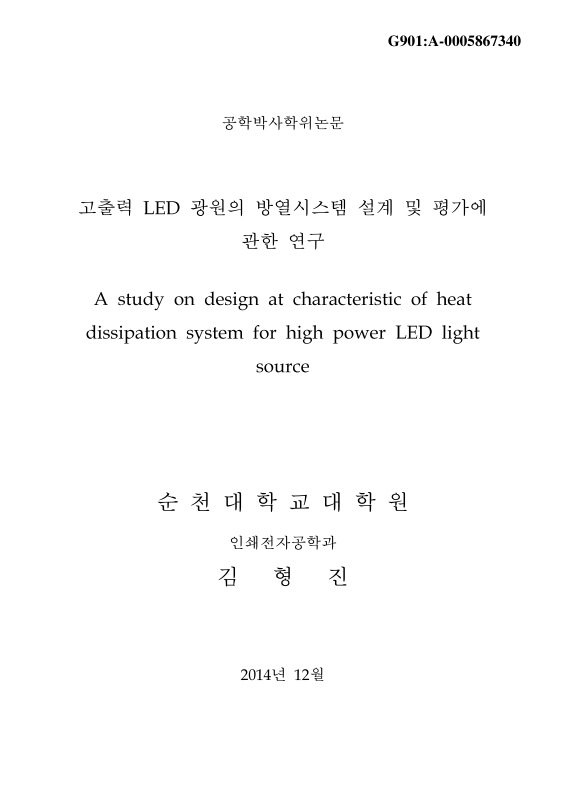
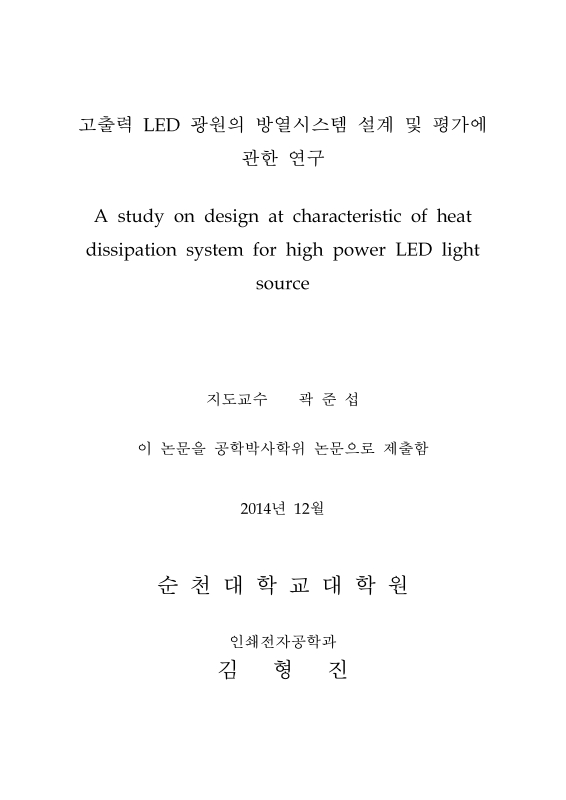
표제지
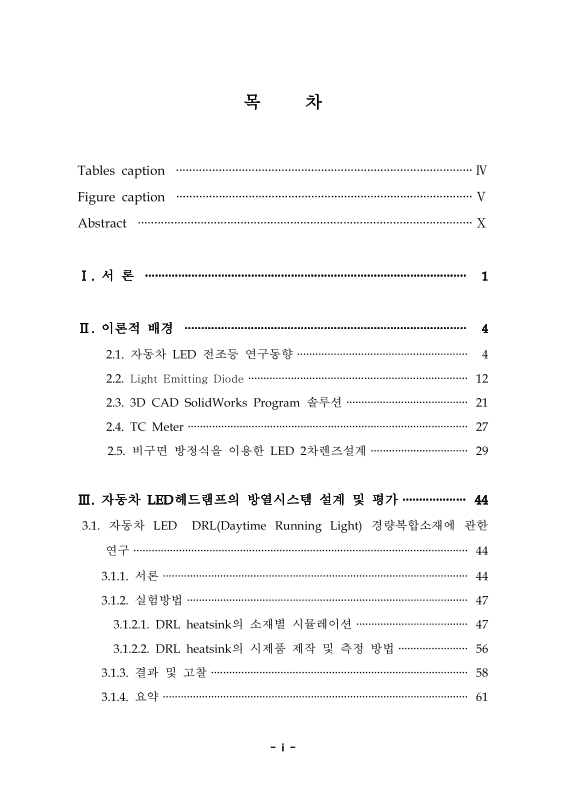
목차
Abstract 13
I. 서론 16
II. 이론적 배경 19
2.1. 자동차 LED 전조등 연구 현황 19
2.2. Light-emitting diode 27
2.2.1. Light-emitting diode의 원리 30
2.2.2. Light-emitting diode의 구조 32
2.2.3. LED Package 34
2.3. 3D CAD SolidWorks Program 솔루션 36
2.4. TC Meter (Thermal Conductivity Meter) 42
2.5. 비구면 방정식을 이용한 LED 2차 렌즈 설계 44
2.5.1. LED 소자의 광학적 특성 52
2.6. 참고문헌 56
III. 자동차 헤드램프 방열시스템 설계 및 평가 59
3.1. 자동차 LED DRL(Daytime Running Light) 경량복합소재에 관한 연구 59
3.1.1. 서론 59
3.1.2. 실험 방법 62
3.1.2.1. DRL heatsink의 소재별 시뮬레이션 62
3.1.2.2. DRL heatsink의 시제품 제작 및 측정 방법 71
3.1.3. 결과 및 고찰 73
3.1.4. 요약 76
3.1.5. 참고문헌 78
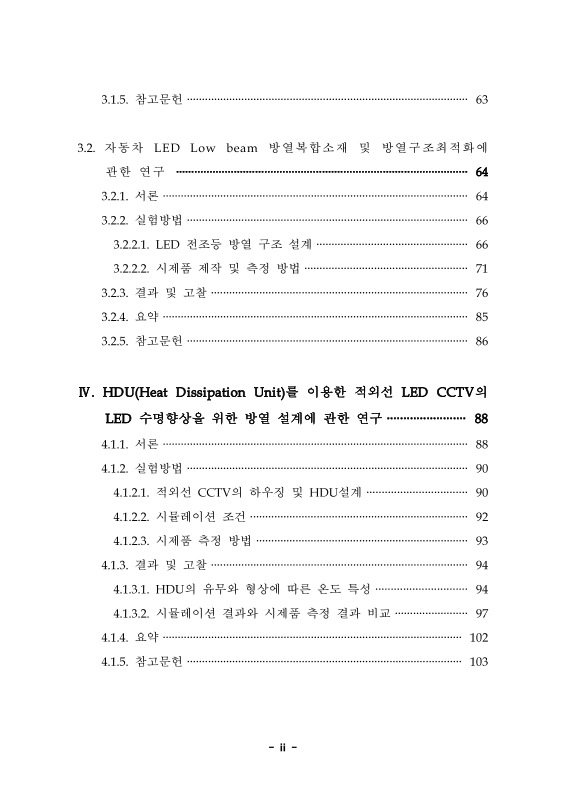
3.2. 자동차 LED Low beam 방열복합소재 및 방열구조 설계최적화에 관한 연구 79
3.2.1. 서론 79
3.2.2. 실험 방법 81
3.2.2.1. LED 전조등 방열 구조 설계 81
3.2.2.2. 시제품 제작 및 측정 방법 86
3.2.3. 결과 및 고찰 91
3.2.4. 요약 100
3.2.5. 참고문헌 101
IV. HDU(Heat Dissipation Unit)를 이용한 적외선 LED CCTV의 LED 수명향상을 위한 방열설계에 관한 연구 103
4.1.1. 서론 103
4.1.2. 실험 방법 105
4.1.2.1. 적외선 CCTV의 하우징 및 HDU설계 105
4.1.2.2. 시뮬레이션 조건 107
4.1.2.3. 시제품 측정 방법 108
4.1.3. 결과 및 고찰 109
4.1.3.1. HDU의 유무와 형상에 따른 온도 특성 109
4.1.3.2. 시뮬레이션 결과와 시제품 측정 결과 비교 112
4.1.4. 요약 117
4.1.5. 참고문헌 118
V. 두 가지 배광을 갖는 LED 횡단보도 조명장치에 관한 연구 119
5.1.1. 서론 119
5.1.2. 실험 방법 122
5.1.2.1. LED 횡단보도 조명장치 설계 및 제작 122
5.1.3. 결과 및 고찰 142
5.1.4. 요약 146
5.1.5. 참고문헌 147
VI. 결론 148
그림 2.1.1. 자동차 전조등 광원별 특성 비교 21
그림 2.1.2. 제조업체별 자동차 LED 전조등 개발 현황 22
그림 2.1.3. 자동차용 LED전조등의 주요 국가별 기술개발 동향 24
그림 2.1.4. 국내 LED 전조등 관련 특허 등록 현황 24
그림 2.1.5. 자동차용 LED전조등의 지능화 기술 개발 로드맵 26
그림 2.1.6. 에너지 천이에 의한 빛 에너지 방출과 방출된 파장에 따른 색상 28
그림 2.1.7. GaN 기반 반도체 재료와 GaAs 기반 반도체 재료의 에너지갭과 격자상수 29
그림 2.1.8. 순방향 전압에서의 p-n 접합 LED 31
그림 2.1.9. LED chip structure (a) Lateral chip, (b) vertical chip 33
그림 2.1.10. LED 패키지 및 모듈의 기본구조 35
그림 2.1.11. TC Meter 장비 이미지 42
그림 2.1.12. 2차 곡선의 이심률 45
그림 2.1.13. e²값에 따른 곡선의 형상 49
그림 2.1.14. 기준면과 비구면 변형항 51
그림 2.1.15. 빛의 굴절의 특성 54
그림 2.1.16. 다른 매질의 변화에 따라 빛의 전반사 특성 55
그림 3.1.1. 헤드램프 구조 및 명칭 61
그림 3.1.2. DRL(Daytime Running Light) 구조 63
그림 3.1.3. Heatsink 물성별 온도 특성 분석 65
그림 3.1.4. Konduit(0.1~10.3W/m·k) 열전도율별 온도 특성 분석 67
그림 3.1.5. Konduit(0.2~2.3W/m·k) 열전도율별 온도 특성 분석 69
그림 3.1.6. 실험장비 및 개략도 72
그림 3.1.7. 접촉식 thermal couple을 이용한 알루미늄합금과 Konduit Heatsink 온도 측정 포인트 72
그림 3.1.8. 80℃ 챔버안에서의 thermal couple을 이용한 Heatsink 온도 측정 74
그림 3.1.9. Aluminium, Konduit type의 히트싱크 온도 특성 74
그림 3.1.10. Aluminium, Konduit type의 온도 특성 75
그림 3.2.1. 자동차 전조등 low beam 3D 구조 설계 83
그림 3.2.2. 방열해석 및 시제품 사출성형 모델 85
그림 3.2.3. 12가지 방열구조 형상에 따른 시뮬레이션 결과 85
그림 3.2.4. 열전도성 플라스틱 시료 87
그림 3.2.5. 방열플라스틱 파단면 SEM 분석 87
그림 3.2.6. 열전도성 플라스틱 사출성형 디자인 88
그림 3.2.7. 열전도성 플라스틱 사출성형 시제품 88
그림 3.2.8. 실험장비 및 개략도 89
그림 3.2.9. 접촉식 thermal couple을 이용한 Heatsink 온도 측정 포인트 90
그림 3.2.10. Cylinder type 히트싱크 온도 특성 92
그림 3.2.11. Rectangle type 히트싱크 온도 특성 92
그림 3.2.12. HP007 Cylinder, Rectangle type 온도 특성 94
그림 3.2.13. HP009 Cylinder, Rectangle type 온도 특성 95
그림 3.2.14. HP059 Cylinder, Rectangle type 온도 특성 96
그림 3.2.15. 2765 Cylinder, Rectangle type 온도 특성 97
그림 3.2.16. Cylinder, Rectangle type 온도 특성 98
그림 3.2.17. Cylinder, Rectangle type soldering point 온도 특성 99
그림 3.2.18. Cylinder, Rectangle type Tj 온도 특성 99
그림 4.1.1. 적외선 LED CCTV 제품군 106
그림 4.1.2. Thermo couple을 통한 LED PCB, HDU, heatsink 온도 측정 포인트 108
그림 4.1.3. 적외선 LED CCTV 상온 25℃에서 HDU 유무에 따른 시뮬레이션 결과 110
그림 4.1.4. 상온 25℃에서 서로 다른 HDU 형상에 대한 시뮬레이션 결과 111
그림 4.1.5. 상온 25℃에서 시뮬레이션과 시제품의 HDU 유무에 따른 측정 결과 113
그림 4.1.6. 고급형 열전소자 LED CCTV 시제품 및 열전소자와 팬의 동작 온도 특성 분석 115
그림 4.1.7. 고급형 열전소자 LED CCTV 시제품 및 열전소자와 팬의 동작 온도 특성 분석 116
그림 5.1.1. 횡단보도등 설치 사례 121
그림 5.1.2. LED히트싱크 설계 이미지 123
그림 5.1.3. 시작품의 LED히트싱크 열 해석 시뮬레이션 결과 124
그림 5.1.4. 히트파이프와 LED 모듈 설계 이미지 124
그림 5.1.5. LED모듈의 1차원 열저항 모델 125
그림 5.1.6. LED 횡단보도 장치 설계 및 시제품 127
그림 5.1.7. 2차선 시가지 도로의 LED 횡단보도 이미지 128
그림 5.1.8. 4차선 시가지 도로의 LED 횡단보도 이미지 128
그림 5.1.9. LED 60°, 120° 2차 렌즈 설계 및 시제품 130
그림 5.1.10. LED 60°, 120° 2차 렌즈 배광분포 130
그림 5.1.11. LED 60°, 120° 렌즈 및 LED 모듈 시제품 131
그림 5.1.12. 시가지 2차선 도로의 LED횡단보도 조도분포(횡단보도 8m × 4m, 등기구 높이 5m) 133
그림 5.1.13. 시가지 2차선 도로의 LED횡단보도 히트싱크각도별 도로면 조도분포 134
그림 5.1.14. 시가지 4차선 도로의 LED횡단보도 조도분포(횡단보도 16m × 4m, 등기구 높이 5m) 135
그림 5.1.15. 시가지 4차선 도로의 LED횡단보도 히트싱크각도별 조도분포 136
그림 5.1.16. LED dimmer PCB 구성도 137
그림 5.1.17. LED dimmer PCB 회로 설계도 138
그림 5.1.18. LED dimmer PCB 시제품 139
그림 5.1.19. 배열에 따른 독립 전원 방식 장치 이미지 140
그림 5.1.20. 배열에 따른 독립 전원 방식 동작 이미지 141
그림 5.1.21. 시뮬레이션과 시제품 결과 비교 (2차선) 143
그림 5.1.22. 시뮬레이션과 시제품 결과 비교 (4차선) 144
그림 5.1.23. 적외선 열화상 카메라 측정 결과 145
The optical characteristics in order to apply the LED light source the vehicle light and a different form that is released from Halogen and HID Xeon lamp. Therefore, the new optical system considers the photonic of the LED module development and optimized cooling system development considering the thermal characteristic are essential.
In order to use the LED as the light source is changed to 15% of the input power to light the remaining 85% is converted to heat. The heat generated is closely related to the LED life and may cause problems with life and reduce performance degradation.
In this research, the thermal conductivity of the Konduit which can be applied to the heatsink of DRL was changed. Thermal performance evaluation of the prototype was conducted by simulation studies.
Second, the thermally conductive plastic used in LED headlight studied through the various protection against heat material and structure of discharge heat designs.
Third, thermal analysis of HDU (Heat Dissipation Unit) for infrared CCTV is performed by using SolidWorks Simulation (Thermal analysis) package, in order to change the part materials and HDU shape is optimized. Furthermore, HDU disperses the aggregated heat around the LED inside the housing. The junction temperature of infrared LED checked by HDU check was 65.83℃, 42.02℃, respectively. In addition, the Thermoelement by changing the shape of the HDU was possibly designed and equipped with. Comparison with simulation and prototype measurement results, without HDU model was 65.83℃, 61.99℃, respectively. In addition to with HDU model was 42.02℃, 39.01℃, respectively. Only HDU mounted into infrared CCTV is usable in the ordinary house or outdoors. Also HDU with thermal element, fan mounted into infrared CCTV is usable in a blast furnace workplace or high temperature workplace.
Fourth, LED lighting fixtures for crosswalk become popular in order to recognize the pedestrians at crosswalk, which can enhance the safety of the pedestrian at crosswalk. However, there are several problems related to the LED lighting fixtures for crosswalk, such as a lot of energy consumption due to a constant illumination during night and glaring of pedestrians at the opposite side of crosswalk. In this study, in order to overcome these problems, we have investigated a novel LED lighting fixture for crosswalk, which has two modules with different angles (60°, 120°). Illuminance of min and max at four-line city street crosswalk shown 50 Lux, 125 Lux, respectively. Illuminance of min and max at eight-line city street crosswalk shown 150 Lux, 200 Lux, respectively. Simulation investigation was optimized design using optical program. Prototype was verified measurement by goniometer system.*표시는 필수 입력사항입니다.
| 전화번호 |
|---|
| 기사명 | 저자명 | 페이지 | 원문 | 기사목차 |
|---|
| 번호 | 발행일자 | 권호명 | 제본정보 | 자료실 | 원문 | 신청 페이지 |
|---|
도서위치안내: / 서가번호:

우편복사 목록담기를 완료하였습니다.
*표시는 필수 입력사항입니다.
저장 되었습니다.
