
 대표어
대표어
권호기사보기
| 기사명 | 저자명 | 페이지 | 원문 | 기사목차 |
|---|
결과 내 검색
동의어 포함
표제지
요약
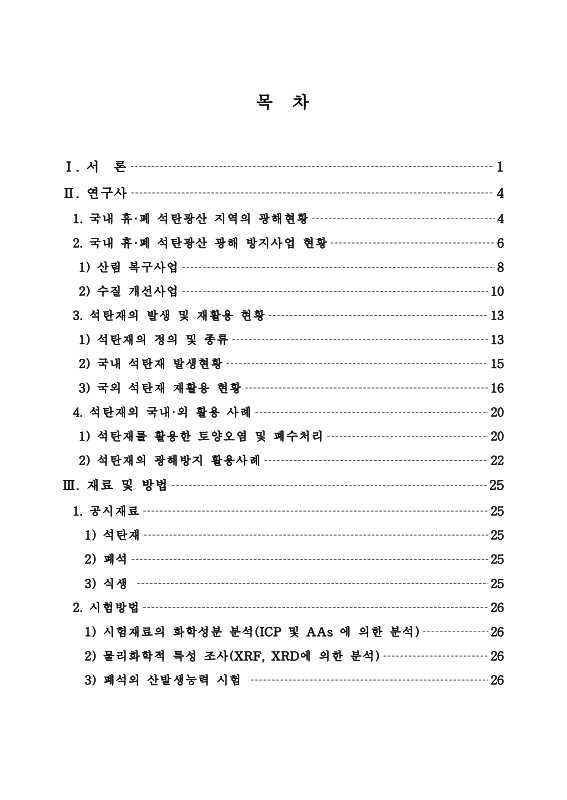
목차
I. 서론 12
II. 연구사 15
1. 국내 휴·폐 석탄광산 지역의 광해현황 15
2. 국내 휴·폐 석탄광산 광해방지사업 현황 17
1) 산림복구사업 19
2) 수질개선사업 21
3. 석탄재의 발생 및 재활용 현황 24
1) 석탄재의 정의 및 특성 24
2) 국내 석탄재 발생현황 26
3) 국외 석탄재 재활용 현황 27
4. 석탄재의 국내·외 활용 사례 31
1) 석탄재를 활용한 토양오염 및 폐수처리 31
2) 석탄재의 광해방지 활용사례 33
III. 재료 및 방법 36
1. 공시재료 36
1) 석탄재(Coal combustion residuals) 36
2) 폐석 36
3) 식생 36
2. 시험방법 37
1) 시험재료의 화학성분 분석(ICP 및 AAs에 의한 분석) 37
2) 물리화학적 특성 조사(XRF, XRD에 의한 분석) 37
3) 폐석의 산 발생 능력 시험 37
4) 폐석에 대한 석탄재의 처리요구량 실험(Batch test) 39
5) Column leaching test 39
6) Greenhouse Bioassay 40
(1) 발아내성평가 40
(2) Pot 실험 41
7) Field Application Experiment 43
(1) 조사지역의 개요 44
(2) 지질 45
(3) 현장처리구 구성 46
3. Data의 분석 52
IV. 결과 및 고찰 53
1. 공시재료(석탄재, 폐석)의 화학적 특성 53
2. 석탄재, 폐석의 물리·화학적 특성(XRD, XRF 분석) 55
3. 산 발생능력 시험(ABA test) 60
4. Batch test 61
1) 석탄재의 중화능력 평가 61
5. Column leaching test 64
6. Greenhouse Bioassay 74
1) 발아내성시험 74
2) Pot experiment 77
7. Field Application 80
1) 현장 처리구 침출수 및 유거수 모니터링 80
(1) 유거수와 침출수 내 pH 및 EC 변화 80
(2) 유거수와 침출수 중의 중금속 농도변화 87
2) 현장 시험포장 처리구 토양 모니터링 97
(1) pH, EC 97
(2) 중금속 농도 99
3) 시험포장 처리구의 생육조사 104
4) 현장시험 포장 별 식생피복도 조사 108
V. 종합고찰 115
VI. 결론 118
VII. 참고문헌 120
Abstract 132
Figure 1. Present status of coal ash produced, recycled and landfilled in Korea 26
Figure 2. Pot of greenhouse experiment. 42
Figure 3. Greenhouse pot experiment(before seed). 42
Figure 4. Location of field experiment site. 44
Figure 5. Layout of the field experiment plots. 48
Figure 6. Side view of the field experimental plots. 48
Figure 7. Layout and treatment of the field experimental plots. 49
Figure 8. Construction of the field experimental site(1). 50
Figure 9. Construction of the field experimental site(2). 51
Figure 10. X-ray diffraction graph of the coal ash. 57
Figure 11. X-ray diffraction graph of mine waste. 57
Figure 12. Particle size distribution of the coal ash. 59
Figure 13. pH of the mine waste by treatment of coal ash. 63
Figure 14. EC of the mine waste by treatment of coal ash. 63
Figure 15. pH of the leachate passed through the column. 65
Figure 16. EC of the leachate passed through the column. 66
Figure 17. Change of Ca concentration in the column leachate. 67
Figure 18. Change of Mg concentration in the column leachate. 67
Figure 19. Change of Cu concentration in the column leachate. 68
Figure 20. Change of Zn concentration in the column leachate. 69
Figure 21. Change of Pb concentration in the column leachate. 69
Figure 22. Change of Fe concentration in the column leachate. 71
Figure 23. Change of Al concentration in the column leachate. 71
Figure 24. Change of As concentration in the column leachate. 72
Figure 25. Change of SO₄²- concentration in the column leachate.(이미지참조) 73
Figure 26. Germination test of Perennial Ryegrass. 75
Figure 27. Germination test of Cd treatment 76
Figure 28. Germination test of Pb treatment 76
Figure 29. Germination test of Al treatment 76
Figure 30. Crop growth result of greenhouse pot experiment(Rye). 79
Figure 31. pH of runoff in the field treatments. 82
Figure 32. pH of leachate(1.0 m) in the field treatments. 83
Figure 33. pH of leachate(1.5 m) in the field treatments. 84
Figure 34. Change of the runoff EC in field treatments. 85
Figure 35. Change of leachate(1.0 m) EC in field treatments. 86
Figure 36. Change of leachate(1.5 m) EC in field treatments. 86
Figure 37. Change of the runoff Cu concentration in field treatments. 87
Figure 38. Change of the runoff Pb concentration in field treatments. 88
Figure 39. Change of the runoff Zn concentration in field treatments. 88
Figure 40. Change of the runoff As concentration in field treatments. 89
Figure 41. Change of the runoff Al concentration in field treatments. 90
Figure 42. Change of the leachate(1.0 m) Al concentration in field treatments. 91
Figure 43. Change of the leachate(1.5 m) Al concentration in field treatments. 91
Figure 44. Change of the runoff Fe concentration in field treatments. 92
Figure 45. Change of the leachate(1.0 m) Fe concentration in field treatments. 93
Figure 46. Change of the leachate(1.5 m) Fe concentration in field treatments. 93
Figure 47. Change of the runoff SO₄²- concentration in field treatments.(이미지참조) 94
Figure 48. Change of the leachate(1.0 m) SO₄²- concentration in field treatments.(이미지참조) 95
Figure 49. Change of the leachate(1.5 m) SO₄²- concentration in field treatments.(이미지참조) 95
Figure 50. Change of the runoff Ca concentration in field treatments. 96
Figure 51. Change of the leachate(1.0 m) Ca concentration in field treatments. 97
Figure 52. Change of soil pH and EC in field treatments. 98
Figure 53. Change Cu concentration in soil in field treatments. 99
Figure 54. Change Pb concentration in soil in field treatments. 100
Figure 55. Change Zn concentration in soil in field treatments. 100
Figure 56. Change As concentration in soil in field treatments. 101
Figure 57. Change As concentration(aqua regia) in soil in field treatment. 101
Figure 58. Change Al concentration in soil in field treatments. 102
Figure 59. Change Fe concentration in soil in field treatments 103
Figure 60. Comparison of plant height by different the treatment of CCRs 105
Figure 61. Comparison of plant height by different the treatment of CCRs(2010.09.15.). 105
Figure 62. Comparison of plant weight(fresh) by different the treatments. 106
Figure 63. Comparison of plant weight(dry) by different the treatments. 106
Figure 64. Color class or Group of WinCAM program for Surface coverage in field experiment treatment. 109
Figure 65. Surface coverage data of control. 109
Figure 66. Surface coverage in the field experiment treatments(2010.06.10.) 111
Figure 67. Surface coverage in the field experiment treatments(2010.06.25.) 112
Figure 68. Surface coverage in the field experiment treatments(2010.07.25.) 113
Figure 69. Surface coverage in the field experiment treatments(2010.11.12.) 114
국내 휴폐석탄광산지역에서 발생되는 폐석의 유실 및 산성광산배수 등 광해에 의해 발생되는 중금속 오염은 매우 심각하다. 또한 폐석탄광산 대부분은 산간지역에 계곡에 위치하고 있어 폐기물이 수계로 유입되고 있다. 이러한 이유로 광해방지 사업에 다양한 공법들이 적용되고 있다. 본 연구의 목적은 폐석탄광산지역의 광해복원을 위한 석탄재의 적용가능성을 평가하는데 있다. 석탄재의 처리량을 회분식 실험을 통해 결정하고 현장시험의 이를 바탕으로 광산지역에 석탄재와 폐석을 혼합(20 %, 40 %)하여 총 7개의 현장 처리구를 구성하였다. 각 처리구에 발생되는 토양, 유거수 및 침출수를 주기적으 모니터링 하였다. 연구결과는 다음과 같다.
1. 석탄재를 20%, 40% 혼합하여 처리할 경우 발아율과 pH가 증가하였다.
2. 석탄재를 처리할 경우 현장 시험구의 토양과 유거수 및 침출수의 pH값은 단일폐석처리구(pH 3.4-3.7) 보다 증가하였다(pH4.6-5.9)
3. 석탄재의 처리량이 증가할수록 중금속의 안정화 효율이 증가하였으나 철, 알루미늄은 안정화 효율은 미비하여 이에 대한 개선 연구가 필요하다.
4. 석탄재 처리 시 식생의 피복도는 폐석처리구에 비해 3배 이상 증가하였으며 특히, 석탄재를 40% 처리 시 95 %이상의 피복율을 나타내었다.
이를 종합하여 볼 때 석탄재는 pH를 증가시켜 중금속을 안정화하며, 산성폐기물 및 산성광산배수를 저감하며 식물생육에 필요한 양분제공 및 토질을 개선하여 지속가능한 공법에 활용될 수 있는 유용자원으로 재활용이 가능할 것으로 사료된다.*표시는 필수 입력사항입니다.
| 전화번호 |
|---|
| 기사명 | 저자명 | 페이지 | 원문 | 기사목차 |
|---|
| 번호 | 발행일자 | 권호명 | 제본정보 | 자료실 | 원문 | 신청 페이지 |
|---|
도서위치안내: / 서가번호:

우편복사 목록담기를 완료하였습니다.
*표시는 필수 입력사항입니다.
저장 되었습니다.
