
 대표어
대표어
권호기사보기
| 기사명 | 저자명 | 페이지 | 원문 | 기사목차 |
|---|
결과 내 검색
동의어 포함
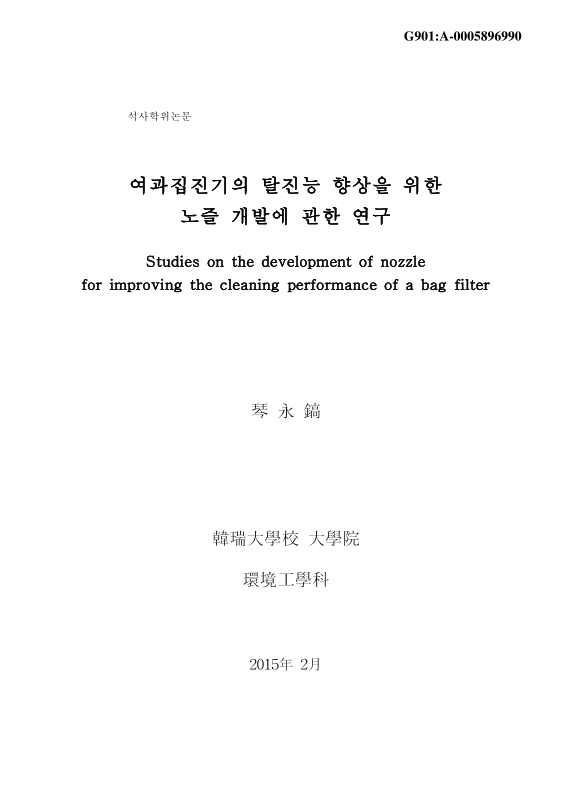
표제지
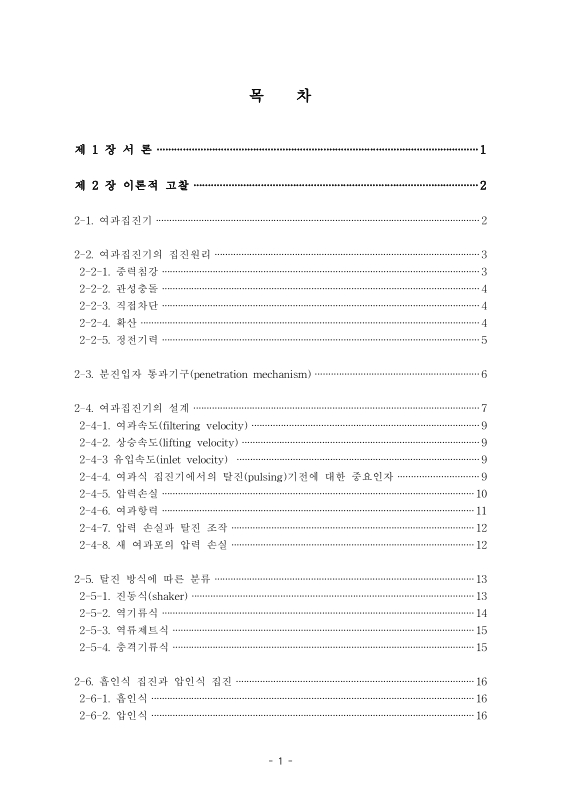
목차
국문초록 12
제1장 서론 13
제2장 이론적 고찰 14
2-1. 여과집진기 14
2-2. 여과집진기의 집진원리 15
2-2-1. 중력침강 15
2-2-2. 관성충돌 16
2-2-3. 직접차단 16
2-2-4. 확산 16
2-2-5. 정전기력 17
2-3. 분진입자 통과기구(penetration mechanism) 18
2-4. 여과집진기의 설계 19
2-4-1. 여과속도(filtering velocity) 21
2-4-2. 상승속도(lifting velocity) 21
2-4-3. 유입속도(inlet velocity) 21
2-4-4. 여과식 집진기에서의 탈진(pulsing)기전에 대한 중요인자 21
2-4-5. 압력손실 22
2-4-6. 여과항력 23
2-4-7. 압력 손실과 탈진 조작 24
2-4-8. 새 여과포의 압력 손실 24
2-5. 탈진 방식에 따른 분류 25
2-5-1. 진동식(shaker) 25
2-5-2. 역기류식 26
2-5-3. 역류제트식 27
2-5-4. 충격기류식 27
2-6. 흡인식 집진과 압인식 집진 28
2-6-1. 흡인식 28
2-6-2. 압인식 28
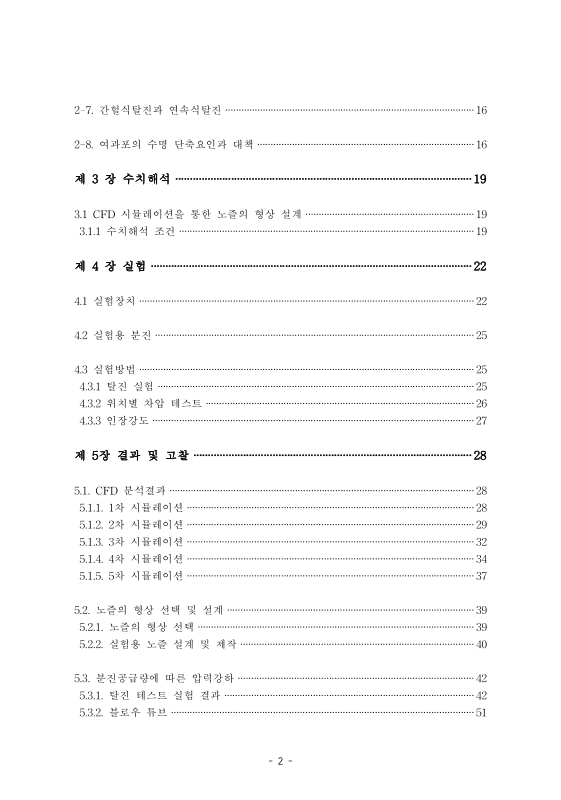
2-7. 간헐식탈진과 연속식탈진 28
2-8. 여과포의 수명 단축요인과 대책 28
제3장 수치해석 31
3.1. CFD 시뮬레이션을 통한 노즐의 형상 설계 31
3.1.1. 수치해석 조건 31
제4장 실험 34
4.1. 실험장치 34
4.2. 실험용 분진 37
4.3. 실험방법 37
4.3.1. 탈진 실험 37
4.3.2. 위치별 차압 테스트 38
4.3.3. 인장강도 39
제5장 결과 및 고찰 40
5.1. CFD 분석결과 40
5.1.1. 1차 시뮬레이션 40
5.1.2. 2차 시뮬레이션 41
5.1.3. 3차 시뮬레이션 44
5.1.4. 4차 시뮬레이션 46
5.1.5. 5차 시뮬레이션 49
5.2. 노즐의 형상 선택 및 설계 51
5.2.1. 노즐의 형상 선택 51
5.2.2. 실험용 노즐 설계 및 제작 52
5.3. 분진공급량에 따른 압력강하 54
5.3.1. 탈진 테스트 실험 결과 54
5.3.2. 블로우 튜브 63
5.3.3. A 형상 노즐 64
5.3.4. B 형상 노즐 65
5.3.5. C 형상 노즐 67
5.3.6. D 형상 노즐 68
5.4. 백의 위치별 차압 테스트 72
5.5. 탈진 전·후의 압력강하 차이 76
5.6. 블로우 튜브 높이에 따른 탈진 특성 77
5.7. 인장강도 83
제6장 결론 84
참고문헌 85
Abstract 87
논문 발표 및 연구수행 실적 89
[Fig. 1] The dust collection mechanism of fabric filter. 15
[Fig. 2] Classification of particle collection mechanism according to particle size and efficiency. 17
[Fig. 3] Particle emission mechanisms. 18
[Fig. 4] Major equipment configuration of the fabric filter. 19
[Fig. 5] Shaking type fabric filters. 25
[Fig. 6] Reverse air cleaned fabric filter. 26
[Fig. 7] Pulse jet cleaned fabric filter. 27
[Fig. 8] The pretreated filter media layer. 30
[Fig. 9] Boundary conditions; 33
[Fig. 10] Schematic diagram of the experimental setup. 35
[Fig. 11] Pilot plant and operating procedures used in this experiment. 35
[Fig. 12] The main components of the pilot plant. 36
[Fig. 13] Particle size distribution of dust used in this study. 37
[Fig. 14] Appearance of the cutting filter bag by location to measure the differential pressure across the filter cloth. 39
[Fig. 16] Velocity field, air flow field, and streamline field of the blow tube. 40
[Fig. 17] Measuring the amount of cleaning air injected into the inside of filter bag. 41
[Fig. 18] Simulation conditions of the umbrella-shaped nozzle (cleaning pressure: 3 kgf/㎠). 42
[Fig. 19] Velocity field of the umbrella-shaped nozzle. 43
[Fig. 20] Comparison of the cleaning air amount on the umbrella-shaped nozzle. 43
[Fig. 21] Simulation conditions of the skirt-shaped nozzle (cleaning pressure: 3 kgf/㎠). 44
[Fig. 22] Velocity field of the skirt-shaped nozzle. 45
[Fig. 23] Comparison of the cleaning air amount on the skirt-shaped nozzle. 45
[Fig. 24] Simulation conditions of the double umbrella-shaped nozzle (cleaning pressure: 3 kgf/㎠). 47
[Fig. 25] Velocity field of the double umbrella-shaped nozzle. 48
[Fig. 26] Comparison of the cleaning air amount on the double umbrella-shaped nozzle. 48
[Fig. 27] Simulation conditions of the double umbrella-shaped nozzle according to the diameter(cleaning pressure: 3 kgf/㎠). 49
[Fig. 28] Velocity field of the double umbrella-shaped nozzle according to the diameter. 50
[Fig. 29] Comparison of the cleaning airamount on the double umbrella-shaped nozzle according to the diameter. 50
[Fig. 30] Photos of four types of nozzle tested in this study. 52
[Fig. 31] Drawings for each nozzle. 54
[Fig. 32] Comparison of the pressure drop between blow tube and nozzle after dust filteration. 56
[Fig. 33] Comparison of the pressure drop between blow tube and nozzle after bag cleaning. 58
[Fig. 34] Comparison of the pressure drop between blow tube and nozzle after dust filteration. 61
[Fig. 35] Comparison of the pressure drop between blow tube and nozzle after bag cleaning. 62
[Fig. 36] Change of the pressure drop with the experimental conditions just used blow tube only (a) after dust filtration, (b) after bag cleaning. 63
[Fig. 37] Change of the pressure drop with the experimental conditions for the A shape nozzle (a) after dust filtration, (b) after bag cleaning. 65
[Fig. 38] Change of the pressure drop with the experimental conditions for the B shape nozzle (a) after dust filtration, (b) after bag cleaning. 66
[Fig. 39] Change of the pressure drop with the experimental conditions for the C shape nozzle (a) after dust filtration, (b) after bag cleaning. 67
[Fig. 40] Change of the pressure drop with the experimental conditions for the D shape nozzle (a) after dust filtration, (b) after bag cleaning. 69
[Fig. 41] Comparison of the pressure drop in the filter bag after dust filtration between blow tube and D-shape nozzle. 70
[Fig. 42] Comparison of pressure drop in the filter bag after dust cleaning between blow tube and D-type nozzle. 71
[Fig. 43] Pressure drop according to the position of the filter bag. 74
[Fig. 44] Difference of the pressure drop before between and after bag cleaning for the A shape nozzle. 76
[Fig. 45] Difference of the pressure drop before between and after bag cleaning for the D shape nozzle. 76
[Fig. 46] The total amount of dust removed until the end of the experiment. 80
[Fig. 47] Cycling test for the blow tube and nozzles until the end of the experiment. 82
*표시는 필수 입력사항입니다.
| 전화번호 |
|---|
| 기사명 | 저자명 | 페이지 | 원문 | 기사목차 |
|---|
| 번호 | 발행일자 | 권호명 | 제본정보 | 자료실 | 원문 | 신청 페이지 |
|---|
도서위치안내: / 서가번호:

우편복사 목록담기를 완료하였습니다.
*표시는 필수 입력사항입니다.
저장 되었습니다.
