

권호기사보기
| 기사명 | 저자명 | 페이지 | 원문 | 기사목차 |
|---|
| 대표형(전거형, Authority) | 생물정보 | 이형(異形, Variant) | 소속 | 직위 | 직업 | 활동분야 | 주기 | 서지 | |
|---|---|---|---|---|---|---|---|---|---|
| 연구/단체명을 입력해주세요. | |||||||||
|
|
|
|
|
|
* 주제를 선택하시면 검색 상세로 이동합니다.
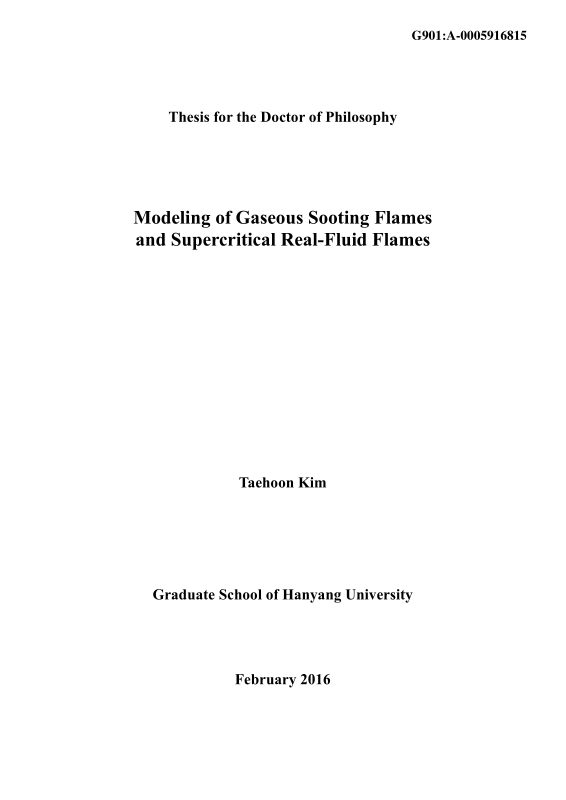
Title Page
Contents
ABSTRACT 15
Chapter 1. Introduction 17
1.1. Soot Formation and Combustion Model 17
1.2. Supercritical Combustion Model 23
1.3. The Outline of This Work 29
Chapter 2. Mathematical Formulation and Numerical Modeling 31
2.1. Fundamental Governing Equation and Modeling 31
2.1.1. Mass Conservation Equation 31
2.1.2. Momentum Conservation Equation 32
2.1.3. Energy Conservation Equation 32
2.1.4. Species Conservation Equation 33
2.1.5. Chemical Kinetics 34
2.1.6. Turbulence Model 34
2.2. Real-Fluid Properties Model 37
2.2.1. Real-Fluid Equation of State 37
2.2.2. Real-Fluid Transport Properties 39
2.3. Combustion Model 41
2.3.1. Laminar Flamelet Model 41
2.3.2. Mixture Fraction Equation 43
2.3.3. Turbulent Non-premixed Flame Modeling 44
2.3.4. Presumed Shape PDF Approach 45
2.3.5. Interactive Transient Flamelet Model 46
2.4. Soot Formation Model 49
2.4.1. Two-equation Soot Model 49
2.4.2. Detailed Soot Model 53
Chapter 3. Modeling for Non-premixed Gaseous Laminar and Turbulent Sooting Flames 67
3.1. Laminar Non-premixed CH₄/Air Flame 67
3.1.1. Comparison with FTE results 67
3.1.2. Comparison with experimental data 76
3.2. Laminar Non-premixed C₂H₄/Air Flame 87
3.2.1. Laminar non-premixed N₂/Ar diluted ethylene flame (Flame A) 88
3.2.2. Laminar non-premixed non-diluted ethylene flames (Flame B and C) 98
3.3. Laminar Pressurized Non-premixed CH₄/Air Flame 103
3.3.1. Comparison with experimental data 103
3.3.2. Characteristic of soot formation in pressurized non-premixed flame 106
3.4. Turbulent Non-premixed C₂H₄/Air Flame 109
3.4.1. Effect of Soot Radiation 110
3.4.2. Effects of inflow flow velocities on soot formation characteristics 112
Chapter 4. Modeling for Real-Fluid Propellant Flames at Supercritical Pressure 119
4.1. Local Flame Structure of Real-Fluid Flamelet Model 119
4.2. Mixing Characteristic of Cryogenic Liquid Nitrogen Jet 135
4.3. Turbulent Non-Premixed GH₂/LOx Jet Flame 151
4.4. Turbulent Non-Premixed GCH₄/LOx Jet Flame 163
Chapter 5. Conclusions 181
5.1. Non-premixed Gaseous Laminar and Turbulent Sooting Flames 181
5.1.1. Laminar Non-premixed CH₄/Air Flame 181
5.1.2. Laminar Non-premixed C₂H₄/Air Flame 182
5.1.3. Laminar Pressurized Non-premixed CH₄/Air Flame 183
5.1.4. Turbulent Non-premixed C₂H₄/Air Flame 184
5.2. Real-Fluid Propellant Flames at Supercritical Pressure 186
5.2.1. Local Flame Structure of Real-Fluid Flamelet Model 186
5.2.2. Mixing Characteristic of Cryogenic Liquid Nitrogen Jet 187
5.2.3. Turbulent Non-Premixed GH₂/LOx Jet Flame 188
5.2.4. Turbulent Non-Premixed GCH₄/LOx Jet Flame 190
Chapter 6. Future Works 191
Bibliography 193
국문요지 203
Figure 2.1. Solution procedures for the Interactive Transient Flamelet (ITF) model 46
Figure 3.1.1. Predicted centerline profiles of (a) temperature and (b) OH mass fraction at iteration... 69
Figure 3.1.2. Contour of temperature, soot volume fraction, and OH and C₂H₂ mass fractions... 70
Figure 3.1.3. Axial profiles of the predicted temperature, OH mass fraction, C₂H₂ mass fraction... 71
Figure 3.1.4. Axial profiles of the predicted soot mass fraction reaction rate using ITF-C and ITF-... 72
Figure 3.1.5. Radial profiles of the predicted C₂H₂ mass fraction using ITF-C and ITF-U models... 73
Figure 3.1.6. Radial profiles of the predicted soot volume fraction using ITF-C and ITF-U models... 74
Figure 3.1.7. Predicted distribution of streamlines, stoichiometric line, temperature, soot volume... 77
Figure 3.1.8. Axial profiles of the predicted temperature, soot volume fraction, and H₂O, CO₂,... 79
Figure 3.1.9. Predicted distribution of streamlines, stoichiometric line, temperature, soot volume... 80
Figure 3.1.10. Radial profiles of the predicted temperature using ITF-ED and ITF-DD models... 81
Figure 3.1.11. Radial profiles of the predicted H₂ and OH mass fraction using ITF-ED and ITF-DD... 82
Figure 3.1.12. Radial profiles of the predicted CH₄ mole fraction using ITF-ED and ITF-DD... 83
Figure 3.1.13. Radial profiles of the predicted C₂H₂ mole fraction using ITF-ED and ITF-DD... 84
Figure 3.1.14. Radial profiles of the predicted soot volume fraction using ITF-ED and ITF-DD... 85
Figure 3.2.1. Predicted centerline profiles of temperature, soot volume fraction, C₂H₂, benzene... 89
Figure 3.2.2. Predicted centerline profiles of temperature, soot volume fraction, C₂H₂, benzene... 90
Figure 3.2.3. Reduced fractional moments of transient flamelet solution at axial position of 1㎝... 93
Figure 3.2.4. Reduced fractional moments of transient flamelet solution at axial position of 6.5㎝... 94
Figure 3.2.5. Predicted centerline profiles of temperature and soot volume fraction with (solid line)... 95
Figure 3.2.6. O₂ oxidation rate [#/㎤] distribution for first soot moment with (top) and without... 95
Figure 3.2.7. Predicted centerline profiles of temperature and soot volume fraction with oxidation... 96
Figure 3.2.8. O₂ oxidation r ate [#/㎤] distribution for first soot moment with oxidation rate... 96
Figure 3.2.9. Radial integrated soot volume fractions along the center line. Experimental data by... 101
Figure 3.2.10. Soot volume fraction distribution for Flame B (top) and C (bottom) 102
Figure 3.3.1. Distribution of temperature (top) and soot volume fraction (bottom) at various... 105
Figure 3.3.2. Numerical (line) and experimental data [Joo and Gülder (2009)] (symbol) radial... 107
Figure 3.3.3. Maximum conversion of fuel's carbon to soot as a function of pressure 107
Figure 3.3.4. Predicted radial profiles of C₂H₂ mass fraction (left) and soot volume fraction (right)... 108
Figure 3.3.5. Predicted radial profiles of production rate (left-line), oxidation rate (left-dashed line)... 108
Figure 3.4.1. Axial profiles of mean temperature and soot volume fraction for Case 1; the lines are... 110
Figure 3.4.2. Temperature distribution with soot radiation (top) and without soot radiation (bottom)... 111
Figure 3.4.3. Axial profiles of temperature (dashed line) and reaction rate (net reaction, nucleation,... 111
Figure 3.4.4. Contour of temperature and soot volume fraction for Case 2 and Case 3. 112
Figure 3.4.5. Axial and radial profiles of mean temperature (red line) and soot volume fraction... 113
Figure 3.4.6. Axial and radial profiles of mean temperature (red line) and soot volume fraction... 114
Figure 3.4.7. Comparison of axial profiles of the radial averaged conditional scalar dissipation rate... 116
Figure 3.4.8. Comparison of axial profiles of temperature and soot volume fraction (solid line:... 116
Figure 3.4.9. Comparison of local flame structures at four axial positions (z/D=5, 50, 100 and 200)... 117
Figure 4.1.1. Comparison of NIST data and predicted thermodynamic and transport properties for... 120
Figure 4.1.2. Real-fluid effects on flame structure (0.0<Z<1.0) at transcritical and supercritical... 123
Figure 4.1.3. Real-fluid effects on thermophysical properties and local flame structure (0.0<Z<... 124
Figure 4.1.4. Profiles of constant-pressure specific heat in the oxygen-rich mixture fraction space... 126
Figure 4.1.5. Differential diffusion effects on near-equilibrium flame structure 128
Figure 4.1.6. Differential diffusion effects on highly non-equilibrium flame structure 129
Figure 4.1.7. Predicted profiles of temperatures and major species mass fractions for four pressures 130
Figure 4.1.8. Predicted profiles of minor species mass fractions for four pressures 131
Figure 4.1.9. Extinction characteristics and heat release rate correlation 133
Figure 4.1.10. Maximum temperature and heat release rate correlation 134
Figure 4.2.1. Schematic geometry of the injector and chamber for four test cases 136
Figure 4.2.2. Comparison of NIST data and predicted thermodynamic properties for nitrogen 137
Figure 4.2.3. Predicted and measured [Telaar et al. 2001] radial profiles of density in the cryogenic... 139
Figure 4.2.4. Centerline profiles of density, compressibility factor, temperature, constant-pressure... 140
Figure 4.2.5. Centerline profiles of normalized axial velocity and constant-pressure specific heat;... 141
Figure 4.2.6. Predicted and measured [Telaar et al. 2001] radial profiles of density in the cryogenic... 143
Figure 4.2.7. Centerline profiles of density, compressibility factor, temperature, constant-pressure... 144
Figure 4.2.8. Centerline profiles of normalized axial velocity and constant-pressure specific heat;... 145
Figure 4.2.9. Centerline profiles of density, temperature, and constant-pressure specific heat;... 147
Figure 4.2.10. Centerline profiles of density, temperature, and constant-pressure specific heat;... 148
Figure 4.2.11. Centerline profiles of normalized axial velocity and density for Case 3 and Case 4 149
Figure 4.3.1. Schematic of the geometry of the injector and chamber for the C60 test case 151
Figure 4.3.2. Comparison of NIST data and predicted thermodynamic properties for oxygen... 153
Figure 4.3.3. Flame structure and distribution of thermophysical properties in a transcritical... 155
Figure 4.3.4. Distribution of temperature, streamlines, OH mass fraction, constant-pressure... 157
Figure 4.3.5. Distribution of temperature, streamlines, OH mass fraction, constant-pressure... 158
Figure 4.3.6. Radial profiles of the constant-pressure specific heat, temperature, density, and O₂... 160
Figure 4.3.7. Comparison of the predicted OH mass fraction field and the measured Abel-... 161
Figure 4.3.8. Predicted and measured [Habiballah et al. 2006, Vingert et al. 2006] radial profiles of... 162
Figure 4.4.1. Schematic geometry of injector and chamber for G2 case 163
Figure 4.4.2. Comparison of NIST data and predicted thermodynamic properties for oxygen 165
Figure 4.4.3. Distribution of temperature, streamlines, constant-pressure specific heat and CO mass... 166
Figure 4.4.4. Comparison between the predicted OH mass fraction field and the measured Abel... 167
Figure 4.4.5. Centerline profiles of O₂ mass fraction, axial velocity, density, and constant -... 169
Figure 4.4.6. Effect of O₂ inlet temperature on local flame structure at 56 bar. 171
Figure 4.4.7. Real-fluid effects on thermodynamic properties in oxygen-rich mixing region for... 172
Figure 4.4.8. Distribution of OH mass fraction and streamlines for three O₂ inlet temperatures. 173
Figure 4.4.9. Centerline profiles of temperature, axial velocity, density, and constant-pressure... 174
Figure 4.4.10. Effect of chamber pressure on local flame structures at the transcritical conditions. 176
Figure 4.4.11. Real-fluid effects on thermodynamic properties in oxygen-rich mixing region for... 177
Figure 4.4.12. Distribution of OH mass fraction and streamlines for three chamber pressure 178
Figure 4.4.13. Centerline profiles of temperature, axial velocity, density, and constant-pressure... 179
본 연구는 초임계 압력 상황에서의 실유체 화학반응 유동뿐만 아니라 매연입자가 생성되는 층류 및 난류 비예혼합 기체 화염장을 예측하기 위한 포괄적인 연소모델을 개발하는데 주된 목적이 있다.
먼저, 층류 및 난류 비예혼합 화염장에서 매연입자생성과 복사열전달 같이 화염장의 화학반응과 비교하여 비교적 긴 특성시간 가지는 물리현상을 보다 정확하게 예측하기 위하여 쌍방향의 비정상 화염편 (Interactive Transient F lamelet) 모델을 고안하였다. 본 ITF 모델은 메탄/공기 층류 비예혼합 화염장의 매연입자생성은 Twoequation 모델을, 에틸렌/공기 충류 비예혼합 화염장은 Method of Moments Interpolative Closure (MOMIC) 모델을 이용하여 입자생성, 표면성장 및 산화 그리고 응고작용과 같은 물리적 현상을 고려하도록 개발하였다. 본 연구에서 기체화학반응과 매연입자의 생성 화학반응은 서로 강건하게 영향을 받도록 설계 하였다. 같은 혼합분율 공간에서 기체 화학종과 매연입자에 의한 복사냉각을 고려하였으며 이때 발생하는 매연입자 혼합분율의 공간상에서의 비물리적인 확산은 매연입자의 질량 확산량을 무시함으로써 극복하였다. 이러한 방법론적 이점으로 본 ITF 모델은 난류 비예혼합 화염으로 확장하는데 있어서 모델의 일관성을 유지할 수 있었다. Two-equation 과 MOMIC 매연입자 모델이 고려된 본 ITF 모델을 검증하기 위해서 입자생성, 표면성장과 산화모델의 반응률 뿐만 아니라 매연입자의 체적분율, 수밀도, 온도, 화학종의 질량분율을 다른 연구자의 Full Transport Equation 방법을 이용한 수치해석 결과와 비교하였다. 더 나아가, 본 ITF 모델이 가지고 있는 정확도를 확인하기 위하여 화염장에서의 smoking, non-smoking 특성예측, 기체 화학종의 편중확산이 매연입자 생성에 미치는 영향, 온도장, 화학종의 몰분율 그리고 매연입자 체적분율의 실험값과 비교하여 평가하였다. 그리고 로켓 추진제 연소상황에서 본 모델을 적용하였을 때 그 타당성을 알아보기 위하여, 고압의 층류 (메탄/공기) 및 대기압의 난류 (에틸렌/공기) 비예혼합 화염장의 매연입자 생성 특성 및 화염구조 예측능력에 대하여 상세히 고찰하였다.
다음으로 비이상기체의 난류 혼합특성 및 비예혼합 화염장을 예측하기 위하여 실유체 화염편 모델을 개발하였다. 비이상기체 특성이 나타나는 초임계 조건은 액체추진제 로켓과 가스터빈 같은 고압의 연소상황에서 맞닥뜨린다. 초임계 조건에서 급격한 물성치의 변화를 포함하는 실유체의 독특한 거동은 혼합유체가 열역학적인 초월임계 상황을 지나면서 보다 뚜렷하게 나타난다. 한편, 앞서 ITF 모델에도 사용한 화염편 모델은 초월임계 및 초임계 영역에서 난류 화염장내의 실유체 열역학적 물성치의 큰 변화와 상세 화학반응을 고려하기에 강건하고 신뢰할 수 있는 방법 중 하나이다. 그리하여 먼저 본 화염편 모델을 초월임계 및 초임계 영역에서 실유체를 고려할 수 있도록 개선하였다. 그리고 이를 검증하기 위하여 넓은 범위의 열역학적 조건에서 기체수소와 극저온 액체산소의 국소화염구조 계산을 수행하였다. 이러한 수치해석 결과를 바탕으로 액체추진체 로켓 상황에서 맞닥뜨리는 실유체 효과, 압력, 편중확산이 국소화염구조에 미치는 영향을 논의 하였다. 계속해서 실유체 화염편 모델의 혼합특성 예측에 대한 검증을 위하여 극저온 액체질소 분사에 대한 연구가 수행되었다. 이때 난류는 k-ε 모델을 사용하여 예측하였으며 초월임계와 초임계에 걸쳐서 난류 혼합과정의 스칼라 변동 효과를 고려하기 위하여 가정된 확률 밀도 함수와 보존 스칼라 접근 방식을 사용하였다. 이에 따라 본 연구에서 사용하고 있는 두 종류의 실유체 상태 방정식 (SRK and PR)과 고밀도 유체에 대한 보정 방법을 적용한 실유체 화염편 모델이 넓은 영역에서 열역학 및 수송 물성치를 올바르게 예측하는지 검증하였다. 이를 위하여 4 종류의 극저온 질소 분무 실험에 대해서 수치해석을 수행하였으며 이 수치해석 결과를 바탕으로 극저온 실유체의 혼합특성에 대하여 두 종류의 실유체 방정식의 결과 차이의 대하여 상세히 고찰하였다. 결과적으로 본 실유체 모델은 극저온 질소 유체의 분무과정 특성을 명확하게 예측하였으며 'pseudo-boiling'으로 명명되는 초월임계 영역에서 나타나는 실유체의 특별한 거동을 예측할 수 있었다.
마지막으로 본 연구에서 개발한 실유체 화염편 연소모델을 이용하여 초임계 상황의 기체수소/극저온액체산소, 기체메탄/극저온액체산소 동축 제트 화염장에 대한 연구를 수행하였다. 각각 OH 라디칼의 실험적인 분포와 수치해석 결과를 비교하여 기체수소/극저온 액체산소 화염에서는 약한, 기체메탄/극저온 액체산소 화염에서는 강한 재순환 유동장을 관찰하였으며 이는 앞서 극저온 질소 유체 분무 연구에서 발견한 'pseudo-boiling' 현상과 관련이 있음을 확인하였다. 이러한 현상은 일반적인 동축 제트 화염장에서는 나타나지 않는 것으로, 이 재순환 유동은 고압에서 유체추진제 화염장의 화염길이와 반경방향으로의 화염확산에 영향을 주는 것을 확인하였다. 추가적으로 기체메탄/극저온액체산소 화염장에서 극저온액체산소의 주입온도와 연소실 압력 변화에 따른 수치적인 실험을 수행하였다. 이를 통하여 산화제의 주입 온도와 연소실 압력이 증가할수록 'pseudo-boiling' 현상이 감소하였으며 이에 따른 화염구조의 특성에 대하여 상세히 고찰하였다*표시는 필수 입력사항입니다.
| 전화번호 |
|---|
| 기사명 | 저자명 | 페이지 | 원문 | 기사목차 |
|---|
| 번호 | 발행일자 | 권호명 | 제본정보 | 자료실 | 원문 | 신청 페이지 |
|---|
도서위치안내: / 서가번호:

우편복사 목록담기를 완료하였습니다.
*표시는 필수 입력사항입니다.
저장 되었습니다.
