
 대표어
대표어



권호기사보기
| 기사명 | 저자명 | 페이지 | 원문 | 기사목차 |
|---|
결과 내 검색
동의어 포함
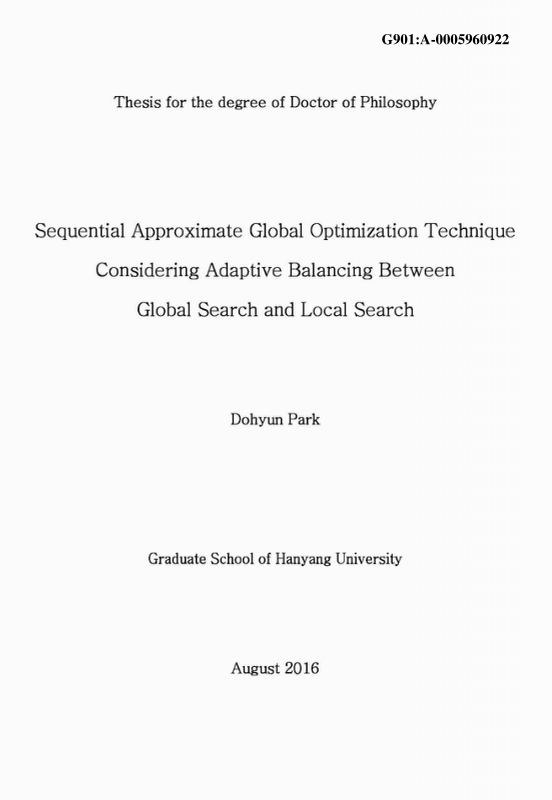
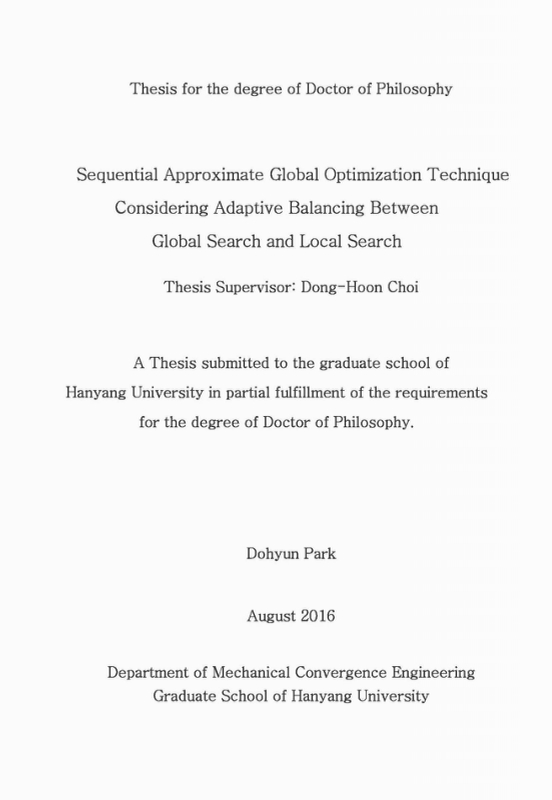
Title Page
Contents
ABSTRACT 11
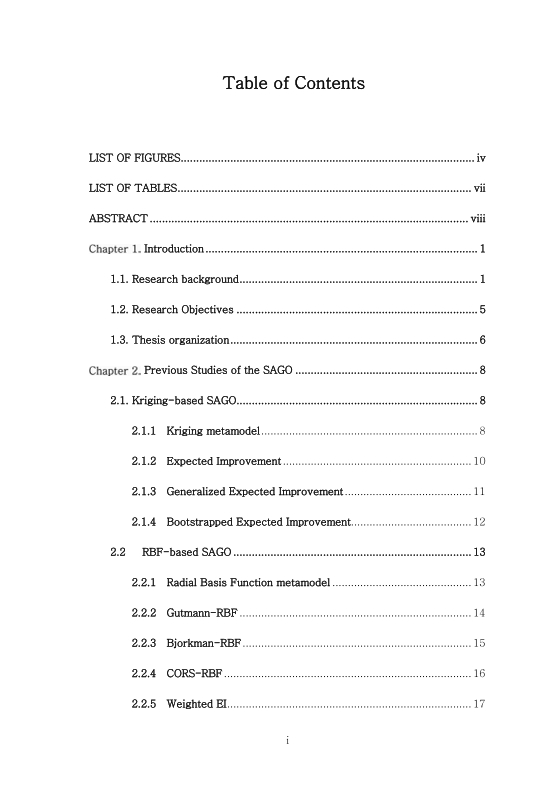
1. Introduction 13
1.1. Research background 13
1.2. Research Objectives 17
1.3. Thesis organization 18
2. Previous Studies of the SAGO 20
2.1. Kriging-based SAGO 20
2.1.1. Kriging metamodel 20
2.1.2. Expected Improvement 22
2.1.3. Generalized Expected Improvement 23
2.1.4. Bootstrapped Expected Improvement 24
2.2. RBF-based SAGO 25
2.2.1. Radial Basis Function metamodel 25
2.2.2. Gutmann-RBF 26
2.2.3. Bjorkman-RBF 27
2.2.4. CORS-RBF 28
2.2.5. Weighted EI 29
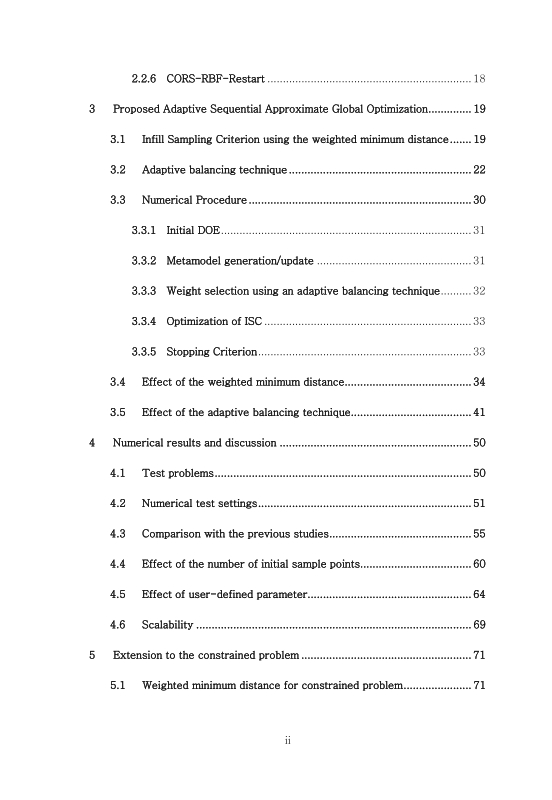
2.2.6. CORS-RBF-Restart 30
3. Proposed Adaptive Sequential Approximate Global Optimization 31
3.1. Infill Sampling Criterion using the weighted minimum distance 31
3.2. Adaptive balancing technique 34
3.3. Numerical Procedure 42
3.3.1. Initial DOE 43
3.3.2. Metamodel generation/update 43
3.3.3. Weight selection using an adaptive balancing technique 44
3.3.4. Optimization of ISC 45
3.3.5. Stopping Criterion 45
3.4. Effect of the weighted minimum distance 46
3.5. Effect of the adaptive balancing technique 53
4. Numerical results and discussion 62
4.1. Test problems 62
4.2. Numerical test settings 63
4.3. Comparison with the previous studies 67
4.4. Effect of the number of initial sample points 72
4.5. Effect of user-defined parameter 76
4.6. Scalability 81
5. Extension to the constrained problem 83
5.1. Weighted minimum distance for constrained problem 83
5.2. ISC for constrained optimization 85
5.3. Numerical test settings for constrained optimization 85
5.4. Numerical test results 86
6. Conclusions 89
Appendix 91
Appendix A. Literature survey on the DOE 91
Appendix B. Literature survey on the metamodel 92
Appendix C. Mathematical test examples for unconstrained optimization 95
Appendix D. Scalable mathematical examples 100
Appendix E. Mathematical test examples for constrained optimization 101
Reference 106
국문요지 113
Fig. 2.1. Graphical illustration of the probability distribution of true response 23
Fig. 3.1. Comparison of distance and weighted minimum distance 33
Fig. 3.2. Pseudo-code for counting consecutive iterations 36
Fig. 3.3. A case when the standard deviation of the nearest neighbor point is... 38
Fig. 3.4. A case when the standard deviation of the nearest neighbor points is... 39
Fig. 3.5. A case when the standard deviation of the nearest neighbor points is... 40
Fig. 3.6. Pseudo-code for counting consecutive iterations 41
Fig. 3.7. Flowchart of an adaptive balancing technique 42
Fig. 3.8. Flow chart of the proposed ASAGO 43
Fig. 3.9. Re-fitting process of the Kriging metamodel 44
Fig. 3.10. Contour plot of Branin example and initial sample points 47
Fig. 3.11. Contour of true response and positions of ISPs at 4th iteration(이미지참조) 48
Fig. 3.12. Contour of true response and positions of ISPs at 8th iteration(이미지참조) 49
Fig. 3.13. Contour of true response and positions of ISPs at 11th iteration(이미지참조) 50
Fig. 3.14. Contour of true response and positions of ISPs of the ASAGOm 51
Fig. 3.15. Convergence history of the objective function 52
Fig. 3.16. Weight history 52
Fig. 3.17. Contour of the Branin example and initial sample points 53
Fig. 3.18. Positions of ISPs and weight history of the ASAGO 54
Fig. 3.19. Positions of ISPs and weight history of the simple SAGO 55
Fig. 3.20. Positions of ISPs of the EI 56
Fig. 3.21. Positions of ISPs of the GEI 57
Fig. 3.22. Positions of ISPs of the WEI 58
Fig. 3.23. Positions of ISPs of the CORS-RBF-Restart 59
Fig. 3.24. Positions of the ISPs until find the global optimum 60
Fig. 3.25. Convergence history of the SAGO algorithms 61
Fig. 4.1. Contour plot of the SC example and positions of the global optimums 64
Fig. 4.2. Positions of ISPs of the ASAGO 65
Fig. 4.3. Average number of function evaluations 67
Fig. 4.4. Standard deviation of the number of function evaluations 71
Fig. 4.5. Success rate 72
Fig. 4.1. Effect of the number of initial sample points on the average number... 74
Fig. 4.2. Effect of the number of initial sample points on the standard... 74
Fig. 4.3. Effect of the number of initial sample points on the success rate 75
Fig. 4.9. Effect of user-defined parameter on the efficiency 79
Fig. 4.10. Effect of user-defined parameter on the robustness 79
Fig. 4.11. Effect of user-defined parameter on the reliability 80
Fig. 5.1. Examples of calculation of weight factor for constraint violation 84
Fig. 5.2. Comparison of average function evaluations for constrained problems 87
Fig. 5.3. Comparison of standard deviation of function evaluations for... 87
Fig. 5.4. Comparison of success rate for constrained problems 87
본 연구에서는 전역 탐색을 위한 향상된 방법인 weighted minimum distance와 국부 탐색과 전역 탐색의 비중을 적응적으로 조절하는 적응적 균형 조절 기법 (adaptive balancing technique)을 제안하였고 이들을 결합하여 Adaptive Sequential Approximate Global Optimization (ASAGO)를 개발하였다.
순차적 근사 전역 최적화 (Sequential Approximate Global Optimization; SAGO)란 초기 메타모델을 생성한 후 순차적으로 실험점을 추가해가며 전역 최적해를 찾아나가는 방법이다. 이러한 SAGO에서는 아직 탐색하지 않은 설계영역을 탐색해 나가는 전역탐색(global search)과 알고 있는 최선해를 개선시켜 나가는 국부탐색(local search)을 조합해 전역 최적해(global optimum)를 탐색한다.
기존의 순차적 근사 최적화 방법들은 이러한 전역탐색과 국부탐색의 중요도를 고정하거나 사전에 정의된 패턴을 반복하기 때문에 설계 문제에 따른 적응성의 부재로 인해 수렴성의 기복이 심한 단점이 있다. 이를 극복하기 위한 방안으로 수렴이력과 실험점에서의 정보를 이용해 순차적 최적화 단계 별로 전역탐색과 국부탐색의 비중을 조절해 주는 adaptive balancing technique을 제안하였다.
또한 기존의 전역 탐색을 위한 방법으로는 단순히 기존 실험점과의 거리나 메타모델의 오차가 사용되었는데 실험점에서의 응답값의 크기에 따른 가중치를 부여해 보다 전역 최적해의 부근을 빠르게 탐색할 수 있는 전역 탐색 방법인 weighted minimum distance를 제안하였다.
본 연구에서는 weighted minimum distance와 adaptive balancing technique을 결합하여 Adaptive Sequential Approximate Global Optimization(ASAGO)를 개발하였다. 그리고 제안된 ASAGO의 성능에 초기 실험점수와 사용자 지정 파라미터들이 주는 영향을 10개의 수학적 예제들에 대해 테스트하였으며 그 결과로부터 적절한 값들을 추천하였다. 또한 기존 순차적 전역 최적화 방법들과 비교하여 제안된 ASAGO의 우수한 성능을 입증하였다.| 번호 | 참고문헌 | 국회도서관 소장유무 |
|---|---|---|
| 1 | Practical Method of Optimization. Chichester: John Wiley & Sons, 1987 | 미소장 |
| 2 | "A Trust Region Framework for Managing Approximation Models in Engineering Optimization," in Proceedings of the 6th AIAA/NASA/USAF Symposium on Multidisciplinary Analysis and Optimization, 1996, pp. 1053-1055 | 미소장 |
| 3 | A trust-region framework for managing the use of approximation models in optimization  |
미소장 |
| 4 | ADAPTIVE RESPONSE SURFACE METHOD - A GLOBAL OPTIMIZATION SCHEME FOR APPROXIMATION-BASED DESIGN PROBLEMS |
미소장 |
| 5 | Adaptive Response Surface Method Using Inherited Latin Hypercube Design Points |
미소장 |
| 6 | "Progressive Quadratic Response Surface Modeling Using Inherited Latin-Hypercube Design," in 11th AIAA/ISSMO Multidisciplinary Analysis and Optimization Conference, Portsmouth, Virginia, 2006 | 미소장 |
| 7 | Minimax and maximin distance designs |
미소장 |
| 8 | Maximum entropy sampling |
미소장 |
| 9 | Design and Analysis of Computer Experiments |
미소장 |
| 10 | "On Sequential Sampling for Global Metamodeling in Engineering Design," in ASME 2002 International Design Engieering Technical Conferences and Computers and Information in Engineering Conference, Montreal, Quebec, Canada, 2002. | 미소장 |
| 11 | Efficient Global Optimization of Expensive Black-Box Functions |
미소장 |
| 12 | "A surrogate-model-based method for constrained optimization," in 8th Symposium on Multidisciplinary Analysis and Optimization, Long Beach, C.A., U.S.A, 2000. | 미소장 |
| 13 | "Computer Experiments and Global Optimization," Ph.D., Statistics, University of Waterloo, 1997. | 미소장 |
| 14 | "Flexibility and Effciency Enhancements for Constrained Global Design Optimization with Kriging Approximations," Ph.D., Mechanical Engineering, University of Michgian, 2002. | 미소장 |
| 15 | Global Optimization of Stochastic Black-Box Systems via Sequential Kriging Meta-Models |
미소장 |
| 16 | A sampling technique enhancing accuracy and efficiency of metamodel-based RBDO: Constraint boundary sampling |
미소장 |
| 17 | Clustered multiple generalized expected improvement: A novel infill sampling criterion for surrogate models |
미소장 |
| 18 | "Convergence properties of the expected improvement algorithm with fixed mean and covariance functions," Journal of Statistical Planning and Inference, vol. 140, pp. 3088-3095, Nov 2010. | 미소장 |
| 19 | Expected improvement in efficient global optimization through bootstrapped kriging |
미소장 |
| 20 | Infill sampling criteria for surrogate-based optimization with constraint handling |
미소장 |
| 21 | Enhancing infill sampling criteria for surrogate-based constrained optimization |
미소장 |
| 22 | "A radial basis for function method for global optimization," in Talk at IFIP TC7 Conference, University of Cambridge, 1999. | 미소장 |
| 23 | A Radial Basis Function Method for Global Optimization |
미소장 |
| 24 | Global Optimization of Costly Nonconvex Functions Using Radial Basis Functions |
미소장 |
| 25 | Constrained Global Optimization of Expensive Black Box Functions Using Radial Basis Functions |
미소장 |
| 26 | Improved Strategies for Radial basis Function Methods for Global Optimization |
미소장 |
| 27 | Constrained optimization by radial basis function interpolation for high-dimensional expensive black-box problems with infeasible initial points |
미소장 |
| 28 | The Design and Analysis of Computer Experiments. New York: Springer-Verlag New York, 2003. | 미소장 |
| 29 | The correct Kriging variance estimated by bootstrapping |
미소장 |
| 30 | On the Design of Optimization Strategies Based on Global Response Surface Approximation Models |
미소장 |
| 31 | http://www2.imm.dtu.dk/projects/dace/. | 미소장 |
| 32 | "Surrogate Modelling by Kriging," in International Symposium on Mathematical Programming 2003, Copenhagen, 2003. | 미소장 |
| 33 | http://biomath.ugent.be/~brecht/downloads.html. | 미소장 |
| 34 | "Optimal experimental design to discriminate among rival dynamic mathematical models," Ph.D., Applied Mathematics, Ghent University, 2009. | 미소장 |
| 35 | Engineering Design via Surrogate Modelling: A Practical Guide: John Wiley & Sons, 2008. | 미소장 |
| 36 | "An Implemented extension of branin's method," in Towards Global Optimization, L. C. W. Dixon and G. P. Szego, Eds., ed Amsterdam: North-Holland, 1975, pp. 117-142. | 미소장 |
| 37 | p,p′-DDE-induced changes in the organic and inorganic structure of eggshells of the Mallard, Anas platyrhynchos |
미소장 |
| 38 | "Overview of modern design of experiments methods for computational simulations," in 41st Aerospace Sciences Meeting and Exhibit, Reno, Nevada, 2003. | 미소장 |
| 39 | Application of the Method of Maximum Likelihood to the Improvement of Curves Fitted by the Method of Moments |
미소장 |
| 40 | On the Experimental Attainment of Optimum Conditions |
미소장 |
| 41 | Smallest Composite Designs for Quadratic Response Surfaces |
미소장 |
| 42 | Some New Three Level Designs for the Study of Quantitative Variables |
미소장 |
| 43 | Optimal Design: Experiments for Discriminating between Several Models |
미소장 |
| 44 | Augmented D-Optimal Design for Effective Response Surface Modeling and Optimization | 소장 |
| 45 | A Comparison of Three Methods for Selecting Values of Input Variables in the Analysis of Output from a Computer Code |
미소장 |
| 46 | Maximum entropy sampling |
미소장 |
| 47 | Orthogonal Array-Based Latin Hypercubes |
미소장 |
| 48 | Optimal Latin-hypercube designs for computer experiments |
미소장 |
| 49 | Statistical Learning Theory. New York: John Wiley & Sons, 1999 | 미소장 |
| 50 | Multiquadric equations of topography and other irregular surfaces |
미소장 |
| 51 | Design optimization using support vector regression | 소장 |
| 52 | "A Statistical Approach to Some Basic Mine Valuation Problems on the Witwatersrand," Journal of the South African Institute of Mining and Metallurgy, vol. 94, pp. 95-111, Mar 1994. | 미소장 |
| 53 | Principles of geostatistics |
미소장 |
| 54 | "Comparison of Response Surface and Kriging models for Multidisciplinary Design Optimization," in 7th AIAA/USAF/NASA/ISSMO Symposium on Multidisciplinary Analysis and Optimization, St. Louis, MO, U.S.A, 1998. | 미소장 |
| 55 | "Sequential Approximate Optimization using Kriging Metamodels," KSME Journal, vol. 29, pp. 1199-1208, 2005 | 미소장 |
| 56 | Multiquadric equations of topography and other irregular surfaces |
미소장 |
| 57 | Construction of the radial basis function based on a sequential sampling approach using cross-validation | 소장 |
| 58 | Comparative studies of metamodelling techniques under multiple modelling criteria |
미소장 |
| 59 | "A comparison of metamodeling methods using practical industry requirements," presented at the Proc. of the 47th AIAA/ASME/ASCE/AHS/ASC Structures, Structural Dynamics, and Materials Conference, Newport, RI, 2006. | 미소장 |
| 60 | "A Practical Robust and Efficient RBF Metamodel Method for Typical Engineering Problems," in Proceedings of the ASME 2008 International Design Engineering Technical Conferences & Computers and Imformation in Engineering Conference, Brooklyn, New York, USA, 2008. | 미소장 |
| 61 | "Design and Analysis of Computer Experiments in Multidisciplinary Design Optimization: A Review of How Far We Have Com - or Not," in 12th AIAA/ISSMO Multidisciplinary Analysis and Optimization Conference, Victoria, British Columbia, Canada, 2008. | 미소장 |
| 62 | Survey of modeling and optimization strategies to solve high-dimensional design problems with computationally-expensive black-box functions |
미소장 |
| 63 | Neural networks for pattern recognition. New York: Oxford University Press, 1995. | 미소장 |
| 64 | "An optimization methodology of alkaline-surfactant-polymer flooding processes using field scale numerical simulation and multiple surrogates," Journal of Petroleum Science and Engineering, vol. 47, pp. 197-208, Jun 30 2005. | 미소장 |
| 65 | Ensemble of surrogates |
미소장 |
| 66 | Multiple Surrogate Modeling for Axial Compressor Blade Shape Optimization |
미소장 |
| 67 | Toward an optimal ensemble of kernel-based approximations with engineering applications |
미소장 |
| 68 | Ensemble of metamodels with optimized weight factors |
미소장 |
| 69 | Pointwise ensemble of meta-models using v nearest points cross-validation |
미소장 |
*표시는 필수 입력사항입니다.
| 전화번호 |
|---|
| 기사명 | 저자명 | 페이지 | 원문 | 기사목차 |
|---|
| 번호 | 발행일자 | 권호명 | 제본정보 | 자료실 | 원문 | 신청 페이지 |
|---|
도서위치안내: / 서가번호:

우편복사 목록담기를 완료하였습니다.
*표시는 필수 입력사항입니다.
저장 되었습니다.
