
 대표어
대표어
권호기사보기
| 기사명 | 저자명 | 페이지 | 원문 | 기사목차 |
|---|
결과 내 검색
동의어 포함
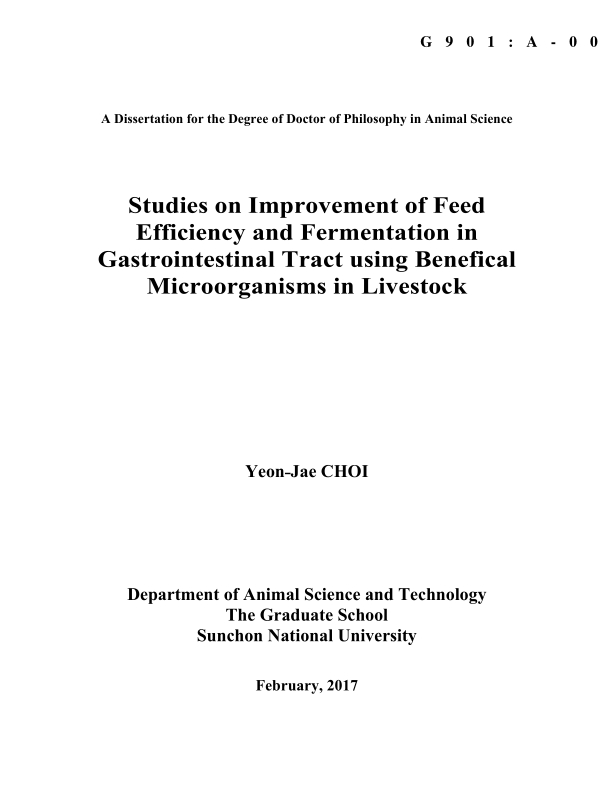
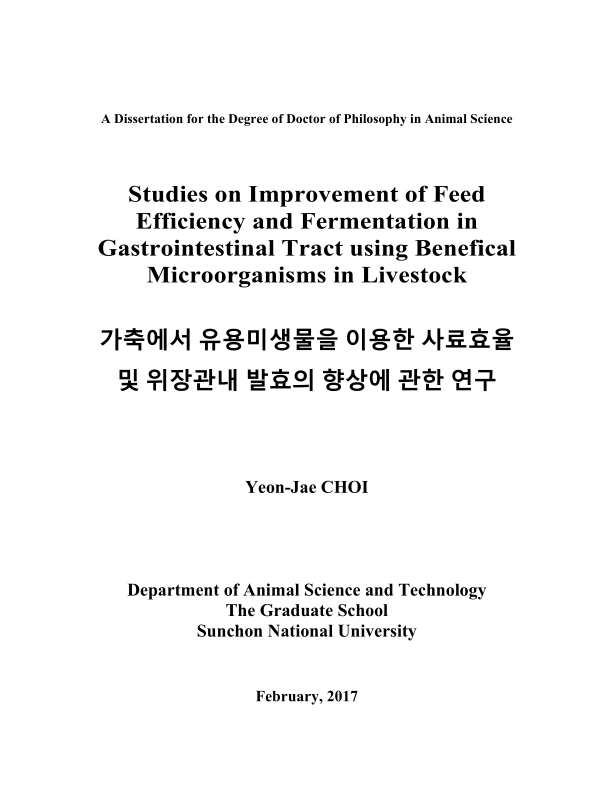
Title Page
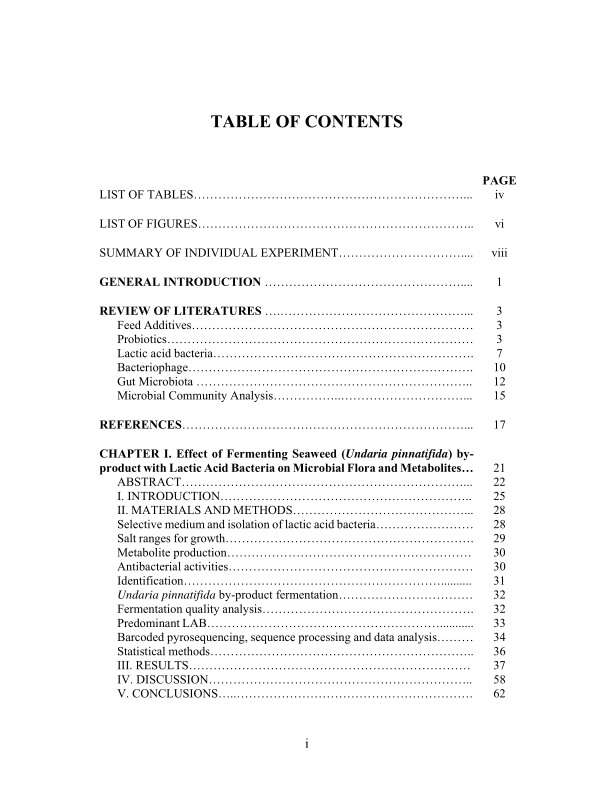
Contents
SUMMARY OF INDIVIDUAL EXPERIMENT 12
GENERAL INTRODUCTION 19
REVIEW OF LITERATURES 21
Feed Additives 21
Probiotics 21
Lactic acid bacteria 25
Bacteriophage 28
Gut Microbiota 30
Microbial Community Analysis 33
References 35
CHAPTER I. Effect of Fermenting Seaweed (Undaria pinnatifida) by-product with Lactic Acid Bacteria on Microbial Flora and Metabolites 39
Abstract 40
I. INTRODUCTION 43
II. Materials and Methods 46
1. Selective medium and isolation of lactic acid bacteria 46
2. Salt ranges for growth 47
3. Metabolite production 48
4. Antibacterial activities 48
5. Identification 49
6. Undaria pinnatifida by-product fermentation 50
7. Fermentation quality analysis 50
8. Predominant LAB 51
9. Barcoded Pyrosequencing, sequence processing and data analysis 52
10. Statistical methods 54
III. Results 55
1. Salt ranges for growth 55
2. Metabolite production 56
3. Antimicrobial activity 57
4. Identification 59
5. Fermentation quality 61
6. Predominant LAB 65
7. Bacterial and fungal diversity changes in SWBP feed during fermentation 67
8. Bacterial and fungal community changes in SWBP feed during fermentation 71
IV. Discussion 76
V. Conclusions 80
VI. References 81
CHAPTER II. Effect of Lactic Acid Bacteria Additives in Total Mixed Ration (TMR) on Fermentation Quality and in vitro Rumen Fermentation 85
Abstract 86
I. INTRODUCTION 88
II. Materials and Methods 90
1. Isolation, identification and metabolite production of microbes 90
2. Fermentation of TMR 91
3. Fermentation quality analysis 92
4. In vitro rumen fermentation 93
5. Parameters for analysis of in vitro rumen fermentation 95
6. Statistical methods 96
III. Results 97
1. Isolation and identification of LAB 97
2. Fermentation quality 98
3. Rumen fermentation in vitro parameters 100
IV. Discussion 104
V. Conclusion 107
VI. References 108
CHAPTER III. Effect of Bacteriophage Feed on Inhibition of Escherichia coli on in vitro Rumen Fermentation 111
Abstract 112
I. INTRODUCTION 114
II. Materials and Methods 116
1. Bacteriophage 116
2. Inhibition of bacterial growth by bacteriophage 117
3. In vitro rumen fermentation 117
3. Analysis of rumen fermentation in vitro parameters 119
4. Quantitative real-time PCR 121
5. Statistical methods 122
III. Results 123
1. Inhibition of bacterial growth by bacteriophage feed 123
2. Rumen fermentation in vitro parameters 124
3. Bacterial population 127
IV. Discussion 130
V. Conclusions 133
VI. References 134
CHAPTER IV. Effect of Dietary Fermented Sulfur Feed on Growth Performance and Gut Microbiota in Broiler Chickens 138
Abstract 139
I. INTRODUCTION 141
II. Materials and Methods 143
1. fermented Sulfur 143
2. Broilers Management and Experimental Design 144
3. Growth performance 144
4. Odorous compounds analysis 146
5. Blood parameters and immunoglobulin 146
6. Proximate composition, fatty acids composition of broier meat 147
7. Sampling and DNA extraction 148
8. Quantitative real-time PCR 148
9. Pyrosequencing analysis of gut microbiota 150
10. Statistical methods 152
III. Results 153
1. Growth performance 153
2. Concentration of odorous compounds in chicken building 155
3. Proximate composition and Fatty acid profiles of broiler meat 157
4. Blood profiles and immunoglobulin of chicken serum 159
5. Bacteria quantification in digesta of chicken 160
6. Bacterial diversity of the broiler gut microbiome 162
7. Bacterial community of the broiler gut microbiome 165
IV. Discussion 172
V. Conclusions 182
VI. References 183
국문초록 189
REVIEW OF LITERATURES 27
Figure 1. Major pathways active in lactic acid bacteria 27
Figure 2. Lytic or lysogenic cycles 29
Figure 3. Phylogenetic distribution of bacterial families in different GIT... 31
Figure 4. Abundance of glycoside hydrolase (GH) families in metagenomes... 32
Figure 5. Bacterial diversity is affected by ageing 34
CHAPTER I. Effect of Fermenting Seaweed (Undaria pinnatifida) by-product with Lactic Acid Bacteria on Microbial Flora and Metabolites 45
Figure 1. The pictures of brown algae 45
Figure 2. Growth response of isolated strains to different salt concentration 55
Figure 3. Changes in relative bacteria and fungi diversities shown through rarefaction analysis using gene... 70
Figure 4. Bacteria taxonomic compositions at the phylum level of SWBP feed during fermentation 73
Figure 5. Bacteria taxonomic compositions at the genus level of SWBP feed during fermentation 74
Figure 6. Fungal taxonomic compositions at the genus level of SWBP feed during fermentation 75
CHAPTER III. Effect of Bacteriophage Feed on Inhibition of Escherichia coli on in vitro Rumen Fermentation 123
Figure 1. Pathogenic microorganisms inhibition of bacteriophage feed 123
Figure 2. DNA copies of in vitro fermentation using rumen fluid inocula from bacteriophage feed 129
CHAPTER IV. Effect of Dietary Fermented Sulfur Feed on Growth Performance and Gut Microbiota in Broiler Chickens 164
Figure 1. Rarefaction analysis using bacteria 16S rRNA gene sequences... 164
Figure 2-1. Taxonomic composition at the phylum level of broiler gut microbiome 166
Figure 2-2. Taxonomic composition at the phylum level of broiler gut microbiome 167
Figure 3-1. Taxonomic composition at the family level of broiler gut microbiome 168
Figure 3-2. Taxonomic composition at the family level of broiler gut microbiome 169
Figure 4-1. Bacterial taxonomic composition of genus level in broiler gut microbiome 170
Figure 4-2. Bacterial taxonomic composition of genus level in broiler gut microbiome 171
*표시는 필수 입력사항입니다.
| 전화번호 |
|---|
| 기사명 | 저자명 | 페이지 | 원문 | 기사목차 |
|---|
| 번호 | 발행일자 | 권호명 | 제본정보 | 자료실 | 원문 | 신청 페이지 |
|---|
도서위치안내: / 서가번호:

우편복사 목록담기를 완료하였습니다.
*표시는 필수 입력사항입니다.
저장 되었습니다.
