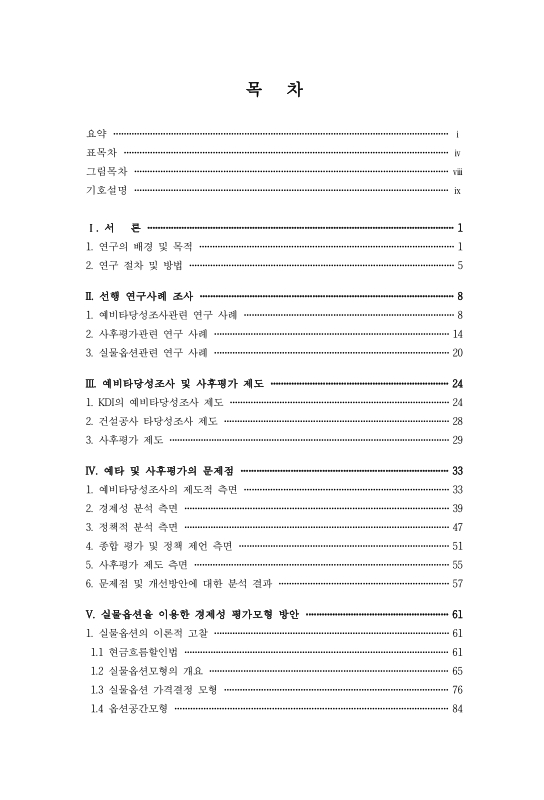
I. 서론 14
1. 연구의 배경 및 목적 14
2. 연구 절차 및 방법 18
II. 선행 연구사례 조사 21
1. 예비타당성조사관련 연구 사례 21
2. 사후평가관련 연구 사례 27
3. 실물옵션관련 연구 사례 33
III. 예비타당성조사 및 사후평가 제도 37
1. KDI의 예비타당성조사 제도 37
2. 건설공사 타당성조사 제도 41
3. 사후평가 제도 42
IV. 예타 및 사후평가의 문제점 46
1. 예비타당성조사의 제도적 측면 46
2. 경제성 분석 측면 52
3. 정책적 분석 측면 60
4. 종합 평가 및 정책 제언 측면 64
5. 사후평가 제도 측면 68
6. 문제점 및 개선방안에 대한 분석 결과 70
V. 실물옵션을 이용한 경제성 평가모형 방안 74
1. 실물옵션의 이론적 고찰 74
1.1. 현금흐름할인법 74
1.2. 실물옵션모형의 개요 78
1.3. 실물옵션 가격결정 모형 89
1.4. 옵션공간모형 97
1.5. ROM을 이용한 경제성 평가모형 99
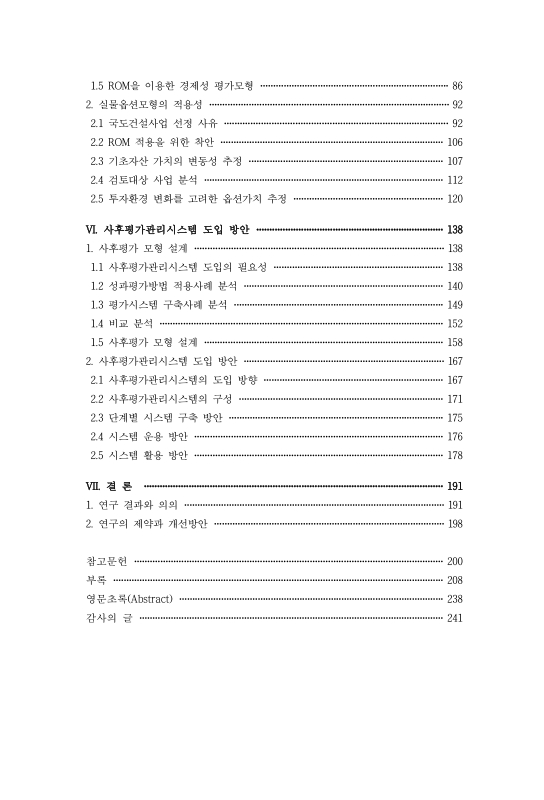
2. 실물옵션모형의 적용성 105
2.1. 국도건설사업 선정 사유 105
2.2. ROM 적용을 위한 착안 119
2.3. 기초자산 가치의 변동성 추정 120
2.4. 검토대상 사업 분석 125
2.5. 투자환경 변화를 고려한 옵션가치 추정 133
VI. 사후평가관리시스템 도입 방안 151
1. 사후평가 모형 설계 151
1.1. 사후평가관리시스템 도입의 필요성 151
1.2. 성과평가방법 적용사례 분석 153
1.3. 평가시스템 구축사례 분석 162
1.4. 비교 분석 165
1.5. 사후평가 모형 설계 171
2. 사후평가관리시스템 도입 방안 180
2.1. 사후평가관리시스템의 도입 방향 180
2.2. 사후평가관리시스템의 구성 184
2.3. 단계별 시스템 구축 방안 188
2.4. 시스템 운용 방안 189
2.5. 시스템 활용 방안 191
VII. 결론 204
1. 연구 결과와 의의 204
2. 연구의 제약과 개선방안 211
List of TablesTable 2.1. Feasibility assessment items to control uncertainty 25
Table 2.2. Case studies of evaluation indictors used in government works 27
Table 2.3. Case studies of evaluation indictors used in BAE 28
Table 2.4. Case studies of evaluation indictors used in BSC 29
Table 2.5. Case studies of evaluation indictors used in PLM 30
Table 2.6. Case studies of problems and introduction methods in post evaluation 32
Table 3.1. Comparison of results of feasibility study from 1994 to 1998 37
Table 3.2. Scope of weights by project type 40
Table 3.3. Comparison the contents of the preliminary feasibility study 40
Table 3.4. Performance of preliminary feasibility study from 1999 to 2016 41
Table 3.5. Comparison the contents of feasibility study system 42
Table 3.6. Number of projects registered in post construction evaluation system 44
Table 3.7. Comparison of results between feasibility study and post evaluation 45
Table 3.8. Evaluation criteria in post evaluation of the construction projects 45
Table 4.1. Cases of reassessment study of feasibility from 1999 to 2012 47
Table 4.2. The main factors of the re-feasibility study 48
Table 4.3. Project performance by project cost scope 49
Table 4.4. Comparison between future and actual traffic 52
Table 4.5. Comparison of traffic estimation results 53
Table 4.6. Results of economic evaluation in preliminary feasibility study 54
Table 4.7. Results of economic evaluation in pre-feasibility and re-feasibility 55
Table 4.8. Results of the project feasibility evaluation by project cost scope 56
Table 4.9. Comparison of project cost and period between plan and completion 58
Table 4.10. Scope of sensitivity analysis 59
Table 4.11. Results of economic analysis using CVM method 60
Table 4.12. Results of the regional balance development 61
Table 4.13. AHP weighted ranges by years 62
Table 4.14. Comparison of the importance results by evaluation area 65
Table 4.15. Comparison of feasibility evaluation of project implementation 66
Table 4.16. Examples of policy suggestions 67
Table 4.17. Comparison of the rate of change of project plan 69
Table 4.18. Example of problems in preliminary feasibility study 71
Table 5.1. Estimation of the real discount rate by year 77
Table 5.2. Comparison of financial options and the real options 83
Table 5.3. Comparison of probability distribution types 89
Table 5.4. Vital statistics for six independent projects 98
Table 5.5. Relationships between the assessment items and option types 105
Table 5.6. Construction cost indices by transportation facilities 106
Table 5.7. 2015 construction investment budget per road type 106
Table 5.8. Construction project investment budget rate per road type 107
Table 5.9. Performance of feasibility study per road type 107
Table 5.10. Comparison of the benefit items in road construction projects 109
Table 5.11. Example of variables that affect benefits in road projects 113
Table 5.12. Comparison of the total cost concept by road project stage 113
Table 5.13. Configuration items of total project costs in road projects 114
Table 5.14. Annual trend of the road construction costs 114
Table 5.15. Overview of the Guji construction project 125
Table 5.16. Comparison of overview of the Guji industrial estate 126
Table 5.17. Comparison of predicted and actual traffic volume 127
Table 5.18. Comparison of average daily traffic volume 127
Table 5.19. Comparison of economic analysis results 128
Table 5.20. Overview of the Gumi construction project 129
Table 5.21. Comparison of basic data analysis results 131
Table 5.22. Comparison of traffic volume survey results 131
Table 5.23. Comparison of economic analysis results 132
Table 5.24. The expected values of the underlying asset 135
Table 5.25. When reducing project size, the expected values of S 136
Table 5.26. Decision paths and values of the option to contract 138
Table 5.27. Economic analysis results at social discount rate = 7.5% 138
Table 5.28. Economic analysis results at social discount rate = 5.5% 139
Table 5.29. The expected values of the underlying asset 140
Table 5.30. When deferring project, the expected values of S 141
Table 5.31. Decision paths and values of the option to defer 142
Table 5.32. Comparison of economic analysis results in re-feasibility study 142
Table 5.33. Comparison of economic analysis results in post evaluation 143
Table 5.34. DCF-based sensitivity analysis in pre-feasibility study 144
Table 5.35. DCF-based sensitivity analysis in post evaluation 144
Table 5.36. Sensitivity analysis for contract option in pre-feasibility study 145
Table 5.37. Sensitivity analysis for contract option in post evaluation 145
Table 5.38. DCF-based sensitivity analysis in re-feasibility study 146
Table 5.39. DCF-based sensitivity analysis in detailed design 146
Table 5.40. Sensitivity analysis for defer option in pre-feasibility study 147
Table 5.41. Sensitivity analysis for abandon option 147
Table 5.42. Vital Statistics for the values of project 148
Table 5.43. Vital Statistics for the values of project 149
Table 6.1. Comparison of performance management systems 154
Table 6.2. Comparison of before and after introduction of evaluation system 170
Table 6.3. Examples of information used in the input phase 194
Table 6.4. Examples of information managed in activity phase 195
Table 6.5. Examples of efficiency evaluation 195
Table 6.6. Examples of effectiveness evaluation 197
Table 6.7. Examples of relevance evaluation 198
Table 6.8. Examples of relevance evaluation in social indicators 199
Table 6.9. Examples of relevance evaluation in policy analysis 199
Table 6.10. Examples of satisfaction and sustainability evaluation 200
Table 6.11. Comparison of post construction evaluation systems 201
Table 7.1. Comparison of economic results of DCF and ROM 205
Table 7.2. Comparison of before and after post evaluation 207
[부록] Table 1. The real interest rate (the discount rate) 221
[부록] Table 2. Annual unit prices of VOT by year, by car model 222
[부록] Table 3. Annual unit prices of VOC in the passenger cars 223
[부록] Table 4. Annual unit prices of VOC in the small buses 223
[부록] Table 5. Annual unit prices of VOC in the large buses 224
[부록] Table 6. Annual unit prices of VOC in the small trucks 224
[부록] Table 7. Annual unit prices of VOC in the medium trucks 225
[부록] Table 8. Annual unit prices of VOC in the large trucks 225
[부록] Table 9. Annual unit prices of VICS 226
[부록] Table 10. Annual unit prices of pollutants 226
[부록] Table 11. Annual unit prices of VOPC in the passenger cars 227
[부록] Table 12. Annual unit prices of VOPC in the small buses 227
[부록] Table 13. Annual unit prices of VOPC in the medium buses 227
[부록] Table 14. Annual unit prices of VOPC in the large buses 228
[부록] Table 15. Annual unit prices of VOPC in the small buses 228
[부록] Table 16. Annual unit prices of VOPC in the medium buses 228
[부록] Table 17. Annual unit prices of VOPC in the large buses 229
[부록] Table 18. Annual unit prices of VONC 229
[부록] Table 19. Estimation of traffic volume before opening a road 230
[부록] Table 20. Estimation of VOT before opening a national road 231
[부록] Table 21. Estimation of VOC before opening a national road 232
[부록] Table 22. Estimation of VICS Table before opening a national road 233
[부록] Table 23. Estimation of VONC before opening a national road 233
[부록] Table 24. Estimation of VOPC before opening a national road 234
[부록] Table 25. Estimation of traffic after opening a national road 235
[부록] Table 26. Estimation of VOT after opening a national road 236
[부록] Table 27. Estimation of VOC after opening a national road 237
[부록] Table 28. Estimation of VICS after opening a national road 238
[부록] Table 29. Estimation of VONC after opening a national road 238
[부록] Table 30. Estimation of VOPC after opening a national road 239
[부록] Table 31. Estimation of benefits 240
[부록] Table 32. Application base unit prices for the VOT estimation 241
[부록] Table 33. Application base unit prices for the VIC estimation 241
[부록] Table 34. Application base unit prices for the VOC estimation 241
[부록] Table 35. Application base unit prices for the VOPC estimation 242
[부록] Table 36. Application base unit prices for the VONC estimation 242
[부록] Table 37. Statistical results through the Monte Carlo simulation 243
[부록] Table 38. Estimation of the volatility of benefits 244
[부록] Table 39. Results of cost-benefit estimation in pre-feasibility study 245
[부록] Table 40. Results of cost-benefit estimation in post evaluation 246
[부록] Table 41. Results of cost-benefit estimation in re-feasibility study 247
[부록] Table 42. Results of cost-benefit estimation in basic design 248
[부록] Table 43. Results of cost-benefit estimation in 1 working zone 249
[부록] Table 44. Results of cost-benefit estimation in 2 working zone 250
Fig. 1.1. Procedure for conducting study 19
Fig. 3.1. Procedure of the preliminary feasibility study 38
Fig. 3.2. Procedure of post evaluation in the construction projects 44
Fig. 4.1. Improvement direction of preliminary feasibility study 73
Fig. 5.1. Changes in the risk and value of the DCF and options 80
Fig. 5.2. Changes in the values of project using real options 83
Fig. 5.3. Changes in the values of the underlying asset at=1 95
Fig. 5.4. Changes in the values of the underlying asset at t=2 95
Fig. 5.5. Changes in the values of the underlying asset at t=n 96
Fig. 5.6. Dividing option space into regions 98
Fig. 5.7. Option space is defined by two Option-Value Metrics 98
Fig. 5.8. Locating the projects in a option space 98
Fig. 5.9. Proposed procedure using ROM in the preliminary feasibility study 104
Fig. 5.10. Changes of costs in the entire life cycle of road facilities 106
Fig. 5.11. Example of flexible decision-making paths in road projects 117
Fig. 5.12. Process for calculating the volatility of the underlying asset 123
Fig. 5.13. Locating the values of contract option in the option space 148
Fig. 5.14. Locating the values of defer option in the option space 149
Fig. 6.1. Four aspects of BSC 156
Fig. 6.2. Procedure of the program logic model 159
Fig. 6.3. Key evaluation issues 160
Fig. 6.4. Example of performance management system used in MOHW 164
Fig. 6.5. Example of evaluation system for construction used in MOLIT 165
Fig. 6.6. Key evaluation indices for publicly financed projects 172
Fig. 6.7. Components of a post evaluation based on pre-feasibility study 174
Fig. 6.8. PLM-based post evaluation model 176
Fig. 6.9. Example of application of post evaluation model 180
Fig. 6.10. Configuration of post evaluation management system 184
Fig. 6.11. Phased Plans for system implementation 188
Fig. 6.12. Example of proposed system operation 191
Fig. 6.13. Example of propose system utilization 192

 대표어
대표어