
 대표어
대표어
권호기사보기
| 기사명 | 저자명 | 페이지 | 원문 | 기사목차 |
|---|
결과 내 검색
동의어 포함
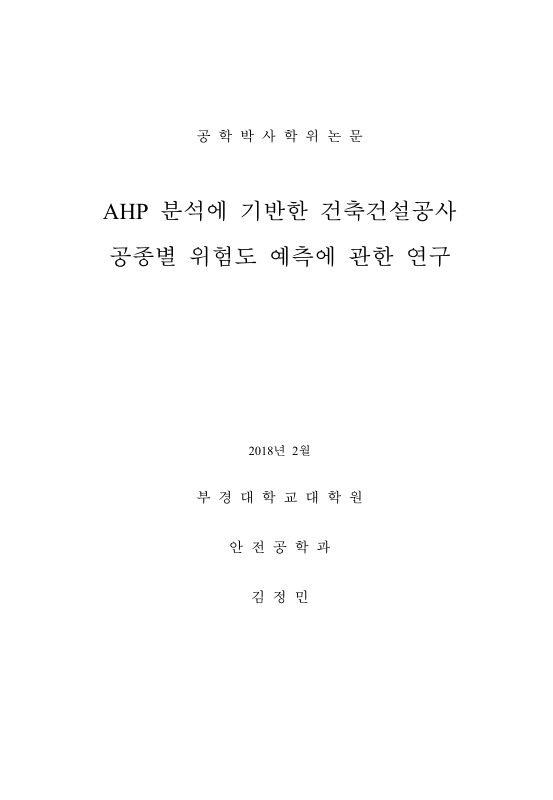
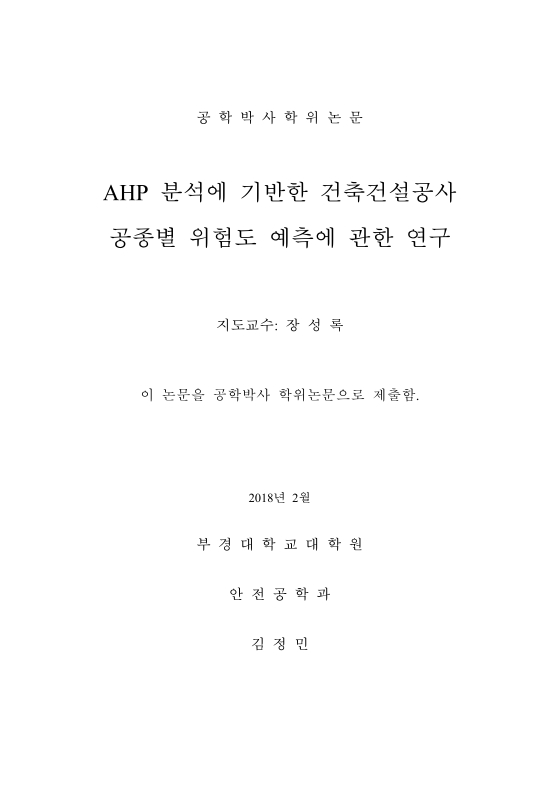
표제지
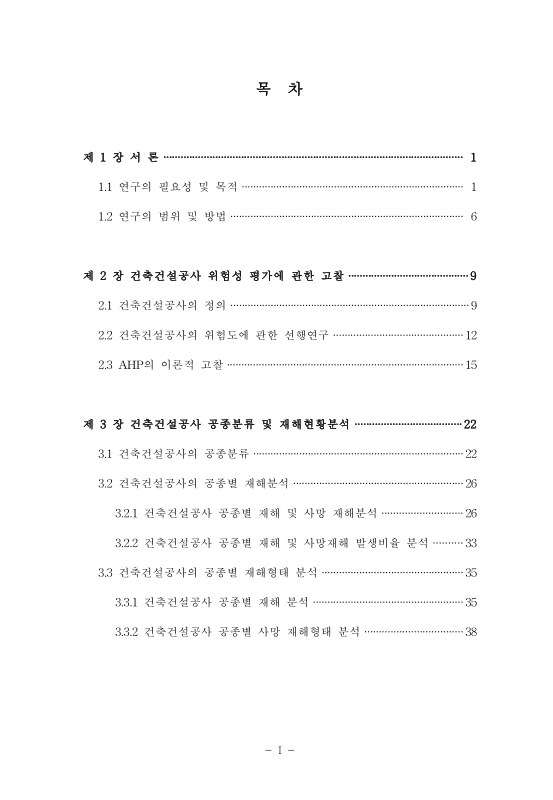
목차
Abstract 10
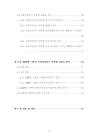
제1장 서론 13
1.1. 연구의 필요성 및 목적 13
1.2. 연구의 범위 및 방법 18
제2장 건축건설공사 위험성 평가에 관한 고찰 21
2.1. 건축건설공사의 정의 21
2.2. 건축건설공사의 위험도에 관한 선행연구 24
2.3. AHP의 이론적 고찰 27
제3장 건축건설공사 공종분류 및 재해현황분석 34
3.1. 건축건설공사의 공종분류 34
3.2. 건축건설공사의 공종별 재해분석 38
3.2.1. 건축건설공사 공종별 재해 및 사망재해 분석 38
3.2.2. 건축건설공사 공종별 재해 및 사망재해 발생 비율 분석 45
3.3. 건축건설공사 재해형태 분석 47
3.3.1. 건축건설공사 공종별 재해형태 분석 47
3.3.2. 건축건설공사 공종별 사망 재해형태 분석 50
3.4. 건축건설공사 공종별 재해율 분석 52
3.4.1. 건축건설공사 공종별 연간 투입인원 분석 52
3.4.2. 건축건설공사 공종별 재해율 분석 55
3.4.3. 건축건설공사 공종별 일반 재해율에 근거한 재해빈도 등급분류 60
3.4.4. 건축건설공사 공종별 사망 만인율 분석 61
3.4.5. 건축건설공사 공종별 사망 만인율에 근거한 재해강도 등급분류 65
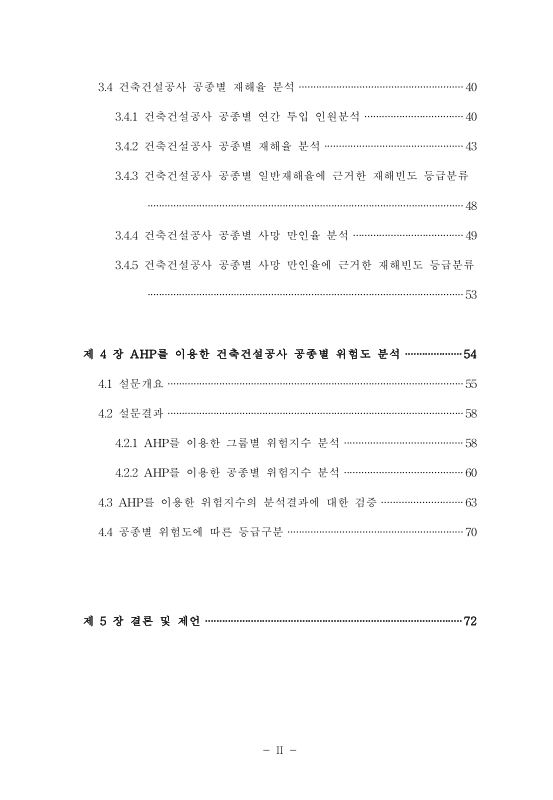
제4장 AHP를 이용한 건축건설공사 공종별 위험도 분석 66
4.1. 설문개요 67
4.2. 설문결과 70
4.2.1. AHP를 이용한 그룹별 위험지수 분석 70
4.2.2. AHP를 이용한 공종별 위험지수 분석 72
4.3. AHP를 이용한 위험지수의 분석결과에 대한 검증 75
4.4. 공종별 위험도에 따른 등급 구분 82
제5장 결론 및 제언 84
참고문헌 89
부록 97
부록 A. 2015년도 사업종류별 산재보험료율에 따른 건설업 구분 97
부록 B. 건축건설공사 공종별 AHP 설문 110
Fig. 1. Flow chart 20
Fig. 2. AHP flow chart 29
Fig. 3. Hierarchy structure model for decision making 30
Fig. 4. Work type classification of architectural work 37
Fig. 5. Sampling of raw data 39
Fig. 6. Sampling of input workers per year 52
Fig. 7. Pareto chart by accident rate according to the work type 58
Fig. 8. Pareto chart by fatal accident rate according to the work type 63
Fig. 9. Process of analysis 69
Fig. 10. Sample of weight analysis of group by AHP 71
Fig. 11. Sample of weight analysis of each work type by AHP 72
Fig. 12. Scatter plot of correlation between accident frequency of each... 79
Fig. 13. Scatter plot of correlation between accident severity of each work... 80
Fig. 14. Scatter plot of correlation between risk index by statistics and risk... 81
It is well-known that the construction industry has a higher risk of deaths than other industries. The higher risk in this industry could be attributable to the combination of the followings: 1) outdoor work site; 2) the nature of employment; 3) complex construction contracts; and 4) various method of construction technology. In the case of construction work, the number of construction work types can range from dozens to hundreds. Consequently, the degree of risk to the construction method can not be evaluated only as the size of the accident and the number of accident like other industries. On this basis, it is necessary to analyze and evaluate potential work-related risk factors as well as the portion of work intensity for each type of work to determine the degree of risk. The goal of this study was to measure the risk of various construction works by taking into consideration the number of working staffs in the actual field of construction and the working time of each type of construction work. Also, the analytic hierarchy process throughout expert interviews was employed if there is no past data, or the amount of data is insufficient.
As a result of analysis of deaths by construction type, the number of deaths was the largest in three construction types including the formwork, temporary construction, and steel frame construction. Among three construction types, the formwork showed a significantly higher rate of deaths in past as compared to the others, but recently the temporary construction work showed a biggest death rate.
As a result of analysis of accident by construction type, the temporary construction work recorded the highest injuries (2,090 cases), followed by the dismantling construction (1,215 cases), formworks (1,174 cases) and moving not related with works (1,122 cases). The result suggested that the temporary construction work is most dangerous construction work type in both the death rate and accident rate.
As a result of analyzing the mortality risk in consideration of the duration of work and number of workers by each type of work, the highest risk of death was found in the steel frame construction, unlike the occurrence ranking in the number of deaths, followed by the temporary construction work, the concrete work, the waterproofing work and the painting work.
As a result of analyzing the general accident risk in consideration of the duration of work and number of workers by each type of work, the steel frame construction, temporary construction, foundation & earthworks, facility construction, and concrete construction were found to be risky.
According to the AHP results, steel frame construction, foundation construction, foundation and earthworks, facility construction and concrete construction were analyzed as high risk type. Based on the accident statistics, the results of the risk assessment considering the annual workforce input showed higher risk in steel construction, foundation construction, concrete construction, demolition construction and painting construction.
Finally, in order to verify the risk estimates by construction type, we compared the risk ranking by type of work considering the annual workforce input. A correlation analysis was conducted between the risk ranking by type of work and the risk ranking by AHP analysis. According to the analysis results, the risk rankings by construction type of construction work were significantly correlated with the risk ranking by AHP analysis. Therefore, in order to evaluate the risk of the work by the new method without accident cases or statistical data, it is considered that the risk of the work and the work type can be estimated by using the AHP analysis by the expert evaluation.
In this study, we conducted a study on the risk of general accident unlike the other studies that have been carried out so far. The results of the AHP analysis can be used as the basic data for determining the priority of safety management in the future. In order to prevent serious accidents including death, the general accident and near misses should be considered for proactive safety management instead of reactive nature of the current safety management trend focusing on the severe accident.*표시는 필수 입력사항입니다.
| 전화번호 |
|---|
| 기사명 | 저자명 | 페이지 | 원문 | 기사목차 |
|---|
| 번호 | 발행일자 | 권호명 | 제본정보 | 자료실 | 원문 | 신청 페이지 |
|---|
도서위치안내: / 서가번호:

우편복사 목록담기를 완료하였습니다.
*표시는 필수 입력사항입니다.
저장 되었습니다.
