
 대표어
대표어
권호기사보기
| 기사명 | 저자명 | 페이지 | 원문 | 기사목차 |
|---|
결과 내 검색
동의어 포함
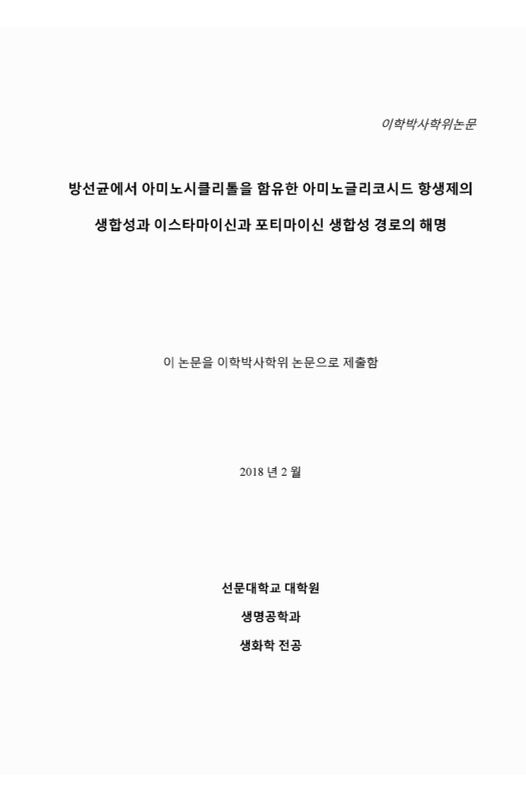
Title Page
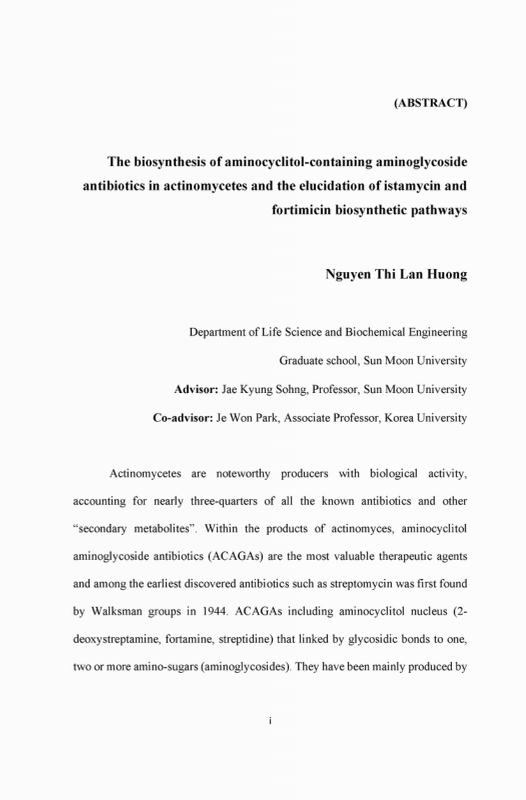
ABSTRACT
Contents
Abbreviations 18
CHAPTER I. INTRODUCTION 23
1.1. Aminocyclitol aminoglycoside antibiotics (ACAGAs) 24
1.1.1. Definition 24
1.1.2. Classification and chemical structure of ACAGAs 25
1.1.3. Biosynthesis and regulation of fortamine and 2-deoxyfortamine- containing ACAGAs 34
1.1.3. Uptake and mode of action 40
1.1.4. Mechanisms of resistance 42
1.1.5. Toxicity 43
1.1.6. Glycosyltransferase involved in fortamine containing ACAGAs 44
1.2. Aminocyclitol antibiotics producers 45
1.3. Aims of the work 48
CHAPTER II. Materials and Methods 51
2.1. General procedure 52
2.1.1. Chemical reagents and enzymes 52
2.1.2. Culture media 53
2.2. Bacterial strains, recombinant plasmids, vectors, and culture conditions 55
2.3. Growth and maintenance of bacterial strains 59
2.3.1. Growth and maintenance of E. coli 59
2.3.2. Growth and maintenance of Streptomyces and Micromonospora 59
2.4. Polymerase chain reaction (PCR) 60
2.5. In vitro manipulation of DNA 60
2.5.1. Plasmid purification from E. coli 60
2.5.2. Genomic DNA extraction from actinomycetes 60
2.5.3. Quantitation of DNA 61
2.5.4. Restriction endonuclease digestion of DNA 61
2.5.5. Addition of 3' A-overhang to PCR products 61
2.5.6. Ligation of DNA fragments 62
2.5.7. Transformation in E. coli 62
2.6. Overexpression and Purification of His-tagged protein IstM 62
2.7. IstM in vitro enzymatic assays and reaction conditions 63
2.8. In silico bioinformatics 64
2.9. Generation of plasmid pEIM32 64
2.10. Construction of gene disruption plasmids 65
2.11. Intergeneric conjugation 66
2.12. Isolation and purification of ACAGAs 67
2.12.1. Standard preparation of istamycin A and istamycin C purification 67
2.12.2. Extraction and clean-up procedure for ACAGAs 68
2.12.3. Separation and purification of ACAGAs 69
2.13. Detection and identification methods for ACAGA metabolites 70
2.13.1. Thin-layer chromatography (TLC) 70
2.13.2. HPLC ESI-ion trap MS/MS analysis 70
2.13.3. NMR analysis 72
CHAPTER III. Istamycin aminocyclitol aminoglycosides profiling using high-performance liquid chromatography (HPLC) with tandem mass spectrometry (ESI-MS/MS) 73
3.1. Introduction 74
3.2. Setup SPE cleanup and HPLC-MS/MS validation 77
3.3. Profiling and characterization of the istamycin intermediates produced in the S. tenjimariensis strain. 81
3.4. Chromatographic separation of istamycin epimers. 89
3.5. Qualitative and quantitative analyses of istamycin congeners produced in the S. tenjimariensis fermentation 90
3.6. Conclusion 93
CHAPTER IV. In vitro enzymatic characterization of glycosyItransferase IstM involved in istamycin biosynthesis in Streptomyces tenjimariellsis ATCC 31603 94
4.1. Introduction 95
4.2. Cloning, expression, and purification of IstM enzyme 98
4.3. In vitro enzymatic assay and reaction conditions 99
4.4. Biochemical characterization of IstM 100
4.5. Conclusion 103
CHAPTER V. Gene inactivation study on istE, a putative C-6-dehydrogenase gene involved in istamycin biosynthesis in Streptomyces tenjimariensis ATCC 31603 105
5.1. Introduction 106
5.2. IstE is essential for conversion of IST-FU-10 to IST-AO 108
5.3. Analysis of the biosynthetic products from the mutant strain S. tenjimariensis ΔIE 110
5.4. Conclusion 113
CHAPTER VI. Identification of forP, a gene required for the C-3' phosphorylation in fortimicin biosynthesis in the Micromollospora olivasterospora DSM43868 115
6.1. Introduction 116
6.2. Inactivation of forP gene in M. olivasterospora. 117
6.3. Analysis of the products of the forP disruption strain 122
6.4. Discussion 127
CHAPTER VII. Overall conclusions and future outlook 129
7.1. Overall conclusion 130
7.2. Outlook 133
BIBLIOGRAPHY 135
국문요약 144
APPENDIX 149
Fig. 1.1. (A) Streptamine containing ACAGAs (2-DOIA-derived AGAs) and core... 28
Fig. 1.2. 2-Deoxystrcptamine containing ACAGAs. Chemical structures of some selected... 30
Fig. 1.3. 2-Deoxystreptamine containing ACAGAs. Chcmical structures of some selected... 31
Fig. 1.4. C7N-aminocyclitol-aminoglycoside antibiotics (C7N -ACAGAs).(이미지참조) 33
Fig. 1.5. Chemical structures of some selected semi-synthetic ACAGAs. 33
Fig. 1.6. (i) Proposed biosynthetic pathway for of fortamine and 2-deoxy fortamine... 37
Fig. 1.6. (ii) Proposed biosynthetic pathway for fortamine and 2-deoxy fortamine... 38
Fig. 1.6. (iii) Proposed biosynthetic pathway for fortamine and 2-deoxy fortamine... 39
Fig. 1.7. Interactions of paromomycin with the 16S rRNA in the A-site. 41
Fig. 1.8. The resistance mechanism of amikacin and tobramycin. 42
Fig. 1.9. A list of the ACAGA antibiotics and application. 48
Fig. 2.1. Map of recombinant plasmid pElM32 for the expression of istM in E. coli. 65
Fig. 3.1. Molecular structures of aminocyclitol intermediates involved in the proposed... 76
Fig. 3.2. The proposed fragmentation pattern of the protonated molecular ion of istamycin... 79
Fig. 3.3.i. Representative mass spectra of the istamycin congeners, which were separately... 82
Fig. 3.3.ii. Representative mass spectra of the istarnycin congeners, which were separately... 83
Fig. 3.4. Representative mass chromatograms of the istamycin congeners, which were... 84
Fig. 3.5. Chemical structure of 15 different istamycin congeners (except 1) and their... 85
Fig. 3.6. Representative mass chromatograms of the five sets of 1ST epimeric mixtures,... 90
Fig. 4.1. Schematic representation of IstM reaction of 2-DOIA with UDP-NAc-D-... 97
Fig. 4.2. Amino acid sequence alignment of IstM with putative GTs 98
Fig. 4.3. Heterologous expression of IstM in E coli BL21 (DE3). Lane I: soluble fraction,... 99
Fig. 4.4. IstM reaction of 2-DOIA with UDP-Glc and UDP-NAcGlc. After the enzymatic... 101
Fig. 4.5. The proposed fragmentation pattern of the protonated molecular ion of... 102
Fig. 4.6. Phylogram of the conserved "M" type enzymes involved in the 2-DOS and related... 104
Fig. 5.1. Multiple amino acid sequence alignment of IstE with other homologous gene... 108
Fig. 5.2. (A) Schematic representation of the in-frame deletions. (B) Electrophoresis... 110
Fig. 5.3. Aminoglycosidc modification by S. tenjimariensis cell-free extracts.... 111
Fig. 5.4. HPLC-ESI-MS/MS analysis of extracts from the IST-producing wild-type strain... 112
Fig. 5.5. The ESI-MS/MS fragmentation pattern of the protonated molecular ion of wild-... 113
Fig. 6.1. Proposed enzymes involved in thc conversion of FTM-KKI. 120
Fig. 6.2. Multiple amino acid sequence alignment of ForP with other homolog gene... 121
Fig. 6.3. The principle schematic layout of homologous recombination. 122
Fig. 6.4. Aminoglycoside modification by M. olivasterospora cell extracts. 123
Fig. 6.5. HPLC-ESI-MS/MS analysis of extracts from the FTM-producing wild-type strain... 125
Fig. 6.6. The ESI-MS/MS fragmentation pattern of the protonated molecular ion of FTM-... 126
Fig. 7.1. The biosynthctic pathway for fortimicin and istamycin with characterized... 133
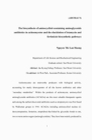
Actinomycetes are noteworthy producers with biological activity, accounting for nearly three-quarters of all the known antibiotics and other "secondary metabolites". Within the products of actinomyces, aminocyclitol aminoglycoside antibiotics (ACAGAs) are the most valuable therapeutic agents and among the earliest discovered antibiotics such as streptomycin was first found by Walksman groups in 1944. ACAGAs including aminocyclitol nucleus (2-deoxystreptamine, fortamine, streptidine) that linked by glycosidic bonds to one, two or more amino-sugars (aminoglycosides). They have been mainly produced by various species of either the genus Micromonospora or Streptomyces (Challis and Hopwood 2003). In the recent year, ACAGAs have received much attention as a broad-spectrum antibiotic for the treatment of various infections despite their perceived toxicity.
A mixture of aminocyclitol aminoglycoside antibiotics, istamycins (ISTs), was found to be produced by a marine Streptomyces species, Streptomyces tenjimariensis in the course of screening for new antibiotics in 1979 by Umezawa groups (Okami et al., 1979). They were described in terms of their isolation and structures. There are numerous studies from Japanese groups of istamycins and its producing strain from 1979 to 1992, and the biosynthetic pathway of IST was proposed in 1989, however, most of the catalytic steps are still not fully characterized. On the other hand, fortimicins (FTMs) produced in fermentation by M. olivasterospora, have been studied for many years in the field of biochemistry (i.e. aminoglycoside resistance) but also remained unclear. So, our group are very interested and paying a lot of attention in the characterization of IST and FTM biosynthetic route.
Firstly, metabolic profiling would be the important approach for providing a better understanding of the biosynthetic gene to metabolite correlations. A high-performance liquid chromatography (HPLC) with electrospray ionization ion trap tandem mass spectrometry (ESI-MS/MS) method was developed and validated for the robust profiling and characterization of biosynthetic congeners in the 2-deoxy-aminocyclitol istamycin pathway, from the fermentation broth of Streptomyces tenjimariensis ATCC 31603. Gradient elution on an Acquity CSH C18 column was performed with a gradient of 5 mM aqueous pentafluoropropionic acid and 50% acetonitrile. Sixteen natural istamycin congeners were profiled and quantified in descending order; istamycin A, istamycin B, istamycin A0, istamycin B0, istamycin B₁, istamycin A₁, istamycin C, istamycin A₂, istamycin C₁, istamycin C0, istamycin X0, istamycin A₃, istamycin Y0, istamycin B3, and istamycin FU-10 plus istamycin AP. In addition, a total of five sets of 1- or 3-epimeric pairs were chromatographically separated using a macrocyclic glycopeptide-bonded chiral column. The lower limit of quantification of istamycin-A present in S. tenjimariensis fermentation was estimated to be 2.2 ng/mL. The simultaneous identification of a wide range of 2-deoxy-aminocyclitol-type istamycin profiles from bacterial fermentation was determined for the first time by employing high-performance liquid chromatography with tandem mass spectrometry analysis and the separation of istamycin epimers (Chapter III).
Next, the postulated IST pathway starting from the 2-DOIA intermediate is outlined in Fig. 1.6. i. In silico analyses of the deduced gene product suggested that IstM is a member of the family 1 glycosyltransferases or GT-I (pseudodisaccharide- forming hexosaminyltransferase) for the introduction of a glucose moiety into the 4-position of 2-DOIA precursor that leads to accumulation of a first pseudo-disaccharide intermediate (IST-FU-10). This, in turn, also could mean that the nucleotide-activated sugar as co-substrates should be very similar for the type of "M" protein of other ACAGAs; therefore, here, we postulate that UDP-(N-Acetyl)-D-glucosamine or UDP-glucose should be the sugar donor. In this study, we presented an in vitro analysis to define the important function of IstM in the pathway of IST (Chapter IV).
As part of our continued effort to verify IST biosynthetic pathway, an adjacent enzyme IstE, a putative C-6-dehydrogenase was characterized by an in-frame deletion istE gene from the genome of the wild-type strain of S. tenjimariensis ATCC 31603. The plasmid pKC1139 possesses a phage integrase directing efficient site-specific integration in bacterial chromosome, erythromycin-induced promoter, and an attP site. By using E. coli ET 12567 (pUZ8002) as a conjugal donor, it was mated with S. tenjimariensis recipient strain. The frequency of exconjugants was 2x10⁻⁴ per recipient cell. From the genotype analysis the knock-out strain S. tenjimariensis (ΔIE), we found that a fragment of 321- bp was deleted from S. tenjimariensis genome, thus causing the accumulation of IST-FU-10 compared to the wild-type strain (Chapter V).
In 2016, our group has been published the metabolic profiling of fortimicin to differentiate and identify a range of FTMs (including epimeric mixtures) produced during M. olivasterospora fermentation based on their distinctive fragmentation spectra (Huong et al., 2016). Furthermore, in the fortimicin study, the characterization of one of the crucial step in FTM biosynthetic pathway, 3',4'-didehydroxylation was investigated by using the same transformation system in the istE disruption experiment. ForP was proposed to catalyze the phosphorylation catalytic step, that acts on the C-4' position of FTM-KK1 intermediate. The forP gene fragment was inactivated by genetic engineering and its mutant strain of M. olivasterospora (ΔforP) was constructed. The FTM-related metabolites of ΔforP strain were analyzed by HPLC-MS/MS, which revealed that the mutant strain no longer produced FTM-AP and later FTM congeners, and the production of FTM-KK1 decreased significantly (Chapter VI).*표시는 필수 입력사항입니다.
| 전화번호 |
|---|
| 기사명 | 저자명 | 페이지 | 원문 | 기사목차 |
|---|
| 번호 | 발행일자 | 권호명 | 제본정보 | 자료실 | 원문 | 신청 페이지 |
|---|
도서위치안내: / 서가번호:

우편복사 목록담기를 완료하였습니다.
*표시는 필수 입력사항입니다.
저장 되었습니다.
