
 대표어
대표어
권호기사보기
| 기사명 | 저자명 | 페이지 | 원문 | 기사목차 |
|---|
결과 내 검색
동의어 포함
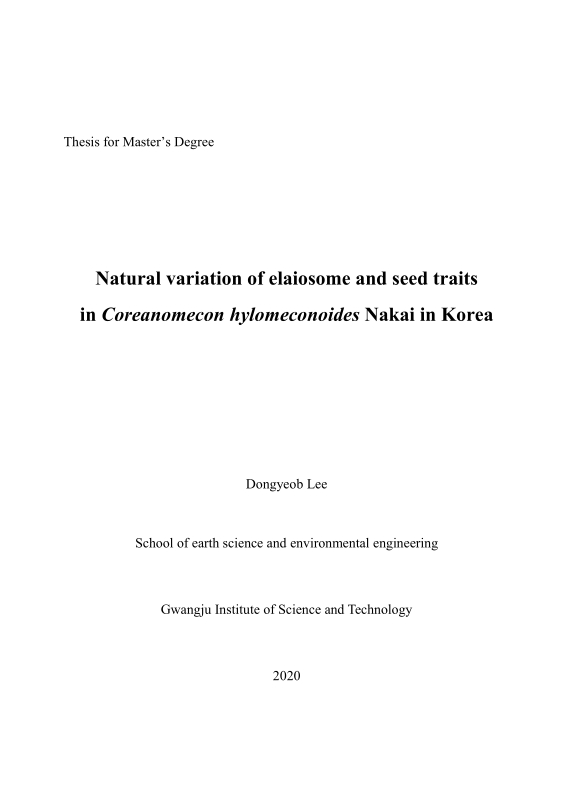
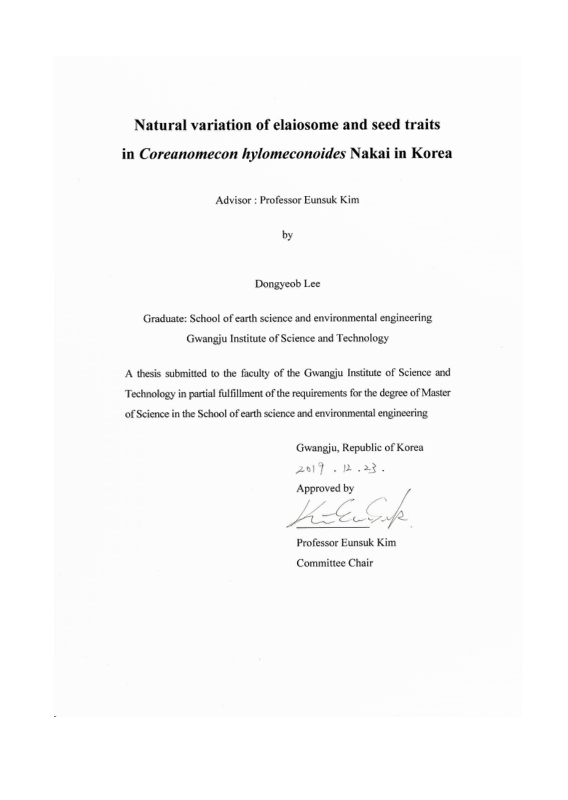
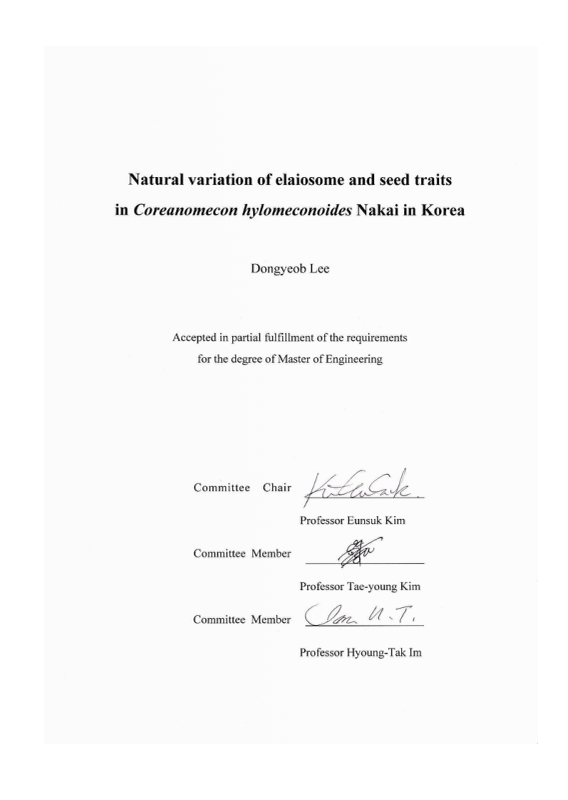
Title Page
Abstract
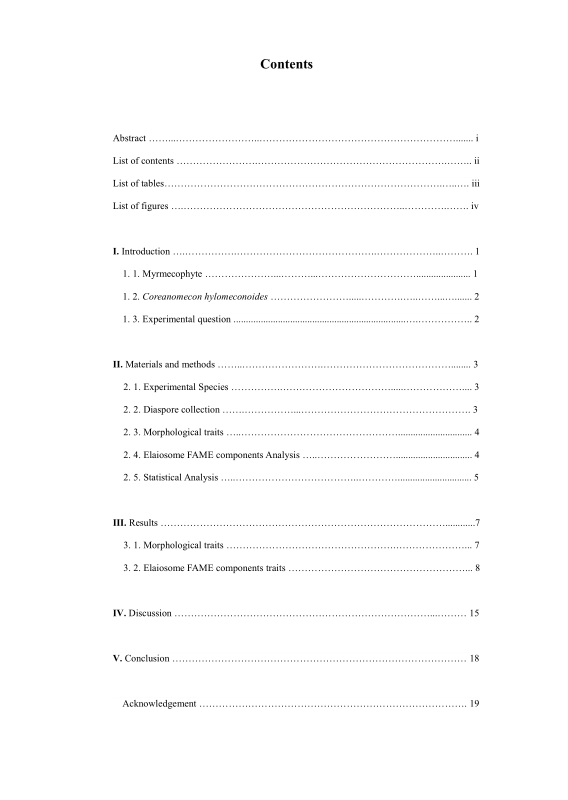
Contents
I. Introduction 8
1.1. Myrmecophyte 8
1.2. Coreanomecon hylomeconoides Nakai 9
1.3. Experimental question 9
II. Materials and methods 10
2.1. Experimental Species 10
2.2. Diaspore collection 10
2.3. Morphological traits 11
2.4. Elaiosome FAME components Analysis 11
2.5. Statistical Analysis 12
III. Results 14
3.1. Morphological traits 14
3.2. Elaiosome FAME components traits 15
IV. Discussion 21
V. Conclusion 24
References 26
Figure 1. The experimental species... 10
Figure 2. The location in maps (left) and information of seven populations (right) of C. hylomeconoides 10
Figure 3. C. hylomeconoides diaspore... 11
Figure 4. Diaspore length in seven populations. Different letters mean significant differences between... 14
Figure 5. Diaspore mass traits in seven populations. Different letters mean significant differences between... 15
Figure 6. Seven FAME components concentration in seven populations. Different letters mean significant differences between populations (p<0.05). The number of... 16
Figure 7. The comparison of FAME component ratio between seven populations. In each population,... 17
Figure 8. The non-metric multidimensional scaling (NMDS) of seven FAME components concentration in... 18
Figure 9. Principal component analysis (PCA) of seven FAME components concentration in seven... 19
Figure 10. Hierarchical cluster analysis dendrogram of FAME components concentration about... 19
Figure 11. Hierarchical cluster analysis dendrogram of mean FAME components concentration in seven... 20
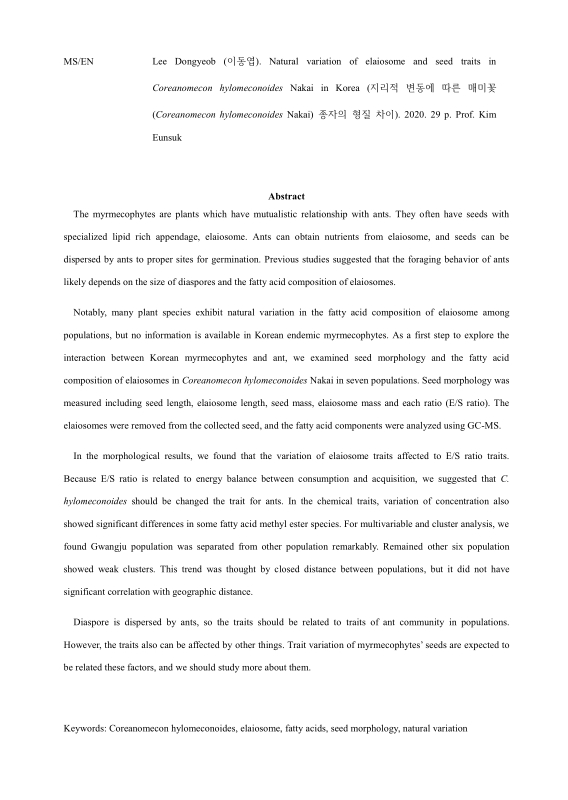
The myrmecophytes are plants which have mutualistic relationship with ants. They often have seeds with specialized lipid rich appendage, elaiosome. Ants can obtain nutrients from elaiosome, and seeds can be dispersed by ants to proper sites for germination. Previous studies suggested that the foraging behavior of ants likely depends on the size of diaspores and the fatty acid composition of elaiosomes.
Notably, many plant species exhibit natural variation in the fatty acid composition of elaiosome among populations, but no information is available in Korean endemic myrmecophytes. As a first step to explore the interaction between Korean myrmecophytes and ant, we examined seed morphology and the fatty acid composition of elaiosomes in Coreanomecon hylomeconoides Nakai in seven populations. Seed morphology was measured including seed length, elaiosome length, seed mass, elaiosome mass and each ratio (E/S ratio). The elaiosomes were removed from the collected seed, and the fatty acid components were analyzed using GC-MS.
In the morphological results, we found that the variation of elaiosome traits affected to E/S ratio traits. Because E/S ratio is related to energy balance between consumption and acquisition, we suggested that C.hylomeconoides should be changed the trait for ants. In the chemical traits, variation of concentration also showed significant differences in some fatty acid methyl ester species. For multivariable and cluster analysis, we found Gwangju population was separated from other population remarkably. Remained other six population showed weak clusters. This trend was thought by closed distance between populations, but it did not have significant correlation with geographic distance.
Diaspore is dispersed by ants, so the traits should be related to traits of ant community in populations. However, the traits also can be affected by other things. Trait variation of myrmecophytes' seeds are expected to be related these factors, and we should study more about them.*표시는 필수 입력사항입니다.
| 전화번호 |
|---|
| 기사명 | 저자명 | 페이지 | 원문 | 기사목차 |
|---|
| 번호 | 발행일자 | 권호명 | 제본정보 | 자료실 | 원문 | 신청 페이지 |
|---|
도서위치안내: / 서가번호:

우편복사 목록담기를 완료하였습니다.
*표시는 필수 입력사항입니다.
저장 되었습니다.
