
 대표어
대표어
권호기사보기
| 기사명 | 저자명 | 페이지 | 원문 | 기사목차 |
|---|
결과 내 검색
동의어 포함
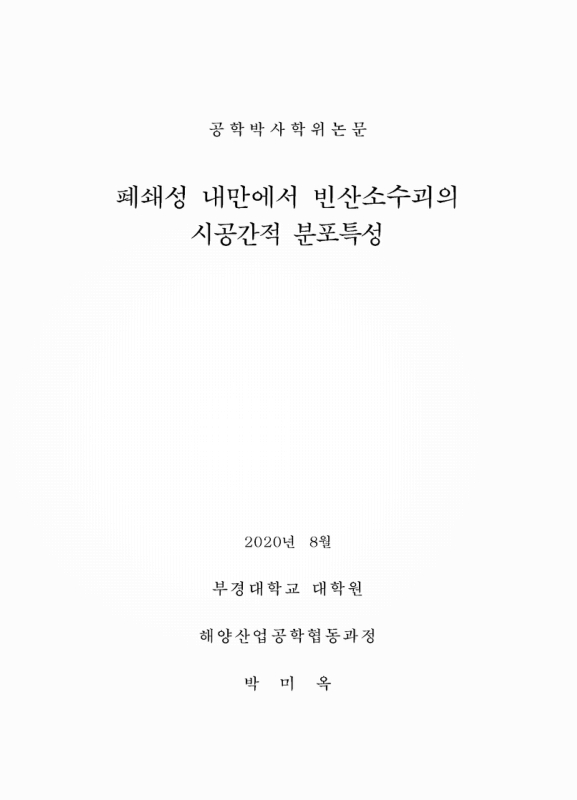
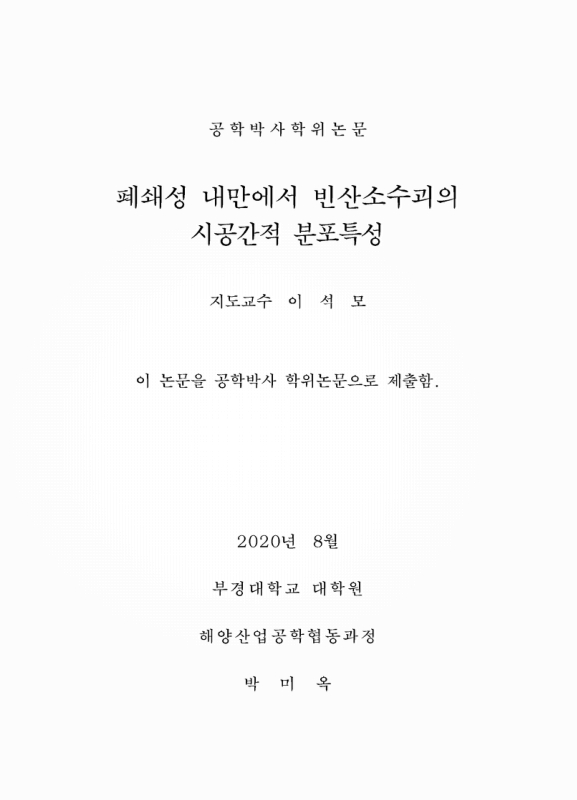
표제지
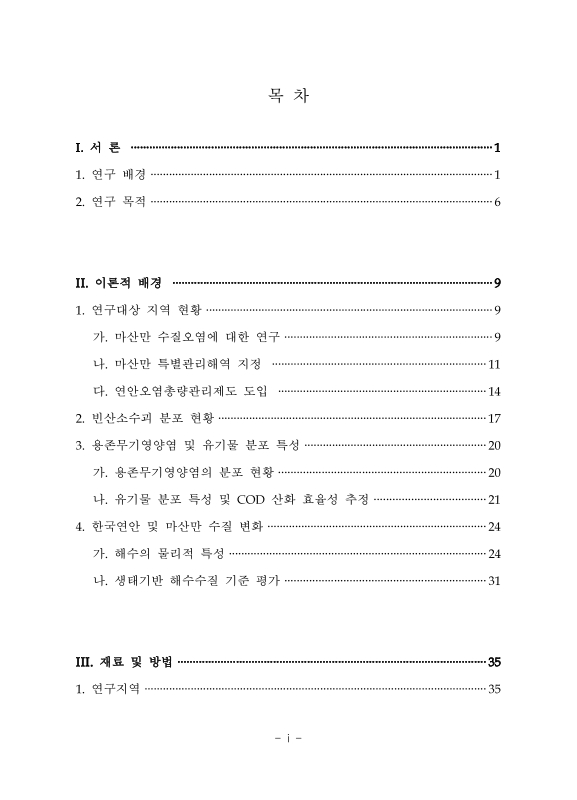
목차
Abstract 14
I. 서론 16
1. 연구 배경 16
2. 연구 목적 21
II. 이론적 배경 24
1. 연구대상 지역 현황 24
가. 마산만 수질오염에 대한 연구 24
나. 마산만 특별관리해역 지정 26
다. 연안오염총량관리제도 도입 29
2. 빈산소수괴 분포 현황 32
3. 용존무기영양염 및 유기물 분포 특성 35
가. 용존무기영양염의 분포 현황 35
나. 유기물 분포 특성 및 COD 산화 효율성 추정 36
4. 한국연안 및 마산만 수질 변화 39
가. 해수의 물리적 특성 39
나. 생태기반 해수수질 기준 평가 46
III. 재료 및 방법 50
1. 연구지역 50
2. 조사방법 50
가. 수질조사 50
나. 연속관측조사 53
다. 자료처리 방법 53
3. 분석방법 55
가. DO, Chl a, SS 분석방법 55
나. 용존무기영양염, TN 및 TP 분석방법 55
다. TOC와 COD 분석방법 56
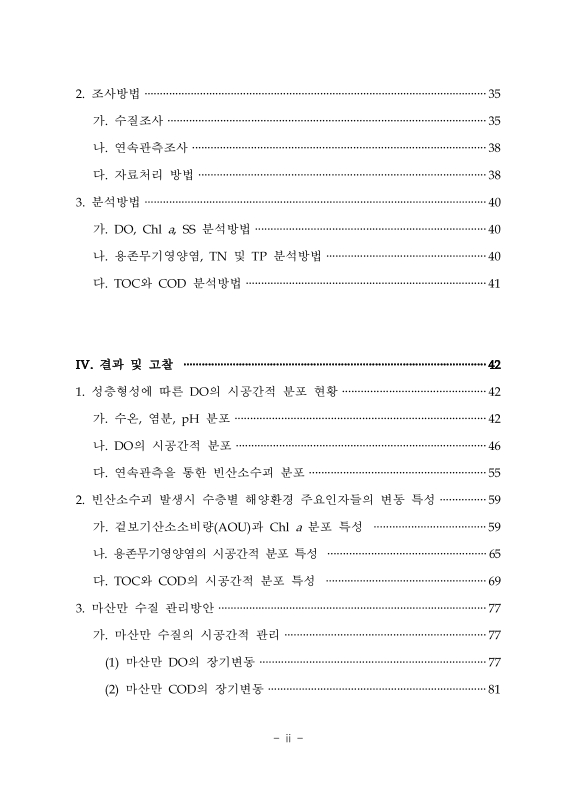
IV. 결과 및 고찰 57
1. 성층형성에 따른 DO의 시공간적 분포 현황 57
가. 수온, 염분, pH 분포 57
나. DO의 시공간적 분포 61
다. 연속관측을 통한 빈산소수괴 분포 70
2. 빈산소수괴 발생시 수층별 해양환경 주요인자들의 변동 특성 74
가. 겉보기산소소비량(AOU)과 Chl a 분포 특성 74
나. 용존무기영양염의 시공간적 분포 특성 80
다. TOC와 COD의 시공간적 분포 특성 84
3. 마산만 수질 관리방안 92
가. 마산만 수질의 시공간적 관리 92
나. 제한인자 관리 103
다. 연안오염총량관리 시행전과 후의 해양환경 변화 111
라. 유기물 지표 개선 117
V. 요약 및 제언 121
VI. Appendix 13
Appendix. 1. Raw data of temperature, salinity, pH, and DO in 2014 125
Appendix. 2. Raw data of temperature, salinity, pH, and DO in 2015 129
Appendix. 3. Raw data of NH4+, NO2-, NO3-, DIN, TN, DIP, TP, Si(OH)₄, SS, and Chl a in 2015(이미지참조) 137
VII. References 145
Fig. 1. Frequency distribution of grade on Korean coast (2010~2019). 18
Fig. 2. Ratio distribution of the 5 grade on Korean coast (2010~2019). 18
Fig. 3. Frequency distribution of DO (〈3 ㎎ L-1) in the bottom seawater on Korean...(이미지참조) 20
Fig. 4. Ratio distribution of the DO (〈3 ㎎ L-1) on Korean coast (2010~2019).(이미지참조) 20
Fig. 5. The special management sea area Masan Bay. 28
Fig. 6. Diagram of oxygen deficient water mass According to eutrophication 32
Fig. 7. Relationship between TOC (△C) and TOD (△O₂). 38
Fig. 8. Spatiotemporal distributions of water quality grade at each station in... 48
Fig. 9. A map showing the sampling locations in Masan Bay (● Seawater, ■... 52
Fig. 10. Seasonal variations of temperature, salinity, pH, and DO in the seawater of... 59
Fig. 11. Seasonal variations of temperature, salinity, pH, and DO in the seawater of... 60
Fig. 12. Spatiotemporal distributions of DO in the bottom seawater of Masan... 63
Fig. 13. Spatiotemporal distributions of DO in the bottom seawater of Masan... 64
Fig. 14. Comparison values of temperature and DO in the seawater of Masan Bay. 66
Fig. 15. Plots of temperature and salinity difference vs. bottom DO in the seawater... 67
Fig. 16. Vertical distributions of temperature, salinity, and DO in the seawater of Masan Bay on each sampling date. 69
Fig. 17. Continuous monitoring results of temperature, salinity, and DO in the... 72
Fig. 18. Continuous monitoring day results of DO in the seawater of Masan... 73
Fig. 19. Seasonal variations of DIN, DIP, Si(OH)₄, and AOU in the seawater of... 83
Fig. 20. Seasonal variations of DOC, POC, TOC, and COD in the seawater of... 87
Fig. 21. Ratio of DOC and POC among TOC in the seawater of Masan Bay... 88
Fig. 22. Correlation of DOC vs. AOU in the surface seawater of Masan Bay... 89
Fig. 23. Correlation of POC vs. Chl a in the surface seawater of Masan Bay... 91
Fig. 24. The long-temporal variations of environmental parameter contents... 94
Fig. 25. Plots of temperature vs. DO in surface (a) and bottom (b) seawaters of... 95
Fig. 26. The long-temporal variations of COD in the seawater (surface,... 98
Fig. 27. The long-temporal variations of DIN and DIP in the seawater... 105
Fig. 28. The seasonal variation of DIN:DIP molar ratio in surface seawater of... 109
Fig. 29. Plots of DIN vs. N/P ratio (a) and DIP vs. N/P ratio (b) in surface... 110
Fig. 30. Correlation of TOC vs. COD in the seawater of Masan Bay. 120
To examine spatiotemporal variations of oxygen deficient water mass (〈3 mg/L), dissolved oxygen was measured with depth in seawater in the eutrophic Masan Bay, Korea. The oxygen deficient water mass was observed continuously in the Bay form May to September. It extends about 9 km from central part of Masan harbor to the West of Modo and about below 5 m depth in summer. In mid-July, oxygen deficient water mass has occurred in the inner part of Masan Bay, and then has spread to the outer part since late-July.
Continuous monitoring results measured using a dissolved oxygen sensor showed that oxygen deficient water mass intermittently began to appear from March in the evening time, and then it persisted until the end of October. The concentration of dissolved oxygen in seawater was lowest between July and August when pollution discharge and stratification intensity was increased. For the conservation and management of marine ecosystems, it is necessary to accurately understand the mechanism and timing of oxygen deficient water mass occurrence.
Long-term variations of bottom DO in seawater of Masan Bay from 1997 to 2016 were studied to understand changes oxygen deficient water mass from before to after the introduction of the total pollution load management system (TPLMS). The oxygen deficient water mass occurred 16 times before and 11 times after. The implementation of TPLMS is judged to have resulted in the decrease in the frequency of the occurrence of oxygen deficient water mass. The average annual concentrations of COD and nutrient in the seawater decreased by about 20%, 50% respectively, when compared to those prior to the introduction of the TPLMS in Masan Bay. Therefore, water quality in Masan Bay has improved considerably since the TPLMS was implemented.
Concentration of organic matter and nutrient in the inner part of Masan Bay was about twice as high in comparison with the outter part. In order to improve the quality of seawater in Masan Bay special management area, it is necessary to identify the cause of contamination and intensive management of the inner part of Masan Bay.
It seems that oxygen deficient water mass in the bottom layer begin as the DO supply from the surface layer to the bottom layer is blocked by the stabilization of water mass due to an increase in the surface seawater temperature. It also seems that oxygen deficient water mass fully develop later in August due to DO consumption as organic matter derived from the land or created in the ocean flows into the bottom layer and decomposes, while the surface layer salinity decreases and the water masses' stratification is enhanced due to the increase in the amount of rainfall in the region during this period. Therefore, continuous monitoring is needed to improve the oxygen deficient water mass of Masan Bay.*표시는 필수 입력사항입니다.
| 전화번호 |
|---|
| 기사명 | 저자명 | 페이지 | 원문 | 기사목차 |
|---|
| 번호 | 발행일자 | 권호명 | 제본정보 | 자료실 | 원문 | 신청 페이지 |
|---|
도서위치안내: / 서가번호:

우편복사 목록담기를 완료하였습니다.
*표시는 필수 입력사항입니다.
저장 되었습니다.
