
 대표어
대표어
 학술연구정보서비스(KERIS)
권호기사보기
| 기사명 | 저자명 | 페이지 | 원문 | 기사목차 |
|---|
결과 내 검색
동의어 포함
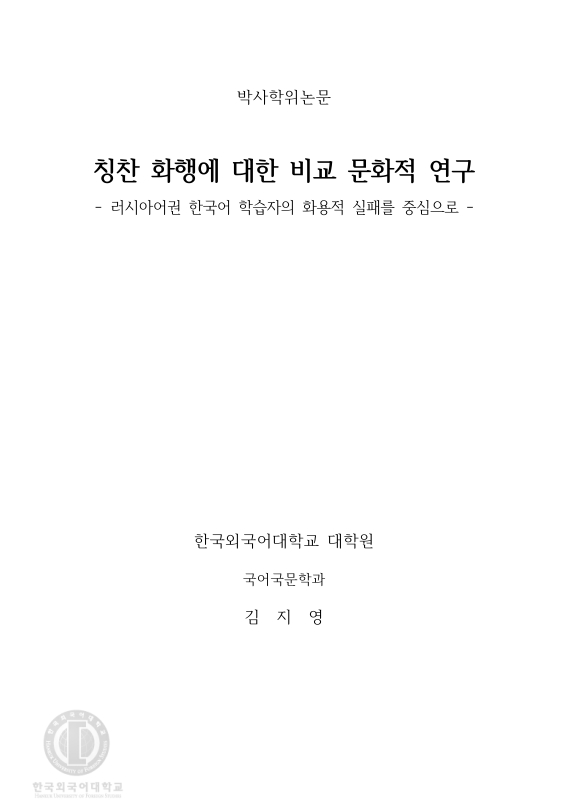
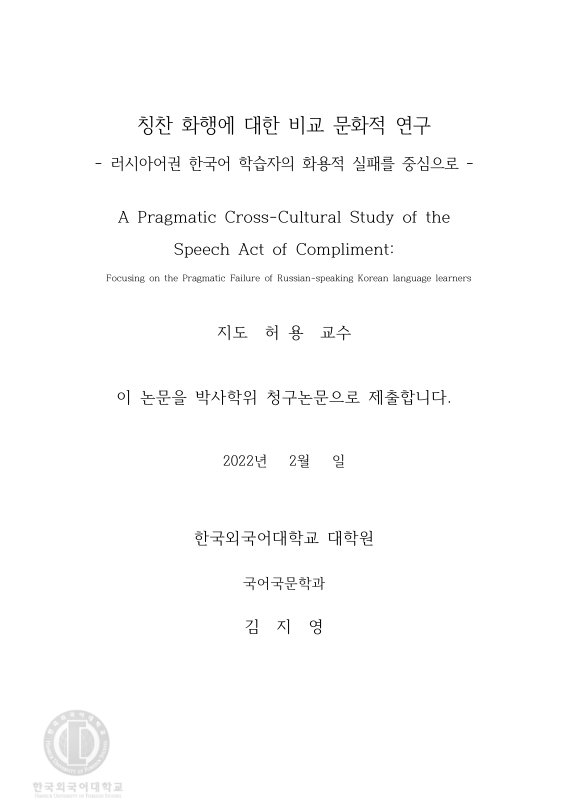
표제지
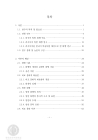
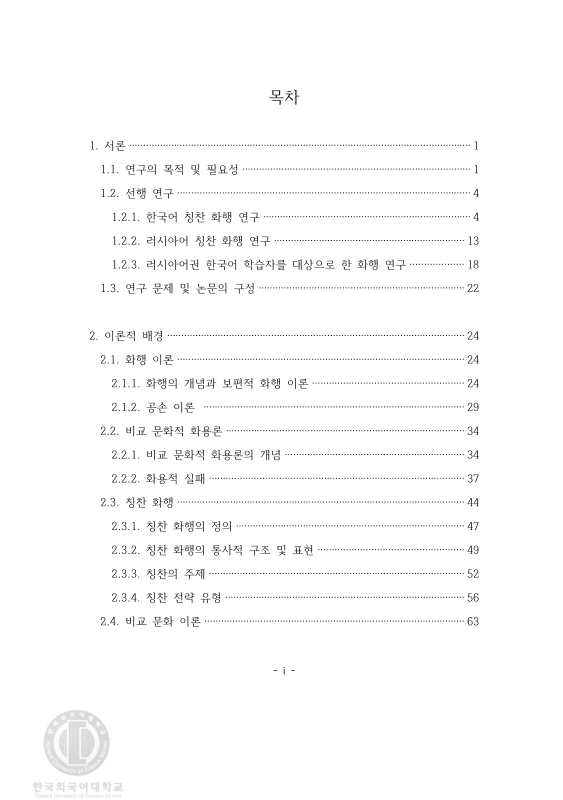
목차
1. 서론 13
1.1. 연구의 목적 및 필요성 13
1.2. 선행 연구 16
1.2.1. 한국어 칭찬 화행 연구 16
1.2.2. 러시아어 칭찬 화행 연구 25
1.2.3. 러시아어권 한국어 학습자를 대상으로 한 화행 연구 30
1.3. 연구 문제 및 논문의 구성 34
2. 이론적 배경 36
2.1. 화행 이론 36
2.1.1. 화행의 개념과 보편적 화행 이론 36
2.1.2. 공손 이론 41
2.2. 비교 문화적 화용론 46
2.2.1. 비교 문화적 화용론의 개념 46
2.2.2. 화용적 실패 49
2.3. 칭찬 화행 56
2.3.1. 칭찬 화행의 정의 59
2.3.2. 칭찬 화행의 통사적 구조 및 표현 61
2.3.3. 칭찬의 주제 64
2.3.4. 칭찬 전략 유형 68
2.4. 비교 문화 이론 75
3. 연구 방법 91
3.1. 연구 설계 및 절차 91
3.2. 1차 예비 조사 92
3.2.1. 대상 및 기간 92
3.2.2. 도구 및 절차 93
3.2.3. 조사 결과 94
3.3. 2차 예비 조사 112
3.3.1. 대상 및 기간 112
3.3.2. 도구 및 절차 113
3.3.3. 조사 결과 114
3.4. 본 조사 122
3.4.1. 대상 및 기간 122
3.4.2. 도구 및 절차 124
3.4.3. 분석 틀 133
3.4.4. 분석 방법 139
4. 칭찬 화행 사용 양상 분석 142
4.1. 전체적인 전략 사용 양상 비교 142
4.2. 주제에 따른 전략 사용 비교 146
4.3. 사회적 지위에 따른 전략 사용 비교 154
4.4. 친밀도에 따른 전략 사용 비교 163
4.5. 기피하는 칭찬 상황 비교 170
4.6. 러시아어권 한국어 학습자에게 어려운 칭찬 상황 175
4.7. 소결 178
5. 러시아어권 한국어 학습자의 화용적 실패 요인 181
5.1. 칭찬 상황별 화용적 실패 사례 181
5.1.1. 칭찬 상황1, 2, 3 181
5.1.2. 칭찬 상황4, 5, 6 185
5.1.3. 칭찬 상황7, 8, 9 189
5.1.4. 칭찬 상황10, 11, 12 195
5.1.5. 칭찬 상황13, 14, 15 198
5.1.6. 칭찬 상황16, 17, 18 203
5.2. 칭찬 화행에서 화용적 실패의 원인 206
5.2.1. 화용 언어적 요인 209
5.2.2. 사회 화용적 요인 225
5.3. 소결 246
6. 결론 249
참고문헌 255
부록 273
부록1. 1차 예비 조사 설문지(한국어 모어 화자용) 273
부록2. 1차 예비 조사 설문지(러시아어 모어 화자용) 275
부록3. 2차 예비 조사 설문지(한국인용) 277
부록4. 2차 예비 조사 설문지(러시아어권 한국어 학습자용) 280
부록5. 본 조사(한국어 모어 화자용) 284
부록6. 본 조사(러시아어권 한국어 학습자용) 289
ABSTRACT 298
〈그림 1〉 공손 전략 선택을 결정하는 상황 44
〈그림 2〉 Brown & Levinson(1987)에 따른 펜 빌리기 45
〈그림 3〉 의사소통 실패를 일으키는 원인 53
〈그림 4〉 Leech(1983:11)의 일반 화용론의 개념 54
〈그림 5〉 고맥락 문화와 저맥락 문화 76
〈그림 6〉 자아와 내·외집단 관계에 대한 동·서양의 관점 79
〈그림 7〉 문화에 따른 사적인 영역과 공적인 영역의 차이 81
〈그림 8〉 러시아와 한국 문화의 공적인 영역과 사적인 영역 82
〈그림 9〉 한국과 러시아의 문화 차원 비교 85
〈그림 10〉 한국과 러시아의 문화 지도 88
〈그림 11〉 국가 간 의사소통 방식과 부정적 피드백 방식의 차이 89
〈그림 12〉 연구 절차 91
〈그림 13〉 사회적 지위에 따른 칭찬 화행 전략 사용 양상 비교 156
〈그림 14〉 친밀도에 따른 칭찬 화행 전략 사용 양상 비교 165
〈그림 15〉 Leech(1983)의 사회적 거리 227
〈그림 16〉 Leech(1983:108) 간접성과 공손함의 정도 234
〈그림 17〉 사적·공적 영역의 차이로 인한 위험 영역 244
〈그림 18〉 한국어와 러시아어 칭찬 화행에 대한 비교 문화 척도 253
The purpose of this research is to examine the causes of the pragmatic failure of Russian-speaking learners of Korean (RLKs) in performing speech acts of compliment from a cross-cultural perspective.
This thesis addresses three research questions. The first is to examine the characteristics of compliment speech acts in the Korean and Russian languages, respectively. The second is to compare the patterns of speech acts of compliment between native speakers of Korean and RLKs. The third is to analyze the causes of RLKs' pragmatic failures in complimenting.
To this end, a total of three rounds of surveys and five discussion sessions were conducted. According to the preliminary survey, a considerable gap was identified between the Korean and Russian languages in terms of the topic, subject, strategy, expression, and syntactic phrase of compliment speech acts.
The primary survey was conducted based on a discourse completion test (DCT) to compare and analyze the patterns of compliment speech acts between native Korean speakers and RLKs. The survey findings reveal that the former group employs both different types and a different frequency of strategies according to the subject of the compliment and the social status and level of intimacy of the speaker and listener. On the other hand, the latter group was found to resort to direct compliments and typical expressions of praise, rather than adopting diverse strategies. These outcomes imply that RLKs are influenced by the pragmatic knowledge of their mother tongue in performing speech acts of compliment.
Subsequently, discussion sessions were held to shed light on the causes of RLKs' pragmatic failure, which was categorized into two types - pragmalinguistic failure and sociopragmatic failure. Pragmalinguistic failure involves elements of titles, honorifics, pragmatic conventional expressions, the interference of the mother tongue in words of praise, and final endings. The actual cases discussed indicate that linguistic differences between Korean and Russian cause pragmatic failure. Sociopragmatic factors include the social distance between the participants of a conversation, the degree of indirectness, and values, and it was found that differences in non-linguistic aspects, i.e., culture or way of thinking, also caused pragmatic failure.
Lastly, the following four cross-cultural scales were established to describe the differences between Korean- and Russian-speaking communities, which were identified as the root causes of RLKs' pragmatic failure in performing speech acts of compliment. The first is the preferred method of utterances (direct, indirect), the second is values in priority (truthfulness, politeness), the third is the domain accepted for speech (private, public), and the fourth is the forms of utterance (fixed, situation-dependent).
This research contributes to understanding RLKs, about whom relatively little research has been done compared to their counterparts from other language worlds. In addition, it is the first study to analyze the different characteristics involved in speech acts of compliment between the Korean and Russian languages. In the course of the research, this study not only compared the pragmatic strategies and failures observed in the two languages, but also investigated the reasons for these phenomena. Finally, this research applied diverse cross-cultural theories to the analysis of RLKs' speech acts.*표시는 필수 입력사항입니다.
| 전화번호 |
|---|
| 기사명 | 저자명 | 페이지 | 원문 | 기사목차 |
|---|
| 번호 | 발행일자 | 권호명 | 제본정보 | 자료실 | 원문 | 신청 페이지 |
|---|
도서위치안내: / 서가번호:

우편복사 목록담기를 완료하였습니다.
*표시는 필수 입력사항입니다.
저장 되었습니다.
