

본문 바로가기 주메뉴 바로가기
국회도서관 홈으로 정보검색 소장정보 검색

목차보기

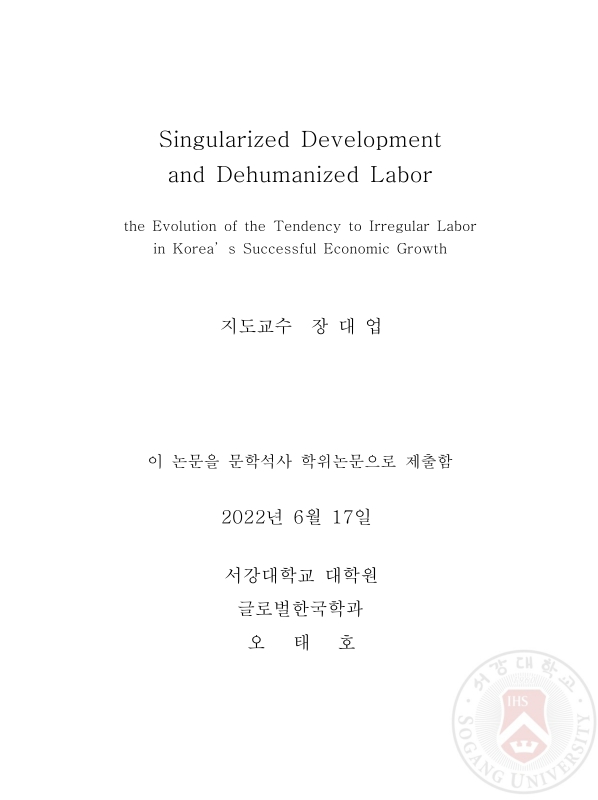
Title Page

Contents

Abstract 8

Chapter 1. Introduction 10

Chapter 2. Definition of development 13

2.1. History of development 13

2.2. Notion of development in Korean development 18

2.2.1. State-driven development 18

2.2.2. Neoliberal development 21

Chapter 3. Dehumanization of labor and capitalist development 23

3.1. Critiques of development 23

3.1.1. Labor's place in mainstream economic doctrines 23

3.1.2. Questioning growth-centered development: the human development approach 26

3.1.3. Commodification of labor in capitalist development 28

3.1.4. Alienated and exploited labor in capitalist development 32

3.2. Irregularization as a principal form of dehumanized labor 38

Chapter 4. Dehumanization of labor in the early period of Korean development 45

4.1. Uniqueness of Korean development 45

4.2. Repressed agency of labor 46

4.3. Irregular labor in the early period of Korean development 51

Chapter 5. Dehumanization of labor in the late period of Korean development 56

5.1. Brief effort to humanize labor 56

5.2. Rollback to classical economic doctrine 63

Chapter 6. Conclusion 67

References 72

List of Tables

Table 1. Meanings of development through history 17

List of Graphs

Graph 1. Trade Union density of 17 OECD countries 43

초록보기

This thesis seeks to find the relationship between the nature of South Korean development and the dehumanization of labor by tracing how Korea's successful economic growth has been underpinned by a tendency to irregularize labor. Prioritizing economic growth among many aspects of development, mainstream development discourses have effectively singularized the meanings of development. Korean development was no exception. One of the consequences of such singularization was the dehumanization of labor. As in mainstream development discourses, two major doctrines of Korean development, developmental statism and neoliberalism identified economic growth as the single most important end of Korean development, did not allow the agency of labor to have a place in their theorization of development and implementation of development policies, and in so doing dehumanized labor. This thesis criticizes such theories and practices of development by engaging with the three most prominent critical thinkers of capitalist development: Sen, Polanyi, and Marx. Sen proposes the humanization of development through the concept of human-centered development. Polanyi and Marx criticize capitalist development as it has commodified, alienated, and, thus, dehumanized labor. The dehumanization of labor marks not only the general history of development but also Korean development. The dehumanization of labor could be indicated, primarily if not exclusively, in the form of irregularization, which keeps workers away from the secured regular status. A close look into Korea's development history shows that both the early and late periods of Korean development have dehumanized labor although there were different methods to repress labor. The general tendency to irregularization was also deeply gendered as the vast majority of women workers have never enjoyed secured status. In conclusion, this dissertation proposes an important precondition for a paradigm shift in development trajectory, the humanization of labor through which Korea's working-class population can realize their human potential as the end of development. Humanizing labor is not just about regularizing employment but improving the lives of workers so that they can realize multi-dimensional human potential. The value of workers should be revalued as much as the notion of and priority in development should be reconsidered.

