
 대표어
대표어
권호기사보기
| 기사명 | 저자명 | 페이지 | 원문 | 기사목차 |
|---|
결과 내 검색
동의어 포함
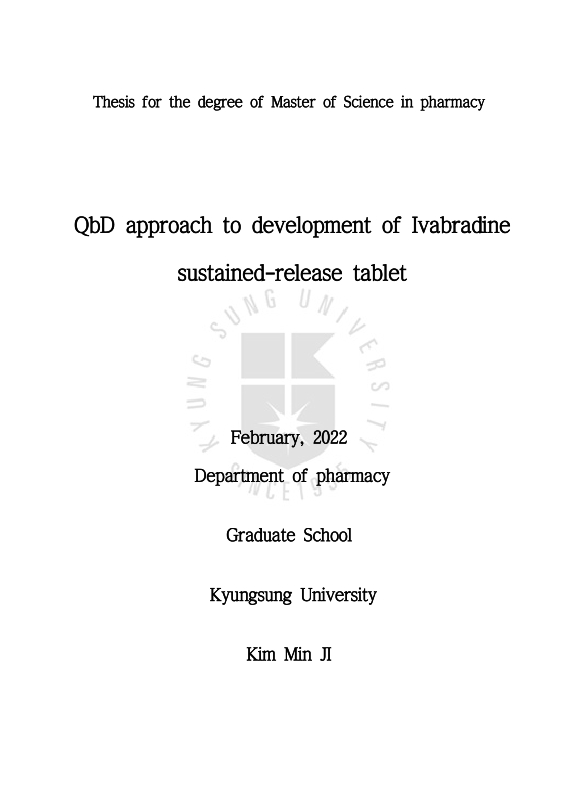
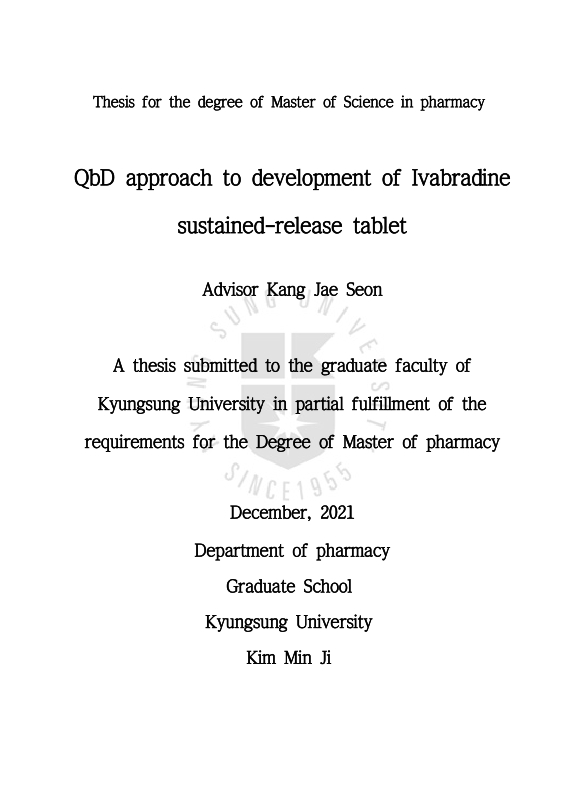
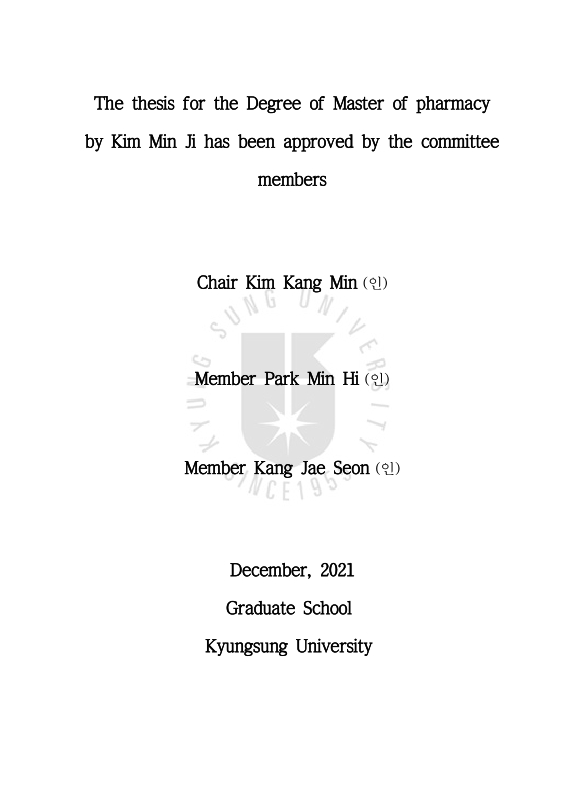
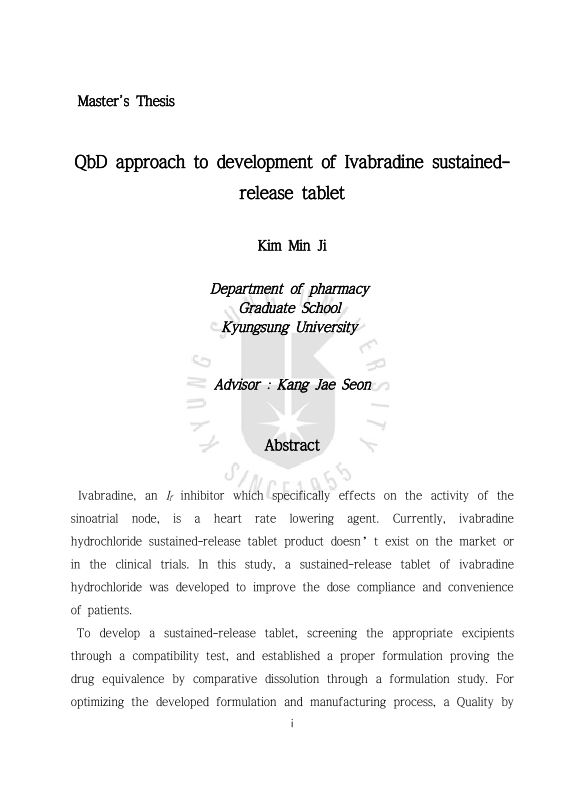
Title Page
Abstract
Contents
Chapter 1. Compatibility study 12
1.1. Introduction 12
1.2. Material and Experimental methods 13
1.2.1. Materials 13
1.2.2. Methods 13
1.3. Results and Discussion 15
1.3.1. XRD analysis 15
1.3.2. DSC and TG analysis 16
1.3.3. Impurity test 17
Chapter 2. Formulation study 19
2.1. Introduction 19
2.2. Materials and methods 19
2.2.1. Methods 19
2.2.2. Wet granulation process 20
2.2.3. Tablet compression process 20
2.2.4. Test methods 20
2.3. Results and Discussion 23
2.3.1. Flowability 23
2.3.2. Hardness and Friability 23
2.3.3. Assay and Content Uniformity 23
2.3.4. Comparative dissolution test 24
Chapter 3. QbD study 26
3.1. Introduction 26
3.2. Material and Experimental method 27
3.2.1. Materials 27
3.2.2. Experimental design 27
3.3. Results and discussion 29
3.3.1. Quality Target Product Profile (QTPP) 29
3.3.2. Determination of the Critical Quality Attributes (CQAs) 29
3.3.3. Initial risk assessment of material attribute 31
3.3.4. Initial risk assessment of tablet compression process variables 35
Chapter 4. Overall Conclusion 41
Reference 42
개요 45
Figure 1. X-ray diffraction results on initial(A), after 4 weeks (B) under accelerated condition (40 ℃, 75% relative humidity) 16
Figure 2. DSC (A) results for initial (a), after 4 weeks (b). TG analysis (B) results of initial (a), after 4 weeks (b) under accelerated condition (40 ℃, 75%... 17
Figure 3. Contour plot combinations of material attributes factors: A-Content Uniformity, B-Friability, C-Carr's Index, D-Angle of Repose, E-Dissolution at 1h,... 34
Figure 4. Design space for material attributes of ivabradine sustained release tablet 35
Figure 5. Contour plot combinations of process variables factors in tablet compression process: A-Content Uniformity, B-Friability, C-Dissolution at 1h, D-... 39
Figure 6. Design space for tablet compression process of ivabradine sustained release tablet 40
이바브라딘은 심장 동방 결절의 If 채널을 선택적으로 억제하여 심박수를 낮추는 약물이다. 현재 시판 또는 임상시험 진행중인 이바브라딘 염산염 서방정이 존재하지 않는다. 본 연구에서는 환자의 복용순응도와 편의성을 개선하기 위하여 이바브라딘 염산염 서방정 개량신약을 개발하는 것을 목적으로 하였다.
서방정 개량신약 개발을 위하여 배합적합성 시험을 통해 적절한 첨가제를 선별하고, 제형 연구를 통해 동등성을 갖는 적절한 제형을 확립하였다. 이후 확립된 제형 및 제조 공정이 최적화되었는지 설계기반 품질고도화(QbD: Quality by Design)를 적용하여 평가하였다.
배합적합성 시험 결과, 미결정화셀룰로오스, 히드록시프로필메칠셀룰로오스, 제이인산칼슘, 이산화규소 및 스테아린산마그네슘은 가속 조건 (40 ℃, 상대습도 75%) 하에서 4주간 안정함을 XRD, DSC, TG 및 순도 시험을 통해 확인하였다.
제형 연구 결과 미결정화셀룰로오스, 히드록시프로필메칠셀룰로오스, 제이인산칼슘, 이산화규소 및 스테아린산마그네슘의 적절한 조성비가 확립되었다. 해당 서방정은 습식과립, 건조, 정립, 최종 혼합, 활택 및 타정 공정의 순서로 제조되었다. 또한, 정립 공정에서는 흐름성, 타정 공정에서는 경도 및 마손도를 확인하였으며 제조된 정제에 대해서는 함량 및 함량균일성을 확인하여 적절한 제조 조건을 확인하였다. 확인된 정제에 대하여 비교용출시험을 진행하였고 의약품 동등성을 확보하였다.
QbD 연구에서 제품의 품질 목표 사항(QTPP, Quality Target Product Profile)은 원료의약품의 특성과 RLD(Reference listed drug) 특성에 대해 정의되었다. 주요 품질 특성(CQA, Critical Quality Attributes)은 환자의 안전과 해당 의약품의 효능을 기반으로 선정되었다. 이를 바탕으로 제형 및 공정 변수의 영향을 확인하기 위해 첨가제 및 타정 공정에 대해 초기 위험도 평가를 수행하였고 실험 설계법(DoE, Design of Experiment) 중 완전요인설계법을 사용하여 주요 물질 특성 및 주요 공정 변수를 식별하였다. 해당 결과를 기반으로 허용 기준 내에서 최적화된 제형 및 제조 공정을 확인하였다.*표시는 필수 입력사항입니다.
| 전화번호 |
|---|
| 기사명 | 저자명 | 페이지 | 원문 | 기사목차 |
|---|
| 번호 | 발행일자 | 권호명 | 제본정보 | 자료실 | 원문 | 신청 페이지 |
|---|
도서위치안내: / 서가번호:

우편복사 목록담기를 완료하였습니다.
*표시는 필수 입력사항입니다.
저장 되었습니다.
