
 대표어
대표어
 학술연구정보서비스(KERIS)


권호기사보기
| 기사명 | 저자명 | 페이지 | 원문 | 기사목차 |
|---|
결과 내 검색
동의어 포함
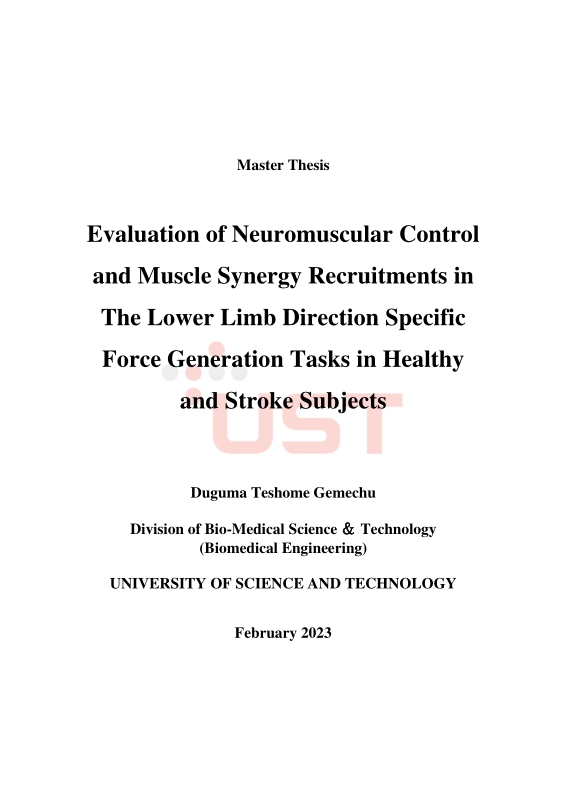
Title Page
ABSTRACT
국문 초록
Contents
Abbreviations 13
Introduction 14
The rationale for Direction-Specific Force Generation Tasks 16
Hypotheses 17
Part I 18
1. Introduction 18
2. Materials and Methods 22
Subjects 22
Experiment setup and protocol 22
Data Processing 26
Data Analysis 27
Muscle Synergy Extraction 29
3. Results 35
Peak Force in the anterior, posterior, medial, and lateral direction tasks 35
Force Vectors in the direction-guided force generation task 38
EMG Patterns of lower limb muscles in a direction focused force generation task 40
Muscle synergies in the direction focused force generation tasks 42
Muscle Synergies Specific to Force generation direction 44
Preferred Directions of Synergies in Each of the Force Generation Tasks 45
4. Discussion 47
Peak Force, Force Vectors, and Cosine Angles in the direction-focused tasks 47
The muscle activation pattern of the lower limb muscles in the direction-based force generation task 49
Muscle Synergy in direction-guided force generation tasks 50
Muscle synergies similarity across Subjects 51
Muscle Synergies are specific to the direction of force generation direction 51
Part II 54
1. Introduction 54
2. Methods 59
Subjects Inclusion Criteria 59
Experiment Setup and Protocol 62
Data Processing 62
Data Analysis 63
Statistical Test 65
3. Results 66
Delayed Response time 66
Reduced maximal force-generating capability 67
Co-contraction index across multiple joints 69
Force Vector's Cosine Angles 70
Muscle Synergy Recruitment Patterns and Preferred Directions 72
VAF and Stroke Muscle Synergy Patterns 74
Muscle Synergy Similarities Across Groups 80
Muscle Synergy Preferred Directions Across Groups 82
4. Discussion 84
Reduced Neuromuscular Performance and Motor Control in Stroke 84
VAF and Muscle Synergy Patterns 85
Merging of Muscle Synergy Patterns in Stroke 87
Conclusion 90
Future Direction 91
Bibliography 92
Figure 1. Experiment setup 25
Figure 2. Directional guide cues appearing in random orders 26
Figure 3. Force recorded graph from force generation tasks upon direction cues, the dashed grey vertical lines indicate the appearance and removal of directional cues. 28
Figure 4. Cosine angles/directions 28
Figure 5. The principle of non-negative matrix factorization 30
Figure 6. Muscle Synergy Extraction algorithm (NMF) 30
Figure 7. Force generated in the axes of instructed directions (anterior and posterior on the Y-axis and medial and lateral on the X-axis) during the direction-guided... 36
Figure 8. Peak forces generated during force generation task in each direction 37
Figure 9. Force output distribution of each subject on the X-Y axis for all four force instructed directions (A). The force output vector for each direction of the force-... 38
Figure 10. Cosine Angle as a measure for force vector alignment with the axis of instructed direction of force generation task. 40
Figure 11. Mean EMG compared between the instructed directions of force generation in the anterior, posterior, medial and lateral directions. 41
Figure 12. Group Muscle synergies of all force generation tasks in the anterior, posterior, medial and lateral directions. A) The Muscle synergy weights, B)... 43
Figure 13. Similarity index of muscle synergies extracted from concatenating the EMG activities of force generation in all directions and muscle synergies extracted... 45
Figure 14. Muscle Synergies preferred directions 46
Figure 15. Reaction time across directions of force generation task 66
Figure 16. Maximal force generated across the directions of force generation tasks 67
Figure 17. Co-contraction Index 69
Figure 18. Force vector cosine angles for each of the directions of force generation tasks 70
Figure 19. Muscle synergy recruitment patterns and preferred directions for the healthy group 72
Figure 20. Stroke muscle synergy recruitment patterns and each synergies preferred directions 79
Figure 21. Across Group similarities of Muscle Synergy weights and their preferred directions 82
*표시는 필수 입력사항입니다.
| 전화번호 |
|---|
| 기사명 | 저자명 | 페이지 | 원문 | 기사목차 |
|---|
| 번호 | 발행일자 | 권호명 | 제본정보 | 자료실 | 원문 | 신청 페이지 |
|---|
도서위치안내: / 서가번호:

우편복사 목록담기를 완료하였습니다.
*표시는 필수 입력사항입니다.
저장 되었습니다.
